Description
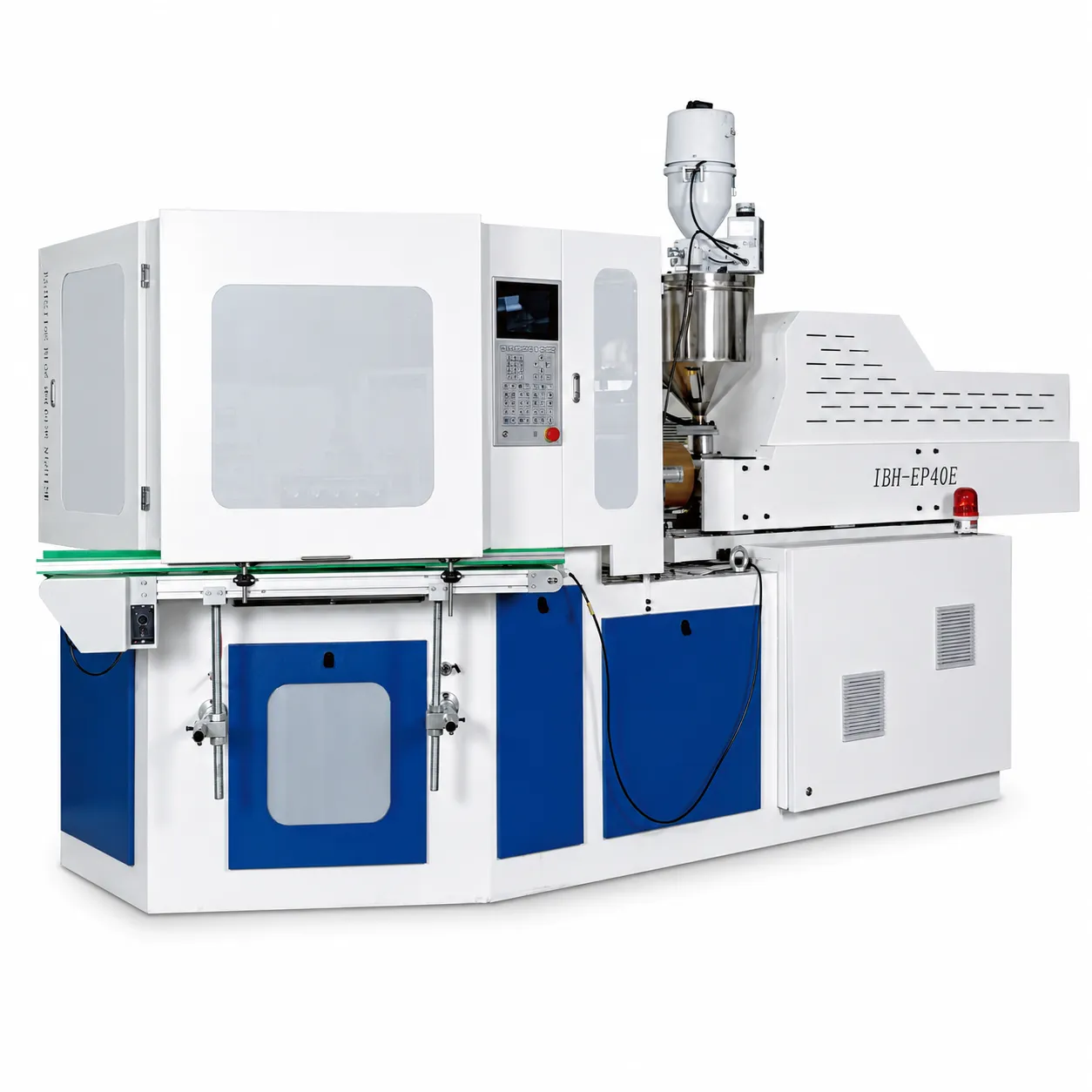
Technical Specifications
| Parameter | Specification |
|---|---|
| Injection System | |
| Screw Diameter | 40 / 45 mm |
| Screw L/D | 22:1 |
| Injection Weight | 190 / 260 g |
| Heating Power | 7.5 KW |
| Barrel Zones | 3+N |
| Injection Stroke | 120 mm |
| Clamping System | |
| Injection Clamping Force | 400 KN |
| Injection Opening Stroke | 165 mm |
| Blow Clamping Force | 60 KN |
| Blow Opening Stroke | 140 mm |
| Rotary Table Lift | 70 mm |
| Mould | |
| Max Platen Size | 480 x 340 mm |
| Mould Thickness | 180 mm |
| Max Bottle Diameter | 120 mm |
| Max Bottle Height | 220 mm |
| Volume Range | 1 – 1500 ml |
| Stripping Stroke | 220 mm |
| Hydraulic System | |
| System Pressure | 14 MPa |
| Motor Power | 11 KW |
| Dry Cycle | 3.5 s |
| Total Power | 20 KW |
| Utilities | |
| Compressed Air | 0.7 – 1.2 MPa |
| Cooling Water | 3.5 m³/h |
| Machine | |
| Dimensions (L×W×H) | 3.5 × 1.3 × 1.7 M |
| Net Weight | 3.8 T |
Max Cavity Reference
| Volume | 10 ml | 30 ml | 60 ml | 100 ml | 250 ml | 500 ml | 1000 ml |
|---|---|---|---|---|---|---|---|
| Max Cavities | 9 | 8 | 6 | 4 | 3 | 2 | 1 |
*Cavity counts are for reference only and depend on bottle design and mould configuration. Contact our team for a project-specific assessment.
Overview
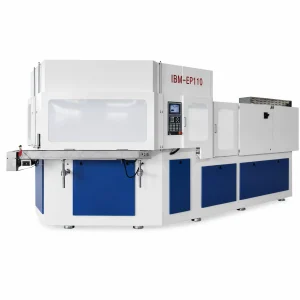
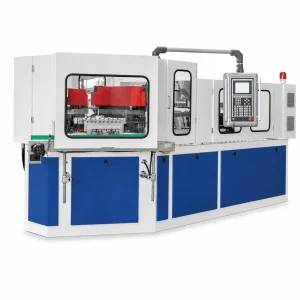
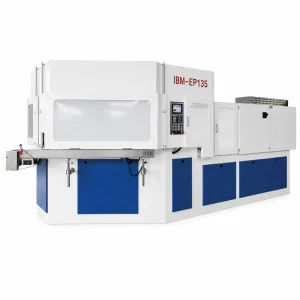
The EP-IBM40 is Ever-Power’s entry-level injection blow molding machine, engineered for manufacturers who need high-precision small-bottle production with a compact footprint. Built on a full European-style three-station rotary frame, it delivers 400 KN of injection clamping force — 20–30% greater than comparable machines in the same class. At 3.8 tonnes and measuring just 3.5 × 1.3 × 1.7 metres, the EP-IBM40 fits into facilities where space and budget are primary considerations without sacrificing bottle quality.
The machine handles bottles from 1 ml to 1,500 ml and processes HDPE, LDPE, PP, high-clarity PS, ABS, EVA, and PCTG. Its pressurised clamping structure keeps the booster cylinder out of the mould open/close cycle, reducing energy consumption by 10–20% compared with conventional designs. Zero flash and zero material waste — no parison pinch-off, no edge trim — make it the correct process choice for pharmaceutical and cosmetic applications where contamination control and consistent neck tolerance are critical.
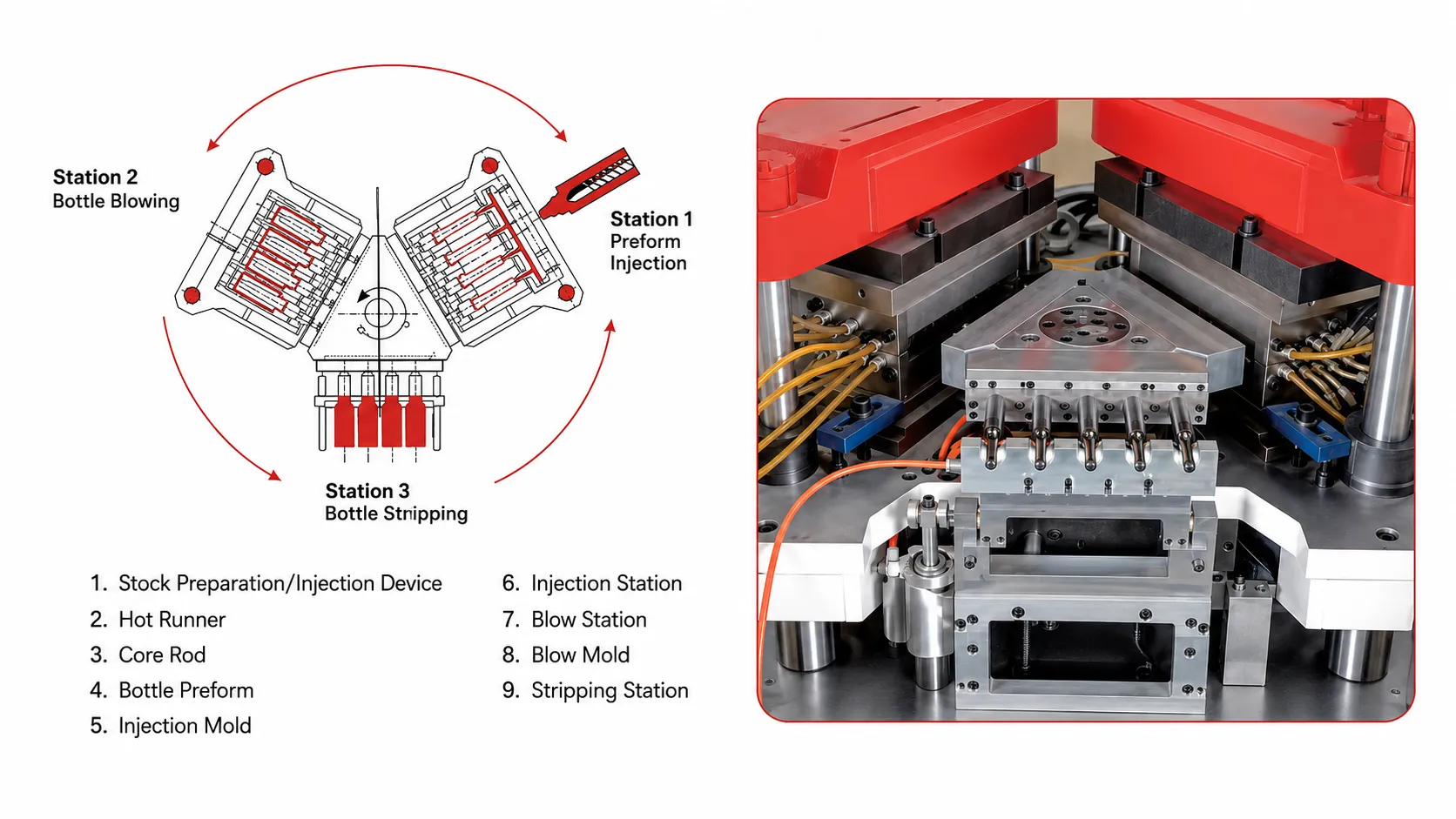
How It Works — 3-Station Rotary Cycle
01
Preform Injection
Molten resin is injected into the preform mould around the core rod. Bottle neck, threads, and finish are formed to micron-level tolerance at this station — permanently and without secondary finishing.
02
Bottle Blowing
The preform, retaining injection heat, rotates to the blow station. Compressed air expands it against the blow mould cavity to form the final bottle body. No reheating required.
03
Automatic Ejection
Cooled bottles are stripped from the core rods via the 220 mm stripping stroke onto the output conveyor. All three stations operate simultaneously every cycle, eliminating idle time.
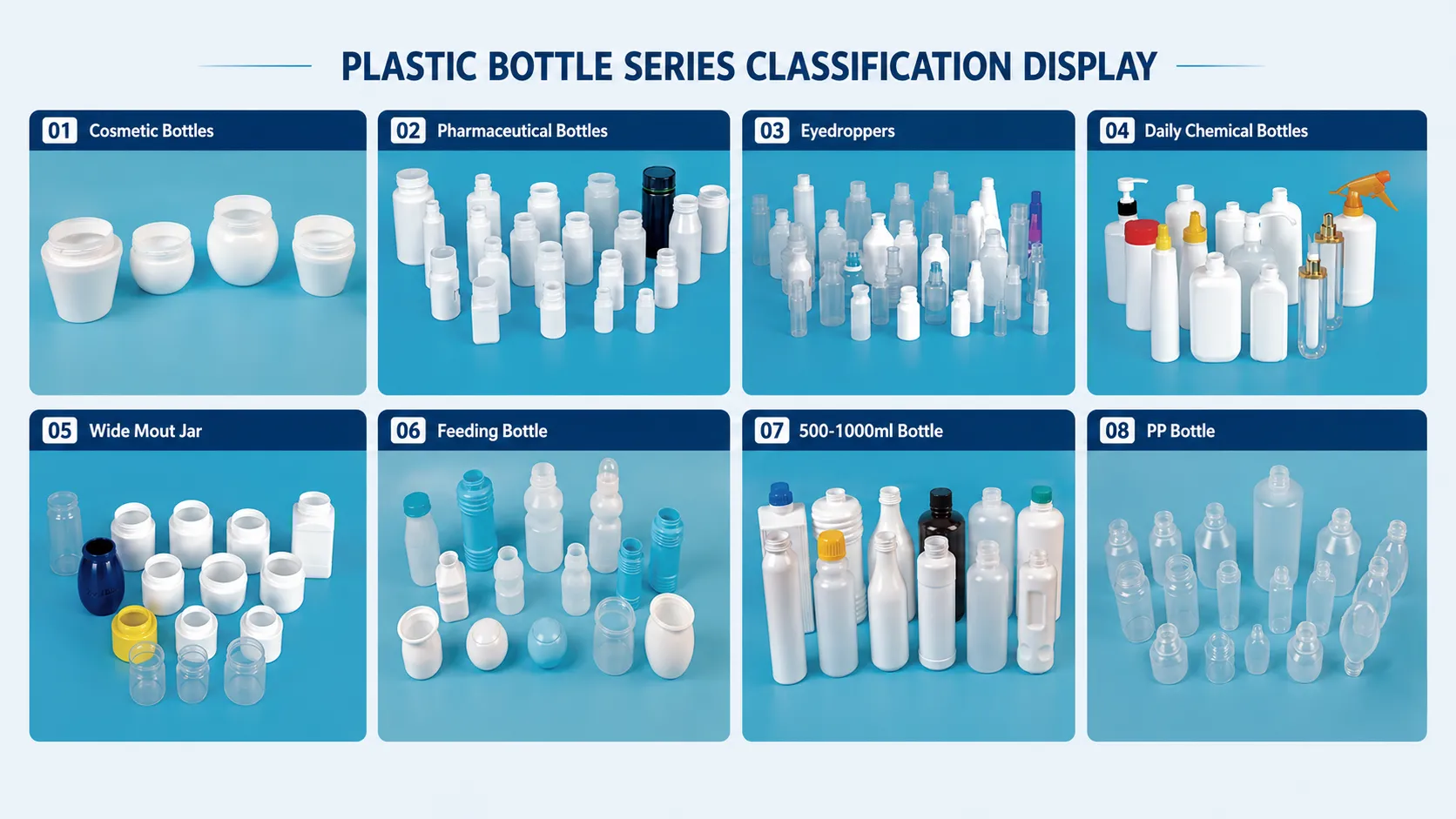
Application Industries
The EP-IBM40 is widely used in pharmaceutical packaging (eye-drop bottles, oral liquid bottles, nasal spray containers), cosmetic and personal care packaging (serum bottles, cream jars, lotion containers), food and healthcare supplements (vitamin bottles, feeding bottles, condiment containers from 10 ml to 250 ml), and daily chemical packaging. High-clarity PS capability enables optically transparent bottles for premium cosmetic and laboratory applications.
Pharmaceutical
Cosmetics
Food & Dairy
Daily Chemical
Key Features
European-Style Frame
Full European structural design delivers 20–30% higher clamping force than market equivalents at this capacity class, ensuring mould stability across all 9 cavities.
Servo Rotary Table
Standard servo-driven indexing provides consistent station-to-station positioning accuracy, reducing dry-cycle time and eliminating mechanical drift over extended shifts.
Pressurised Clamping
Booster cylinder disengages from mould open/close motion, reducing energy consumption 10–20% versus conventional clamping designs for sustainable 24-hour operation.
Zero Flash Output
One-step injection-blow process eliminates parison pinch-off, producing flash-free bottles with zero scrap — versus 20–40% waste typical of extrusion blow moulding.
100% Neck Accuracy
Bottle neck and thread dimensions are injection-moulded to 100% cap-seal accuracy. No secondary trimming at the mouth or base of any finished bottle.
Downstream Integration
Output conveyor connects directly to visual inspection, leak testers, labelling, and packing systems for fully unattended production.
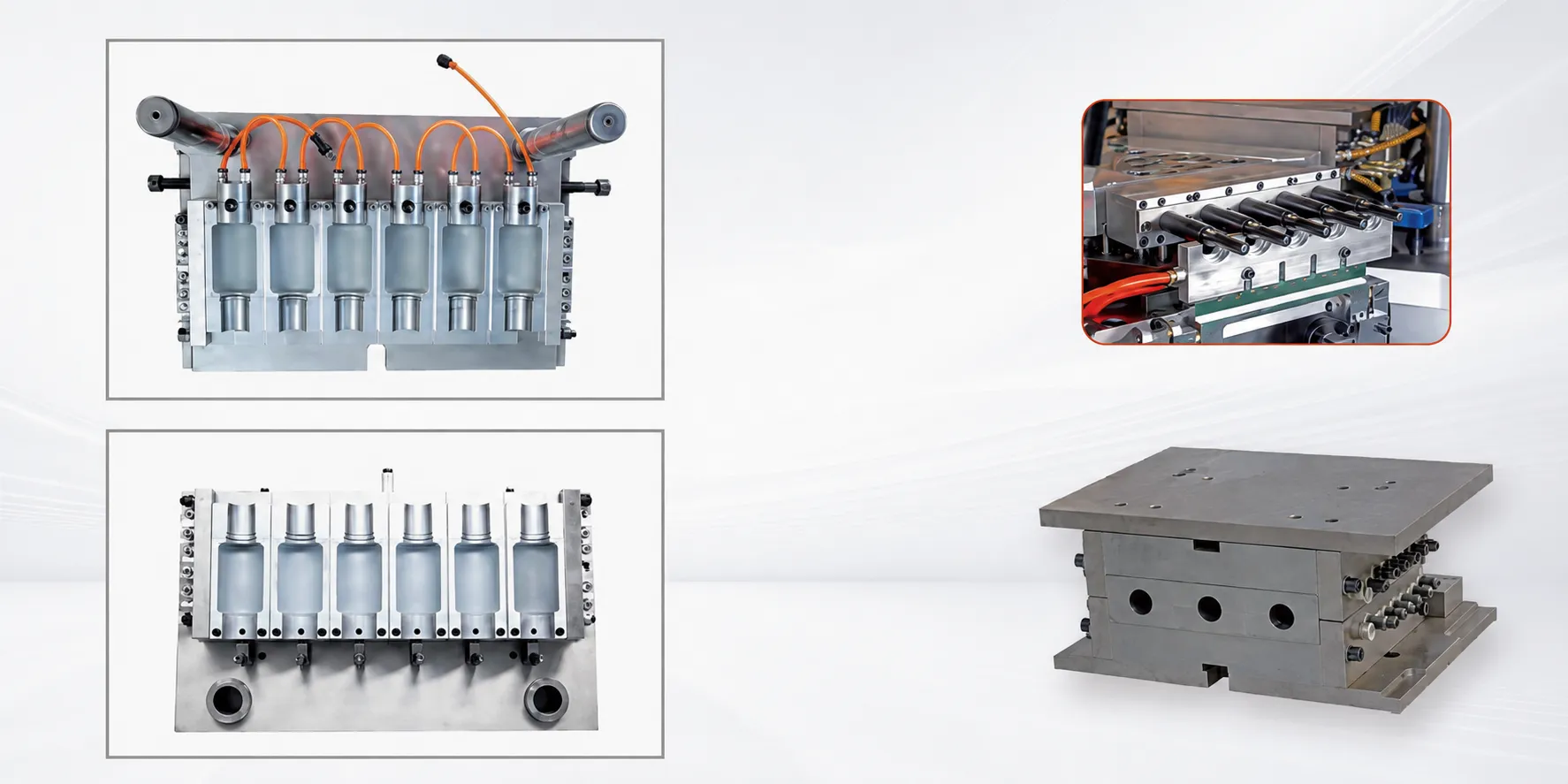
Mould System
Ever-Power supplies complete injection and blow mould packages for the EP-IBM40, manufactured in 4Cr13 stainless steel or imported S136 alloy steel for extended service life. Activity-designed cavity and neck-ring arrangements use dedicated oil and water channels ensuring stable preform dimensions and straightforward mould changeover. Blow mould bodies are optionally available in lightweight magnesium-aluminium alloy for faster cooling cycles. Core rods use a special internal structure engineered for fast cycle times and effective cooling performance throughout extended production runs.
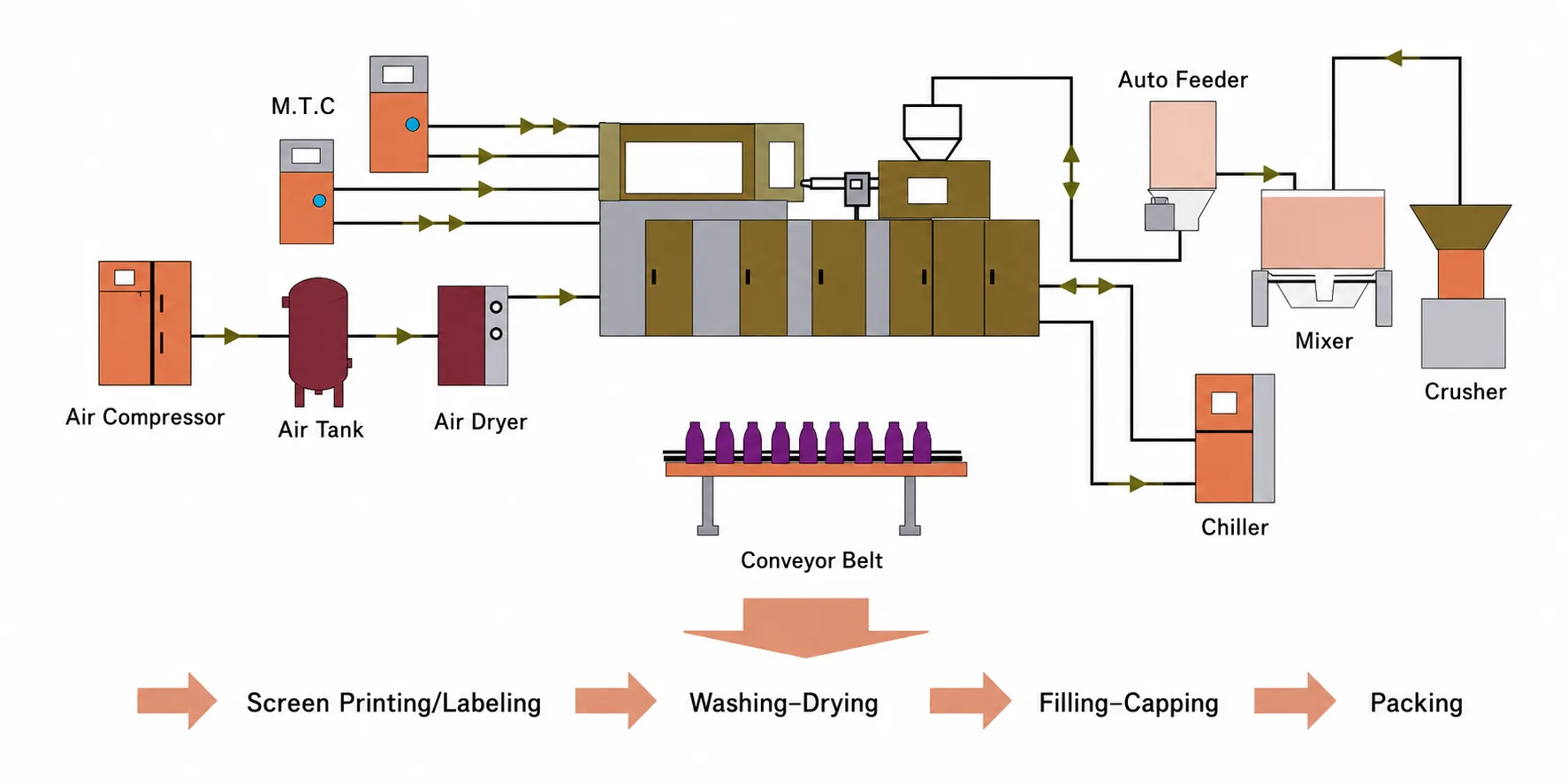
Production Line Integration
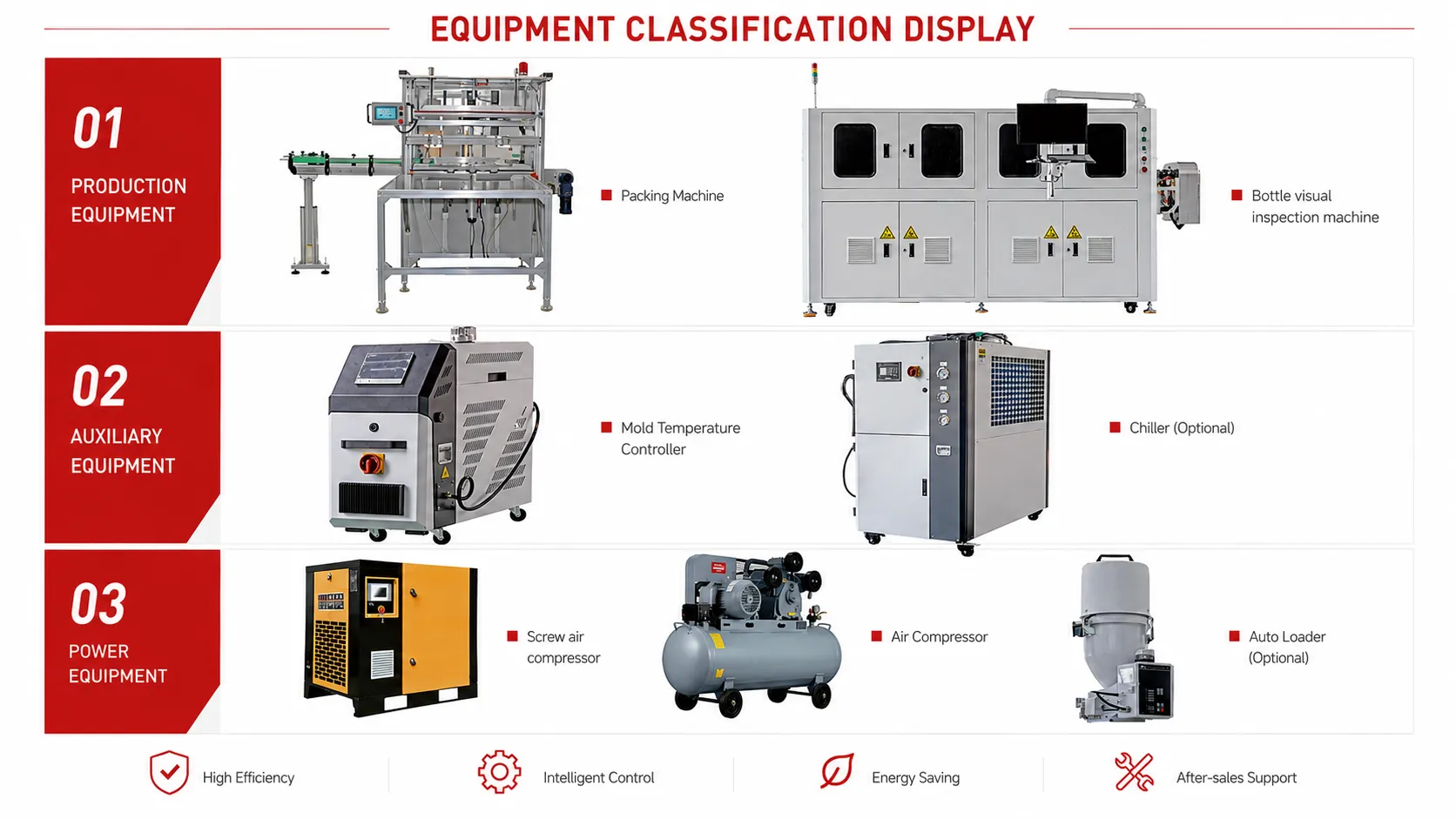
The EP-IBM40 integrates with Ever-Power’s full auxiliary equipment range as a complete turnkey production line. Available components include screw or piston air compressor, mould temperature controller, industrial water chiller, bottle visual inspection machine (detecting foreign particles, underfill, and base defects), automatic material loader for continuous resin feeding, and inline packing equipment. All components are sized to match the EP-IBM40 output rate.
IBM vs Extrusion Blow Moulding
Injection blow moulding eliminates the parison pinch-off entirely. Bottle weight variation is approximately 1% versus 3% for extrusion blow moulding (EBM). Wall thickness is uniform across all cavities with no 10–20% variation. There is no cut-off seam at the bottle base. Material waste is zero versus 20–40% scrap from EBM flash trimming. For pharmaceutical and cosmetic applications where neck precision, zero contamination, and material efficiency are requirements, IBM is the correct process choice.
Manufacturing & Quality
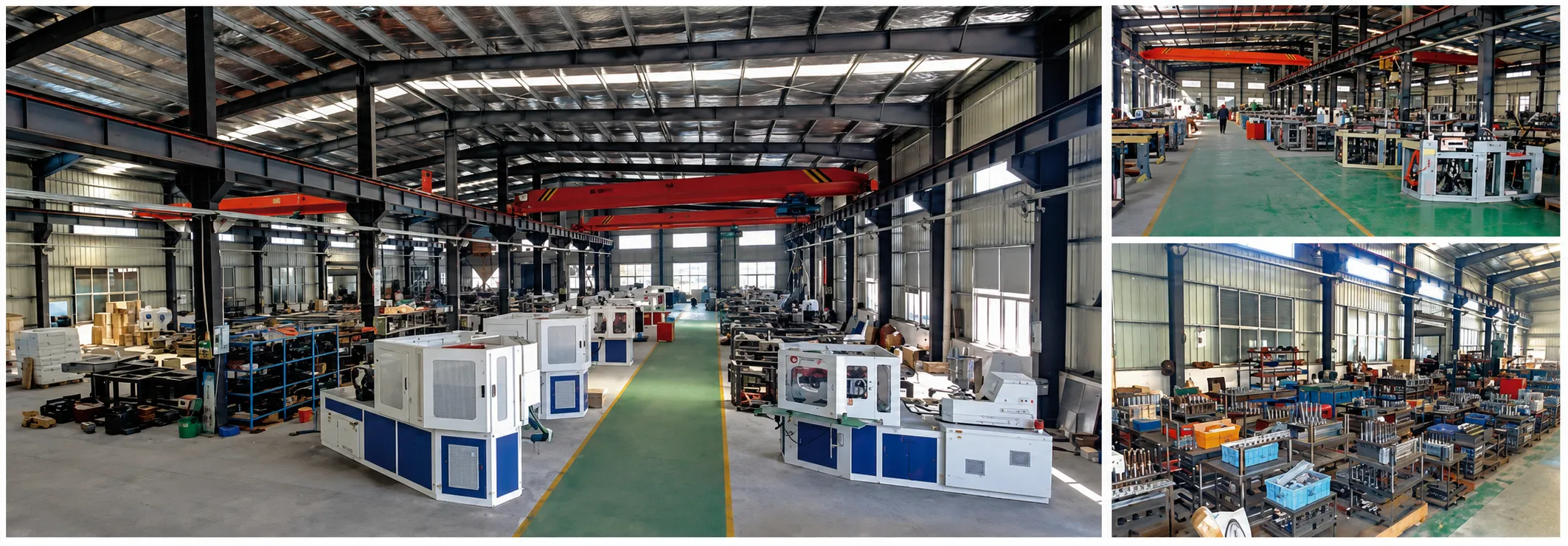
Every EP-IBM40 is assembled and factory-tested before shipment. CE certification, commissioning documentation, and on-site operator training are included with every machine order. Our 24/7 technical hotline handles urgent production support at any hour, and a preventive maintenance programme is available to minimise unplanned downtime over the machine’s operational life.
*All specifications are for reference only. Ever-Power reserves the right to modify technical parameters as part of ongoing product improvement. Contact [email protected] for the current confirmed datasheet.
Why Injection Blow Moulding for Small-Format Bottles
For bottles in the 1 ml to 250 ml range, injection blow moulding is technically superior to extrusion blow moulding in every dimension that matters to pharmaceutical and cosmetic manufacturers. The IBM process forms the bottle neck and threads in the injection mould, where tolerances are controlled to fractions of a millimetre. Every bottle from every cavity carries identical neck geometry across the entire production shift. Cap-seal integrity is a function of mould engineering, not production conditions, which means pharmaceutical manufacturers can validate the sealing performance of IBM bottles with confidence and audit-readiness that EBM bottles cannot deliver.
Material efficiency is the second major advantage. Because the IBM process has no parison pinch-off, there is no flash, no base seam, and no edge trim to discard. Every gram of resin fed into the machine exits as a finished bottle. In a high-volume pharmaceutical or cosmetic operation running HDPE or PP at continuous 24-hour production, eliminating the 20–40% material waste typical of extrusion blow moulding translates into measurable raw-material cost savings per year that directly improve production economics.
The EP-IBM40 brings these IBM process advantages to manufacturers operating at small-to-medium scale, without the capital investment or floor space requirement of larger platforms. Its compact 3.5 × 1.3 × 1.7 metre footprint allows it to be installed in facilities where space is constrained, while its 400 KN clamping force and servo rotary table deliver the bottle quality and dimensional consistency expected from much larger machines. For a first IBM machine investment or a capacity addition for a secondary product line, the EP-IBM40 offers the right balance of output, quality, and investment efficiency.
Resin Selection & Material Compatibility
Choosing the correct resin for your bottle application is as important as choosing the correct machine. HDPE is the standard choice for pharmaceutical and chemical containers, offering excellent chemical resistance, opaque white appearance, and wide regulatory approval including FDA food-contact and USP Class VI. LDPE is specified for squeezable eye-drop bottles and nasal spray containers where the patient applies finger pressure to dispense the product. PP is chosen for hot-fill applications and autoclavable containers requiring higher heat resistance than HDPE. High-clarity PS produces optically transparent bottles for premium cosmetics and laboratory reagents, while PCTG delivers superior impact resistance and chemical compatibility for luxury personal-care packaging. The EP-IBM40’s 3+N barrel heating zones accommodate the different melt-temperature requirements of each resin family, and our materials engineering team can advise on optimal processing parameters for your specific grade selection.
Choosing the Right IBM Machine — When the EP-IBM40 Is the Right Fit
The EP-IBM40 is the correct machine choice for manufacturers whose primary bottle format falls in the 1 ml to 250 ml range, who are establishing a new IBM production line for the first time, or who need a secondary machine to expand capacity on a specific small-format product without duplicating their existing larger platform. Its 400 KN clamping force and 9-cavity maximum at 10 ml position it correctly for single-shift or double-shift pharmaceutical and cosmetic operations producing 20,000 to 50,000 bottles per day at 30 ml formats.
For manufacturers considering their first IBM investment after operating extrusion blow moulding lines, the EP-IBM40 provides a low-risk entry point to the IBM process. The machine’s compact size allows installation alongside existing equipment without major facility reconfiguration, and its servo rotary table and pressurised clamping structure provide the process repeatability needed to validate bottle quality to pharmaceutical or cosmetic specifications from the initial production runs. Mould investment for the EP-IBM40 is proportional to its cavity count: a 9-cavity pharmaceutical mould for the EP-IBM40 represents a lower capital commitment than equivalent tooling for larger platforms, allowing manufacturers to validate the commercial case for IBM before committing to higher-capacity machines.
The EP-IBM40 is also the preferred second machine for manufacturers who already operate a larger IBM platform for their primary product but need a separate, dedicated machine for a niche small-volume product that would be inefficient to produce on a high-cavity large machine. Running a 30 ml eye-drop bottle at 9-cavity output on the EP-IBM40 dedicated to that product allows the larger machine to remain on its primary product without the downtime associated with mould changes, while keeping capital investment in the secondary machine proportional to the niche product’s revenue contribution.
Configure Your EP-IBM40 Production Line
Send us your bottle drawing, target volume, daily output, and resin type. Our engineers will return an optimised cavity configuration and full production line quotation within 24 hours.