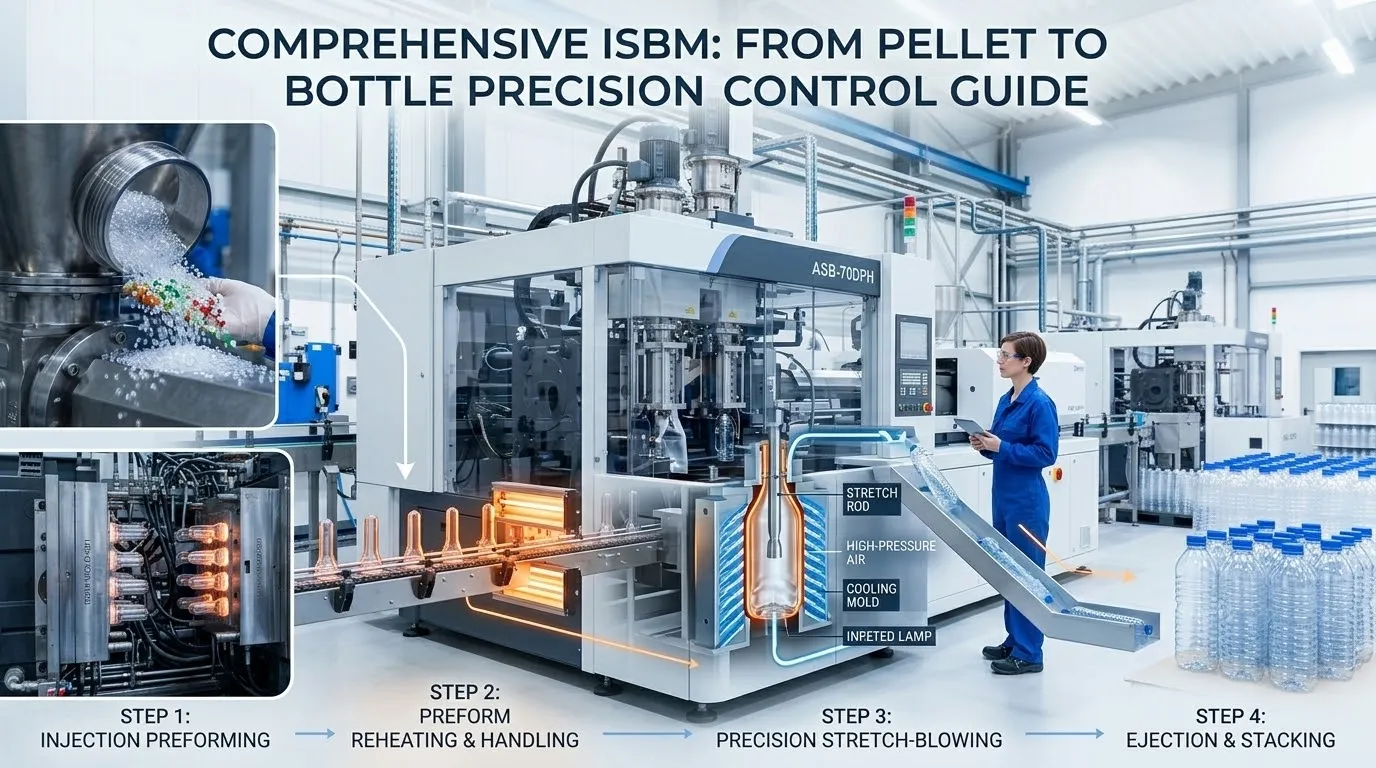
The stretch blow moulding process is one of the most technically demanding manufacturing methods in modern plastic packaging. In a single, uninterrupted production cycle, raw polymer resin enters the machine as pellets and exits as an optically clear, dimensionally precise container ready for filling. Understanding this process at a fundamental level is the basis of every cost, quality, and throughput decision a factory director or procurement engineer will make when evaluating machinery.
Ever-Power has spent over two decades engineering injection stretch blow moulding machines for cosmetic brands, pharmaceutical manufacturers, food and beverage producers, and specialty packaging companies across more than 60 countries. This guide draws directly from that engineering experience to explain how each stage works, why it matters, and how machine design choices translate into measurable production outcomes.
Whether you are evaluating a first machine purchase, planning a capacity upgrade, or troubleshooting an existing line, the technical grounding here will support better decisions.
What Is Injection Stretch Blow Moulding?
Understanding the core technology before examining each step
One Continuous Cycle
ISBM combines preform injection, axial and radial stretching, and blow moulding into a single uninterrupted machine cycle. The result is a biaxially oriented container with superior clarity, barrier properties, and mechanical strength compared to extrusion blow moulded alternatives.
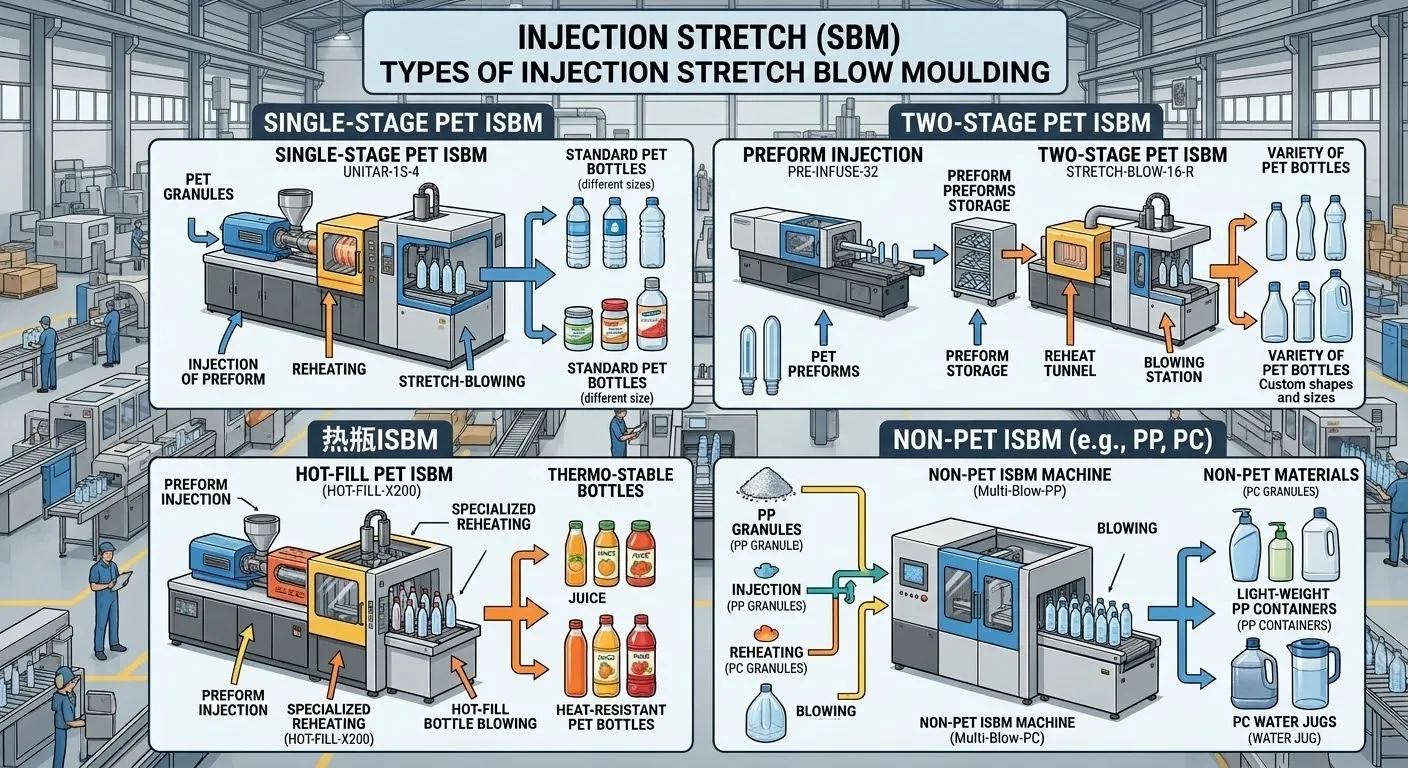
One-Step vs Two-Step
In one-step ISBM the preform is injected and blown while still thermally active, eliminating reheating energy and preform storage contamination risk. Two-step processes cool and store preforms before reheating — efficient at very high commodity volumes, but not optimal for premium containers or diverse material portfolios.
Why Biaxial Orientation Matters
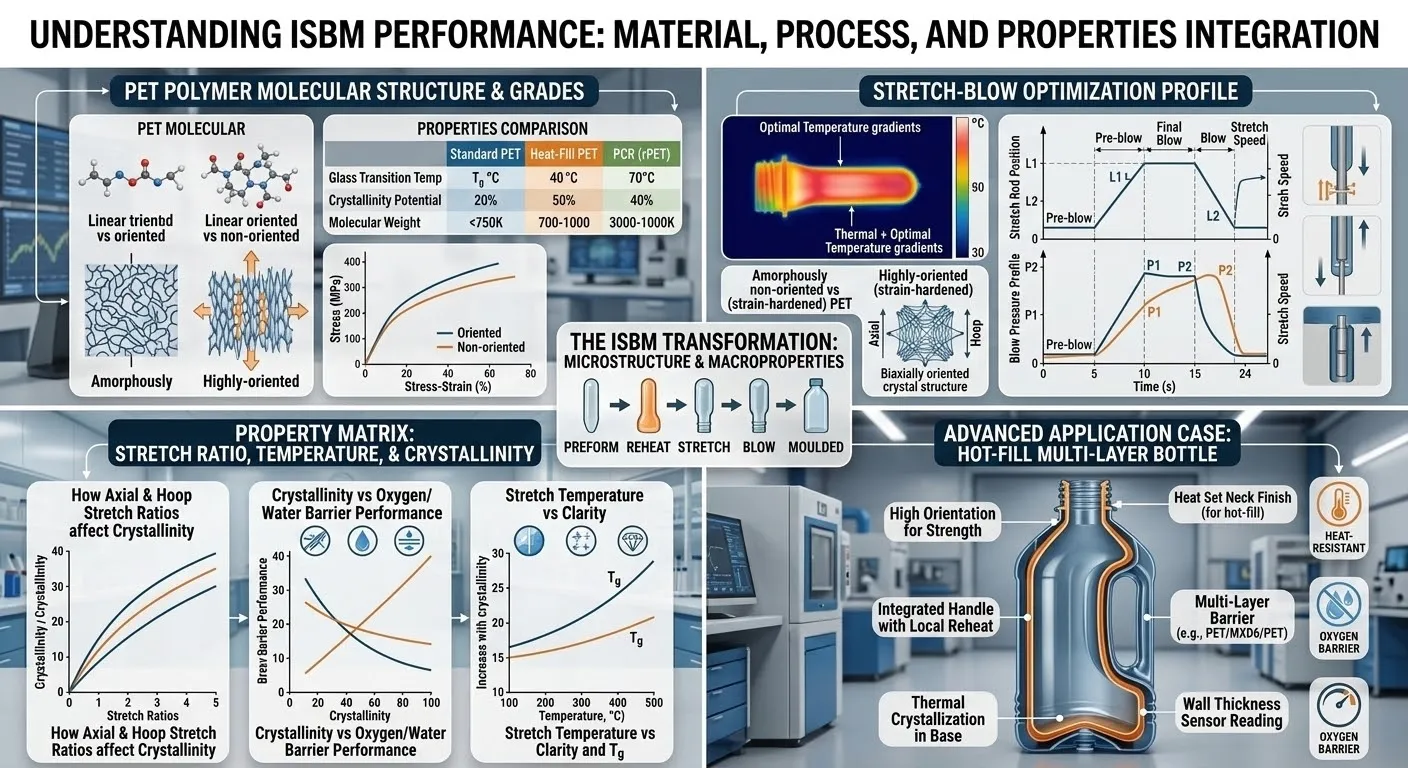
Stretching the polymer in both the axial and hoop directions simultaneously aligns the molecular chains in two planes. This biaxial orientation measurably increases tensile strength, gas barrier performance, optical clarity, and drop-impact resistance — the reason biaxially oriented PET dominates global beverage and pharmaceutical packaging.
Every Stage of the ISBM Process in Detail
From raw pellets to finished bottles — each stage governed by precise engineering parameters
Resin Drying and Plasticisation
Before any moulding begins, raw PET, PETG, PC, PP, or Tritan pellets must be rigorously dried. PET is highly hygroscopic — if moisture exceeds 50 ppm entering the barrel, hydrolytic degradation occurs during melting, reducing molecular weight and producing hazy, structurally weakened preforms. A crystallising dryer at 160 to 175 degrees Celsius run for four to six hours is standard for PET.
Once dry, the resin feeds into the extruder screw, which uses mechanical shear and conductive heat from barrel heaters to progressively melt and homogenise the polymer. The uniformity of this melt directly governs the clarity and structural integrity of every container produced downstream.
Preform Injection
The molten polymer is injected at high pressure through the hot runner system into the closed injection mould cavity, forming the preform — a thick-walled, test-tube-shaped intermediate part. Injection clamping force must keep the mould halves fully closed against injection pressure. Insufficient force causes flash on the parting line and dimensional inaccuracy in the bottle neck threads.
In the EP-HGY50-V3-EV, injection clamping force is 50 KN, suitable for single-cavity cosmetic containers. In the EP-HGY200-V4 this rises to 300 KN for large multi-cavity pharmaceutical moulds. Hot runner temperature must be zone-controlled to prevent cold slugs appearing as inclusions in the finished bottle wall.
Simultaneous Stretch and Blow
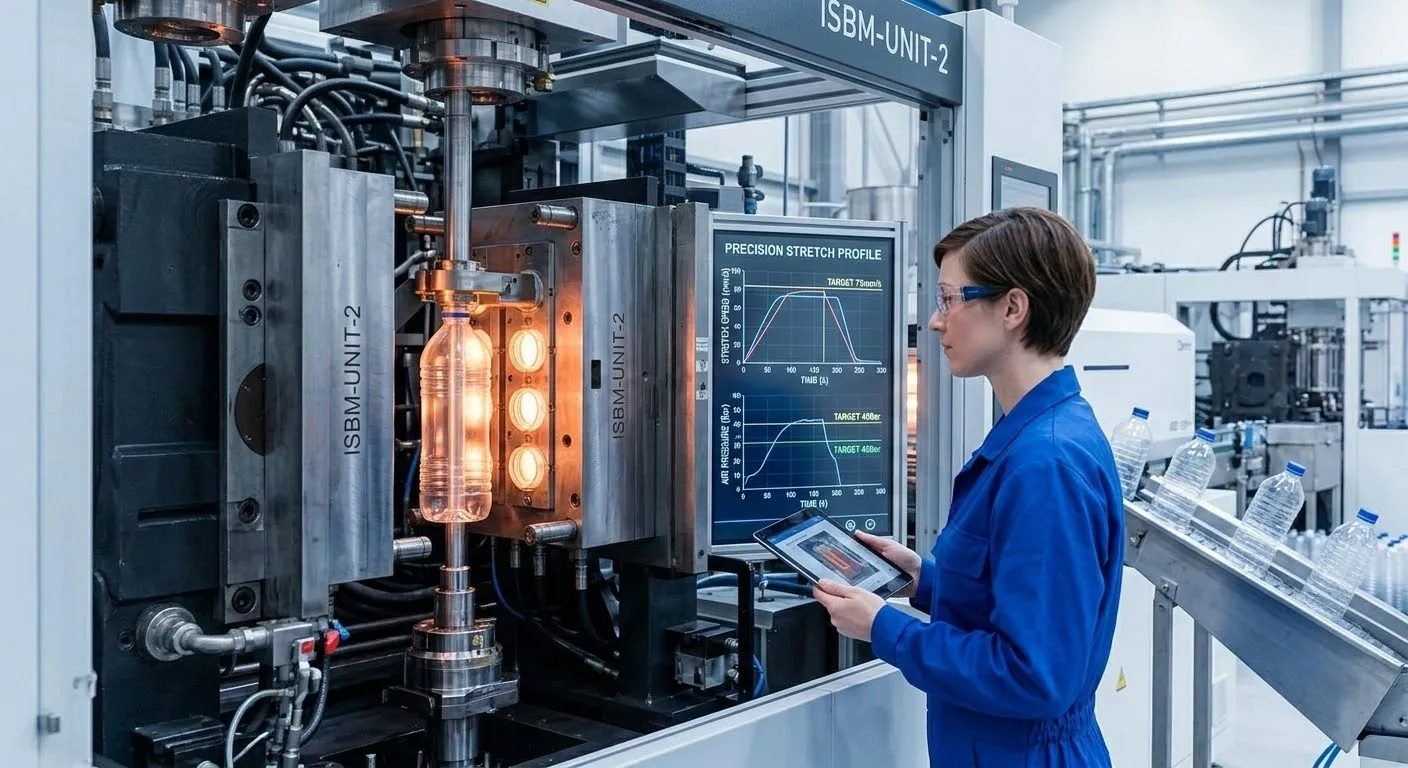
This is the defining operation. A stretch rod descends axially through the preform neck while high-pressure compressed air — 2.0 to 3.5 MPa in all Ever-Power machines — simultaneously inflates the preform radially against the blow mould cavity. The combined action forces polymer chains to orient in both directions at the molecular level.
Timing is critical. If pre-blow air arrives before the stretch rod reaches its lower limit, material rushes toward the neck and the base becomes dangerously thin. If the stretch rod leads too far without air support, the base develops stress whitening. Ever-Power PLCs execute these events with millisecond precision, adjustable from the touchscreen without mechanical intervention.
Cooling, Depressurisation and Ejection
Once the container fills the blow mould cavity, cooling begins. The mould surface is maintained at 5 to 15 degrees Celsius by chilled water circulating through internal channels. Insufficient cooling contact time causes thermal deformation when the bottle is released, leading to ovality variation and base push-up failures that fail quality inspection.
After cooling, high-pressure air vents, the mould opens, and a take-out arm transfers the finished bottle to the outfeed conveyor. In the single stage injection stretch blow molding machine design this happens simultaneously with injection of the next preform and conditioning of another, creating a fully parallel production cycle with zero idle time between shots.
3-Station vs 4-Station ISBM
Station count is the single most consequential machine configuration decision
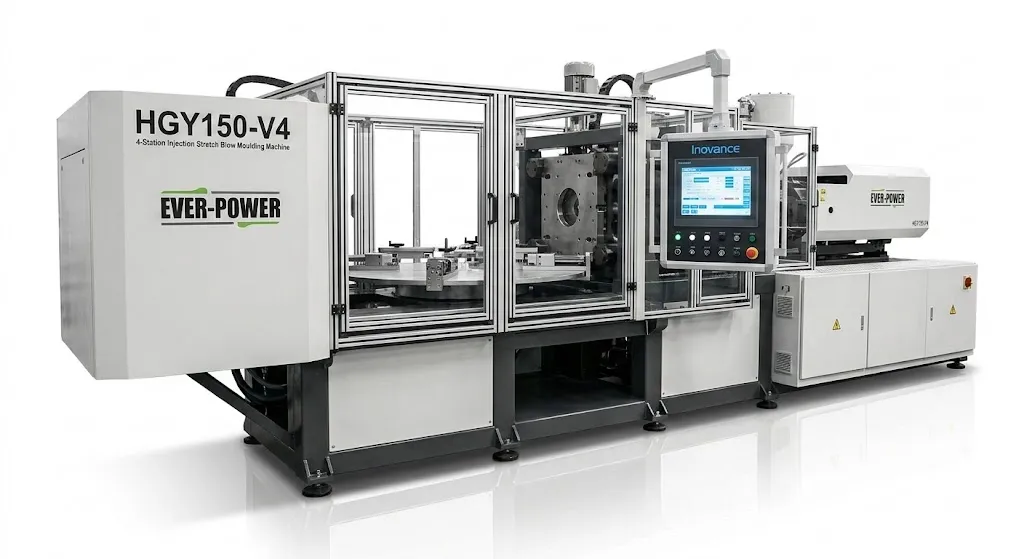
EP-HGY150-V4 — 4-station machine with dedicated temperature conditioning for premium cosmetic and pharmaceutical containers.
Materials Processed in One-Step ISBM
Each resin has distinct processing characteristics that determine how the single stage injection stretch blow molding machine must be configured
Polyethylene Terephthalate
The most widely processed resin in the stretch blow moulding process. PET delivers exceptional clarity, high oxygen barrier, and strong mechanical performance. Its narrow blow window of 95 to 115 degrees Celsius requires precise zone-level temperature control. Suitable for beverages, cooking oils, pharmaceutical syrups, and personal care products.
PET Glycol-Modified
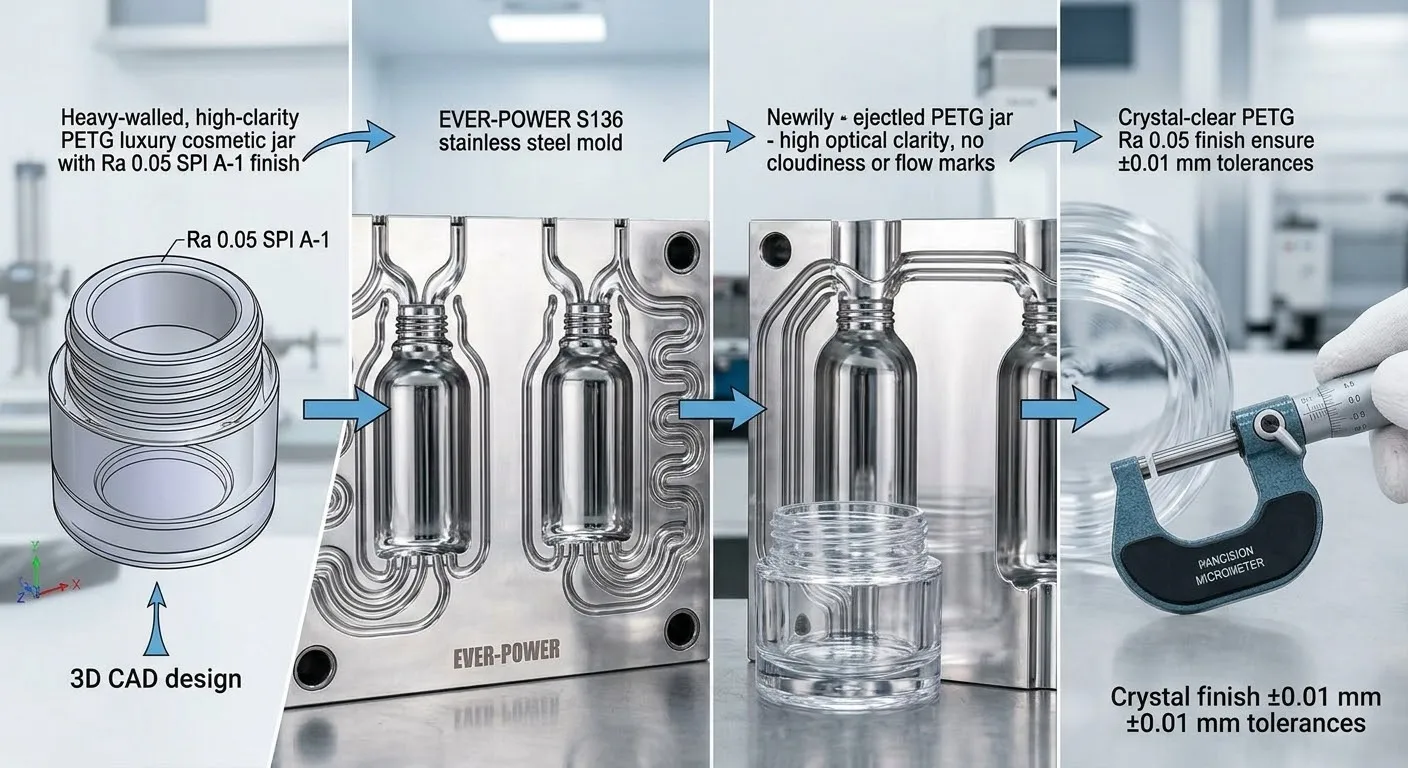
PETG processes at lower temperatures, has a broader processing window, and delivers glass-like clarity without crystallisation drying. Ideal for luxury cosmetic jars, premium food containers, and medical device packaging where optical clarity is a primary brand requirement and complex shapes are required.
BPA-Free Copolyester
Inherently BPA-free with exceptional chemical and shatter resistance. Tritan’s temperature sensitivity demands a 4-station machine with precise conditioning control. Material of choice for infant nursing bottles, reusable sports containers, and medical packaging where BPA-free certification and optical clarity are both required.
Polypropylene
Excellent chemical resistance, low density, and microwave-safe profile. PP requires a very narrow processing window and benefits significantly from 4-station conditioning. Applications include yoghurt containers, personal care packaging, and hot-fill food service containers requiring FDA compliance.
Polycarbonate
Processes at significantly higher temperatures than PET, requiring careful melt temperature control to avoid yellowing. Produces containers with outstanding impact strength and optical clarity for water cooler bottles, reusable containers, and specialty optical applications. The 4-station conditioning stage is essential for defect-free output.
Critical Parameters in the Stretch Blow Moulding Process
Variables that production engineers must monitor to achieve consistent output quality
High-pressure blow air delivered through Parker valves fills the preform against the cold mould wall. Insufficient pressure causes incomplete bottle formation and surface defects.
Chilled water at 8 to 12 degrees Celsius circulates through the blow mould, determining cooling rate and cycle time. Consistent water temperature is essential for repeatable bottle geometry.
Clamping force must exceed the separating force from injection pressure. Ever-Power machines range from 50 KN for cosmetic applications to 400 KN in the EP-HGY650-V4.
For PET, an ASR of 2.0 to 2.5 combined with a hoop stretch ratio of 3.5 to 4.5 achieves optimal biaxial orientation. Deviation reduces barrier performance and mechanical strength.
All Ever-Power ISBM machines operate on standard 3-phase industrial power at 370 to 400 V, compatible with Europe, Australia, the Middle East, and most global markets.
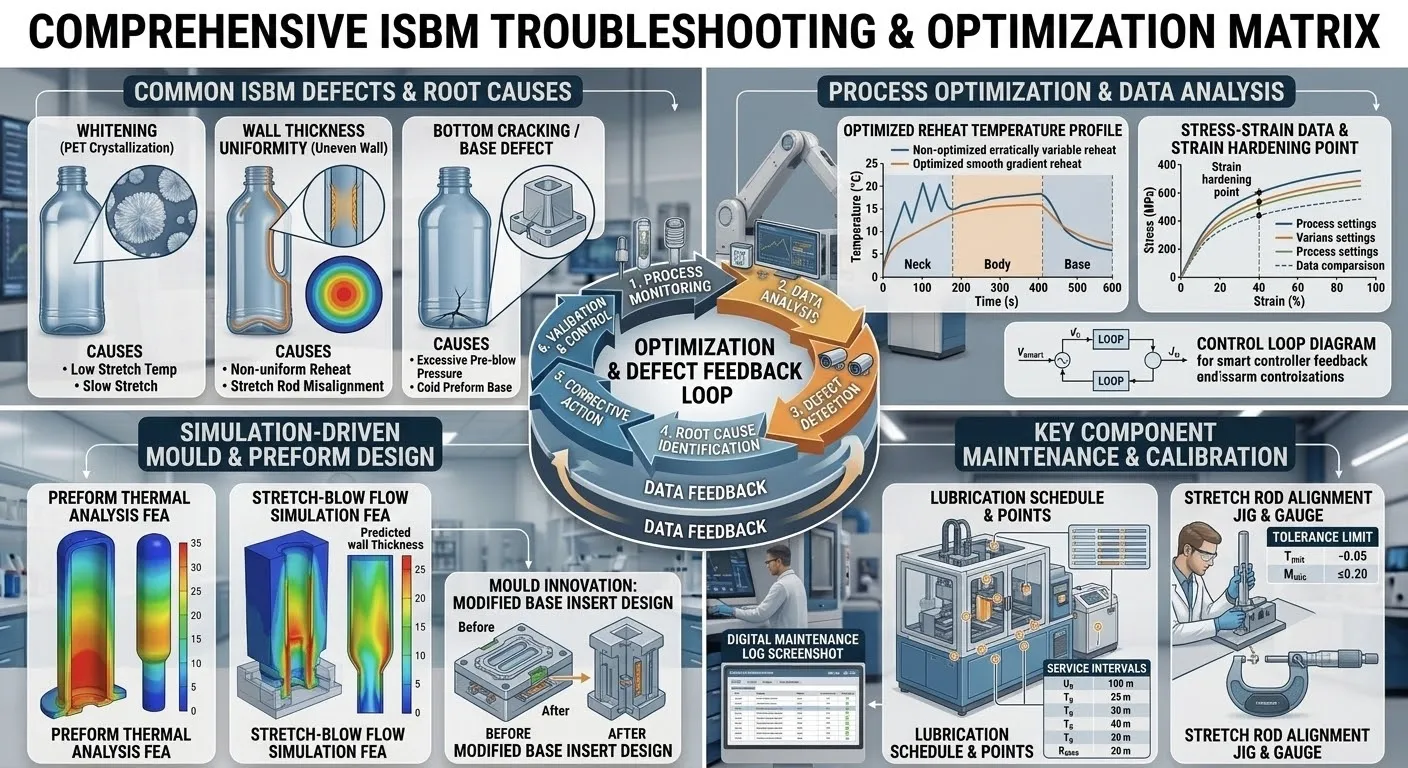
Common Defects and Their Root Causes
Every defect traces back to a specific parameter deviation. Understanding cause and effect is the foundation of systematic process control.
Wall Thickness Variation
Cause: Non-uniform preform temperature at stretching. Thinner sections show where the preform was hotter. Most common with asymmetrical shapes on 3-station machines.
Solution: Switch to a 4-station machine with independent conditioning, or review the hot runner zone temperature map to achieve more uniform preform temperature before blow.
Stress Whitening
Cause: Preform temperature too low at blowing. The polymer orients below its glass transition temperature, creating micro-voids that scatter light and produce white haze.
Solution: Increase conditioning temperature in 2-degree increments. Verify injection mould cooling water is not pulling excessive heat from the preform before it reaches the blow station.
Cloudy Base
Cause: PET base held above the crystallisation range of 90 to 160 degrees Celsius for too long. PET crystallises within this range and loses transparency permanently.
Solution: Reduce cycle time to minimise preform exposure. Increase cooling water flow rate in the injection mould to cool the base section faster.
Flash on Neck Threads
Cause: Injection clamping force insufficient to hold neck ring inserts closed against injection pressure. Molten polymer escapes and solidifies as flash, preventing correct cap seating.
Solution: Verify measured clamping force matches machine specification. Check neck ring insert wear and consider whether resin viscosity has changed between batches.
Our Complete ISBM Machine Portfolio
Every machine ships after ISO 9001 quality control and a 72-hour continuous dry-run acceptance test
Where Is the Stretch Blow Moulding Process Used?
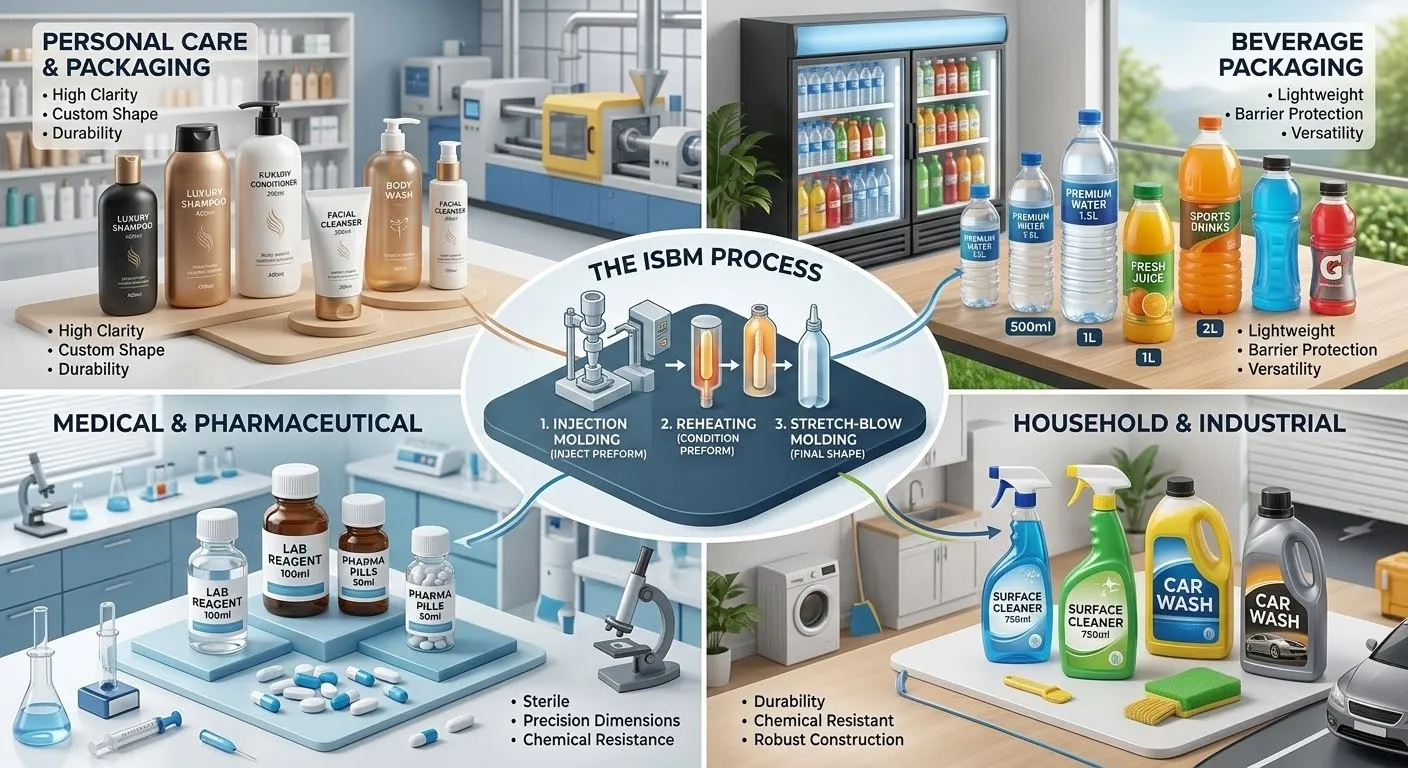
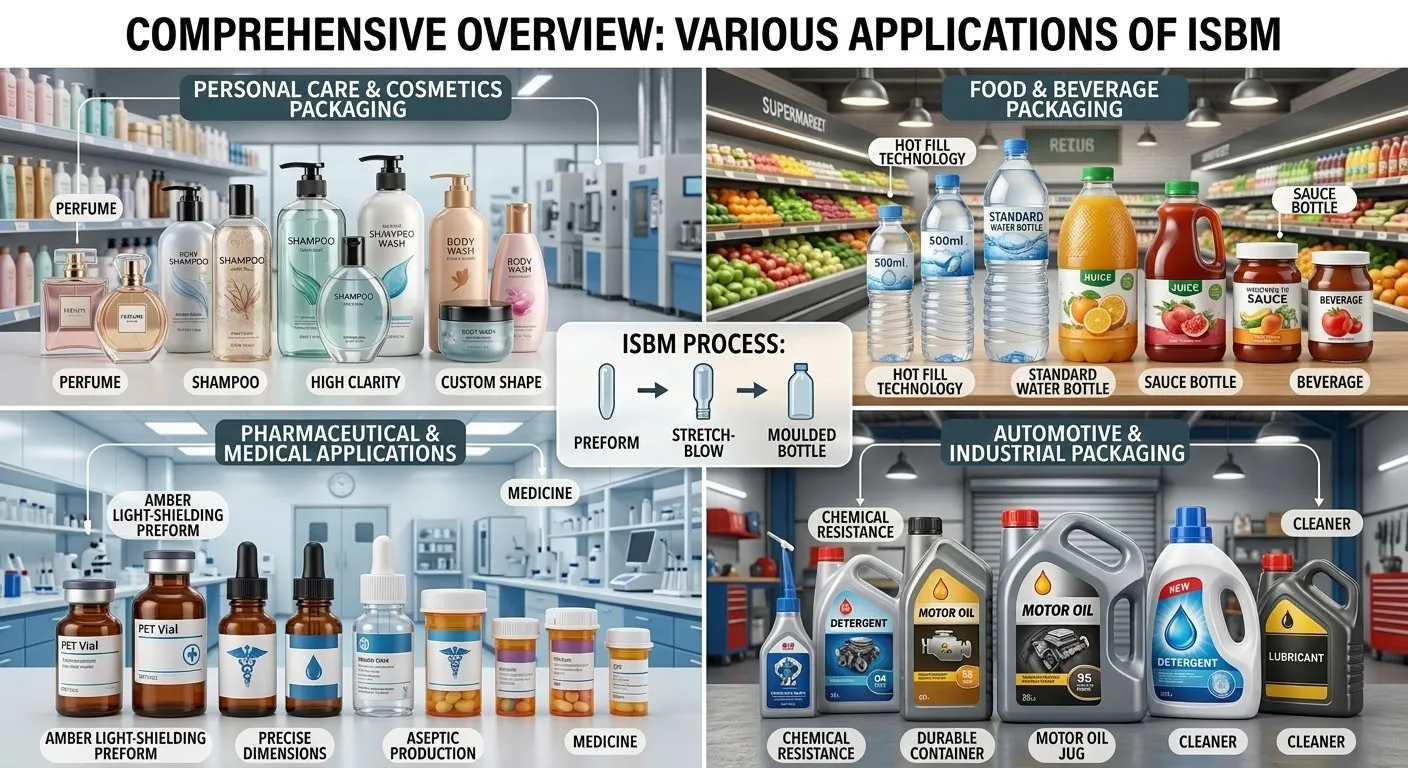
ISBM technology serves virtually every major packaging sector globally
Pharmaceutical Packaging
Syrup bottles, eye drop vials, tablet containers, and nasal spray bottles require precise neck thread geometry, high barrier against moisture and oxygen, and a hygienic one-step process that minimises contamination risk. ISBM in PET or PP meets all these requirements within a single compact machine.
Luxury Cosmetics
Prestige skincare and perfume brands demand heavy-wall jars and bottles that replicate the aesthetic and weight of glass. PETG on 4-station machines produces cosmetic containers with wall thickness exceeding 4 mm, glass-like transparency, and complex oval or asymmetrical profiles impossible on simpler equipment.
Food and Condiment Jars
PET jars for peanut butter, honey, spices, and cooking oils require superior oxygen barrier and structural integrity to survive retail stacking. Biaxial orientation in the ISBM process significantly reduces oxygen permeation, extending shelf life beyond what injection moulded PP containers achieve at equivalent wall thickness.
Baby and Infant Products
Infant nursing bottles require BPA-free materials, optical clarity, shatter resistance, and precise neck threading to accept standard silicone teats. Tritan and PP on 4-station ISBM machines deliver all these requirements. The closed-loop one-step process minimises contamination versus two-step manufacture with preform storage.
Beverage Containers
Niche and premium beverage producers use one-step ISBM for superior material distribution in complex bottle shapes and the ability to process premium resins like PETG for differentiated shelf presence at moderate volumes where two-step machinery would be over-specified and inflexible.
Chemical and Household Products
Essential oils, cleaning concentrates, fabric softeners, and agrochemicals require containers with excellent chemical resistance and leak-free closure sealing. Biaxially oriented PET containers produced by ISBM show significantly improved stress-crack resistance and precise neck thread geometry versus injection moulded alternatives.
Ready to Discuss Your ISBM Requirements?
Our senior engineers have configured injection stretch blow moulding production lines for packaging manufacturers in over 60 countries. We provide a detailed technical proposal and ROI analysis within 48 hours of your inquiry.
Frequently Asked Questions
All technical parameters cited refer to measured performance data from Ever-Power machines under standard factory test conditions. For data sheets and machine configuration advice, contact [email protected] or visit our contact page.