What is the best injection molding machine?
There is no single best injection moulding machine — the best machine for any operation is the one that produces the right output at the required quality, cycle time, and energy efficiency for the specific application. For buyers who need to produce finished PET or PP bottles, the relevant machine category is a one-step ISBM machine, not a general injection moulding machine. This guide explains how to evaluate and select the best machine for bottle production specifically, with the criteria that matter most in real production environments.
Best for What? Defining the Selection Criteria
Before comparing machines, define what “best” means for your operation. The criteria that determine machine suitability differ by application:
- Container volume and format — the machine must have sufficient injection clamping force and blow station capacity for the preform weight and bottle volume you need to produce
- Output rate — the machine must produce enough bottles per hour to meet your filling line or market demand, at the cavity count that fits your mould budget
- Energy efficiency — drive system determines energy consumption; a servo-hydraulic machine uses 30–45% less electricity than fixed-speed hydraulic; a full-servo machine uses 40–55% less
- Process control precision — servo-driven machines provide better repeatability of injection speed, conditioning temperature, stretch rod force, and blow pressure, leading to tighter bottle weight and wall thickness distribution
- After-sales support in your market — the best machine technically is worthless if spare parts take 6 weeks to arrive or commissioning support is unavailable in your country
- Total cost of ownership — purchase price plus energy, maintenance, and downtime cost over 10 years; a machine that costs less to buy but more to run is rarely the best choice over its operating life

Selecting the best ISBM machine requires matching clamp force, station count, and drive system to the specific container volume, resin, and production output required.
Best ISBM Machine by Application Category
For one-step ISBM bottle production, the best machine varies by application. Ever-Power’s EP-HGY series covers all major ISBM bottle production categories:
| Application | Best Model | Why |
|---|---|---|
| Pharmaceutical vials 30–200 ml | EP-HGY50-V3-EV | Full servo, cleanroom-compatible, precision neck control |
| Cosmetic flacons 50 ml–1 L | EP-HGY150-V4-EV | Full servo, complex shape capability, PETG compatible |
| Water & beverage 250 ml–2 L | EP-HGY150-V4 | Servo-hydraulic, high output, 2–4 cavity options |
| Edible oil & food 1–5 L | EP-HGY250-V4 | 250 kN clamp, handles larger preform weights |
| Complex shapes & 6-station | EP-HGYS280-V6 | 6-station with additional conditioning & post-blow cooling |
| Industrial & agrochem 2–10 L | EP-HGY650-V4 | 400 kN, largest clamp in the EP-HGY range |
Full Servo vs Servo-Hydraulic: Which Is Better?
For pharmaceutical and cosmetic applications, full-servo (all-electric) ISBM machines are generally the better choice. Full-servo machines have no hydraulic fluid in the system, eliminating the risk of hydraulic oil contamination in cleanroom or near-cleanroom environments. They also offer superior repeatability on each axis because servo motors provide closed-loop force and position control without the pressure variations inherent in hydraulic systems. The EP-HGY50-V3-EV and EP-HGY150-V4-EV are full-servo machines recommended for pharmaceutical and premium cosmetic applications.
For food, beverage, edible oil, and industrial applications, servo-hydraulic machines are the practical and cost-effective choice. They provide energy savings of 30–45% over fixed-speed hydraulic, excellent process repeatability for standard PET bottle formats, and a lower purchase price than full-servo equivalents. The EP-HGY150-V4 through EP-HGY650-V4 are servo-hydraulic machines covering this application range.
What Makes Ever-Power EP-HGY the Best Choice for ISBM
No machine manufacturer can claim to be universally best across all applications and all markets. But for buyers evaluating one-step ISBM machines for pharmaceutical, cosmetic, food, beverage, and industrial container production in export markets including Brazil, South Korea, Australia, the Netherlands, the UK, Canada, and Colombia, Ever-Power’s EP-HGY and EP-BPET series offers several specific advantages:
- Dedicated ISBM specialisation — Ever-Power designs and builds only ISBM and IBM machines, not general injection moulding equipment; all process knowledge and R&D is focused on blow moulding
- Complete machine-plus-mould supply — machine and matched mould set from a single supplier eliminates interface compatibility risk and provides one accountability point for performance
- Servo drive standard — all EP-HGY machines use servo-hydraulic or full-servo drive as standard; no fixed-speed hydraulic options are offered
- On-site commissioning and training — every installation includes on-site commissioning and operator training as standard, not as an optional extra
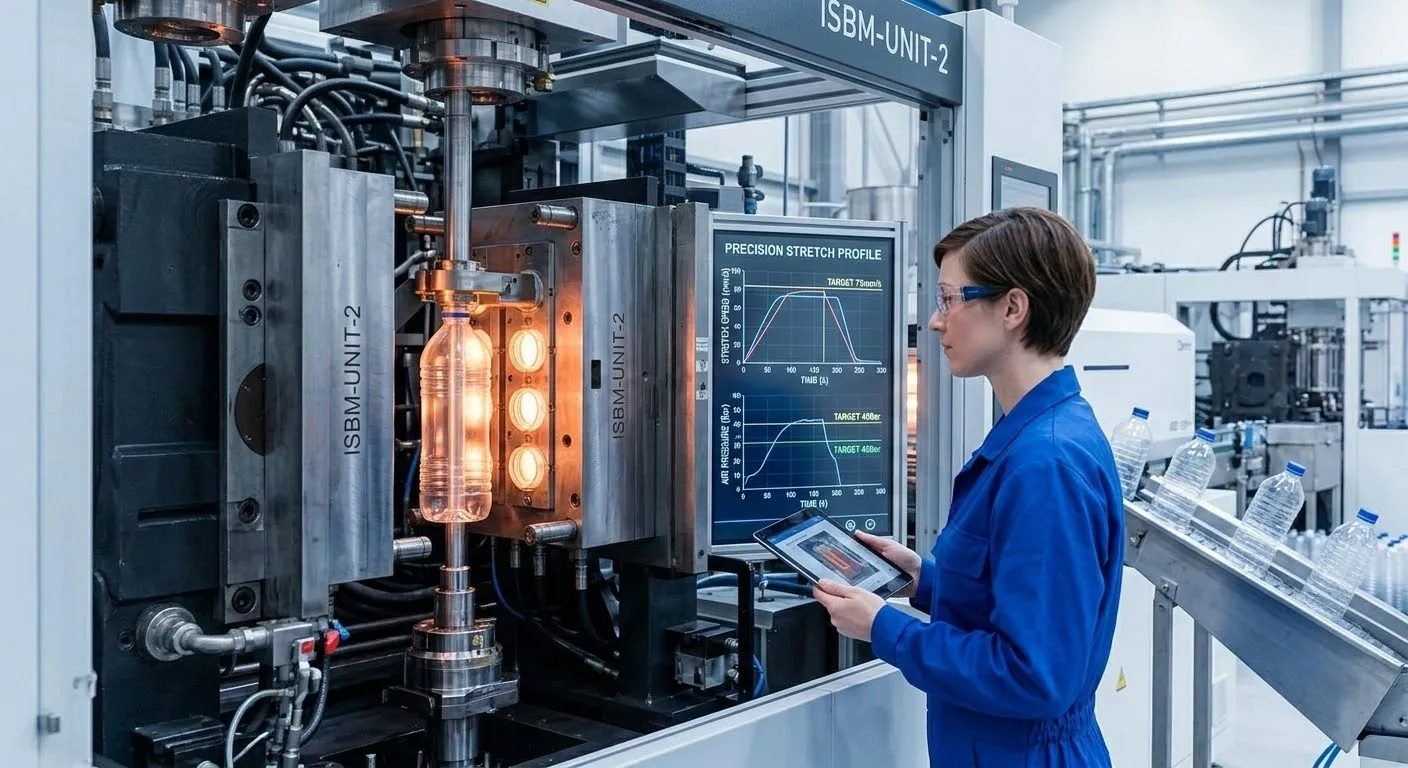
Ever-Power ISBM machine production facility — all machines are run-tested and factory-accepted before shipment with full process documentation.
Want a machine recommendation for your specific bottle and production requirement?
Send Ever-Power your container drawing, resin specification, target output, and market — our applications team will identify the best EP-HGY model for your operation and provide indicative pricing within 24 hours.
Browse the full EP-HGY and EP-BPET one-step ISBM machine range, or explore custom mould options for your container format.
Frequently Asked Questions
Is a Japanese ISBM machine better than a Chinese one?
Japanese ISBM machines (principally Nissei ASB) have a long track record and strong global service network. Chinese specialist ISBM machines from established manufacturers such as Ever-Power now match Japanese machines on technical performance — servo drive systems, precision conditioning, and machine accuracy — at significantly lower purchase prices. The practical differentiator for most buyers is after-sales support quality and spare parts availability in their specific market. Ever-Power has service coverage and installed base in Brazil, South Korea, Australia, the Netherlands, the UK, and Canada.
How do I verify a machine is actually as good as the supplier claims?
Request a factory visit to observe the machine running your bottle (or a comparable format) at the supplier’s facility before purchase. Ask to see: actual cycle time data logged from the HMI (not theoretical); bottle weight variation data from a 1-hour production run; energy consumption in kWh per 1,000 bottles; and a reference customer in your industry who can be contacted directly. Suppliers who cannot or will not provide these are not the best choice regardless of quoted specifications.
What warranty should I expect on the best ISBM machine?
A standard warranty for ISBM machines from established manufacturers is 12 months on parts and workmanship from commissioning date (or 15 months from shipment, whichever comes first). Premium suppliers extend this to 18–24 months on structural components. Confirm warranty coverage explicitly in the purchase contract, including whether the warranty covers on-site repair or replacement parts only, and what the response time commitment is for warranty claims. Ever-Power provides a 12-month parts warranty on all EP-HGY and EP-BPET machines with on-site technical support response.
Evaluating Supplier After-Sales Support as Part of Machine Quality
The best injection moulding or ISBM machine is not necessarily the one with the highest specification on paper — it is the one that performs most reliably in your production environment with the support needed to recover quickly when problems arise. A technically superior machine from a supplier with poor spare parts availability or no on-site support presence in your country will cost more in real production than a technically equivalent machine from a supplier with strong local support. This is why after-sales support capability should be evaluated with the same rigour as machine technical specification during the purchase process.
The questions to ask any ISBM machine supplier about after-sales support are: What is the typical lead time for critical spare parts (barrel and screw, stretch rod seals, blow valve components, servo motor) shipped to my country? Do you have remote diagnostic access to the machine HMI? Who is your nearest authorised service engineer to my facility, and what is their typical response time? Can I speak with a reference customer in my industry in my country? Suppliers who cannot answer these questions concretely — or who deflect with generalities — represent a higher operational risk than their purchase price might suggest. Ever-Power can provide specific answers to each of these questions for its target markets in Brazil, South Korea, Australia, the Netherlands, the UK, and Canada.
Process Validation and Regulatory Considerations for Pharmaceutical ISBM
For pharmaceutical producers selecting an ISBM machine, the best machine is also one that supports the regulatory validation requirements applicable to pharmaceutical primary packaging. Pharmaceutical containers produced by ISBM must meet applicable pharmacopoeial standards (USP, EP, JP) for container material and performance, and the manufacturing process must be validated to demonstrate consistent production within specified limits. This validation requirement has practical implications for machine selection: the machine must provide documented evidence of process parameter control — logged data for injection temperature, blow pressure, conditioning temperature, and cycle time per production batch — and must support the statistical process control (SPC) analysis required for regulatory submission.
EP-HGY full-servo machines (EP-HGY50-V3-EV and EP-HGY150-V4-EV) include an HMI data logging system that records all critical process parameters per cycle and can export production data in formats compatible with standard SPC software. This capability directly supports pharmaceutical process validation and batch release documentation requirements. For pharmaceutical producers evaluating ISBM machine suppliers, confirmation that the machine’s data logging system meets their specific validation protocol requirements should be part of the technical specification review before purchase commitment.