How much does a 300 ton injection molding machine cost?
A 300-ton injection moulding machine costs between USD 35,000 and USD 300,000 depending on drive system, country of manufacture, and application-specific options. However, for buyers whose goal is producing finished plastic bottles rather than solid parts, a standard 300-ton injection moulding machine is not the right equipment — and understanding why requires clarifying the difference between general injection moulding and one-step ISBM bottle production.
300-Ton General Injection Moulding Machine: Price by Type
A 300-ton clamping force injection moulding machine is a mid-to-large format machine for solid plastic part production. At 300 tonnes (approximately 3,000 kN of clamping force), it is suited to larger moulds with more cavities or larger parts that require higher injection pressures and mould support areas. Indicative prices:
| Machine Type | Origin | Indicative Price (USD) |
|---|---|---|
| Hydraulic (fixed-speed pump) | China | USD 35,000–65,000 |
| Servo-hydraulic | China | USD 50,000–100,000 |
| All-electric | Japan / Taiwan | USD 120,000–200,000 |
| Servo-hydraulic, premium | Europe (Engel, Arburg, KM) | USD 180,000–300,000+ |
These prices are for machines producing solid plastic parts. A 300-ton machine is not a one-step bottle machine — it cannot produce finished hollow bottles without a separate blow moulding machine.
Why 300-Ton IM Machines Are Not Used for PET Bottle Production
The confusion between standard injection moulding machine tonnage and ISBM machine capability is common. At 300 tons of clamping force, a standard injection moulding machine is certainly capable of producing PET preforms — the thick-walled intermediate that is later blown into a bottle in a two-step process. Husky and Sipa, for example, produce PET preform injection systems in this tonnage class for high-cavity preform production serving large bottle manufacturing operations.
However, a 300-ton injection moulding machine cannot produce finished bottles in a single operation. Producing finished bottles requires either: (a) a one-step ISBM machine that integrates injection and blow in the same platform; or (b) a two-step system consisting of a preform injection machine (which may be a 300-ton machine) plus a separate reheat stretch blow moulding machine. The two-step route is used for very high-volume commodity bottle production; the one-step ISBM route is preferred for pharmaceutical, cosmetic, food, and mid-volume beverage packaging.
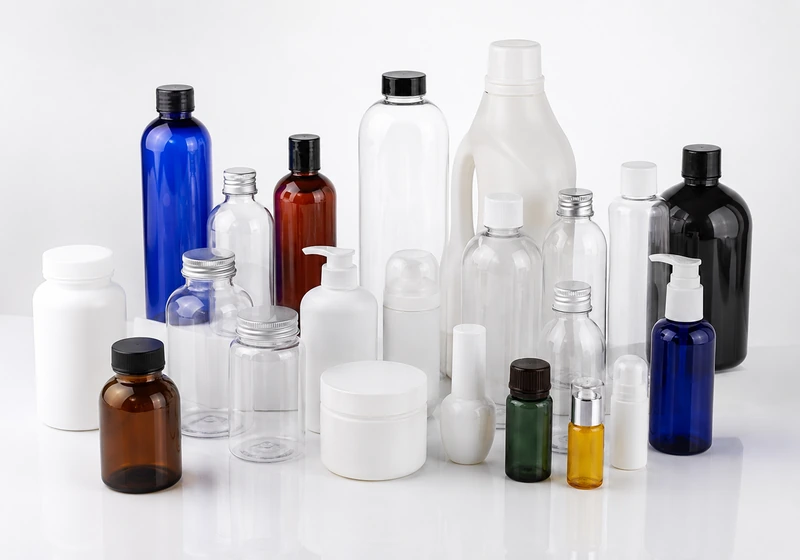
Finished PET and PP containers from one-step ISBM — produced directly from resin pellets in a single machine without the intermediate preform storage step required by two-step processes.
One-Step ISBM Machines: The Right Equipment for Finished Bottles
If your goal is to produce finished PET or PP bottles, the relevant machine category is a one-step ISBM machine. These are specified in kN of injection clamping force, not in tonnes, and are significantly more compact than a 300-ton general IM machine. Ever-Power’s EP-HGY series covers the full range of one-step ISBM bottle production:
| Model | Clamp | Bottle Range | Drive |
|---|---|---|---|
| EP-HGY50-V3-EV | 50 kN | 30–500 ml | Full servo |
| EP-HGY150-V4 | 150 kN | 100 ml–2 L | Servo-hydraulic |
| EP-HGY200-V4 | 200 kN | 200 ml–3 L | Servo-hydraulic |
| EP-HGY250-V4 | 250 kN | 500 ml–5 L | Servo-hydraulic |
| EP-HGY650-V4 | 400 kN | 2–10 L | Servo-hydraulic |
Total Cost of Ownership: What to Compare
Whether evaluating a 300-ton general IM machine or a one-step ISBM machine, purchase price is only 30–50% of the total cost of ownership over a 10-year operating life. The most financially significant decisions are drive system (servo vs hydraulic) and maintenance programme quality. A servo-hydraulic machine at 30–45% lower energy consumption than a fixed-speed hydraulic equivalent saves USD 15,000–50,000 in electricity over 10 years at commercial production volumes — a saving that typically exceeds the drive system price premium within 3–5 years of operation. All EP-HGY series machines use servo-hydraulic or full-servo drive as standard.
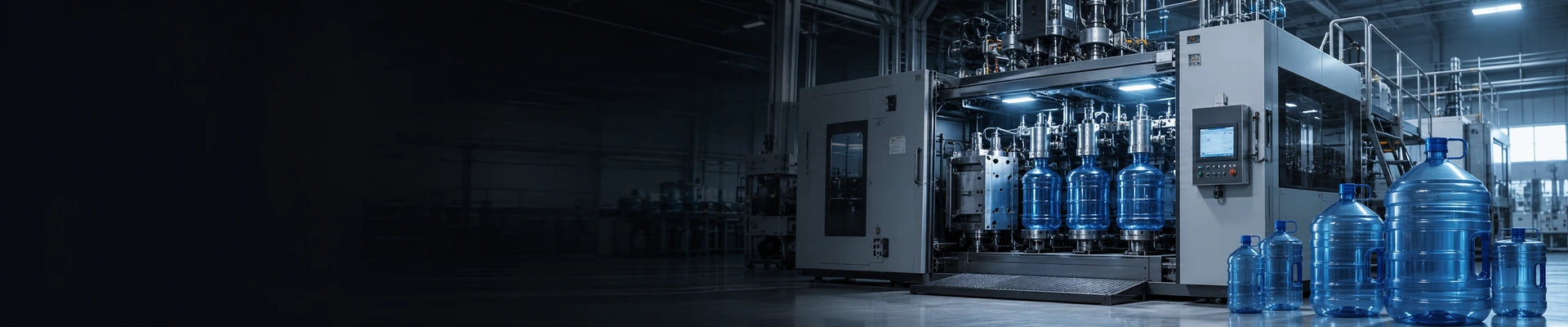
EP-HGY650-V4 — 400 kN injection clamp ISBM machine for large-format containers from 2 to 10 litres in PET and PP.
Choosing the Right Machine for Your Application
Before requesting a quotation for any injection moulding or blow moulding machine, the most important question to answer is: what does the machine need to produce? If the output is solid plastic parts — caps, closures, automotive components, technical parts — a standard injection moulding machine in the appropriate tonnage class is correct. If the output is finished hollow bottles or containers in PET, PP, or PETG — water bottles, pharmaceutical vials, cosmetic flacons, edible oil containers — a one-step ISBM machine is the correct choice, and standard injection moulding machines are not a substitute regardless of tonnage.
Need help identifying the right machine for your container production?
Ever-Power’s applications team can confirm whether a one-step ISBM machine is the right choice for your container specification, and recommend the specific EP-HGY model that matches your bottle volume, resin, and output target.
Browse the full EP-HGY and EP-BPET one-step ISBM machine range, or contact us to discuss the right machine for your specific bottle and production requirements.
Frequently Asked Questions
Can a 300-ton injection moulding machine make PET preforms?
Yes. A 300-ton injection moulding machine can produce PET preforms for a two-step blow moulding process. However, it requires a separate reheat blow moulding machine to convert those preforms into finished bottles. If you want to produce finished bottles from resin pellets in a single machine without storing or handling preforms, a one-step ISBM machine is the correct choice — it is not a 300-ton standard injection moulding machine.
What is the difference between a 300-ton and a 200-ton injection moulding machine?
The 300-ton machine has higher clamping force (3,000 kN vs approximately 2,000 kN), which allows it to hold larger moulds with more cavities or larger part areas against higher injection pressures. It has a larger platen size, a higher injection unit capacity, and a higher purchase price. For ISBM bottle production, neither machine size is the correct specification — ISBM machines are compact rotary table machines specified in kN of injection clamp, not in large tonnage classes.
Is a 300-ton machine suitable for pharmaceutical packaging?
A 300-ton general injection moulding machine can produce solid pharmaceutical packaging components — caps, closures, dispensing systems — but cannot produce finished pharmaceutical bottles. For finished PET or PP pharmaceutical bottles (oral solid dose, liquid oral, ophthalmic), a one-step ISBM machine such as the EP-HGY50-V3-EV or EP-HGY150-V4-EV is the correct equipment, providing the biaxial orientation, clarity, and dimensional accuracy required for pharmaceutical container specifications.
Understanding the Two-Step Route: Preform IM Plus Blow Moulding
If a 300-ton injection moulding machine is used to produce PET preforms, those preforms must subsequently be fed into a separate reheat stretch blow moulding (RSBM) machine to become finished bottles. The two-step route separates the process into two distinct machines, two operator roles, a preform storage and handling system, and a reheating energy cost at the blow machine. The advantage of two-step at very high volumes is that the blow machine can run multiple preforms per cycle at very short cycle times, achieving throughput rates that one-step machines cannot match. At commodity scale — hundreds of millions of bottles per year for a single format — the two-step route is economically superior.
For pharmaceutical, cosmetic, and mid-volume beverage producers, however, the two-step route introduces complexity and contamination risk that the one-step route eliminates. Preforms must be stored and handled between the injection machine and the blow machine — a process that exposes them to environmental contamination, handling damage, and moisture reabsorption (critical for PET, which is hygroscopic). One-step ISBM machines eliminate all of this: the preform is made and blown in the same thermal cycle, without ever leaving the machine or being stored, and the bottle exits directly to a clean conveyor system. For most pharmaceutical, cosmetic, and food applications, the simplicity and contamination control of one-step ISBM more than justifies its lower maximum throughput compared to two-step.
Comparing Machine Investment Scenarios
For a buyer deciding between a 300-ton preform injection machine plus a separate RSBM blow machine (two-step) and a one-step ISBM machine, the total investment comparison changes significantly when all capital items are included. A 300-ton preform injection machine at USD 60,000–120,000 (servo-hydraulic, Chinese manufacture) must be paired with a reheat blow moulding machine at USD 80,000–300,000 for the output scale it can feed, a preform handling and conveying system at USD 10,000–30,000, and mould tooling for both the preform injection mould and the blow mould. Total two-step investment for a mid-volume operation is typically USD 200,000–600,000 or more.
A one-step ISBM machine for the same container range — an EP-HGY250-V4 for 500 ml to 5 L containers, for example — at USD 100,000–200,000 plus a mould set at USD 20,000–60,000 and ancillaries at USD 20,000–50,000, gives a total one-step investment of USD 140,000–310,000 for equivalent capability. For most mid-volume pharmaceutical, cosmetic, food, and industrial container producers, the lower total investment of one-step ISBM — combined with the operational simplicity of a single machine — makes it the better choice.
Summary: Matching Machine Type to Your Production Need
The 300-ton injection moulding machine is a well-established, capable platform for solid plastic part production at mid-to-large scale. It is not, however, the correct machine for anyone whose primary objective is to produce finished PET or PP bottles in-house. Buyers who specify a 300-ton injection moulding machine for bottle production will find themselves needing either to add a separate reheat blow moulding machine (making the total investment significantly larger than a one-step ISBM machine) or to purchase their bottles from an external supplier — the situation they were trying to move away from.
One-step ISBM machines are compact, purpose-built, and priced specifically for bottle production across the full volume range from 30 ml pharmaceutical vials to 10-litre industrial containers. They eliminate the two-step complexity of separate preform injection and blow moulding, reduce contamination risk by keeping the preform within the machine from injection to ejection, and deliver finished bottles with the biaxial molecular orientation that gives PET containers their commercial value: glass-like clarity, light weight, and structural strength that no unoriented process can match. For any producer whose core output is hollow PET or PP containers, specifying a one-step ISBM machine rather than a large-tonnage general injection moulding machine is the correct equipment decision.