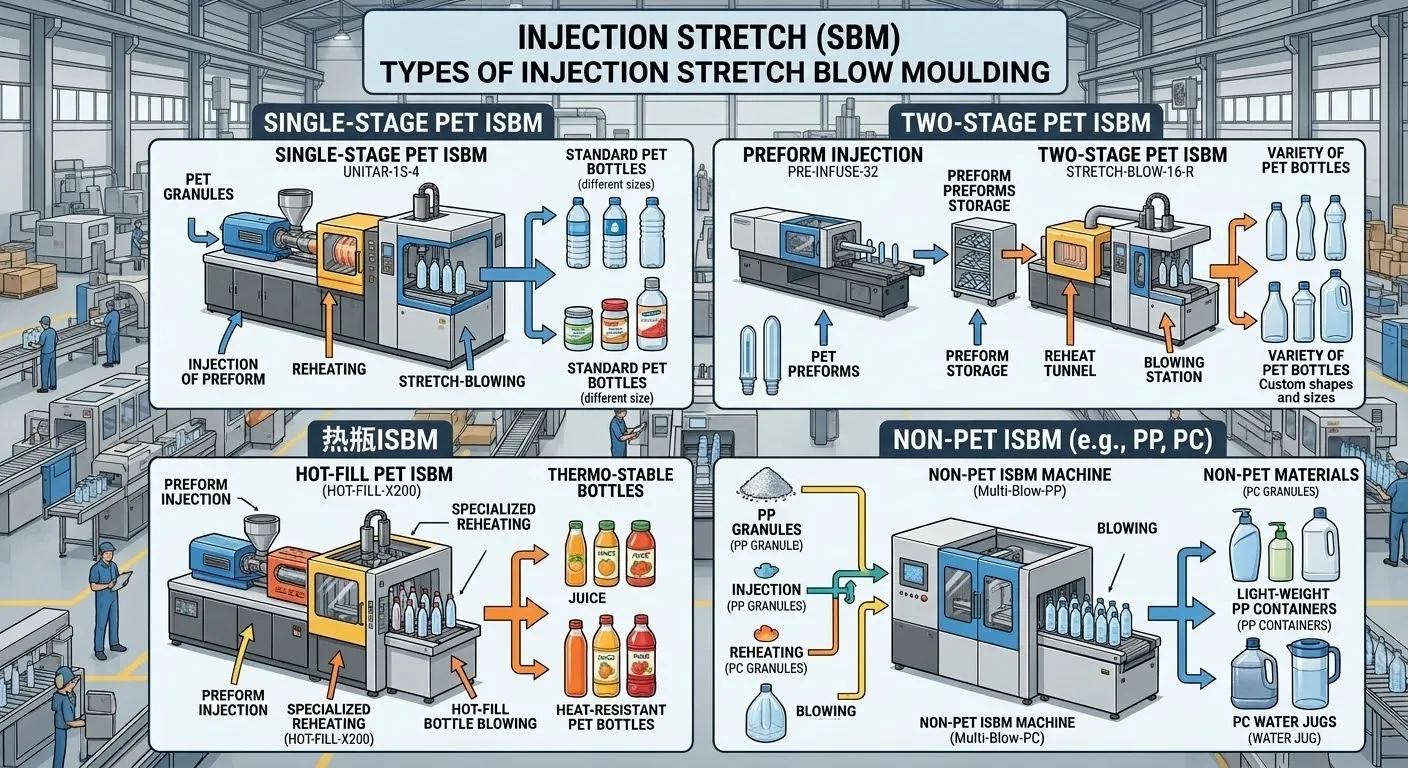
Injection stretch blow moulding — ISBM — is the manufacturing process that produces the bottles, jars, and containers you encounter every day in cosmetics, pharmaceuticals, food, and personal care. It is a one-step process: a plastic preform is injected, conditioned, stretched, and blown into a finished container in a single continuous cycle, without ever leaving the machine. The result is a container with dimensional precision, optical clarity, and structural integrity that two-step processes cannot consistently achieve at the same cost.
This guide covers the complete ISBM picture for people who need to make decisions: what the process is, how it differs from other blow moulding technologies, what materials it works with, what products it is best suited to produce, how to choose between 3-station and 4-station machine configurations, and what the key variables are that determine whether ISBM is the right process for a given packaging application.
By the end of this guide you will have a working understanding of the technology sufficient to evaluate machines, specify tooling, and have an informed conversation with equipment manufacturers — including about Ever-Power’s own machine range and how each model fits into the ISBM landscape.
What Is Injection Stretch Blow Moulding?
ISBM combines three operations — injection moulding, stretch orientation, and blow moulding — into a single integrated machine cycle
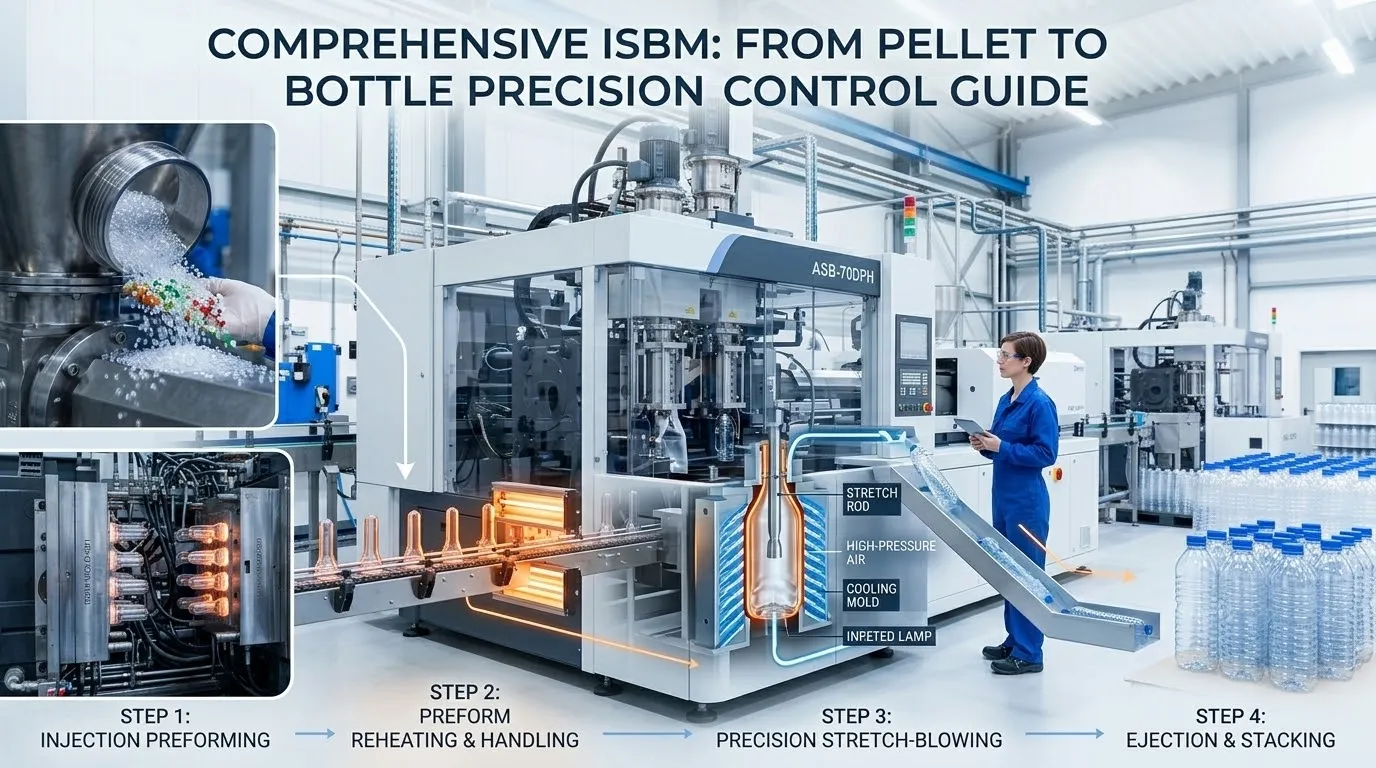
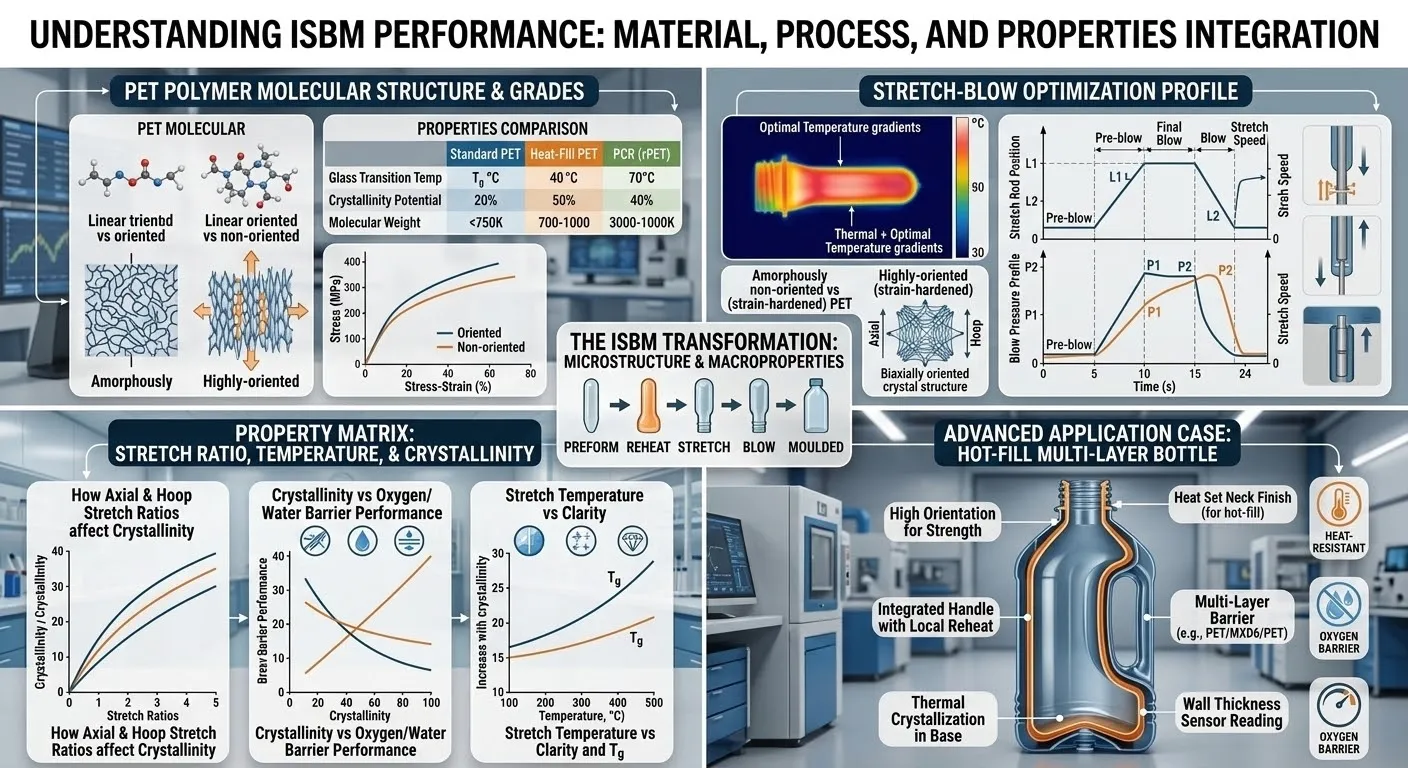
In injection stretch blow moulding, plastic resin pellets are fed into an injection unit, melted, and injected under high pressure into a preform mould. The resulting preform — a thick-walled, test-tube-shaped intermediate part — retains its injection heat as the machine turntable rotates it to the conditioning station (on 4-station machines) and then to the blow station. At the blow station, a stretch rod extends axially into the preform while high-pressure air simultaneously inflates it radially against the walls of the blow mould cavity. The container is then cooled, ejected, and the cycle repeats.
The simultaneous axial stretching (from the stretch rod) and hoop stretching (from the blowing pressure) produces biaxial molecular orientation in the container wall. This orientation is what gives ISBM containers their characteristic properties: high tensile strength, good gas barrier performance, excellent optical clarity, and impact resistance greater than the equivalent unoriented polymer. For PET, biaxial orientation is what makes the difference between a structurally adequate container and a premium one.
The “one-step” descriptor — used interchangeably with ISBM — distinguishes this process from two-step stretch blow moulding, where preforms are manufactured separately, stored, and then reheated for blowing in a second machine. In one-step ISBM the preform goes directly from injection to blowing in a single machine, eliminating the reheating step and its associated energy cost, preform storage, and contamination risk.
vs two-step reheat stretch blow moulding, by eliminating secondary preform reheating
Neck thread dimensional tolerance — achieved by injection moulding the thread, not blowing it
ASR 2.0–2.5 axially and HSR 3.5–4.5 hoop — the range that maximises PET orientation
Range achievable on Ever-Power ISBM machines — from small serum vials to large food containers
How ISBM Works: The Four Stations
Modern ISBM machines rotate a turntable through three or four stations in each cycle — each station performing a distinct operation simultaneously
Station 1 — Injection
Molten plastic is injected under pressure into the preform mould cavity. The preform — including its neck thread and all thread detail — is formed here by injection moulding, which is why ISBM thread dimensions are more precise than extrusion blow moulded containers. The hot runner system delivers melt at controlled temperature to each cavity gate. Injection clamping force must be sufficient to hold the preform mould closed against injection pressure — 50 KN on the EP-HGY50-V3-EV, up to 300 KN on the EP-HGY200-V4.
Station 2 — Temperature Conditioning (4-Station Only)
In 4-station machines, the preform moves to a dedicated conditioning pot that can add or remove heat from specific zones of the preform body before blowing. This differential thermal conditioning is essential for complex container geometries — oval bottles, square bottles, heavy-based cosmetic jars — where uniform material distribution requires a non-uniform preform temperature profile. In 3-station machines, this station is absent; the preform moves directly from injection to blowing using residual heat.
Station 3 — Stretch and Blow
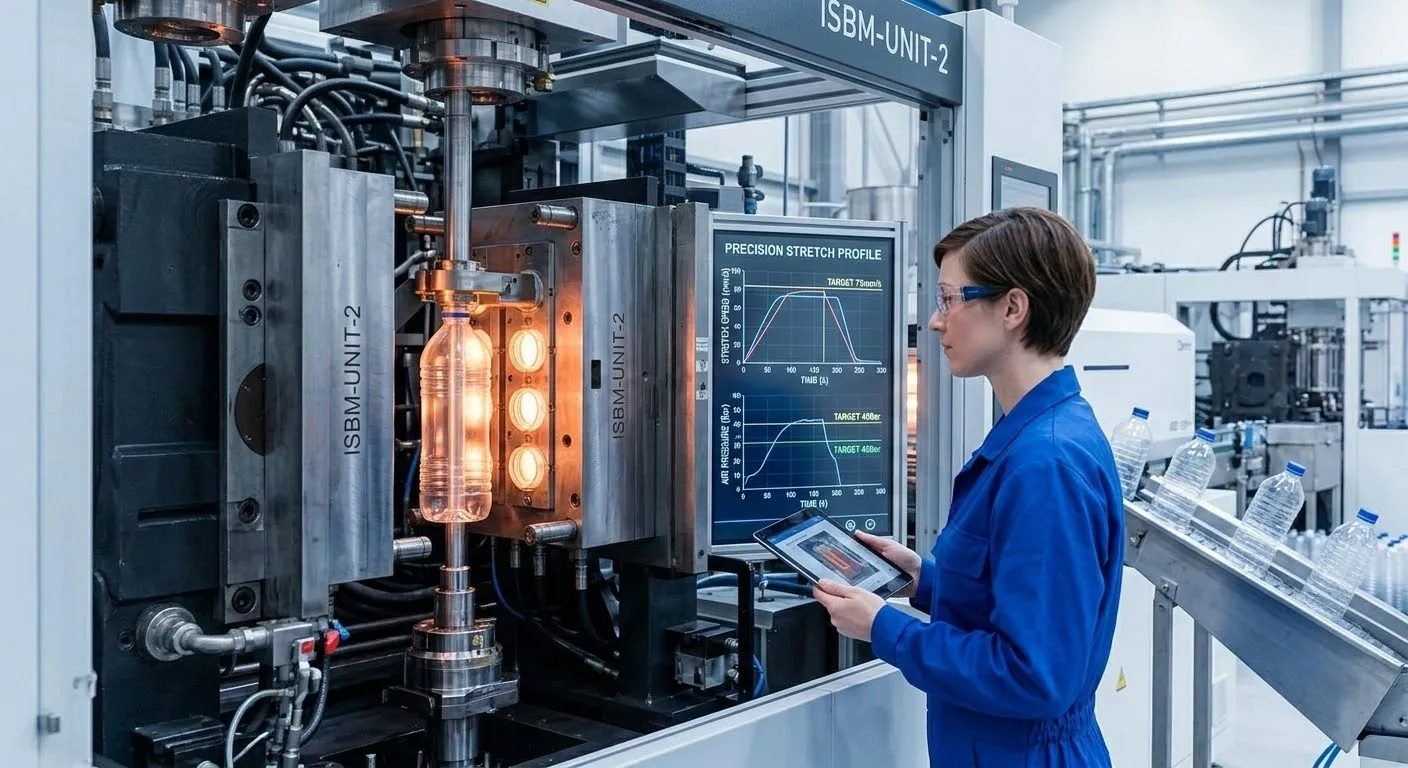
The blow mould closes around the conditioned preform. A stretch rod descends axially into the preform, extending it to the container’s target length while high-pressure air (2.0–3.5 MPa) simultaneously inflates it radially against the chilled blow mould cavity walls. Both stretching operations happen simultaneously — this biaxial orientation is what distinguishes ISBM from injection blow moulding, which uses only radial blowing without axial stretching. The container cools against the chilled mould, solidifying its shape.
Station 4 — Ejection / Take-Out
The finished container is ejected from the blow mould and removed from the machine by the take-out mechanism — either gravity-drop to a conveyor or robotic arm for cosmetic-grade handling. As the turntable completes its rotation, each station repeats its operation simultaneously: the injection station is already injecting the next preform while the blow station is blowing, and the take-out station is ejecting the previous container. This parallel operation is what gives ISBM its production efficiency.
ISBM vs Other Blow Moulding Processes
Understanding how ISBM compares to IBM, EBM, and REHEAT-SBM clarifies what it is best suited for and where other processes make more sense
What Materials Can ISBM Process?
ISBM is primarily a PET and PETG process, but modern machines can handle a broader range of engineering and specialty resins
The primary ISBM resin. PET responds ideally to biaxial orientation — the stretch ratio range of ASR 2.0–2.5 and HSR 3.5–4.5 produces a container with tensile strength, gas barrier, and clarity significantly superior to unoriented PET. Used for food, beverage, pharmaceutical, and personal care containers where barrier and clarity are required.
The premium cosmetic resin. PETG processes at lower temperatures than PET, has higher natural clarity, and is more amenable to complex shapes and heavy-wall applications. Its wider stretch ratio tolerance allows more latitude in preform and container design. PETG containers can be polished to Ra 0.02 mirror finish — indistinguishable from glass. The resin of choice for luxury skincare and fragrance packaging.
BPA-free resins for baby products, reusable beverage containers, and medical applications requiring FDA compliance. Tritan requires precise temperature control — its narrow processing window means the injection barrel and blow station temperature management must be accurate. Available on 4-station machines with their temperature conditioning capability. PC is used for medical device packaging requiring sterilisation resistance.
Used primarily for pharmaceutical packaging — syrup bottles, closure systems — where chemical resistance to oils and solvents is required and PET’s barrier advantage is less important. PP has a narrower stretch ratio range than PET and requires careful preform design and temperature control. Available with appropriate screw configuration on Ever-Power 4-station machines.
What Products Does ISBM Make?
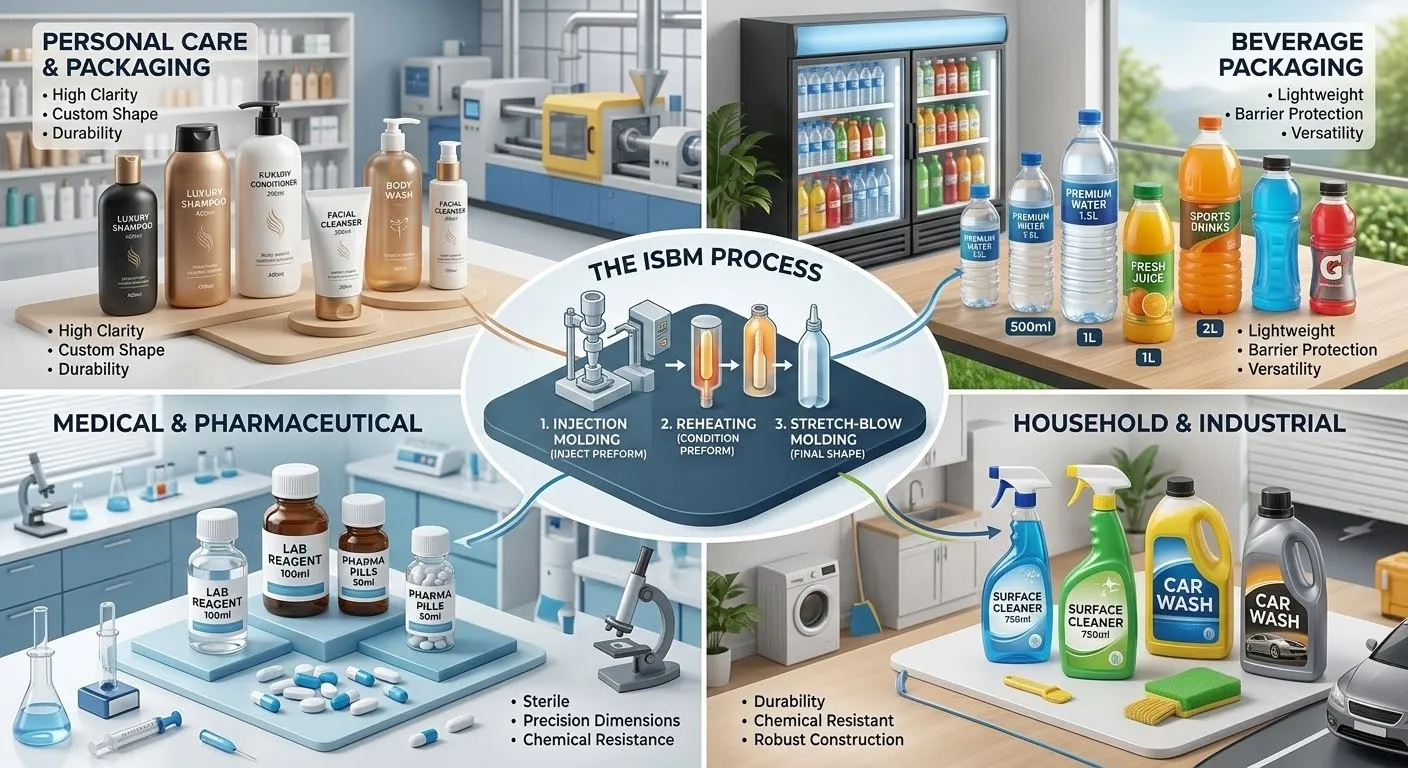
ISBM is used wherever clarity, precise thread geometry, biaxial orientation, or complex container shapes are required at production quantities
PETG and Tritan skincare jars, serum bottles, fragrance flacons, lotion bottles. The primary application driving demand for 4-station ISBM. Glass-like clarity and heavy-wall capability make ISBM the only plastic process that genuinely competes with glass for prestige cosmetic packaging.
PET oral liquid bottles, syrup containers, eye drop vials, tablet packaging. The one-step closed-loop process prevents atmospheric contamination between injection and blowing — critical for GMP compliance. Full-servo machines (V4-EV series) with no hydraulic oil are required for cleanroom pharmaceutical production.
PET wide-mouth jars for peanut butter, honey, spices, and condiments. The biaxial orientation of ISBM PET provides the gas barrier and mechanical strength these applications require. Large injection volume machines — EP-HGY200-V4 with 480 cm³ capacity — handle the heavy preforms needed for these wide-mouth containers.
Shampoo, body wash, sunscreen, hair care bottles in PET and PETG. Complex oval and flat bottle geometries are achievable with 4-station machines and proper preform design. The 4-station temperature conditioning station applies differential preform heating that ensures even material distribution into asymmetrical corners.
Tritan and PP nursing bottles, sippy cups, and infant feeding accessories. BPA-free material requirements and the need for precise temperature control across the injection and conditioning cycle make 4-station full-servo ISBM the appropriate production platform for premium infant products.
Essential oil bottles, detergent containers, sanitisers, and household chemical packaging where PET’s chemical resistance and barrier properties are valuable. The precision neck thread from ISBM is particularly important for leak-proof closures on aggressive chemical products.
3-Station vs 4-Station: Which Do You Need?
The single most important machine configuration decision — and the one that most determines what containers you can produce
The 3-station machine uses residual injection heat directly for blowing — no separate conditioning station. This makes it more compact, more energy-efficient, and simpler to operate. The EP-HGY50-V3-EV is the 3-station machine in Ever-Power’s range.
The 3-station is the right choice when: containers are round in cross-section, wall thickness targets are achievable with the preform residual heat temperature profile, and production volumes favour the smaller machine footprint and lower capital cost.
The 4-station adds a dedicated temperature conditioning station between injection and blowing. This station can apply differential heating — warming the sides of the preform more than the front and back, for example — to achieve uniform material distribution in non-round and complex-shaped containers.
The 4-station is required when: containers are oval, square, or flat in cross-section; container walls are heavy (cosmetic jar territory); the container base requires significantly more material than the shoulder; or material type (Tritan, PC) benefits from additional conditioning time.
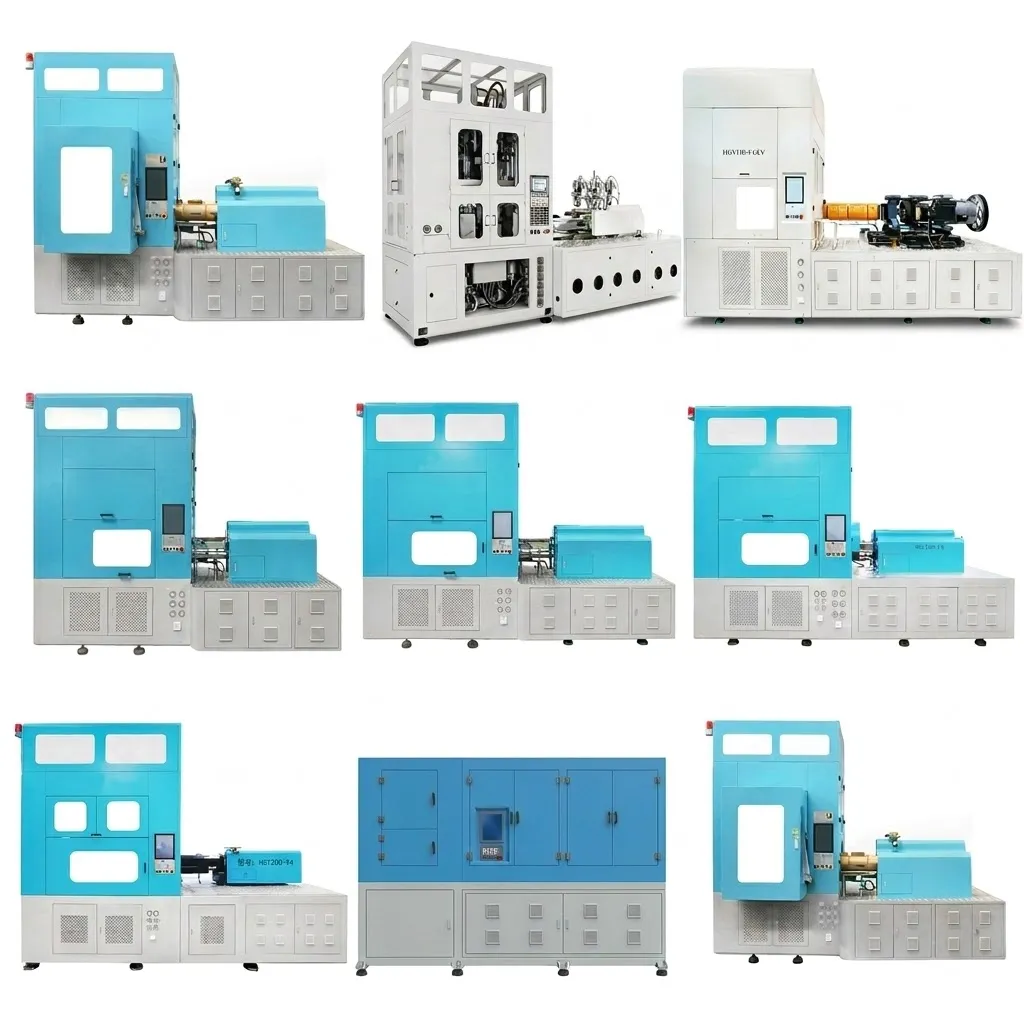
Which Ever-Power ISBM Machine Is Right for Your Application?
Ever-Power’s machine range covers every ISBM application from entry-level cosmetic production to high-tonnage pharmaceutical and food packaging
EP-HGY50-V3-EV
Compact 3-station full-servo machine. Single or 2-cavity. PET/PETG cosmetic and personal care round bottles up to 2500 ml. Lowest footprint and capital cost in the range. Energy saving up to 40% vs hydraulic. Compatible with ASB-12M-equivalent tooling.
EP-HGY150-V4
The most versatile machine in the range. 150 KN injection, 200 KN blow. Full cosmetic range including PETG jars, oval bottles, Tritan. ASB-12M mold compatible. PET, PETG, PC, Tritan, PP. 188–480 cm³ injection volume.
EP-HGY150-V4-EV
Oil-free full servo platform. 10-axis servo architecture, 102.8 KW. Class 100,000 cleanroom compliant. For pharmaceutical and premium cosmetic production where hydraulic oil contamination is unacceptable. Same mold compatibility as V4.
EP-HGY200-V4 / V4-B
300 KN injection force for large-format containers. Tri-servo pump system. 13-ton chassis. Aoki 250 series mold compatible (V4-B accepts existing Aoki mold bases directly). Up to 480 cm³ injection volume, 2500 ml containers.
Ready to Evaluate ISBM for Your Application?
Tell us your container target, resin, annual volume, and current production process. Our engineering team will evaluate whether ISBM is the right technology, which machine configuration applies, and what tooling your containers will require — within 48 hours.
Frequently Asked Questions About ISBM
Technical information in this guide reflects Ever-Power’s engineering experience and standard industry practice. Specific production outcomes depend on container design, resin grade, and machine configuration. Contact [email protected] or view our full machine range to discuss your specific application.