If you are operating a Nissei ASB-12M injection stretch blow moulding machine, you are running equipment that was — at the time of its introduction — the global benchmark for one-step ISBM precision. The ASB-12M built a reputation for producing high-quality 4-station containers in cosmetic, pharmaceutical, and food packaging applications, and much of that reputation was justified.
The practical reality in 2026 is that most ASB-12M machines in active service are 15 to 25 years old. Spare parts are increasingly difficult to source. Energy consumption is dramatically higher than modern servo machines. Technical support from the original manufacturer has become limited. Production managers are facing the decision to either continue maintaining aging equipment at increasing cost and risk, or to replace it.
The replacement decision is complicated by one major factor: the tooling. ASB-12M molds represent a significant capital investment — often hundreds of thousands of dollars across a full mold portfolio — and the conventional assumption is that replacing the machine means replacing the molds. This guide explains why that assumption is incorrect, and how a direct mold-transfer replacement is not only possible but increasingly the preferred route for manufacturers who have qualified their ASB-12M tooling to their product specifications.
Why ASB-12M Operators Are Evaluating Replacements in 2026
Four factors are driving the replacement decision across multiple markets simultaneously
Spare Parts Scarcity
ASB-12M machines manufactured in the late 1990s and early 2000s are now outside the standard parts support window. Proprietary servo drives, PLC modules, and hydraulic valve assemblies are becoming critically difficult to source, with lead times extending to 6 to 12 months for certain components. A single unexpected breakdown can halt production for months.
Hydraulic Energy Penalty
Original ASB-12M machines use hydraulic drive systems that consume energy continuously regardless of machine activity. In markets where electricity costs have risen sharply — Germany, Australia, the UK, and large parts of Southeast Asia — the energy cost differential between a running ASB-12M and a modern full servo machine can exceed USD 30,000 per machine per year in a 24/7 production environment.
Control System Limitations
Original ASB-12M PLC systems lack modern data logging, remote diagnostics, and Industry 4.0 connectivity. Quality systems increasingly require production parameter traceability for pharmaceutical and food packaging. The control architecture of aging ASB-12M machines cannot support these requirements without costly and technically complex retrofitting that often costs more than the residual machine value.
New Japanese Machine Pricing
The current list price for a new Nissei ASB machine in the same clamping force class as the ASB-12M ranges from USD 400,000 to over USD 700,000 depending on configuration. For manufacturers operating multiple aging ASB-12M units, a full fleet refresh at Japanese OEM pricing represents a capital expenditure that is difficult to justify against the production economics of what the machines are actually producing.
What Makes a Machine ASB-12M Mold Compatible?
Mold compatibility is defined by four specific engineering parameters — all of which must match to enable a direct mold transfer without modification
The ASB-12M uses a 4-station rotary turntable design. The injection mold and blow mold are mounted to the machine’s clamping platens via specific bolt patterns, and the preform is transferred between stations on a neck ring carrier system. For a different machine to accept ASB-12M tooling without modification, it must replicate four critical dimensional parameters.
It is important to understand that “ASB-12M compatible” does not mean cosmetically similar — it means mechanically and dimensionally identical in the parameters that physically govern whether the mold seats correctly, the platens close without interference, and the neck ring system transfers preforms accurately. Any deviation in these parameters requires tooling modification, which generates cost and qualification time that defeats the purpose of a mold-transfer replacement strategy.
Tie-Bar Spacing
The distance between the tie bars in both horizontal and vertical axes determines the maximum mold footprint that can be physically installed. A replacement machine must match the ASB-12M tie-bar spacing to accept the same mold bases without requiring the molds to be remachined or adapted.
Mold Mounting Plate Pattern
The bolt pattern on the stationary and moving platens must match the ASB-12M mold base bolt pattern to allow direct mounting. A mismatch here requires drilling new holes in either the mold base or the machine platen — an expensive and time-consuming modification that also affects mold structural integrity.
Mold Open Stroke
The distance the moving platen travels during mold opening must be sufficient to clear the tallest finished container produced by the mold. If the replacement machine’s stroke is shorter than the ASB-12M’s, taller containers cannot be ejected without hitting the mold face — a fundamental constraint that cannot be overcome without a different mold design.
Injection Nozzle Interface
The injection nozzle taper angle, nozzle orifice diameter, and hot runner sprue bushing dimensions must match the ASB-12M hot runner specification. A mismatch at the nozzle contact point causes material leakage, cold slug formation, and inconsistent preform weight — all of which result in defective containers.
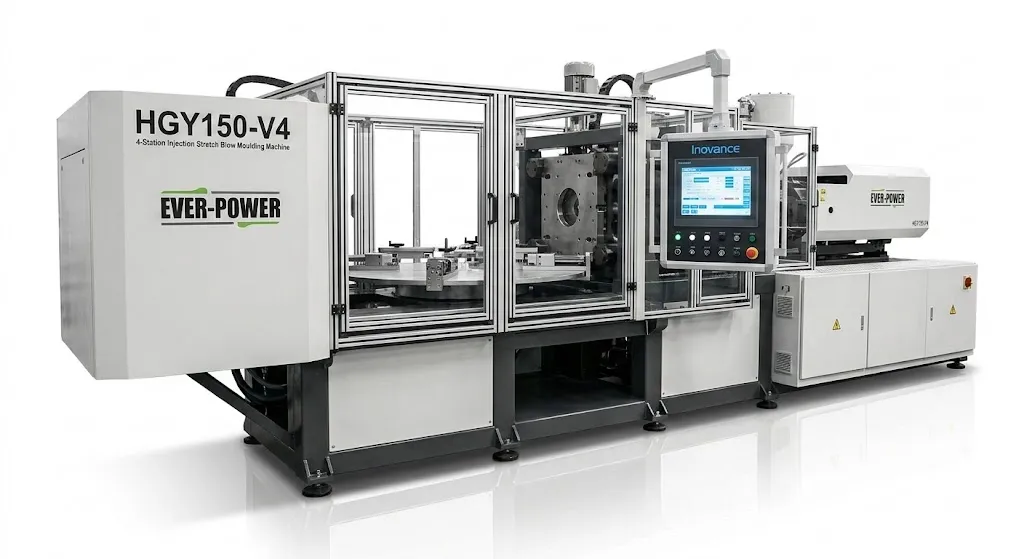
Ever-Power EP-HGY150-V4: Technical Specification vs ASB-12M
The EP-HGY150-V4 is engineered as a direct replacement platform for ASB-12M machines, with dimensional parameters matched to accept existing mold bases without modification
While the EP-HGY150-V4 is engineered to match ASB-12M mold dimensions, Ever-Power requires buyers to submit their existing mold blueprints prior to order confirmation so our engineering team can conduct a formal dimensional verification. This free pre-purchase assessment ensures complete compatibility and identifies any mold-specific adaptations needed before the machine ships, preventing costly surprises during installation.
The ASB-12M Replacement Process: From Inquiry to First Production
A structured replacement programme that protects your existing tooling investment and minimises production downtime
Submit Mold Blueprints for Compatibility Assessment
Send your ASB-12M mold engineering drawings to Ever-Power’s technical team. Our engineers will cross-reference the tie-bar spacing, mold base dimensions, hot runner sprue bushing specification, and mounting plate bolt pattern against the EP-HGY150-V4 platen dimensions. This assessment is conducted at no charge and typically completed within 48 hours. You will receive a formal compatibility report identifying any dimensions that require adaptation and a clear statement of whether direct mold transfer is achievable.
Machine Order and Factory Acceptance Test
Once the compatibility assessment is complete and the machine order is placed, the EP-HGY150-V4 is built to your specific screw diameter and process configuration requirements. Before shipment, every machine undergoes a 72-hour continuous dry-run acceptance test covering all servo movements, heating zone calibration, cooling water circuit integrity, and PLC sequence operation. If a customer mold set can be shipped to the Ever-Power factory for a wet run acceptance test, this can also be arranged — confirming first-article container quality before the machine leaves China.
On-Site Installation and Mold Mounting
An Ever-Power commissioning engineer travels to your facility for installation. The existing ASB-12M molds are removed from the old machine and mounted directly onto the EP-HGY150-V4 platens. The commissioning engineer verifies platen alignment, injection nozzle contact, cooling water circuit connections, and hot runner zone mapping to the new PLC before initial heating. The typical commissioning window for a single machine replacement is 3 to 5 working days from installation to consistent production-quality first article containers.
Process Parameter Transfer and Optimisation
The existing ASB-12M process parameters — injection temperature profiles, cycle timing, blow pressure, conditioning temperatures, and stretch rod stroke — are translated into the EP-HGY150-V4 PLC format. Because the new machine has a more capable control system, some parameters can be refined during this process to improve output quality or cycle time. The commissioning engineer documents a full process parameter record for each mold set, which becomes part of the production quality record for the new machine.
First Article Qualification and Production Handover
First article containers produced on the new machine are measured against the existing container specifications — dimensional tolerances, wall thickness distribution, top-load strength, drop-impact performance, and optical clarity. For pharmaceutical and food packaging applications, the Ever-Power commissioning engineer provides a dimensional test report and process parameter summary to support any internal revalidation procedures the customer may need to complete. On handover, the customer’s operators are trained on the EP-HGY150-V4 PLC interface, mold change procedure, and routine maintenance schedule.
Full Tooling Replacement vs Direct Mold Transfer: The Cost Comparison
Understanding the real capital difference between the two replacement routes for a typical ASB-12M operator with an established mold portfolio
The cost figures above are indicative estimates based on industry data and are provided for comparative purposes only. Actual machine pricing depends on configuration, screw diameter, and market. Annual energy saving estimates are calculated from standard factory test comparisons between continuous-run hydraulic ISBM machines and Ever-Power servo machines under comparable production conditions. Contact [email protected] for accurate pricing specific to your requirements.
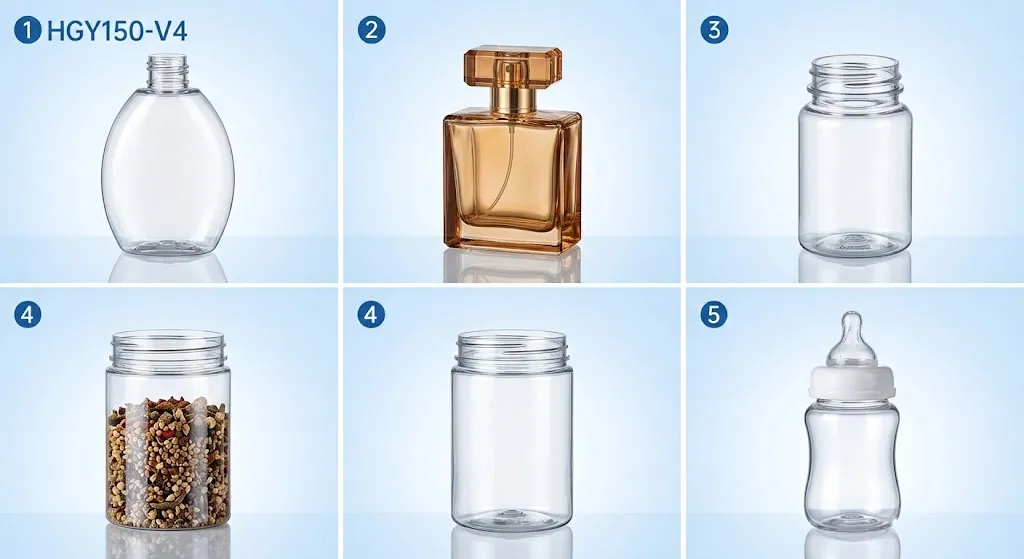
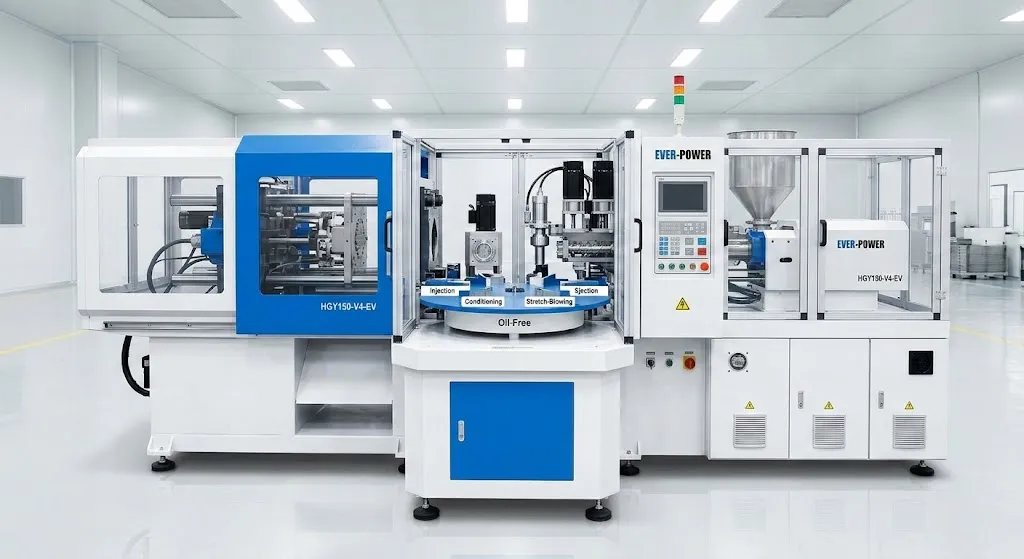
For Pharmaceutical and Infant Care Applications: The EP-HGY150-V4-EV
If your ASB-12M replacement is going into a cleanroom environment or pharmaceutical production, consider the full servo variant
Ready to Replace Your ASB-12M?
Send us your mold drawings and we will confirm compatibility, provide a full technical proposal, and give you factory-direct pricing — within 48 hours and at no charge. Our engineers have completed ASB-12M replacement projects for manufacturers in the USA, Germany, Thailand, South Africa, Russia, Brazil, and Australia.
Frequently Asked Questions
Technical specifications and cost estimates cited in this article are based on Ever-Power engineering data and publicly available industry information. Mold compatibility is always subject to formal verification of customer-specific mold blueprints prior to order. Contact [email protected] or visit our contact page for application-specific engineering advice.