For three decades, Nissei ASB and Aoki have been the reference standard for one-step injection stretch blow moulding. Their machines have earned their reputation: precision engineering, reliable output, and global installed base. But they also command a price premium that can be difficult to justify — particularly when replacement machines are needed for existing tooling, when energy costs have risen significantly, or when local technical support has become unreliable as the machines age.
Ever-Power has been building ISBM machines for over 20 years. This article is a direct technical and commercial comparison — not a marketing document. It identifies where Ever-Power machines match Japanese specification, where they exceed it, where they remain behind, and what the realistic total cost of ownership comparison looks like across a 10-year machine life. It is written for procurement engineers and production managers who need accurate information to make a defensible equipment decision.
Disclaimer: Nissei ASB and Aoki are registered trademarks of their respective companies. This article uses these names solely for comparative reference in the context of equipment evaluation. Ever-Power has no affiliation with either company.
Where the Machines Are Built the Same
Ever-Power sources the same tier-one components used in Japanese machines — this is a deliberate engineering and supply chain decision, not a coincidence
The most common misconception about Chinese-manufactured ISBM machines is that they use inferior components. For Ever-Power machines, this is factually wrong for the critical subsystems. The components that determine machine precision, reliability, and longevity are sourced internationally — the same suppliers that Japanese machine manufacturers use — because these components are simply the best available for their function.
The meaningful differences between Ever-Power and Japanese machines are in mechanical architecture decisions, software, and price — not in the quality of bearings, valves, or control hardware.
Parker high-pressure pneumatic valves are specified on all Ever-Power machines. Parker is the global standard for ISBM blow air management — the same brand specified in Japanese machines and European ISBM equipment. Blowing pressure management to 2.0–3.5 MPa with consistent valve response across millions of cycles.
NSK ball screws and linear guides provide the mechanical precision for mold stroke positioning. Japanese Industrial Standards (JIS) compliant. The same NSK components are used in Nissei ASB machines. Micro-millimeter positioning repeatability across the full stroke range, maintained across decades of production cycles.
Inovance (Delta-equivalent tier) servo motors are used across the range. For full-servo machines (V3-EV, V4-EV), 10 independent servo axes provide digital precision for every machine movement. Servo system response and positioning accuracy comparable to Japanese servo platforms, with local spare parts availability that ASB and Aoki cannot offer outside Japan.
YUKEN hydraulic control valves on servo-hydraulic models (V4 series). YUKEN is globally recognised for hydraulic precision in injection moulding and blow moulding equipment. ISO fluid power standard compliant. Consistent clamping force delivery across temperature and viscosity variations, with straightforward global spare parts availability.
Inovance and MIRLE PLCs provide the machine control architecture. Multilingual touchscreen interface (English, Chinese, with additional languages available). Remote diagnostic capability for Ever-Power engineering support. Recipe storage, parameter logging, and fault diagnostics. Functionally comparable to the Omron and Mitsubishi PLCs used in Japanese machines, with the significant advantage of local spare parts availability globally.
Airtac pneumatic cylinders for auxiliary machine functions. ISO 6431 standard compliant. Widely available globally — maintenance teams in most markets can source Airtac replacements locally without factory supply chain dependence. This local parts availability advantage is significant compared to proprietary pneumatic components on Japanese machines that require Japan-origin spares.
EP-HGY150-V4 vs Nissei ASB-12M: Specification Comparison
The ASB-12M is the world’s most widely installed 4-station ISBM machine. The EP-HGY150-V4 is designed as its functional replacement.
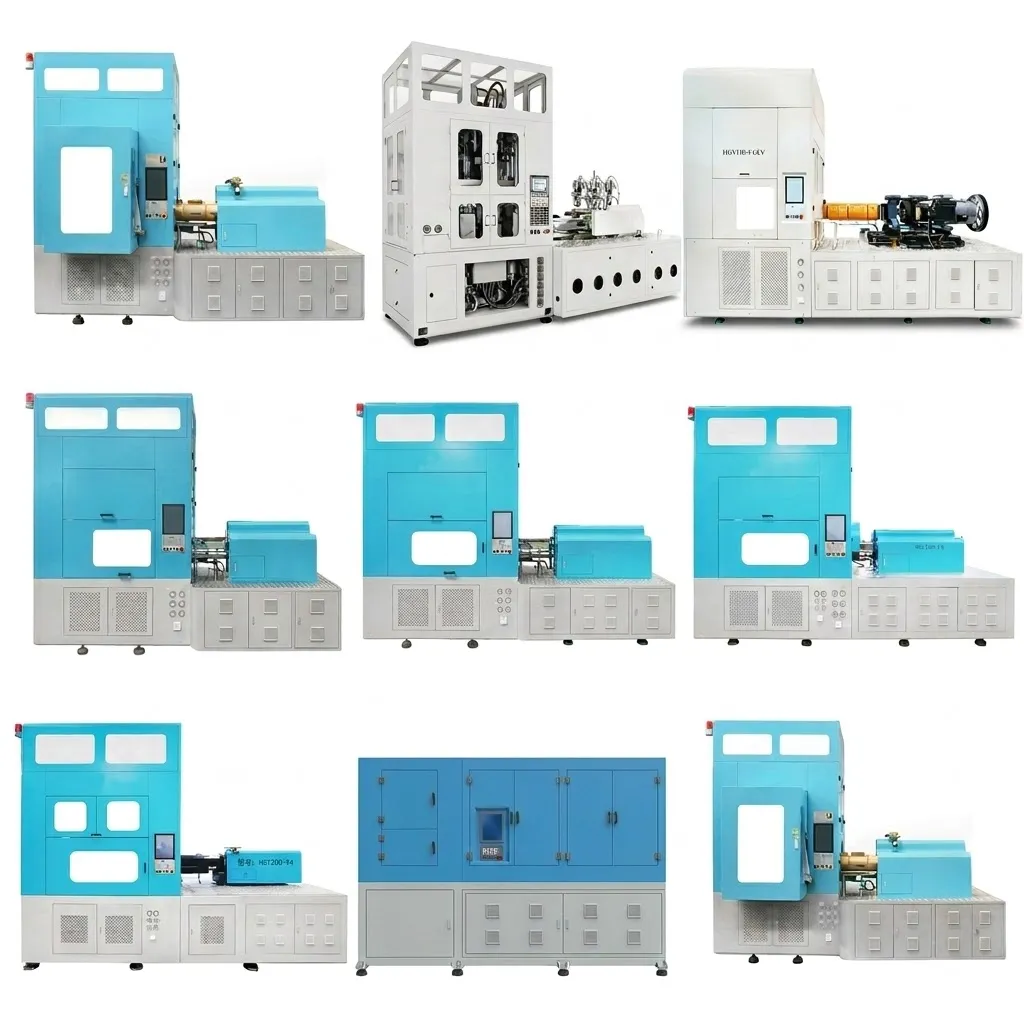
EP-HGY200-V4 vs Aoki 250 Series: Specification Comparison
The Aoki 250 series dominates heavy-tonnage ISBM for large cosmetic and food containers. The EP-HGY200-V4 is its functional replacement — and the EP-HGY200-V4-B accepts existing Aoki 250 mold bases directly.
Where Japanese Machines Still Have Advantages
A useful comparison requires honesty about where gaps remain — and who those gaps matter to
Installed Base Track Record
Nissei ASB and Aoki machines have decades of documented production history in the field. An ASB-12M installed in 1998 has a production record. An Ever-Power EP-HGY150-V4 installed in 2022 does not yet have a 25-year track record. For procurement processes that weight historical longevity data heavily, this gap is real. It is narrowing — Ever-Power has machines in production across multiple continents — but the Japanese brands’ installed base depth remains an advantage for risk-conservative procurement teams.
Software Depth and Process Libraries
Japanese machines — particularly ASB — carry decades of embedded process knowledge in their control software and application libraries. Container-specific process recipes, troubleshooting guidance, and parameter optimisation tools reflect accumulated engineering experience. Ever-Power’s control software is capable and improving, but it does not yet have the depth of documented process libraries that Japanese OEMs have developed over 30 years of applications engineering. For complex containers requiring fine process tuning from day one, this can translate to a longer commissioning time on an EP machine vs an ASB.
Global Certified Service Network
ASB and Aoki have certified service centres in major manufacturing regions — North America, Europe, Southeast Asia. Ever-Power provides remote technical support (24-hour response) and dispatches engineers for commissioning and major maintenance, but does not yet have the same density of locally certified service presence. For buyers in regions where on-site response time matters and remote support is not sufficient, this network gap is a real consideration. It is particularly relevant for high-volume pharmaceutical production where machine downtime has direct patient supply implications.
The practical implication of these gaps:
For cosmetic packaging producers, mid-size pharmaceutical manufacturers, and food processors evaluating a first or replacement ISBM machine — where the primary decision drivers are technical capability, mold compatibility, energy cost, and capital cost — these gaps rarely change the decision outcome. For the largest pharmaceutical manufacturers with stringent vendor qualification requirements and zero-tolerance for support response delays, the Japanese brands’ service network advantage may still be decisive. Know your procurement context before you weight these factors.
Total Cost of Ownership: The 10-Year Picture
The capital price gap between EP and Japanese machines is large. Over 10 years, the TCO gap is even larger when energy and maintenance are included.
The starting point of the cost comparison is capital — and the gap is significant. A new Nissei ASB-12M or Aoki 250 series machine, imported and commissioned outside Japan, typically carries a total landed cost that is 2.5 to 4 times the equivalent Ever-Power machine specification for comparable clamping force and injection volume. This gap reflects Japanese manufacturing cost structures, import logistics, dealer margins, and brand premium, not fundamental technology cost.
Over a 10-year production life, three additional cost categories widen the gap further. Energy costs: at $0.15/kWh and 6,000 production hours per year, the ~30–40% energy saving of an EP servo machine vs a hydraulic Japanese machine represents $15,000–40,000 in annual electricity savings depending on machine size and utilisation — $150,000–400,000 over 10 years. Spare parts: internationally sourced components (Parker, NSK, Inovance, Airtac) are available from multiple suppliers globally; proprietary Japanese OEM parts are single-sourced and command OEM pricing. Support: Ever-Power remote support is included; Japanese OEM on-site service rates outside Japan are substantial.
The offsetting TCO item is resale value: Japanese machines typically hold higher residual values than Chinese machines at the same age, particularly in markets where the ASB and Aoki brands are well known. For buyers who rotate equipment on 7–10 year cycles and value residual recovery, this should be included in the TCO model. It rarely changes the direction of the comparison, but it narrows the gap.
Japanese machine capital premium over equivalent EP specification (estimated; varies by model and market)
EP servo vs hydraulic Japanese machine at $0.15/kWh, 6,000 hr/year. Larger machines at higher utilisation approach the upper end.
Existing ASB-12M molds reuse on EP-HGY150-V4. Existing Aoki 250 mold bases reuse on EP-HGY200-V4-B. No new tooling investment required.
Mold Compatibility: How It Works in Practice
Mold compatibility is the single most commercially important advantage EP offers to existing ASB and Aoki users
The EP-HGY150-V4 is designed with tie-bar spacing, mold mounting plate dimensions, and stroke parameters matched to ASB-12M specifications. Existing ASB-12M injection moulds, blow moulds, and neck ring inserts can be mounted and run on the EP machine without structural modification. The preform geometry, hot runner connection, and blow station interface are compatible.
Verification process: prior to order confirmation, Ever-Power’s engineering team reviews the customer’s existing mold drawings to confirm dimensional compatibility at the specific interface points. This is a standard pre-sale step — compatibility is verified, not assumed. Where minor adaptation is required (shim plates, connection fittings), Ever-Power supplies the adaptation hardware as part of the machine delivery package.
The EP-HGY200-V4-B is a specific variant of the V4 series developed explicitly for Aoki 250 series mold compatibility. The machine’s mold base mounting system, injection nozzle alignment, and blow station dimensions are configured to accept Aoki 250 mold bases directly — no adaptor plates, no modification of the existing Aoki tooling. The mold base drops into the machine and runs.
For new tooling projects on the V4-B platform, Ever-Power’s in-house mould design team designs new injection and blow moulds to the Aoki 250 mold base standard — so all new tooling is also compatible with any Aoki 250 machine the customer continues to operate, providing maximum flexibility as the fleet transitions over time.
Important: what mold compatibility does not cover
Mold base dimensional compatibility does not automatically guarantee identical process parameters. The injection unit characteristics, hot runner temperature profiles, and blow station dynamics of the EP machine are similar to but not identical to the Japanese original. Operators should expect to re-tune process parameters when transferring moulds — preform weight, melt temperature, blowing pressure, and stretch rod timing may all require adjustment. Ever-Power’s commissioning engineer works through this parameter set-up during installation. The key point: the mold is reused and the container geometry is preserved; the machine parameters are tuned to the new machine’s characteristics, typically taking 1–3 days for an experienced commissioning team.
Ready to Verify Compatibility with Your Existing Tooling?
Send us your existing mold drawings — ASB-12M, Aoki 250, or any other ISBM platform. Our engineering team will confirm compatibility, identify any required adaptations, and provide a complete machine proposal including pricing, lead time, and commissioning plan within 48 hours.
Frequently Asked Questions
Specifications and cost comparisons in this article are provided for general guidance. Actual performance, compatibility, and costs depend on specific machine models, container designs, and production conditions. Mold compatibility must be verified against specific tooling drawings before order confirmation. Contact [email protected] to begin a compatibility review or view our full machine range.