Wat zijn de nadelen van blaasvormen?
Elk productieproces kent zijn beperkingen, en blaasvormen is daarop geen uitzondering. Inzicht in de daadwerkelijke nadelen van blaasvormen – en welke specifiek gelden voor ISBM in vergelijking met EBM of IBM – stelt kopers in staat om beter onderbouwde beslissingen te nemen over de aanschaf van apparatuur en realistische verwachtingen te scheppen over wat het proces wel en niet kan bereiken in de productie.
Beperking 1: Uitsluitend van toepassing op holle onderdelen
Met blaasvormen kunnen alleen holle verpakkingen worden geproduceerd. Het proces berust op luchtdruk die een kunststof voorvorm tegen een matrijswand uitzet – een mechanisme dat een afgesloten binnenruimte vereist om onder druk te zetten. Massieve kunststof onderdelen kunnen niet met blaasvormen worden geproduceerd; daarvoor is spuitgieten nodig.
Beperking 2: Bovengrens voor de grootte in ISBM
ISBM-machines met één stap zijn beperkt tot containers van maximaal circa 10 liter vanwege de injectieklemkracht die beschikbaar is in een compacte draaitafelconfiguratie. Voor containers groter dan 10 liter is extrusieblaasvormen het standaard alternatief.
Beperking 3: Complexe, niet-ronde vormen zijn moeilijk te realiseren.
De biaxiale blaasstap in ISBM bevoordeelt inherent rotatiesymmetrische vormen. Flessen met een cirkelvormige doorsnede worden gelijkmatig opgeblazen omdat de luchtdruk de voorvorm in alle richtingen gelijkmatig uitzet. Sterk niet-ronde doorsneden – vierkante of zeshoekige vormen – zijn moeilijk te realiseren met een acceptabele wanddikteverdeling, en sommige geometrieën zijn helemaal niet geschikt voor ISBM-machines.
Beperking 4: Hoge investering in mallen
ISBM-matrijzensets – voorvormmatrijs, blaasmatrijs en strekstang – vertegenwoordigen een aanzienlijke kapitaalinvestering. Een complete matrijzenset voor een standaard PET-fles met twee holtes kost doorgaans USD 20.000–40.000. Matrijzen met meerdere holtes voor complexe vormen kunnen USD 80.000 of meer kosten. Deze investering in matrijzen is nodig voor elk nieuw verpakkingsformaat en moet worden afgeschreven over het productievolume.
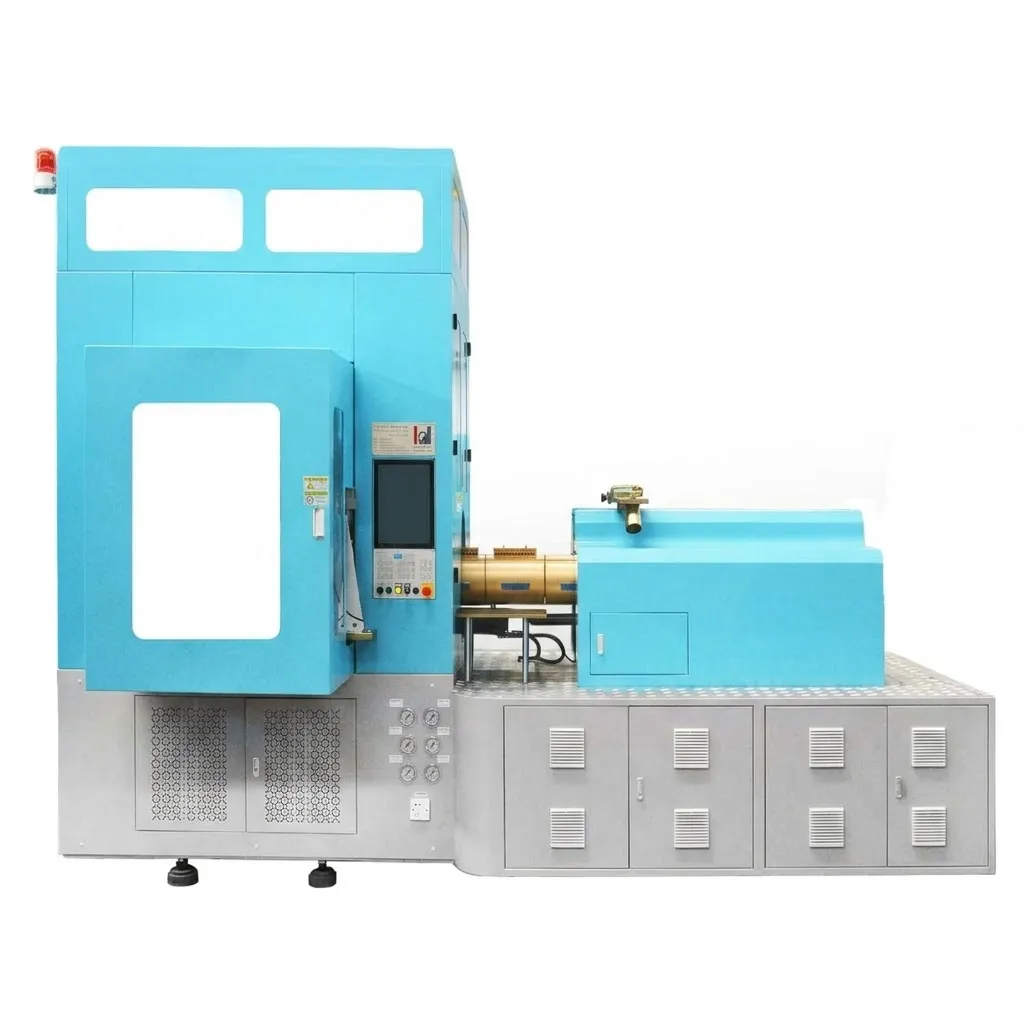
De ISBM-matrijzeninvestering omvat drie onderdelen: de voorvormmatrijs, de blaasmatrijs en de strekstaaf. Het is de belangrijkste toetredingsdrempel voor kleine producenten.
Beperking 5: Controle van de wanddikte vereist expertise.
Het bereiken van een consistente wanddikteverdeling – met name voor complexe vormen – vereist ervaren procesingenieurs en goed ontworpen gereedschappen. De wanddikte in een geblazen verpakking wordt bepaald door de interactie tussen de geometrie van de voorvorm, het temperatuurprofiel tijdens de conditionering, de snelheid van de strekstang, de blaasdruk en de blaastijd. Het optimaliseren van al deze factoren voor een nieuw flesformaat vergt systematische ontwikkeltijd en leidt tot wat opstartafval.
Beperking 6: Lagere output dan bij tweetrapsschakeling bij zeer hoge volumes.
Bij zeer hoge productievolumes – meer dan 20.000 tot 40.000 flessen per uur voor één formaat – behalen tweetraps reheat stretch blow moulding (RSBM) machines een hogere doorvoer dan eentraps ISBM machines, omdat ze de injectiecyclustijd loskoppelen van de blaascyclustijd. Voor standaardvolumes bij grote water- of frisdrankmerken is tweetraps RSBM doorgaans de efficiëntere keuze.
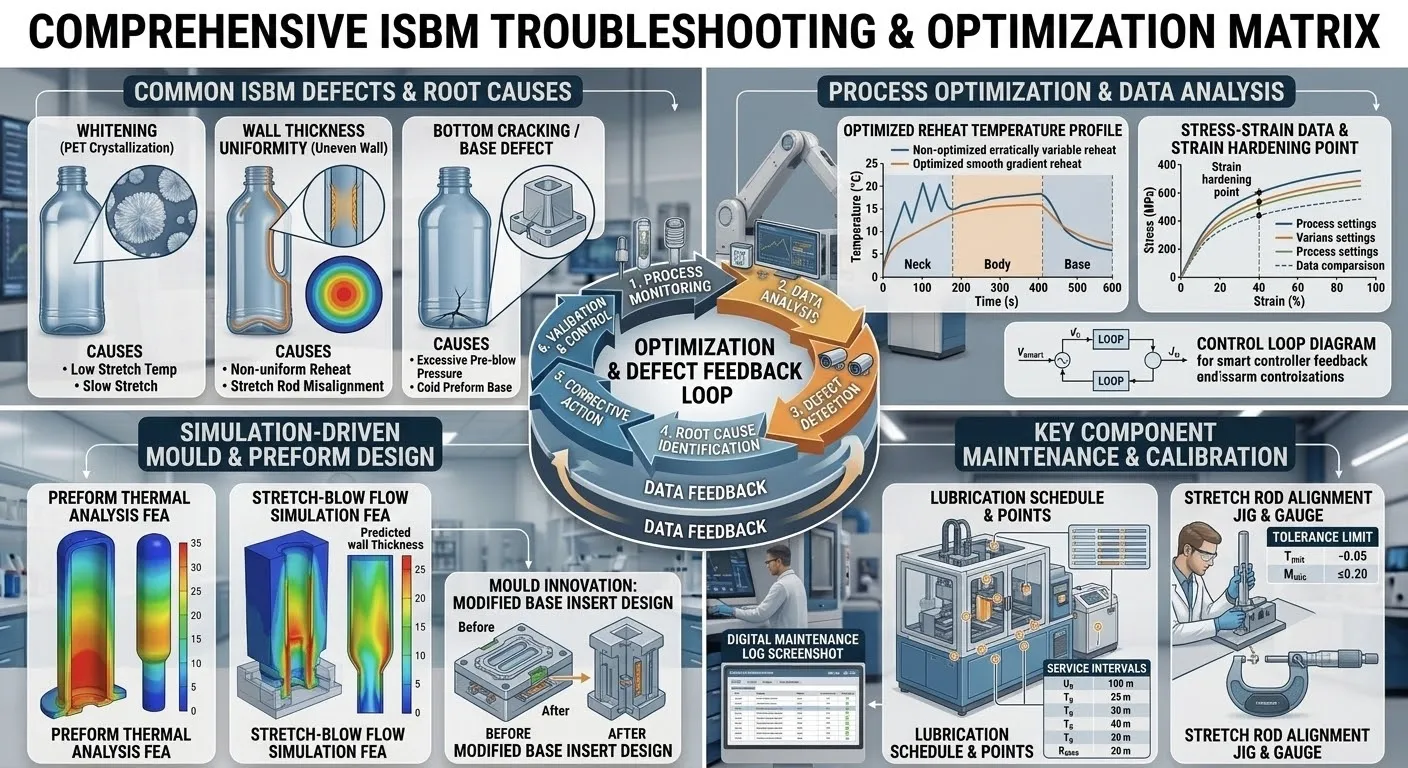
Systematische procesoptimalisatie pakt veel operationele beperkingen van ISBM aan: de consistentie van de wanddikte, het afvalpercentage en de cyclustijd kunnen allemaal worden verbeterd door gestructureerde parameterontwikkeling.
De nadelen in context plaatsen
Deze beperkingen zijn reëel, maar ze moeten worden afgewogen tegen wat ISBM in één stap uniek bereikt: een afgewerkte, biaxiaal georiënteerde, glasheldere, lichtgewicht PET-verpakking geproduceerd uit harskorrels in één geïntegreerde machinecyclus. Voor farmaceutische, cosmetische, voedingsmiddelen- en drankenproductie in middelgrote volumes wegen de voordelen van ISBM ruimschoots op tegen de beperkingen.
Wilt u bespreken of ISBM het juiste proces is voor uw container?
Het applicatieteam van Ever-Power kan uw containerspecificaties beoordelen en bevestigen of ISBM in één stap optimaal is voor uw volume, formaat en marktvereisten.
Zie de het volledige EP-HGY en EP-BPET ISBM machineassortimentof verkennen opties voor aangepaste mallen om de volledige investering in gereedschap te begrijpen.
Veelgestelde vragen
Is blaasvormen een materiaalverspilling?
ISBM behoort tot de meest materiaal-efficiënte productieprocessen voor verpakkingen. De biaxiale oriëntatie zorgt voor structurele sterkte bij zeer dunne wanden, waardoor ISBM-flessen aanzienlijk minder hars per volume-eenheid gebruiken dan alternatieve methoden. Een PET-waterfles van 500 ml geproduceerd met ISBM weegt 8-10 gram; een vergelijkbare, niet-georiënteerde spuitgietfles zou 30-50 gram wegen.
Wat is het minimale productievolume voor een rendabele ISBM?
Het break-evenpunt hangt af van de inkoopprijs van de verpakking, de productiekosten in eigen beheer en de investering in de matrijs. Voor de meeste farmaceutische en cosmetische toepassingen wordt blaasvormen in eigen beheer economisch rendabel bij jaarlijkse volumes van meer dan 500.000 tot 1.000.000 flessen per formaat. Bij lagere volumes is contractblaasvormen doorgaans voordeliger.
Hoe lang duurt het ontwikkelingsproces van een nieuw formaat?
De ontwikkeling van het eerste prototypeproces voor een nieuwe matrijs duurt doorgaans 4 tot 16 uur, afhankelijk van de complexiteit van de fles en de ervaring van de operator met vergelijkbare formaten. Dit is een eenmalige investering per matrijs die niet meer nodig is zodra het procesrecept is opgeslagen. Ever-Power levert procesdocumentatie en ondersteuning bij de inbedrijfstelling op locatie om de ontwikkeltijd voor nieuwe installaties te minimaliseren.
Operational Challenges Specific to ISBM
Resin sensitivity: PET is highly hygroscopic and degrades rapidly if processed without adequate drying. Maintaining the dryer at the correct dew point (−40 °C or below) is a daily operational discipline, not a set-and-forget parameter. A dryer failure that goes unnoticed for a few hours can produce thousands of degraded bottles before the quality issue is detected downstream.
Process window narrowness: PET’s orientation temperature window (90–115 °C at the preform surface) is approximately 25 °C wide. At the lower end, the preform is too stiff to stretch properly, producing stress whitening. At the upper end, premature crystallisation produces haze. Maintaining the conditioning station within this window consistently through ambient temperature variation and cooling water temperature fluctuation requires a well-designed conditioning station with stable IR heater performance and closed-loop temperature control.
Chiller dependency: The entire productivity of an ISBM line depends on the chiller maintaining mould cooling water at 8–12 °C consistently. A chiller fault raising cooling water temperature by even 5 °C will cause bottles to exit the mould above their relaxation temperature, producing post-ejection distortion. Chiller redundancy or standby capacity is worth considering for high-uptime production lines.
The Advantages That Make ISBM Worth It
In the context of its target applications — PET pharmaceutical, cosmetic, food, and beverage containers at mid to high volumes — one-step ISBM’s disadvantages are well understood, manageable, and substantially outweighed by its advantages. No other process produces a biaxially oriented, glass-clear, lightweight PET container from resin pellets in a single, contamination-controlled machine cycle. No other process delivers the combination of supply chain independence (no external preform supply needed), format flexibility (mould change in under 2 hours), and container performance (clarity, barrier, strength, light weight) that one-step ISBM delivers. For the buyers it serves, these advantages define why ISBM is the process of choice despite its operational demands and limitations.
Comparing ISBM Disadvantages to Competing Container Manufacturing Processes
Every container manufacturing process has limitations, and the disadvantages of ISBM must be evaluated in context against the limitations of competing processes. EBM cannot produce PET containers or achieve adequate neck finish precision for pharmaceutical applications. IBM cannot produce biaxially oriented containers with the clarity and light weight required for water, beverage, and premium cosmetic applications. Injection moulding alone would produce containers requiring 5–10 times more resin per container than ISBM for equivalent structural performance. Rotational moulding is limited to large containers and very low production rates.
Viewed against these alternatives, ISBM’s disadvantages — mould cost, size ceiling, non-round shape difficulty, wall thickness complexity — are specific and manageable constraints for a well-understood application range. They do not prevent ISBM from being the clearly optimal process for PET pharmaceutical, cosmetic, food, and beverage containers at mid to high volumes. The process was developed specifically because no existing process could serve this application combination, and it remains the only practical choice for this combination today.
Mitigating the Disadvantages in Practice
Each of ISBM’s practical disadvantages can be mitigated through good engineering and process management. High mould cost is mitigated by selecting mould material appropriate to planned production volume and by ordering matched moulds from the machine manufacturer to eliminate interface compatibility risk. Wall thickness complexity is mitigated by working with an experienced ISBM mould and machine supplier who can model the blow step and predict wall thickness distribution before the mould is cut. Output ceiling at high volumes is mitigated by running multiple ISBM machines in parallel (common at pharmaceutical and cosmetic manufacturers who run several machine platforms across different formats) or by transitioning to two-step RSBM when volumes reach the threshold where that process becomes more economic. Non-round shape limitations are mitigated by involving the machine supplier’s application engineering team in bottle design before the mould is ordered, to confirm that the desired geometry is achievable within the process’s blow dynamics.
Hoe start je het leveranciersevaluatieproces?
Voor kopers die nieuw zijn in de inkoop van ISBM-apparatuur, kan het selecteren van een machine- en matrijsleverancier een ontmoedigende taak lijken. Het praktische uitgangspunt is niet een shortlist van leveranciers, maar een duidelijke specificatie van de verpakking: definieer het flesvolume, de halsafwerking, het hars, het streefgewicht, de vereiste output en eventuele toepassingsspecifieke eisen (farmaceutische GMP, hot-fill, cleanroomcompatibiliteit) voordat u contact opneemt met een leverancier. Met een complete verpakkingsspecificatie in handen kunt u zinvolle en vergelijkbare offertes van meerdere leveranciers ontvangen, omdat elke offerte gebaseerd is op dezelfde technische gegevens.
Het pre-salesproces van Ever-Power begint met een technische beoordeling van de containerspecificaties van de klant. Ons team van applicatie-ingenieurs beoordeelt de specificaties aan de hand van ons machineaanbod, adviseert het meest geschikte model (aantal stations, sluitkracht, aandrijfsysteem) en voert een voorlopige haalbaarheidsbeoordeling van de matrijs uit – dit alles kosteloos en doorgaans binnen 24-48 uur na ontvangst van de specificaties. Deze voorlopige beoordeling stelt kopers in staat inzicht te krijgen in de waarschijnlijke machine- en matrijsconfiguratie en de bijbehorende investering, alvorens een gedetailleerde offerte aan te vragen.
Het complete ISBM-productassortiment van Ever-Power
Het complete assortiment ISBM-machines van Ever-Power, dat in één stap werkt, bestrijkt alle belangrijke toepassingen in de farmaceutische, cosmetische, voedingsmiddelen-, dranken- en industriële verpakkingsindustrie:
| Model | Stations | Klemkracht (kN) | Containerassortiment | Drijfveer |
|---|---|---|---|---|
| EP-HGY50-V3-EV | 3 | 50 | 30–500 ml | Volledige servo |
| EP-HGY150-V4 | 4 | 150 | 100 ml – 2 L | Servo-hydraulisch |
| EP-HGY150-V4-EV | 4 | 150 | 100 ml – 2 L | Volledige servo |
| EP-HGY200-V4 | 4 | 200 | 200 ml – 3 L | Servo-hydraulisch |
| EP-HGY200-V4-B | 4 | 200 | 200 ml – 3 L (handvat) | Servo-hydraulisch |
| EP-HGY250-V4 | 4 | 250 | 500 ml – 5 L | Servo-hydraulisch |
| EP-HGYS280-V6 | 6 | 280 | Complexe vormen | Servo-hydraulisch |
| EP-HGY650-V4 | 4 | 400 | 2–10 L | Servo-hydraulisch |
| EP-BPET-70V4 | 4 | 200 | 500 ml – 3 L (PET) | Servo-hydraulisch |
| EP-BPET-94V3 | 3 | 250 | 1–5 L (PET) | Servo-hydraulisch |
| EP-BPET-125V4 | 4 | 400 | 5–10 L (PET) | Servo-hydraulisch |
Voor de volledige technische specificaties van elk model kunt u terecht op de website. EP-HGY en EP-BPET productpagina'sVoor toepassingsspecifiek advies kunt u contact opnemen met ons team via isbmmolding.com/contact-us Of stuur een e-mail naar [email protected]. Wij beantwoorden alle technische vragen binnen 24 uur.
Overcoming the Disadvantages: What Modern ISBM Machines Offer
Several of the disadvantages described above have been substantially mitigated by advances in one-step ISBM machine technology over the past decade. The high mould cost disadvantage has been addressed by improved mould manufacturing efficiency from Chinese specialist mould makers, reducing single-cavity ISBM mould set prices significantly compared to a decade ago. The wall thickness control difficulty has been reduced by servo-controlled stretch rod systems that allow precise axial speed and force control at each point of the preform’s travel, and by multi-zone conditioning infrared heaters that can be adjusted independently for each zone of the preform’s length.
The output rate limitation of one-step ISBM at very high volumes has been addressed in part by the six-station machine configuration available in the EP-HGYS280-V6, which introduces additional conditioning and post-blow cooling stations that allow the overall cycle time to be reduced without compromising bottle quality. For most pharmaceutical, cosmetic, food, and industrial packaging applications, the output rate of modern one-step ISBM machines is more than sufficient.
The remaining genuine limitation — restriction to hollow parts — is not a disadvantage in context: it describes the intended application of the machine. For buyers who need hollow containers, ISBM’s limitation to hollow output is not a constraint at all. The realistic alternative for most ISBM buyers is purchasing containers from a contract blow moulder rather than producing in-house — and the economics of in-house ISBM production at commercial volumes consistently favour capital investment over purchasing.
Training and Support Considerations
The wall thickness control and process expertise limitation mentioned above underlines the importance of adequate operator training for ISBM machines. A well-trained operator who understands the relationship between preform conditioning temperature, stretch rod timing, and blow pressure can resolve most bottle quality issues at the machine without engineering support. An untrained operator will typically respond to quality defects by trial-and-error parameter changes that can compound the original problem and increase scrap rates substantially. Ever-Power includes on-site operator training as a standard part of the commissioning programme for all EP-HGY and EP-BPET installations, covering machine operation, process parameter setting, quality inspection, and routine maintenance procedures. Remote process support is available for parameter guidance on new bottle formats after installation.