ブロー成形のデメリットは何ですか?
Every manufacturing process has genuine limitations, and blow moulding is no exception. Understanding the real disadvantages of blow moulding — and which apply specifically to ISBM versus EBM or IBM — allows buyers to make better-informed equipment decisions and set realistic expectations for what the process can and cannot achieve in production.
Limitation 1: Restricted to Hollow Parts
Blow moulding can only produce hollow containers. The process relies on air pressure expanding a plastic preform against a mould wall — a mechanism that requires an enclosed internal volume to pressurise. Solid plastic components cannot be produced by blow moulding; injection moulding is required for those.
Limitation 2: Size Upper Limit in ISBM
One-step ISBM machines are limited to containers of approximately 10 litres maximum by the injection clamping force available in a compact rotary table format. For containers larger than 10 litres, extrusion blow moulding is the standard alternative.
Limitation 3: Complex Non-Round Shapes Are Difficult
The biaxial blow step in ISBM inherently favours rotationally symmetrical shapes. Bottles with circular cross-sections blow uniformly because air pressure expands the preform equally in all hoop directions. Strongly non-round cross-sections — square or hexagonal footprints — are difficult to achieve with acceptable wall thickness distribution, and some geometries are impractical on ISBM machines entirely.
Limitation 4: High Mould Investment
ISBM mould sets — preform mould, blow mould, and stretch rod — represent a significant capital investment. A complete mould set for a standard 2-cavity PET bottle typically costs USD 20,000–40,000. Multi-cavity moulds for complex shapes can reach USD 80,000 or more. This mould investment is required for every new container format and must be amortised over production volume.
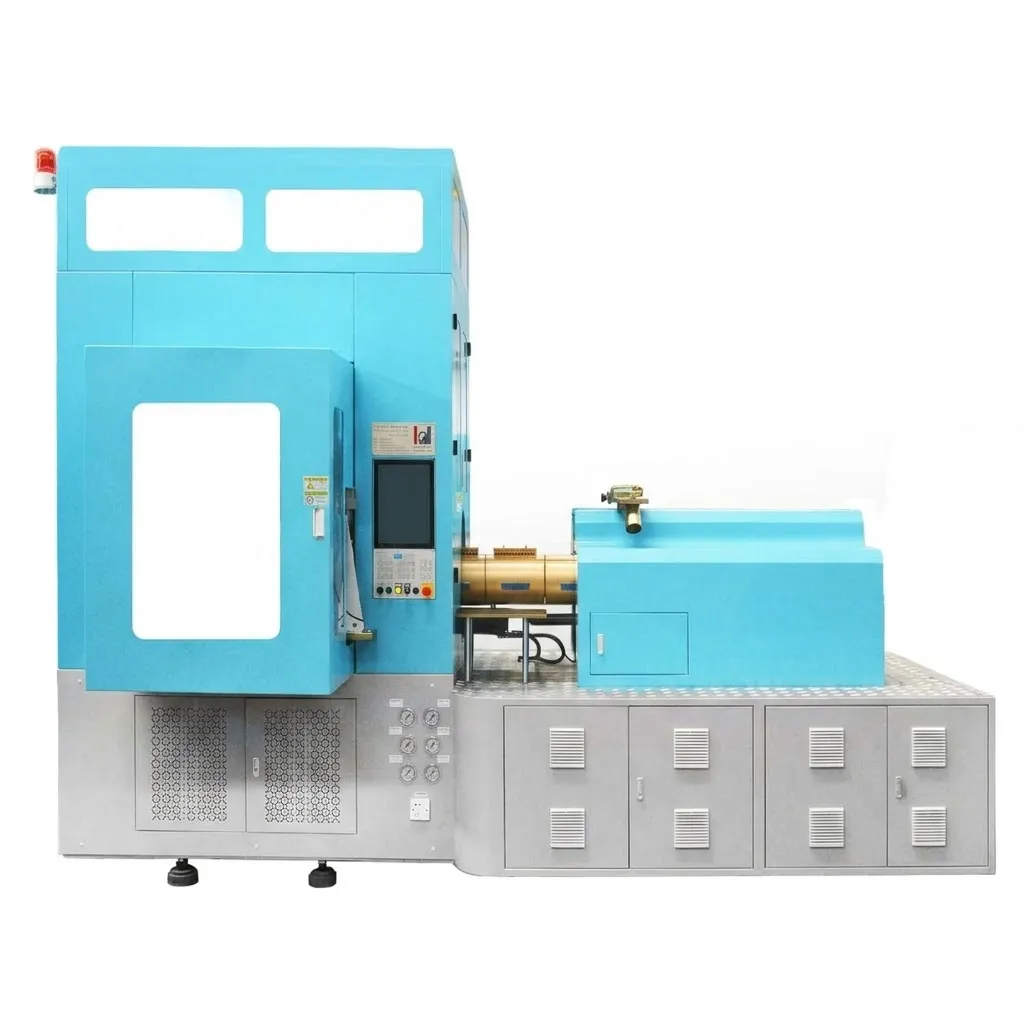
The ISBM mould investment covers three components: preform mould, blow mould, and stretch rod. It is the primary barrier to entry for small-volume producers.
Limitation 5: Wall Thickness Control Requires Expertise
Achieving consistent wall thickness distribution — particularly for complex shapes — requires experienced process engineers and well-designed tooling. Wall thickness in a blown container is determined by the interaction of preform geometry, conditioning temperature profile, stretch rod speed, blow pressure, and blow timing. Optimising all of these for a new bottle format takes systematic development time and produces some start-up scrap.
Limitation 6: Lower Output Than Two-Step at Very High Volumes
At very high production volumes — above 20,000–40,000 bottles per hour for a single format — two-step reheat stretch blow moulding (RSBM) machines achieve higher throughput than one-step ISBM because they decouple the injection cycle time from the blow cycle time. For commodity volumes at major water or CSD brands, two-step RSBM is typically the more efficient choice.
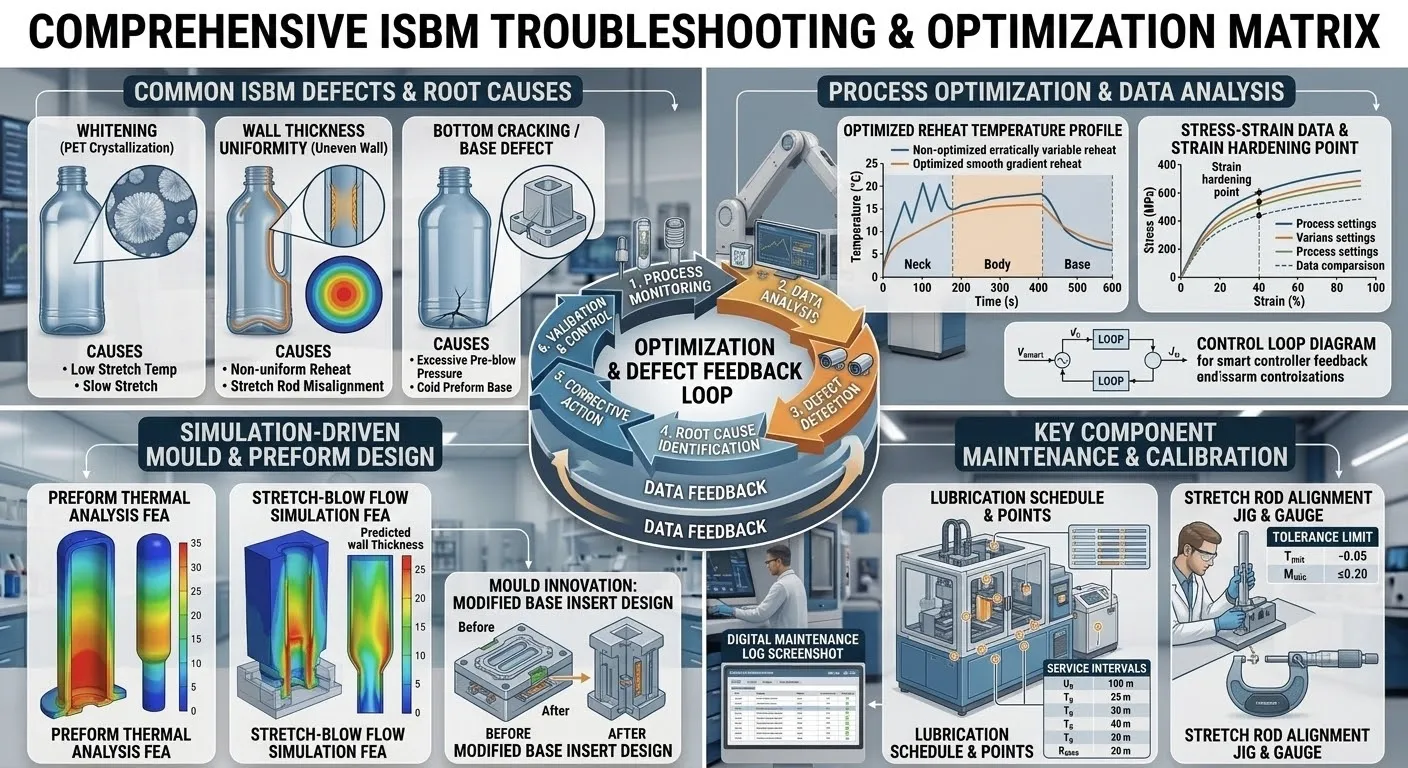
Systematic process optimisation addresses many of ISBM’s operational limitations — wall thickness consistency, scrap rate, and cycle time can all be improved through structured parameter development.
Putting the Disadvantages in Context
These limitations are real, but they must be weighed against what one-step ISBM uniquely achieves: a finished, biaxially oriented, glass-clear, lightweight PET container produced from resin pellets in a single integrated machine cycle. For pharmaceutical, cosmetic, food, and beverage applications at mid-volume, ISBM’s advantages substantially outweigh its limitations.
Want to discuss whether ISBM is the right process for your container?
Ever-Power’s applications team can review your container specification and confirm whether one-step ISBM is optimal for your volume, format, and market requirements.
See the full EP-HGY and EP-BPET ISBM machine rangeまたは探索する カスタム金型オプション to understand the full tooling investment.
よくある質問
Is blow moulding wasteful of material?
ISBM is among the most material-efficient container manufacturing processes. Biaxial orientation provides structural strength at very thin wall sections, so ISBM bottles use substantially less resin per unit of contained volume than any alternative. A 500 ml PET water bottle produced by ISBM weighs 8–10 g; an equivalent unoriented injection-moulded container would require 30–50 g.
What is the minimum production volume for viable ISBM?
The break-even point depends on purchased container price, in-house production cost, and mould investment. For most pharmaceutical and cosmetic applications, in-house ISBM becomes economically viable at annual volumes above 500,000–1,000,000 bottles per format. At lower volumes, contract blow moulding is usually more economical.
How long does new format process development take?
First-article process development on a new mould typically takes 4–16 hours of trial time depending on bottle complexity and operator experience with similar formats. This is a one-time investment per mould that does not repeat once the process recipe is saved. Ever-Power provides process documentation and on-site commissioning support to minimise development time on new installations.
Operational Challenges Specific to ISBM
Resin sensitivity: PET is highly hygroscopic and degrades rapidly if processed without adequate drying. Maintaining the dryer at the correct dew point (−40 °C or below) is a daily operational discipline, not a set-and-forget parameter. A dryer failure that goes unnoticed for a few hours can produce thousands of degraded bottles before the quality issue is detected downstream.
Process window narrowness: PET’s orientation temperature window (90–115 °C at the preform surface) is approximately 25 °C wide. At the lower end, the preform is too stiff to stretch properly, producing stress whitening. At the upper end, premature crystallisation produces haze. Maintaining the conditioning station within this window consistently through ambient temperature variation and cooling water temperature fluctuation requires a well-designed conditioning station with stable IR heater performance and closed-loop temperature control.
Chiller dependency: The entire productivity of an ISBM line depends on the chiller maintaining mould cooling water at 8–12 °C consistently. A chiller fault raising cooling water temperature by even 5 °C will cause bottles to exit the mould above their relaxation temperature, producing post-ejection distortion. Chiller redundancy or standby capacity is worth considering for high-uptime production lines.
The Advantages That Make ISBM Worth It
In the context of its target applications — PET pharmaceutical, cosmetic, food, and beverage containers at mid to high volumes — one-step ISBM’s disadvantages are well understood, manageable, and substantially outweighed by its advantages. No other process produces a biaxially oriented, glass-clear, lightweight PET container from resin pellets in a single, contamination-controlled machine cycle. No other process delivers the combination of supply chain independence (no external preform supply needed), format flexibility (mould change in under 2 hours), and container performance (clarity, barrier, strength, light weight) that one-step ISBM delivers. For the buyers it serves, these advantages define why ISBM is the process of choice despite its operational demands and limitations.
Comparing ISBM Disadvantages to Competing Container Manufacturing Processes
Every container manufacturing process has limitations, and the disadvantages of ISBM must be evaluated in context against the limitations of competing processes. EBM cannot produce PET containers or achieve adequate neck finish precision for pharmaceutical applications. IBM cannot produce biaxially oriented containers with the clarity and light weight required for water, beverage, and premium cosmetic applications. Injection moulding alone would produce containers requiring 5–10 times more resin per container than ISBM for equivalent structural performance. Rotational moulding is limited to large containers and very low production rates.
Viewed against these alternatives, ISBM’s disadvantages — mould cost, size ceiling, non-round shape difficulty, wall thickness complexity — are specific and manageable constraints for a well-understood application range. They do not prevent ISBM from being the clearly optimal process for PET pharmaceutical, cosmetic, food, and beverage containers at mid to high volumes. The process was developed specifically because no existing process could serve this application combination, and it remains the only practical choice for this combination today.
Mitigating the Disadvantages in Practice
Each of ISBM’s practical disadvantages can be mitigated through good engineering and process management. High mould cost is mitigated by selecting mould material appropriate to planned production volume and by ordering matched moulds from the machine manufacturer to eliminate interface compatibility risk. Wall thickness complexity is mitigated by working with an experienced ISBM mould and machine supplier who can model the blow step and predict wall thickness distribution before the mould is cut. Output ceiling at high volumes is mitigated by running multiple ISBM machines in parallel (common at pharmaceutical and cosmetic manufacturers who run several machine platforms across different formats) or by transitioning to two-step RSBM when volumes reach the threshold where that process becomes more economic. Non-round shape limitations are mitigated by involving the machine supplier’s application engineering team in bottle design before the mould is ordered, to confirm that the desired geometry is achievable within the process’s blow dynamics.
サプライヤー評価プロセスを開始する方法
ISBM機器の調達が初めてのバイヤーにとって、機械と金型のサプライヤーを選定するプロセスは、途方もなく難しく感じられるかもしれません。しかし、実際には、サプライヤーの候補リストを作成するのではなく、明確な容器仕様を策定することが重要です。サプライヤーに問い合わせる前に、ボトルの容量、ネックの形状、樹脂の種類、目標重量、必要な生産量、および用途固有の要件(医薬品GMP、ホットフィル、クリーンルーム対応など)を明確に定義してください。容器の仕様が明確になれば、複数のサプライヤーから有意義で比較可能な見積もりを取得できます。なぜなら、各見積もりは同じ技術的情報に基づいて作成されるからです。
Ever-Powerの販売前プロセスは、お客様のコンテナ仕様の技術レビューから始まります。当社のアプリケーションエンジニアリングチームが、仕様を当社の機械ラインナップと照らし合わせて評価し、適切なモデル(ステーション数、型締め力、駆動システム)を推奨するとともに、金型の実現可能性に関する予備的な評価を提供します。これらはすべて無料で、通常、仕様書受領後24~48時間以内に実施されます。この予備評価により、お客様は詳細な見積もりプロセスに進む前に、想定される機械と金型の構成、およびそれに伴う投資額を把握することができます。
Ever-Power社のISBM製品ラインナップ
Ever-Power社の包括的なワンステップISBMマシンシリーズは、医薬品、化粧品、食品、飲料、および工業用容器製造における主要な用途すべてを網羅しています。
| モデル | 駅 | クランプ力(kN) | コンテナ範囲 | ドライブ |
|---|---|---|---|---|
| EP-HGY50-V3-EV | 3 | 50 | 30~500ml | フルサーボ |
| EP-HGY150-V4 | 4 | 150 | 100ml~2L | サーボ油圧式 |
| EP-HGY150-V4-EV | 4 | 150 | 100ml~2L | フルサーボ |
| EP-HGY200-V4 | 4 | 200 | 200ml~3L | サーボ油圧式 |
| EP-HGY200-V4-B | 4 | 200 | 200ml~3L(ハンドル付き) | サーボ油圧式 |
| EP-HGY250-V4 | 4 | 250 | 500ml~5L | サーボ油圧式 |
| EP-HGYS280-V6 | 6 | 280 | 複雑な形状 | サーボ油圧式 |
| EP-HGY650-V4 | 4 | 400 | 2~10リットル | サーボ油圧式 |
| EP-BPET-70V4 | 4 | 200 | 500ml~3L(PETボトル) | サーボ油圧式 |
| EP-BPET-94V3 | 3 | 250 | 1~5リットル(PET製) | サーボ油圧式 |
| EP-BPET-125V4 | 4 | 400 | 5~10リットル(PET製) | サーボ油圧式 |
各モデルの詳細な技術仕様については、以下をご覧ください。 EP-HGYおよびEP-BPET製品ページアプリケーション固有のガイダンスについては、弊社のチームまでお問い合わせください。 isbmmolding.com/contact-us または、[email protected]までメールでお問い合わせください。技術的なお問い合わせには24時間以内にご返信いたします。
Overcoming the Disadvantages: What Modern ISBM Machines Offer
Several of the disadvantages described above have been substantially mitigated by advances in one-step ISBM machine technology over the past decade. The high mould cost disadvantage has been addressed by improved mould manufacturing efficiency from Chinese specialist mould makers, reducing single-cavity ISBM mould set prices significantly compared to a decade ago. The wall thickness control difficulty has been reduced by servo-controlled stretch rod systems that allow precise axial speed and force control at each point of the preform’s travel, and by multi-zone conditioning infrared heaters that can be adjusted independently for each zone of the preform’s length.
The output rate limitation of one-step ISBM at very high volumes has been addressed in part by the six-station machine configuration available in the EP-HGYS280-V6, which introduces additional conditioning and post-blow cooling stations that allow the overall cycle time to be reduced without compromising bottle quality. For most pharmaceutical, cosmetic, food, and industrial packaging applications, the output rate of modern one-step ISBM machines is more than sufficient.
The remaining genuine limitation — restriction to hollow parts — is not a disadvantage in context: it describes the intended application of the machine. For buyers who need hollow containers, ISBM’s limitation to hollow output is not a constraint at all. The realistic alternative for most ISBM buyers is purchasing containers from a contract blow moulder rather than producing in-house — and the economics of in-house ISBM production at commercial volumes consistently favour capital investment over purchasing.
Training and Support Considerations
The wall thickness control and process expertise limitation mentioned above underlines the importance of adequate operator training for ISBM machines. A well-trained operator who understands the relationship between preform conditioning temperature, stretch rod timing, and blow pressure can resolve most bottle quality issues at the machine without engineering support. An untrained operator will typically respond to quality defects by trial-and-error parameter changes that can compound the original problem and increase scrap rates substantially. Ever-Power includes on-site operator training as a standard part of the commissioning programme for all EP-HGY and EP-BPET installations, covering machine operation, process parameter setting, quality inspection, and routine maintenance procedures. Remote process support is available for parameter guidance on new bottle formats after installation.