Wat kost een spuitgietmachine?
The cost of an injection moulding machine varies significantly depending on machine type, clamping force, drive system, and country of manufacture. For buyers looking to produce finished PET or PP bottles, the relevant machine is a one-step injection stretch blow moulding (ISBM) machine, which is specified and priced differently from standard injection moulding equipment. This guide covers both categories, explains how to match machine type to application, and provides indicative price ranges for the full spectrum of injection moulding and ISBM equipment.
Standard Injection Moulding Machine Cost Overview
A standard injection moulding machine converts raw thermoplastic resin pellets into solid plastic parts by injecting molten resin into a closed mould cavity under high pressure. Machine size is described in tonnes of clamping force — the force that holds the mould closed during injection. Price ranges by size and drive system:
| Clamping Force | Aandrijfsysteem | Origin | Price Range (USD) |
|---|---|---|---|
| 50–100 ton | Servo-hydraulisch | China | USD 8,000–25,000 |
| 100–200 ton | Servo-hydraulisch | China | USD 20.000–60.000 |
| 200–500 ton | Servo-hydraulisch | China | USD 40,000–120,000 |
| 100–300 ton | All-electric | Japan / Europe | USD 80,000–250,000 |
| 500+ ton | Servo-hydraulisch | Europe | USD 150,000–500,000+ |
These ranges cover machines producing solid plastic parts: automotive components, caps and closures, consumer goods housings, and medical device parts. Standard injection moulding machines at any tonnage cannot produce finished hollow bottles directly from resin pellets. A bottle requires a blow moulding step that is not present in any standard injection moulding machine.
Why ISBM Machine Pricing Is Different from Standard IM
One-step ISBM machines are not specified in tonnes — they are specified in kilonewtons (kN) of injection clamping force, with values ranging from 50 kN to 400 kN in the EP-HGY range. This is because ISBM preform moulds are compact and require much lower clamping forces than large solid-part injection moulds. A 400 kN ISBM machine is equivalent to approximately 40 tonnes of injection clamping force — a small machine by general IM standards, yet capable of producing containers up to 10 litres in volume.
ISBM machines also integrate functions absent from standard injection moulding machines: a conditioning station with multi-zone infrared heaters, a mechanical stretch rod, a high-pressure blow air system (25–40 bar), and a rotary table that indexes through all stations simultaneously. All four stations operate in parallel — one preform being injected, one being conditioned, one being stretched and blown, one being ejected as a finished bottle. This integration justifies the higher price per unit of clamping force relative to standard IM machines, and delivers a fundamentally different output: finished bottles rather than solid preforms.
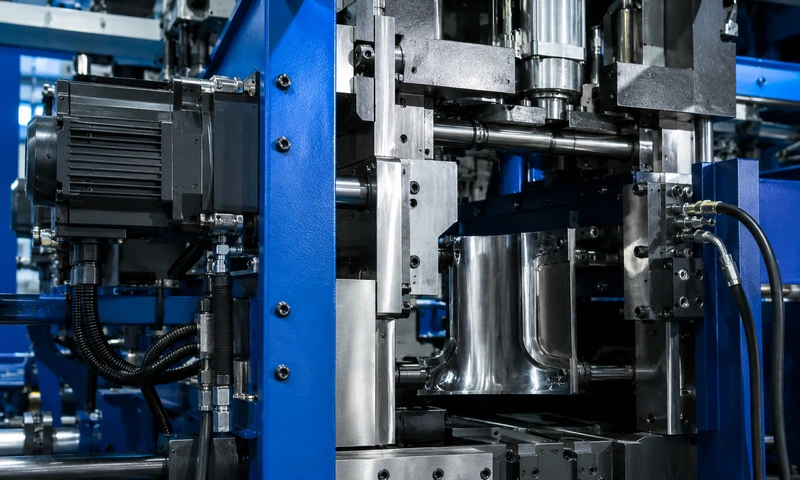
Servo-hydraulic clamping system on the EP-HGY series — on-demand pump operation reduces energy consumption by up to 45% compared with fixed-speed hydraulic machines at equivalent output.
One-Step ISBM Machine Price Ranges
| Model | Clamp | Drijfveer | Bottle Range |
|---|---|---|---|
| EP-HGY50-V3-EV | 50 kN | Volledige servo | 30–500 ml pharma & cosmetic |
| EP-HGY150-V4 / V4-EV | 150 kN | Servo-hyd / Full servo | 100 ml–2 L water & pharma |
| EP-HGY200-V4 | 200 kN | Servo-hydraulisch | 200 ml–3 L beverage & food |
| EP-HGY250-V4 | 250 kN | Servo-hydraulisch | 500 ml–5 L edible oil & food |
| EP-HGYS280-V6 | 280 kN | Servo-hydraulisch | 6-station, complex shapes |
| EP-HGY650-V4 | 400 kN | Servo-hydraulisch | 2–10 L industrial & agrochem |
Key Factors That Drive Machine Cost
Injectieklemkracht is the single largest price driver in both standard IM and ISBM machines. Higher clamp force requires a larger injection unit, a heavier structural frame, larger platens, and more powerful tie bars — all of which add material and machining cost. For ISBM machines, clamp force determines the maximum preform weight and bottle volume achievable on the machine, making it the primary specification decision.
Drive system has the second-largest impact on purchase price. Full-servo (all-electric) machines carry a premium of 20–40% over servo-hydraulic equivalents because of the cost of precision servo motors, drives, and ballscrews that replace the hydraulic system. However, this premium is typically recovered within 3–5 years through energy savings of 30–55% over the machine’s operating life. Servo-hydraulic machines save 30–45% over fixed-speed hydraulic at a more modest price premium of 15–25%.
Station count affects price but less dramatically than clamp force. A 4-station machine costs approximately 15–25% more than a 3-station equivalent at the same clamp force, due to the additional conditioning station, infrared heaters, and associated control hardware. The 4-station configuration is strongly preferred for complex bottle geometries and for applications where conditioning temperature control is critical to bottle quality.
Country of manufacture has a significant effect on ISBM machine pricing. Chinese specialist ISBM manufacturers are typically 30–50% below European equivalents at equivalent technical specification. The relevant considerations when comparing prices across origins are after-sales support availability in your market, spare parts lead times, and on-site commissioning support quality — not purchase price alone.
Total System Investment: Beyond the Machine Price
The machine purchase price is only part of the total investment required to start ISBM production. For a complete, production-ready one-format ISBM line, budget additionally for:
- Mould set — USD 12,000–100,000 for preform mould, blow mould, and stretch rod
- High-pressure compressor — USD 8,000–25,000 for blow air at 25–40 bar
- Desiccant dryer — USD 4,000–12,000 for PET resin moisture control below 50 ppm
- Koeler — USD 5,000–15,000 for blow mould cooling water at 8–12 °C
The mould set and ancillaries represent a one-time investment per container format. Additional bottle formats on the same machine require only a new mould set, not a new machine, making the incremental cost of adding bottle formats much lower than the initial installation cost.
Total Cost of Ownership: The 10-Year View
Purchase price represents approximately 30–50% of the total cost of ownership over a 10-year machine life. The remaining 50–70% is energy consumption, maintenance and spare parts, mould depreciation, and downtime cost. Choosing a servo-hydraulic or full-servo drive system over fixed-speed hydraulic typically saves USD 15,000–40,000 in electricity over 10 years at commercial production volumes — a saving that usually exceeds the drive system price premium within 3–5 years. For this reason, all EP-HGY series machines use servo-hydraulic or full-servo drive as standard; fixed-speed hydraulic options are not offered.
Maintenance cost is the second-largest variable in total cost of ownership. Machines with well-documented preventive maintenance schedules, accessible wear parts, and competitive spare parts pricing have substantially lower lifetime maintenance costs than machines where parts are hard to source or maintenance is left to reactive breakdown-driven repair. Ever-Power provides full maintenance schedules, spare parts stock recommendations, and predictive maintenance guidance in the machine documentation package for all EP-HGY and EP-BPET installations.
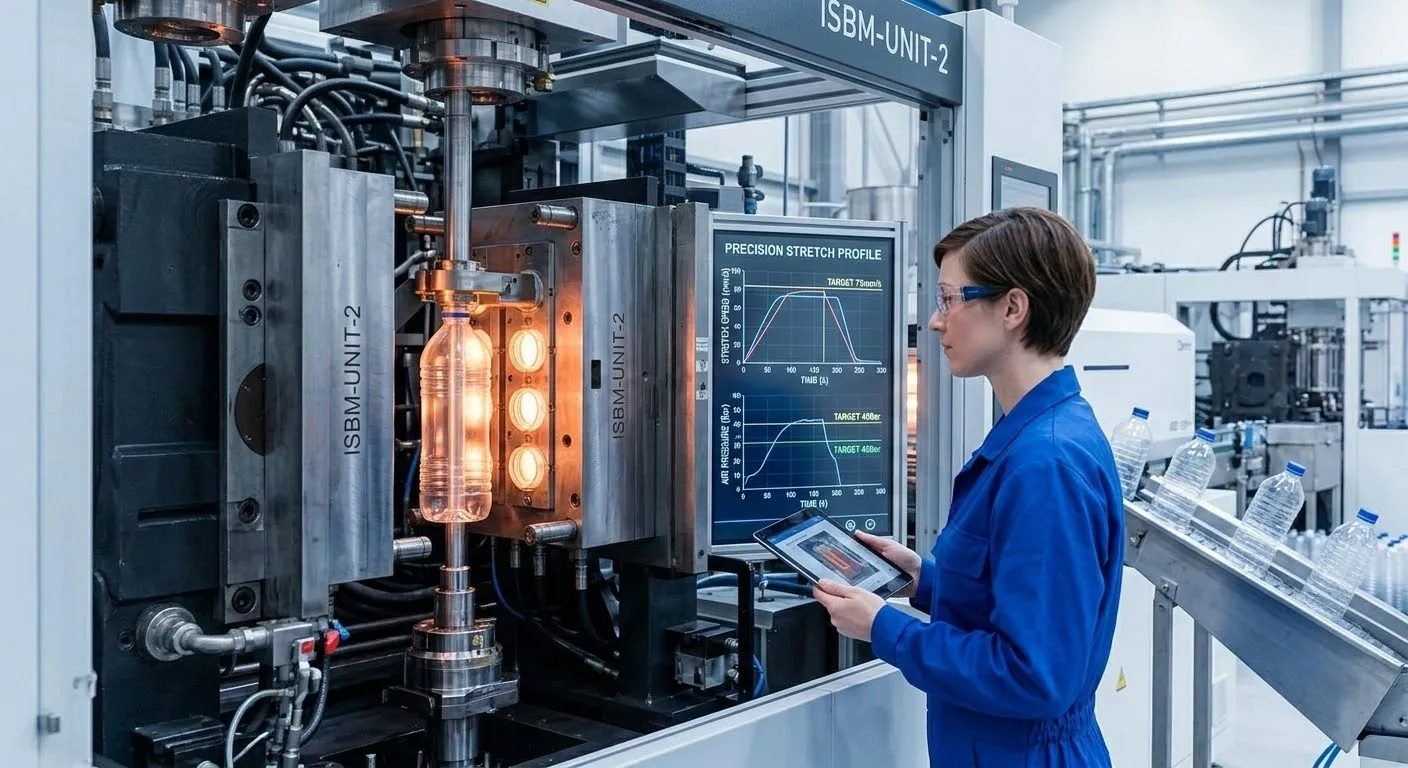
Ever-Power production facility in Hangzhou — all EP-HGY and EP-BPET machines are factory-tested and acceptance-checked before shipment with full process documentation and commissioning support included.
Get a price matched to your bottle specification and output requirement
Send Ever-Power your container drawing, resin type, and target output and we will recommend the right model with indicative pricing within 24 hours.
Browse the full EP-HGY en EP-BPET ISBM machinereeksof verkennen opties voor aangepaste mallen to understand the complete investment required for your container format.
Veelgestelde vragen
What is the cheapest way to start PET bottle production in-house?
The lowest-capital-cost route to in-house PET bottle production is a compact 3-station one-step ISBM machine such as the EP-HGY50-V3-EV, paired with a 1-cavity mould set for your target container. This combination covers pharmaceutical and cosmetic containers from 30–500 ml and represents the most accessible entry point for organisations transitioning from purchased containers to in-house ISBM production. The total investment (machine, mould, compressor, chiller, dryer) is typically USD 80,000–150,000 depending on mould complexity and ancillary specifications.
Does the machine price include installation and operator training?
Ever-Power includes on-site commissioning and operator training as a standard part of the EP-HGY and EP-BPET machine purchase. Commissioning covers machine installation, mould mounting, process parameter setup for the first bottle format, and first-article bottle quality verification. Operator training covers machine operation, quality inspection routines, routine maintenance, and emergency procedures. Confirm scope explicitly in any supplier’s quotation — some suppliers price these services separately.
How long does an ISBM machine last?
A well-maintained EP-HGY or EP-BPET machine has a design life of 15–20 years. Critical wear items — barrel and screw, servo motor brushes (or hydraulic seals on servo-hydraulic machines), rotary table bearings, and stretch rod seals — are replaced on a scheduled maintenance basis throughout the machine’s life. Ever-Power maintains spare parts availability for all current production models and provides maintenance schedules and spare parts recommendations in the machine documentation package supplied with every installation.
Drive System Impact on Running Cost
The decision between fixed-speed hydraulic, servo-hydraulic, and full-servo (all-electric) drive systems affects not only purchase price but the machine’s operating cost for its entire working life. A fixed-speed hydraulic pump runs continuously regardless of whether the machine is actively clamping, injecting, or cooling — energy is consumed even during the dwell periods within each cycle. A servo-hydraulic system runs the hydraulic pump on demand only, matching output precisely to instantaneous requirement, which eliminates idle energy consumption and reduces cycle-to-cycle pressure variation. A full-servo machine replaces all hydraulic axes with servo-motor-driven mechanical systems, producing the lowest possible energy consumption and the highest process repeatability.
At a typical industrial electricity cost of USD 0.08–0.15 per kWh and a daily production shift of 16–20 hours, the difference between a fixed-speed hydraulic and a servo-hydraulic ISBM machine of equivalent output is typically USD 4,000–12,000 per year in electricity savings. Over a 10-year machine life, this saving ranges from USD 40,000 to USD 120,000 — often significantly exceeding the initial price premium for the servo-hydraulic drive. This calculation is why all EP-HGY and EP-BPET machines use servo-hydraulic or full-servo drive as standard, and why buyers should treat drive system energy data as a mandatory input in any purchase evaluation rather than a secondary consideration.
After-Sales Support: The Hidden Cost Variable
In machine procurement, the after-sales support structure of the supplier is a cost variable that rarely appears in purchase price comparisons but can dominate the real cost of ownership. When an ISBM machine stops running, every hour of downtime has a calculable cost: lost production volume, allocated fixed overhead, and potentially missed delivery commitments to downstream customers. For a machine running at 2,000 bottles per hour with a container margin of USD 0.08 per bottle, one hour of downtime costs USD 160 in lost contribution — a figure that compounds rapidly across multi-day breakdowns.
The support variables that determine real downtime cost are: spare parts availability and shipping speed to your country; remote diagnostic capability (can the supplier access the machine’s HMI remotely to diagnose faults?); and on-site engineer response time for faults that cannot be resolved remotely. Ever-Power provides remote diagnostic access on all EP-HGY machines with internet-connected control systems, maintains a global spare parts inventory with express shipping capability to all major markets, and offers on-site technical response in Brazil, South Korea, Australia, the Netherlands, the UK, and Canada. Buyers should confirm these support parameters explicitly with any supplier before finalising a purchase decision, as they are as financially significant as the machine purchase price over the machine’s operating life.
Making the Right Purchase Decision
The most important question to answer before requesting injection moulding or ISBM machine pricing is: what does the machine need to produce? If the answer is solid plastic parts — caps, closures, technical components, or preforms for a separate blow moulding machine — a standard injection moulding machine in the appropriate tonnage class is correct, and price is the primary differentiator among comparable machines. If the answer is finished hollow bottles or containers in PET, PP, or PETG — water bottles, pharmaceutical vials, cosmetic flacons, edible oil containers, agrochemical bottles — then a one-step ISBM machine is the correct equipment category, and the comparison should be made within that category rather than against standard injection moulding machines that cannot produce the required output.