Injection stretch blow moulding (ISBM) is a manufacturing process that converts plastic resin into finished hollow containers in a single, continuous sequence. Unlike processes that require a separately manufactured preform, one-step ISBM takes raw pellets and produces a finished bottle without intermediate handling or storage — making it the preferred choice for short runs, complex shapes, and applications where contamination control matters.
Que se passe-t-il à l'intérieur d'une machine ISBM ?
At its core, ISBM merges two distinct plastics-forming technologies into one platform. First, molten resin — typically PET, PP, or PETG — is injected into a preform mould. The resulting thick-walled tube, known as a preform, is retained on the machine’s mandrel and transferred — still warm — to a blow station, where a stretch rod elongates it axially while high-pressure air expands it radially into the final bottle shape.
The key physical event is biaxial molecular orientation. When PET is stretched in two directions simultaneously at the right temperature, the polymer chains align in both axes. This alignment gives PET bottles their glass-like clarity, their resistance to carbonation pressure, and their ability to be blow-moulded down to wall thicknesses of under 0.3 mm without pinholing.
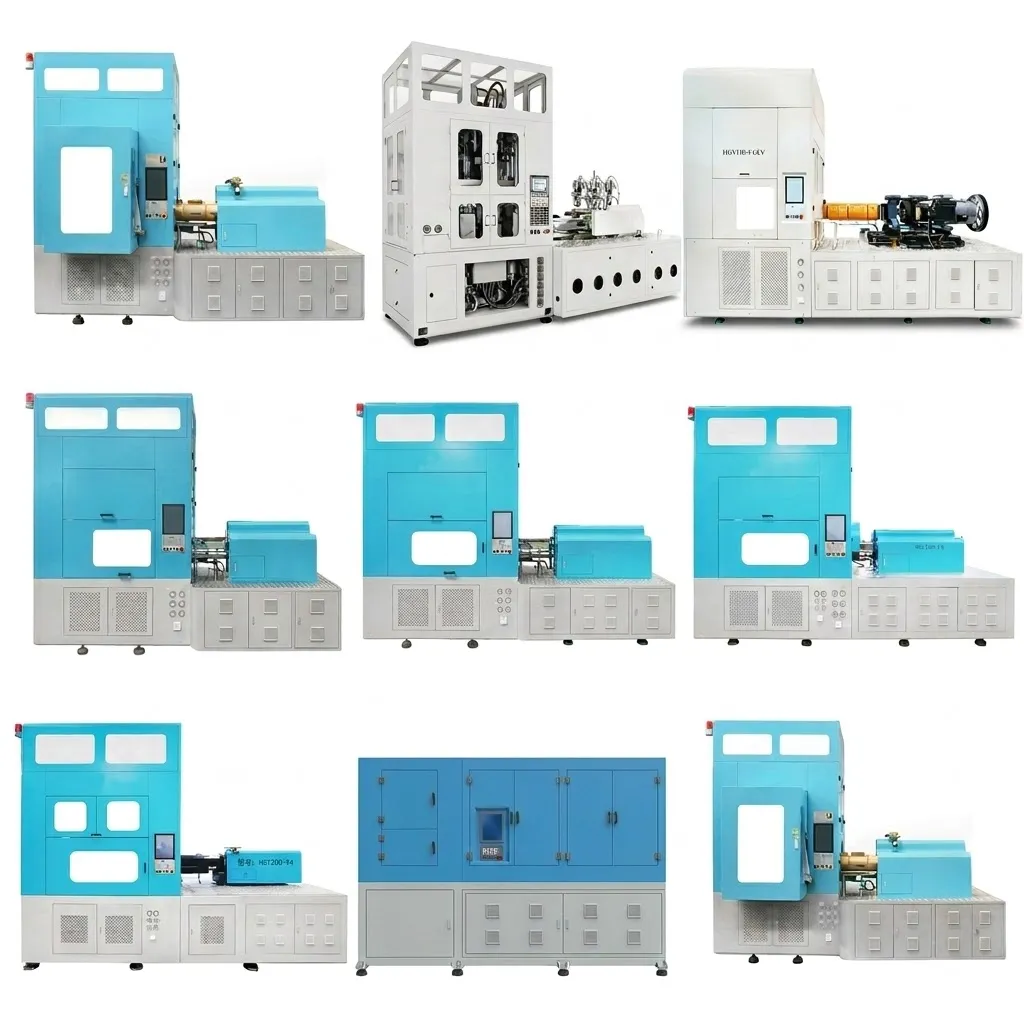
Overview of ISBM machine configurations — 3-station, 4-station, and 6-station designs handle different volume and complexity requirements.
Les trois stations fondamentales
Every ISBM machine performs the same three core operations on a rotating table. Each position runs simultaneously — so while one set of preforms is being injected, another is being conditioned, and a third is being blown.
| Gare | Opération | Variable de contrôle clé |
|---|---|---|
| Injection | Résine injectée dans la cavité de la préforme, refroidie à la température d'éjection | Pression d'injection, température de fusion, temps de conditionnement |
| Étirement | La tige d'étirage s'allonge ; de l'air comprimé dilate la préforme contre le moule de soufflage | Rod speed, pre-blow delay, blow pressure (25–40 bar) |
| Éjection | Ouverture du moule ; la bouteille finie est retirée par convoyeur ou bras de transfert | Température de refroidissement du moule, temps d'éjection |
Four-station machines add a dedicated conditioning station between injection and blow. This position allows fine-tuning of the preform’s axial temperature profile using infrared heaters — critical for complex shoulder shapes or asymmetric sidewall thickness. Six-station designs go further, adding post-blow cooling to enable higher cycle speeds without dimensional instability at ejection.
Soufflage de réchauffage en une étape ISBM vs en deux étapes
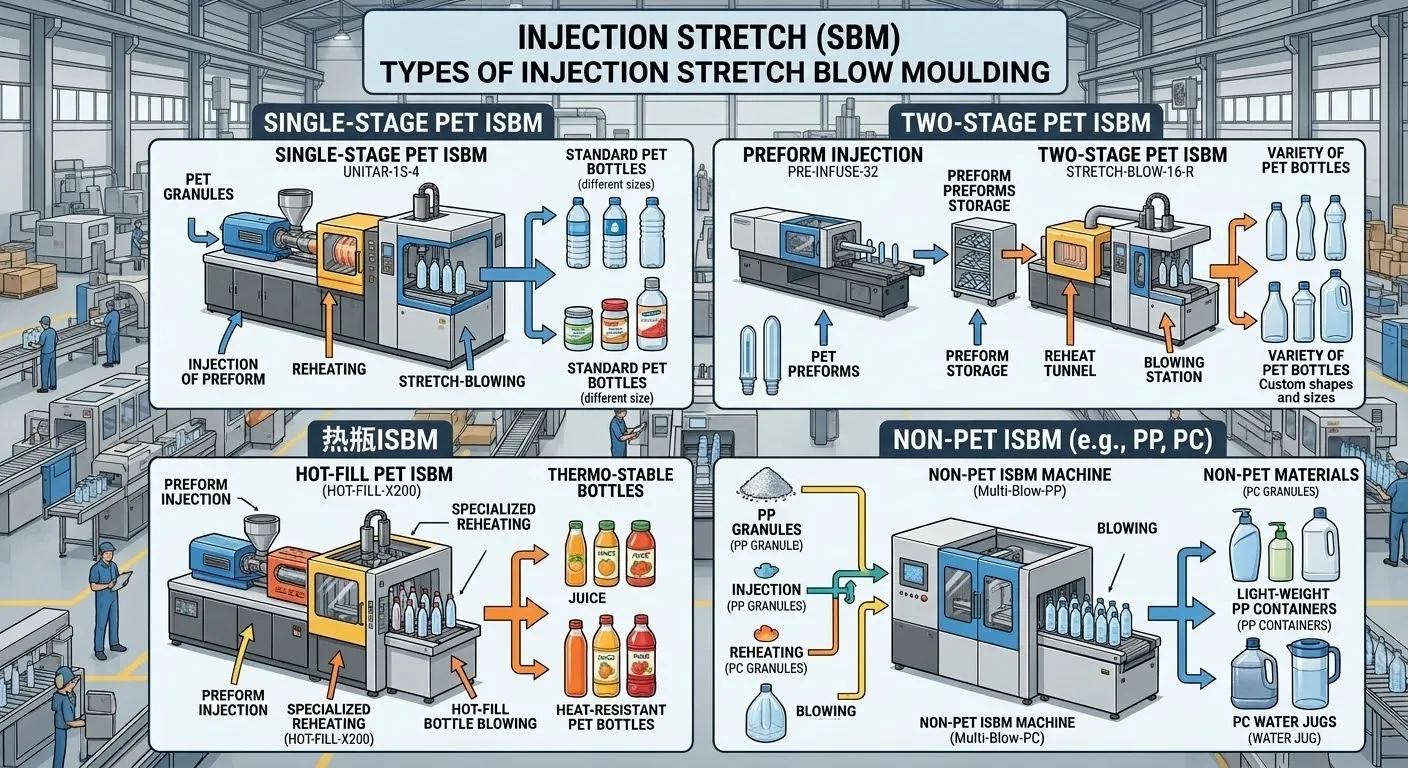
L'ISBM existe sous deux formes de processus, et la terminologie est souvent source de confusion. La distinction réside dans la provenance du préformulaire :
- ISBM en une étape — resin pellets enter; finished bottles exit. The preform never leaves the machine, never cools fully, never risks contamination. Preferred for pharmaceutical, cosmetic, and specialty food packaging.
- Deux étapes (soufflage de réchauffage) — preforms are manufactured separately, stored, and reheated in a standalone blow moulding machine. Very high throughput at scale, but the preform is heated twice, adding energy cost.
- IBM (moulage par injection-soufflage) — similar to ISBM but without the stretch step. Produces heavier, less-oriented bottles. Common for pharmaceutical vials and HDPE containers.
Product range achievable with ISBM — from 10 ml pharmaceutical vials to 10-litre edible oil containers, all from a single platform.
Comment les machines ISBM sont spécifiées
Lorsqu'il s'agit de comparer des machines, quatre chiffres font l'essentiel du travail de qualification :
Force de serrage par injection (kN) — determines maximum preform wall thickness and volume without flash. Ever-Power’s EP-HGY series ranges from 50 kN (EP-HGY50-V3-EV) to 400 kN (EP-HGY650-V4).
Poids maximal des plombs (g) — sets the upper limit on bottle wall weight at a given cavity count. A 150-gram shot across two cavities allows up to 75 g per bottle, covering most 1–2 litre PET containers.
nombre de caries — the number of bottles produced per cycle. More cavities means higher hourly output but a larger mould investment and tighter process control requirements.
pression de la station de soufflage — typically 25–40 bar on standard machines, rising to 60 bar for high-barrier specialty applications.
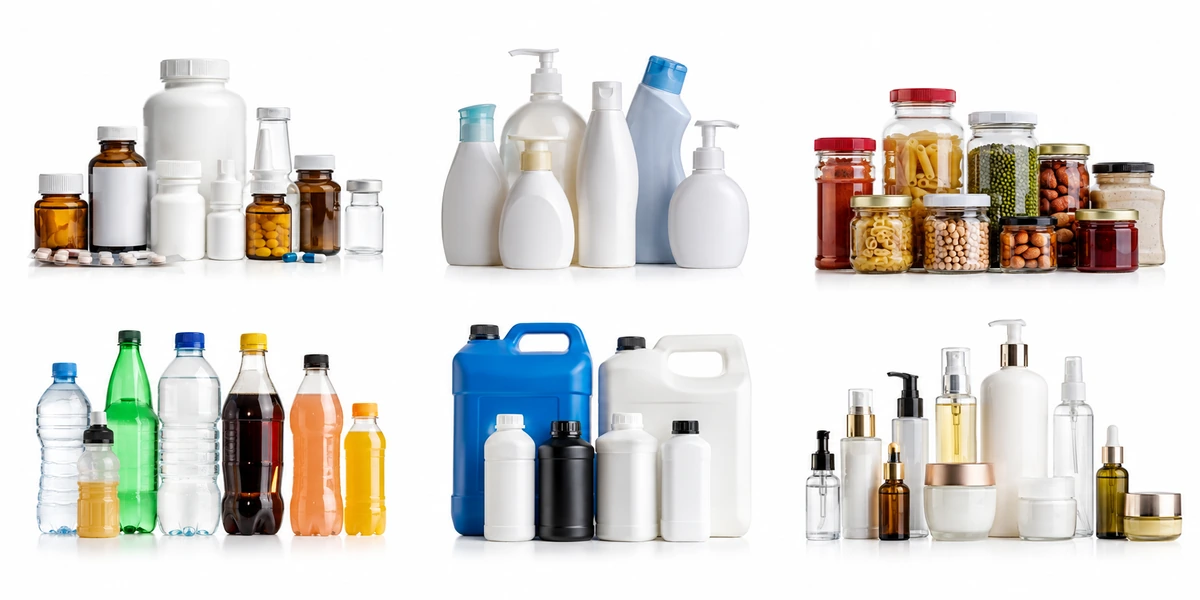
Application sectors served by ISBM technology — pharmaceutical, food and beverage, personal care, and industrial chemical packaging.
Prêt à spécifier la machine ISBM adaptée à votre production ?
Ever-Power’s technical team can match machine configuration to your bottle dimensions, resin, and target output within 24 hours.
Points clés à retenir
Le procédé ISBM est la solution idéale pour les fabricants qui ont besoin de contenants en PET ou PP transparents, légers et aux dimensions précises, sans avoir à gérer un stock de préformes. Pour en savoir plus sur le fonctionnement du procédé, consultez notre documentation. Gamme de machines EP-HGY à 4 postes, ou Contactez notre équipe des applications pour discuter de vos besoins en conteneurs.
Argumentaire économique en faveur de l'ISBM en une seule étape
For manufacturers entering the PET bottle market for the first time, the economic argument for one-step ISBM is straightforward: a single machine replaces two separate production units (a preform injection machine and a standalone blow moulder), requires less floor space, and produces a cleaner product with fewer operator touchpoints. The absence of a preform storage and handling step also means that the risk of preform contamination — a significant concern in pharmaceutical and infant food packaging — is eliminated by design rather than controlled by procedure.
The trade-off is that one-step machines have lower maximum throughput than two-step reheat blow systems at very high volumes. A large two-step SBM machine can run 20,000–40,000 bottles per hour in multi-cavity mode. One-step ISBM machines typically top out at 5,000–12,000 bottles per hour depending on bottle size and cavity count. For most mid-volume producers — particularly in emerging markets and specialty niches — this output range is more than adequate, and the capital and operational simplicity of the one-step platform more than offsets the throughput ceiling.
Options de matériaux : au-delà du PET
Bien que le PET domine la production ISBM en volume, trois autres résines sont régulièrement traitées sur des machines ISBM en une étape et chacune présente des exigences de traitement distinctes :
PP (polypropylène) — processed at a higher melt temperature than PET (typically 200–230 °C) and with a wider orientation temperature window. PP bottles are opaque or translucent, lighter than PET at equivalent wall thickness, and compatible with hot-fill at temperatures up to 120 °C. Commonly used for edible oil, condiment, and pharmaceutical containers where PET’s transparency is not required.
PETG (polyéthylène téréphtalate glycol) — a copolymer of PET with lower haze, higher surface gloss, and better amorphous processability than standard PET. PETG does not crystallise during blow moulding even if the temperature window is slightly exceeded, which gives operators a more forgiving process. Its principal application is premium cosmetic packaging where glass-like appearance is critical.
PC (polycarbonate) — high optical clarity, excellent impact resistance, and a heat deflection temperature that allows autoclaving. Processed at significantly higher barrel temperatures (270–320 °C) and with different stretch parameters than PET. Applications include laboratory ware, reusable water bottles, and medical device packaging. Note that PC use in food contact packaging has been declining due to regulatory restrictions on bisphenol A in some markets.
Terminologie clé de référence
| Terme | Définition |
|---|---|
| Préforme | Tube à paroi épaisse produit par moulage par injection ; forme intermédiaire entre la résine et la bouteille finie |
| Orientation biaxiale | L'alignement moléculaire dans deux directions perpendiculaires (axiale et circonférentielle) renforce et clarifie la bouteille finie |
| Taux de gonflement (BUR) | Le rapport entre le diamètre de la bouteille finie et le diamètre du corps de la préforme, décrivant le degré d'expansion radiale |
| Station de conditionnement | The 4-station ISBM station that uses infrared heaters to adjust the preform’s axial temperature profile before blowing |
ISBM dans le contexte de l'emballage durable
PET containers produced by ISBM are among the most widely recycled plastic packaging formats globally. In most markets with developed collection infrastructure, post-consumer PET bottles have recycling rates of 50–80%, and recycled PET (rPET) is routinely incorporated into new bottle production at rates of 25–100% depending on regulatory requirements and resin availability. The one-step ISBM process contributes to this recyclability because the finished bottle contains only one resin type with no multi-layer barrier coatings or adhesive labels that would complicate sorting and reprocessing.
Lightweighting through ISBM is also a direct sustainability lever. Because biaxially oriented PET is structurally more efficient than unoriented PET, ISBM-produced bottles use less resin per unit of contained volume than any other PET forming process. A 500-ml ISBM water bottle weighing 8–10 g uses approximately 60% less PET than an equivalent bottle produced by injection moulding alone. Over the lifetime of a production line producing millions of bottles, this resin reduction represents a substantial reduction in carbon footprint, both in manufacturing and in transport due to lower filled-bottle weight.
Foire aux questions
Quels types de plastiques peuvent être traités sur une machine ISBM ?
The most commonly processed resins are PET (polyethylene terephthalate), PP (polypropylene), PETG (polyethylene terephthalate glycol), and PC (polycarbonate). Each resin has its own orientation temperature window and process requirements. PET is by far the most common — it accounts for the majority of ISBM production globally — but Ever-Power’s EP-HGY machines are configured to process PP and PETG as well.
Combien de bouteilles par heure produit une machine ISBM ?
Output depends on bottle volume, cavity count, and machine configuration. A 2-cavity 4-station machine producing 500-ml PET water bottles typically achieves 2,000–3,500 bottles per hour. A 6-cavity large-format machine can reach 8,000–12,000 per hour for smaller containers. Ever-Power will confirm specific output estimates for your bottle and cavity count before purchase.
Quelle est la différence entre l'ISBM en une étape et l'ISBM en deux étapes ?
In one-step ISBM, resin pellets enter the machine and finished bottles exit — no preform storage or handling step in between. In two-step (reheat stretch blow moulding), preforms are manufactured separately, cooled, stored, and later reheated for blowing. One-step is preferred for pharmaceutical, cosmetic, and short-run applications; two-step is used for very high-volume commodity bottle production.
Comment puis-je demander un devis pour une machine ISBM ?
Contactez Ever-Power à contactez notre équipe ou par courriel [email protected] Veuillez nous fournir le schéma de votre bouteille, le type de résine, le débit souhaité et toute exigence spécifique à votre application. Notre équipe vous répondra sous 24 heures avec une recommandation de machine et un devis préliminaire.