ISBM Procurement and Strategic Sourcing
Comment choisir la machine ISBM adaptée à la production de bouteilles PET ?
A comprehensive engineering and commercial decision framework covering container specifications, production volume analysis, rPET compatibility, energy efficiency, and the critical integration of proprietary mold tooling.
The Strategic Imperative of Selecting the Optimal ISBM Machine
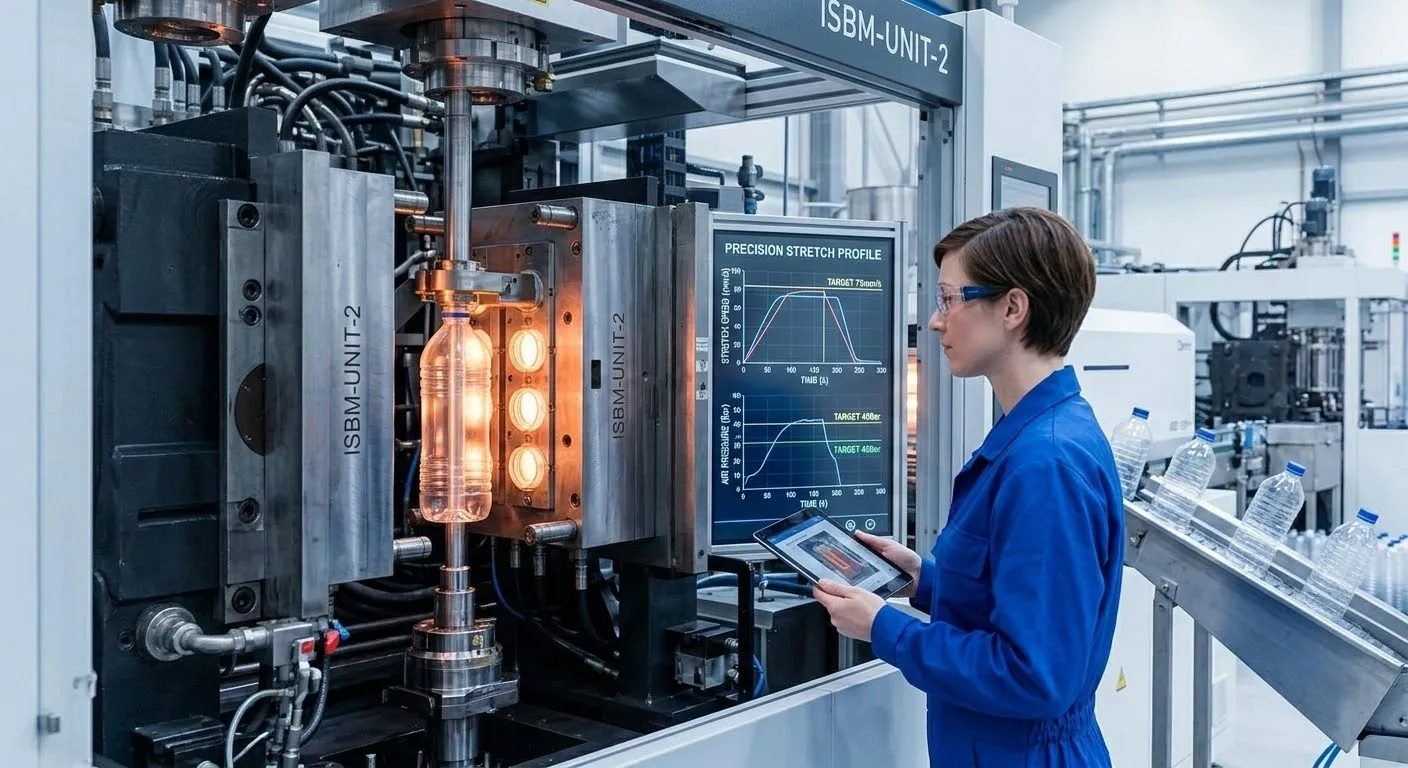
Choosing the right Injection Stretch Blow Molding machine for producing PET bottles is one of the most consequential capital investment decisions a packaging manufacturer will make. This is not a simple equipment purchase; it is a strategic commitment that will define your production capability, product quality ceiling, operational cost structure, and competitive positioning for a decade or more. The wrong selection can result in a machine that is chronically underutilized, incapable of producing the required container geometries, or woefully inefficient at processing the percentage of post-consumer recycled PET that your brand customers now demand. At Toujours-Puissance, a globally recognized Brazilian manufacturer of ISBM equipment, our engineering and commercial teams guide clients through a rigorous, multi-dimensional selection process to ensure the machine architecture aligns perfectly with their current and future production requirements.
The decision framework for selecting an ISBM machine spans a wide spectrum of technical and commercial considerations. You must analyze your target container specifications, including volume, neck finish, geometric complexity, and wall thickness distribution requirements. You must accurately forecast your required production throughput and determine whether a four-station or six-station architecture is appropriate. You must evaluate the machine’s compatibility with your intended resin blend, particularly the percentage of rPET content you aim to incorporate. Energy efficiency, factory floor space constraints, automation and auxiliary equipment integration, and the critical matter of proprietary mold tooling must all be factored into the selection equation. This exhaustive guide will provide you with a step-by-step methodology for navigating this complex decision, referencing specific Ever-Power machine platforms such as the Machine à 4 stations EP-HGY150-V4 to illustrate how different specifications map to different equipment configurations.
Ultimately, the right ISBM machine is the one that delivers the required container quality at the target production volume with the lowest total cost of ownership over its operational life, while providing the flexibility to adapt to evolving market demands. This guide will equip you with the knowledge to make that determination with confidence and precision.
Step One: Defining Your Container Specifications and Geometric Complexity
The single most important driver of ISBM machine selection is the container itself. Every dimension, every geometric feature, and every performance requirement dictates specific machine capabilities.
Container Volume, Neck Finish, and Stretch Ratio
The target container volume directly determines the required preform size and, consequently, the injection unit’s shot capacity. A machine designed for small cosmetic bottles of 50 milliliters will have a completely different injection barrel and clamp force requirement than a machine producing five-liter water jugs. The neck finish specification is equally critical. The neck ring geometry must be compatible with the machine’s transfer clamps and blow mold neck inserts. Standard neck finishes like 28mm PCO or 38mm are widely supported, but proprietary or specialty neck finishes may require custom tooling. The required stretch ratio, defined by the axial elongation and radial expansion needed to form the container, determines whether a standard four-station machine is sufficient or whether a six-station machine with dual conditioning stations, such as the EP-HGYS280-V6, is necessary to achieve the required orientation without inducing stress whitening.
Geometric Complexity and Wall Thickness Distribution
A simple, axisymmetric cylindrical bottle presents far fewer manufacturing challenges than an asymmetrical, flat-oval, or highly contoured container with sharp radii and pronounced shoulders. Complex geometries demand machines with advanced thermal conditioning capabilities. The ability to zone-control the temperature of the conditioning pots, selectively heating or cooling specific regions of the preform, is essential for achieving uniform wall thickness in complex shapes. Containers requiring thick bases for stability or hot-fill resistance, or extremely thin walls for lightweighting, place specific demands on the injection unit’s precision and the stretch rod’s motion control. For demanding applications, the servo-driven stretch rod on machines like the Machine entièrement servo EP-HGY150-V4-EV provides the programmable motion profiles necessary to gently guide the material into every contour without inducing stress.
Step Two: Calculating Required Production Throughput and Cavitation
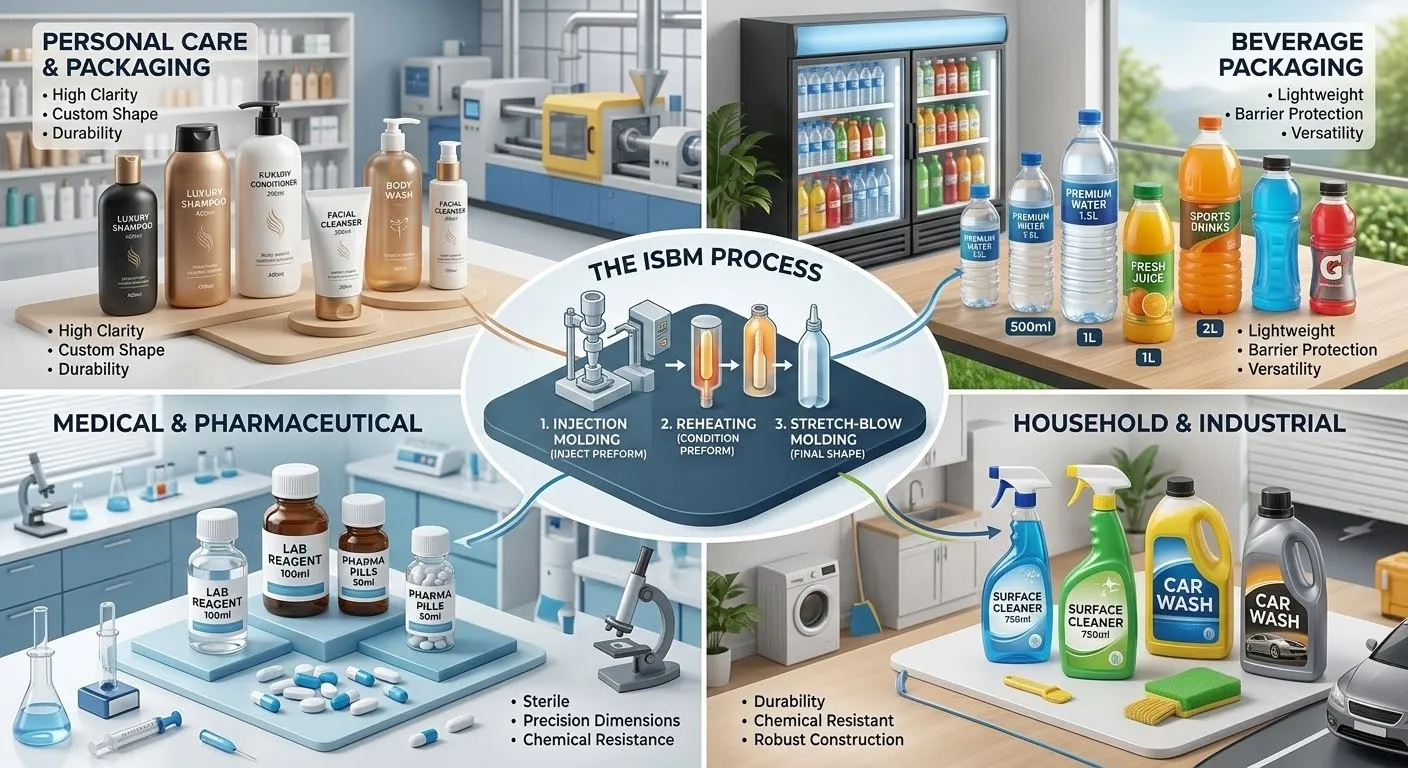
Selecting the right ISBM machine for PET bottle production requires a rigorous calculation of your required annual output, factoring in machine uptime, cycle times, and the number of cavities needed.
📊Calculating Bottles Per Year and Matching Cavitation
Begin with your target annual production volume. A facility requiring 20 million bottles per year has vastly different machine requirements than one needing 100 million. From this number, work backward. Assume a realistic machine uptime, typically 85 to 90 percent, accounting for preventive maintenance, mold changes, and unscheduled stoppages. Determine the cycle time for your container on a single cavity. A typical single-stage ISBM cycle for a standard PET bottle ranges from 10 to 15 seconds. The required number of cavities is then calculated as the target bottles per hour divided by the cycles per hour per cavity. For high-volume operations, double-row architectures such as the Machine à double rangée et 4 stations EP-HGY250-V4-B ou le EP-HGY200-V4-B multiply the cavitation while maintaining the thermal precision of single-stage processing. For extremely large preform payloads, the industrial-scale EP-HGY650-V4 represents the pinnacle of integrated throughput.
⚖️Single-Stage Throughput vs. Two-Stage Flexibility
A common dilemma when choosing an ISBM machine is weighing the integrated efficiency of single-stage against the decoupled throughput of two-stage. For many premium packaging applications, the superior container quality, lower energy consumption, and compact footprint of a single-stage machine like the EP-BPET-125V4 outweigh the sheer speed advantage of a two-stage line. However, if your operation is purely a high-volume commodity water bottle producer where the highest optical quality is not the primary market driver, a two-stage system’s independent optimization of injection and blowing may offer a throughput advantage. The decision must be grounded in your specific market positioning. Premium cosmetics, pharmaceuticals, and spirits brands overwhelmingly specify single-stage production because the container’s visual perfection is non-negotiable.
Step Three: Evaluating rPET Compatibility and Resin Flexibility
In today’s sustainability-driven market, the ability to process high percentages of post-consumer recycled PET reliably is a non-negotiable criterion for choosing the right ISBM machine.
♻️Servo-Driven Injection for Variable rPET Viscosity
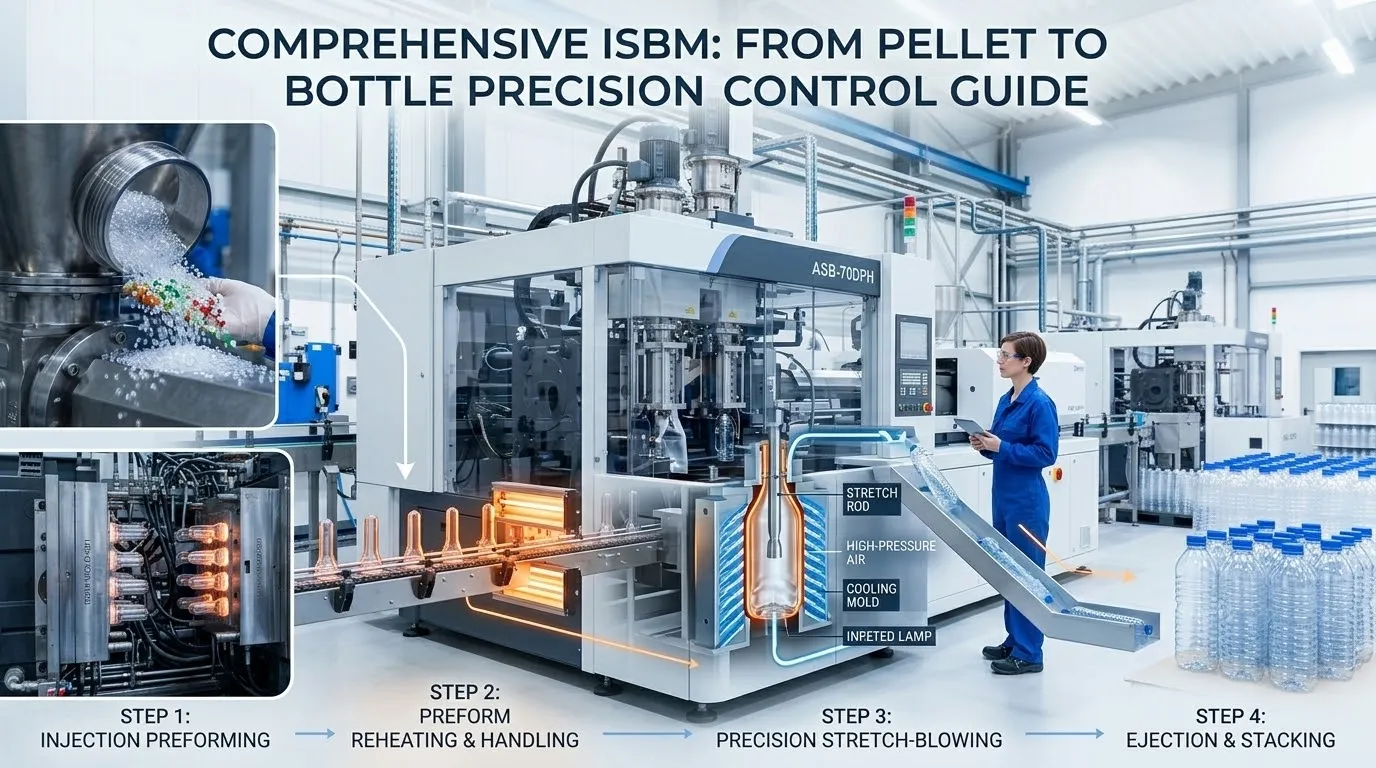
Recycled PET resin exhibits a lower and significantly more variable intrinsic viscosity compared to virgin material. This variability causes fluctuations in melt flow behavior during injection, which can lead to inconsistent preform weights, shot-to-shot variations, and a higher scrap rate. An ISBM machine equipped with a fully electric servo-driven injection unit, such as the EP-HGY150-V4-EV, addresses this challenge directly. The servo drive performs millisecond closed-loop calculations, instantaneously adjusting injection pressure and velocity to compensate for the dropping or fluctuating melt viscosity. This guarantees perfect preform density and weight consistency across every shot, even when running blends with 50 percent, 75 percent, or 100 percent rPET. When choosing your machine, prioritize servo-driven injection if rPET processing is in your roadmap.
🧬Adaptive Stretch Blow Parameters for rPET Elongation
rPET also exhibits different elongation behavior during the stretch blow phase. Its lower molecular weight and broader chain length distribution make it more brittle and prone to tearing if stretched too aggressively. The right ISBM machine for rPET production must offer programmable stretch rod motion profiles, allowing the rod velocity to be reduced and the pre-blow pressure to be adjusted for a gentler orientation ramp. Compact servo-driven platforms like the EP-HGY50-V3-EV provide this adaptive stretching capability, enabling brands to incorporate high recycled content into premium packaging without sacrificing the glass-like clarity and structural integrity that the market demands.
Step Four: Energy Efficiency, Total Cost of Ownership, and Floor Space
The purchase price of an ISBM machine is only one component of its total cost. Energy consumption, maintenance requirements, and the factory floor space it occupies are critical economic factors.
Single-Stage Thermal Efficiency Advantage
A single-stage ISBM machine leverages the latent heat already present in the injection-molded preform, avoiding the massive energy penalty of reheating a completely cold preform in a two-stage system. This translates directly into lower electricity consumption per bottle produced. When evaluating machines, request the specific energy consumption data in kilowatt-hours per thousand bottles. Servo-driven machines further enhance efficiency by only consuming energy during active motion, eliminating the constant power draw of hydraulic pumps. Over the ten to fifteen year operational life of the machine, the energy cost savings of a thermally efficient single-stage cell like the EP-HGY150-V4 can substantially exceed the initial capital investment, making it the economically superior choice in the long run.
Compact Footprint and Lean Manufacturing
A single-stage ISBM cell replaces an entire production line’s worth of equipment—injection molder, conveyor, preform storage silo, and reheat-blow molder—with one integrated machine. This dramatically reduces the required factory floor space, simplifies utility connections, and eliminates the logistical complexity and labor associated with preform handling and storage. For operations with limited floor space or those pursuing a lean manufacturing philosophy, the compact footprint of a machine like the EP-BPET-70V4 is a significant advantage. The all-in-one nature also simplifies workforce training, as operators need to master one integrated machine rather than separate injection and blow molding systems.
Maintenance, Serviceability, and Spare Parts
The best ISBM machine is one that can be maintained efficiently. Evaluate the accessibility of key components such as the injection screw, the hot runner manifold, and the stretch rod assembly. Assess the availability of spare parts and the manufacturer’s technical support infrastructure in your region. Machines designed with modularity, such as the