ISBM Machine Architecture and Engineering
اجزای کلیدی یک دستگاه قالب گیری بادی کششی تزریقی چیست؟
A comprehensive systems engineering breakdown of every critical subsystem, from the plasticizing injection unit to the stretch-blow station, that orchestrates the transformation of PET pellets into high-performance containers.
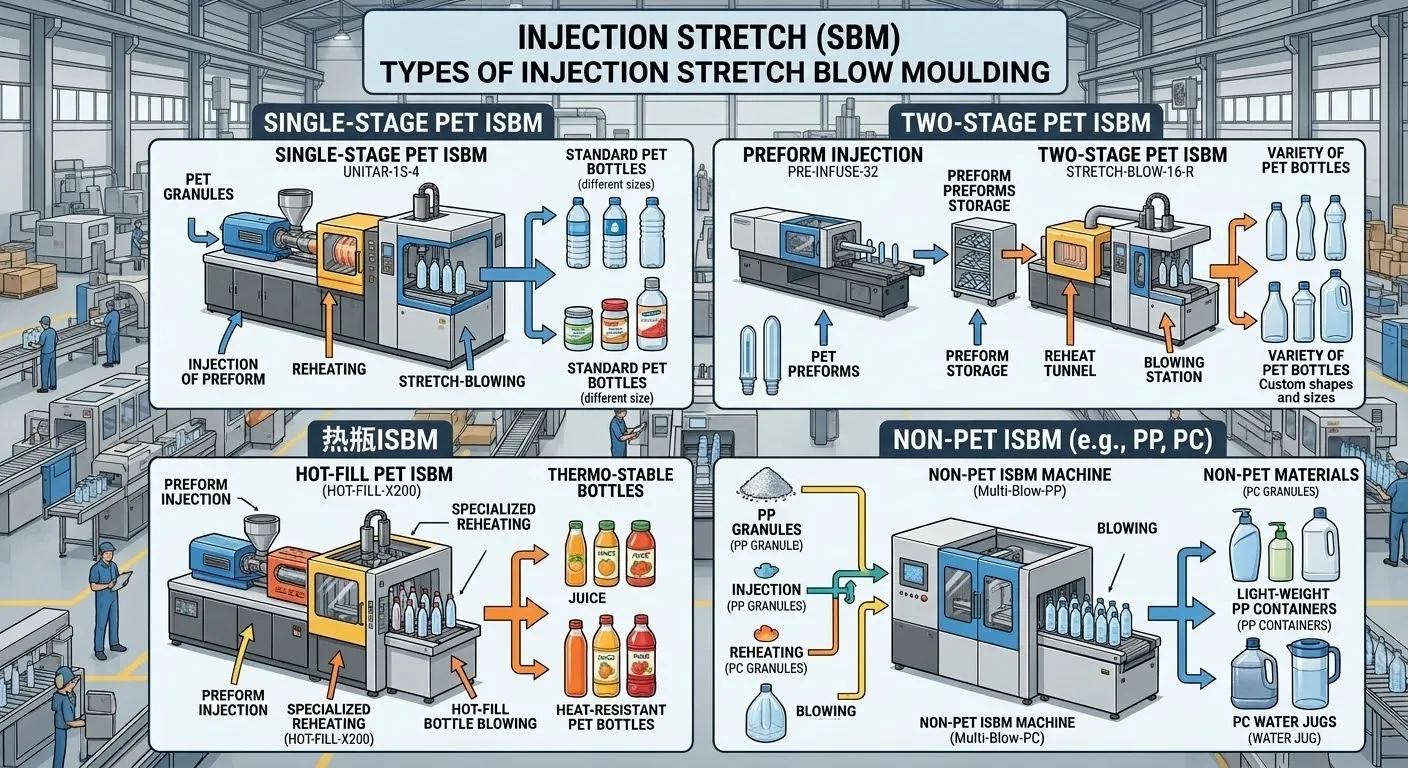
The Integrated Systems Architecture of a Single-Stage ISBM Machine
An Injection Stretch Blow Molding machine is not a simple device. It is a highly integrated, precision-engineered manufacturing cell composed of multiple sophisticated subsystems, each performing a critical, time-synchronized function in the transformation of raw polyethylene terephthalate pellets into a finished, biaxially oriented container. Understanding the key components of an ISBM machine is essential for process engineers, maintenance technicians, and procurement specialists who must evaluate, operate, or invest in this technology. At قدرت همیشگی, a globally recognized Brazilian manufacturer of ISBM equipment, our machines are architected with a meticulous attention to the performance of each individual component and the seamless integration between them.
The single-stage ISBM machine consolidates what would traditionally be two separate factories worth of equipment into one synchronized cell. Its key components span the full spectrum of polymer processing technology: a plasticizing injection unit that melts and injects the resin, a clamping system that holds the precision preform mold, a robotic transfer system that moves the hot preforms between stations, a thermal conditioning station that fine-tunes the preform temperature, a stretch-blow station that executes the critical biaxial orientation, and a sophisticated control system that orchestrates every motion and thermal event. This exhaustive technical guide will dissect each of these key components, explaining their function, design considerations, and the engineering principles that govern their performance. We will reference specific Ever-Power machine platforms, such as the دستگاه ۴ ایستگاهه EP-HGY150-V4, to illustrate how these components are realized in production-grade equipment.
A thorough knowledge of the ISBM machine components is not merely academic. It directly informs troubleshooting effectiveness, preventive maintenance scheduling, and the ability to optimize the process for different container geometries and resin grades, including the increasingly important domain of post-consumer recycled PET. Each component represents a potential point of failure or a lever for quality improvement, and mastering their interactions is the hallmark of a world-class ISBM operation.
The Plasticizing Injection Unit: Melting and Metering the Polymer
The injection unit is the starting point of the ISBM process, responsible for transforming solid PET pellets into a homogeneous, precisely metered melt.
Reciprocating Screw and Barrel Assembly
The heart of the injection unit is the reciprocating screw, which rotates within a heated barrel. Dried PET pellets gravity-feed from the hopper into the barrel throat. As the screw rotates, it conveys the pellets forward along the barrel. The combination of conductive heat from external heater bands wrapped around the barrel and frictional shear heat generated by the compression of the pellets against the barrel wall melts the PET into a homogeneous viscous fluid. The screw is designed with a specific compression ratio and a non-return valve at its tip that prevents the melt from flowing backward during the injection stroke. When sufficient melt has accumulated in front of the screw, the screw acts as a plunger, driven forward by a hydraulic cylinder or a precision ballscrew in servo-electric machines like the دستگاه سروو کامل EP-HGY150-V4-EV, injecting the molten PET under high pressure through the hot runner manifold and into the preform mold cavities.
Hot Runner Manifold and Injection Nozzles
The molten PET exiting the barrel must be distributed evenly to each preform cavity. This is the function of the hot runner manifold, a network of heated channels that split the single melt stream from the barrel into multiple streams, each feeding an individual injection nozzle. The hot runner is a critical precision component. It must maintain the PET at a perfectly uniform temperature across all channels. Any temperature variation will cause some preforms to be injected with hotter or colder material, leading to inconsistent preform weights and optical properties. The hot runner nozzles are equipped with individual heater bands and thermocouples, allowing precise zonal temperature control. The design of the hot runner manifold is a proprietary engineering discipline, and the قالبهای بادی کششی تزریقی تک مرحلهای سفارشی from Ever-Power incorporate optimized hot runner geometries that minimize shear heat generation and ensure perfect melt homogeneity across all cavities.
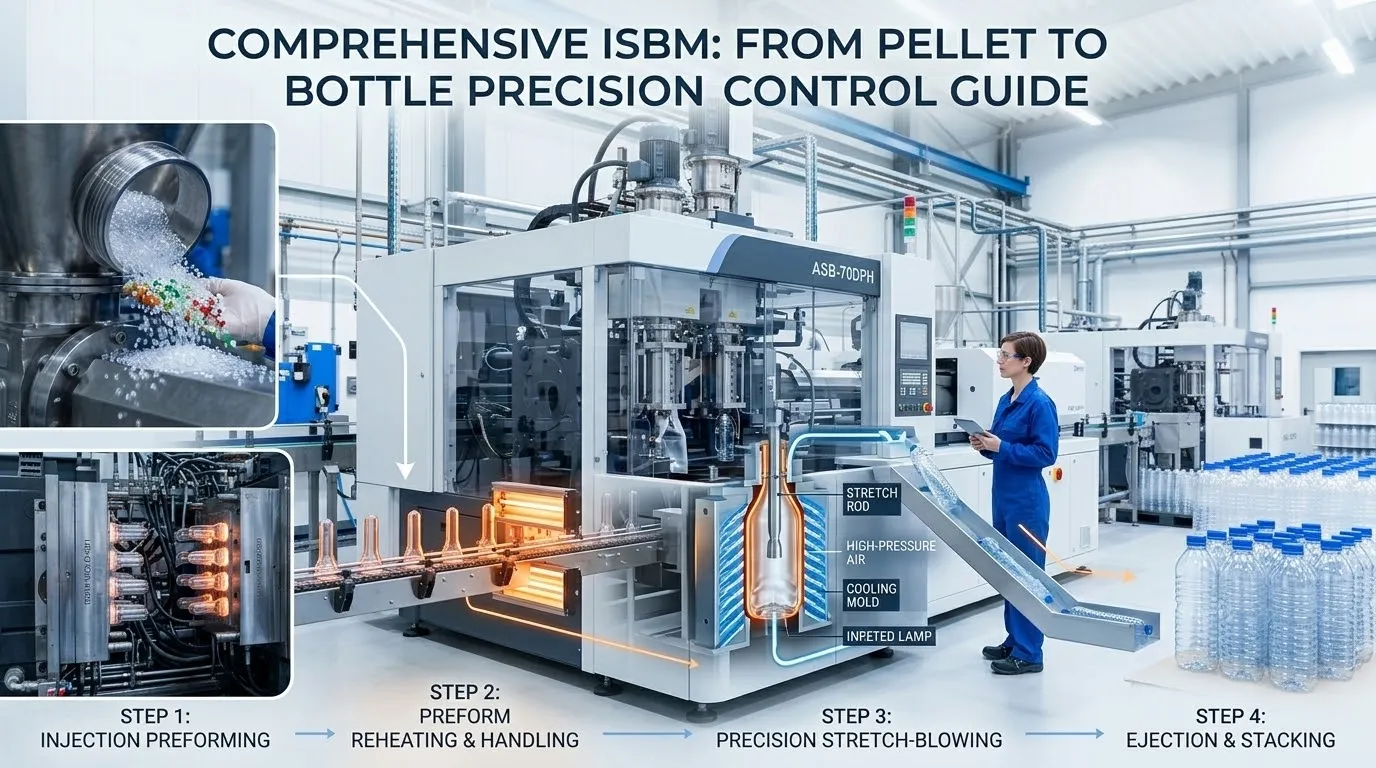
The Clamping System and Preform Injection Mold
The clamping system holds the two halves of the preform injection mold closed against the immense pressure of the injected melt, while the mold itself shapes the preform and rapidly quenches it to the amorphous state.
🔒The Clamping Mechanism
The injection clamp must generate sufficient force to resist the injection pressure, which can exceed hundreds of bar, acting on the projected area of the preform cavities. If the clamping force is insufficient, the mold halves will separate slightly during injection, causing flash—a thin web of plastic that forms at the parting line and ruins the preform. Clamping systems in ISBM machines can be hydraulic, using a direct-acting cylinder, or a toggle-link mechanism that provides a powerful mechanical advantage. Servo-electric clamping, as found on advanced platforms like the EP-HGY50-V3-EV, offers precise control over clamp force, reduced energy consumption, and cleaner operation suitable for pharmaceutical and cleanroom environments. The clamp must open and close rapidly and smoothly to minimize cycle time without causing mechanical shock that could misalign the delicate mold components.
❄️The Preform Mold and Conformal Cooling
The preform injection mold is a masterpiece of precision machining. It consists of a cavity block that forms the exterior of the preform and a core pin that forms the interior bore and the neck finish. The neck finish is formed by a split insert, often called the neck ring, which must open precisely to release the preform. The most critical engineering feature of the preform mold is its cooling system. Conformal cooling channels, drilled or additively manufactured to follow the contour of the preform, circulate chilled water at temperatures between six and ten degrees Celsius. This aggressive cooling rapidly quenches the molten PET to the amorphous state, preventing any spherulite crystal growth. The cooling must be perfectly uniform; any hot spot in the mold will produce a preform with a localized hazy patch. For high-cavitation applications, such as those running on the EP-HGY250-V4, maintaining uniform cooling across all cavities is a significant engineering challenge that Ever-Power addresses through proprietary mold design and rigorous flow analysis.
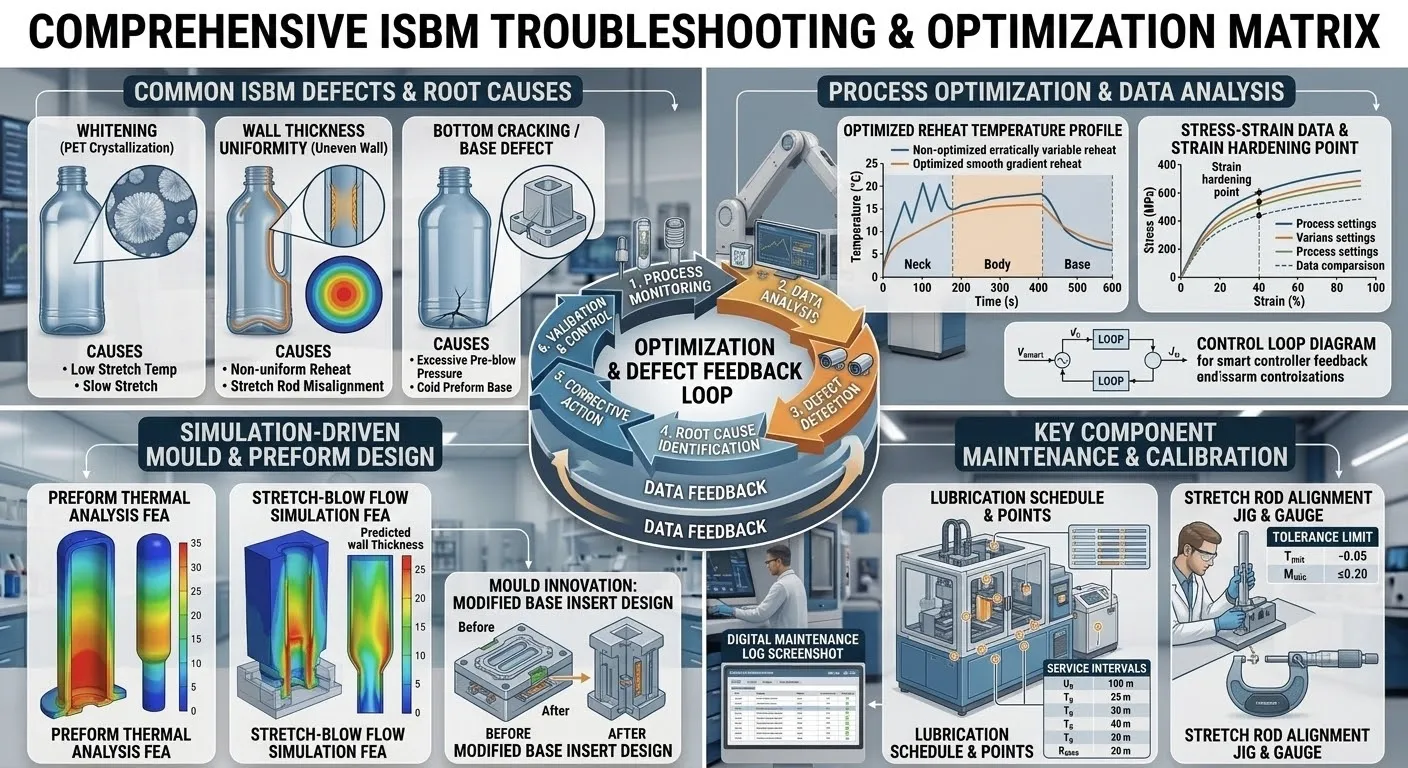
The Robotic Transfer System and Thermal Conditioning Station
Moving the hot preforms between stations and precisely adjusting their temperature profile is accomplished by two of the most critically synchronized key components of an ISBM machine.
🤖The Rotary Indexing Table and Robotic Clamps
In a single-stage ISBM machine, preforms are transported sequentially through the injection, conditioning, stretch-blow, and ejection stations. This is most commonly achieved by a rotary indexing table. A large, precision-machined steel platen rotates in precise 90-degree or 60-degree increments, depending on whether the machine is a four-station or six-station design. Attached to this rotating table are robotic clamps or transfer arms that hold the preforms by their neck rings. These clamps must grip the preforms securely without deforming the still-warm plastic or damaging the critical thread features. The indexing motion must be rapid, vibration-free, and repeatable to within microns of position. Any positioning error will cause the preforms to be misaligned in the subsequent station, leading to damaged tooling or defective containers. On high-speed machines like the EP-HGY200-V4, the indexing mechanism is driven by a precision servo motor or a high-speed hydraulic rotary actuator to minimize cycle time.
🌡️The Conditioning Pots and Thermal Fluid Circuits
The conditioning station consists of steel pots precisely contoured to cradle the exterior of the hot preform. These pots are not simple heaters; they are sophisticated thermal management devices. Each pot is connected to a circuit of circulating thermal fluid, typically a specially formulated oil, that can be precisely heated or cooled. The temperature of the conditioning pots is adjustable in single-degree increments via the machine’s temperature control modules. The pots surround the body of the preform, gently bringing the entire cross-section to a uniform temperature just above the glass transition temperature of PET. The neck finish is deliberately shielded from the heat or actively cooled to ensure it remains rigid and dimensionally stable. For complex container geometries, the revolutionary دستگاه ۶ ایستگاهه EP-HGYS280-V6 features two independent conditioning workstations, allowing a stepped thermal profile that conditions the base and body of the preform at different temperatures. This zonal thermal profiling is a key capability that enables the production of highly asymmetric or thick-base containers.
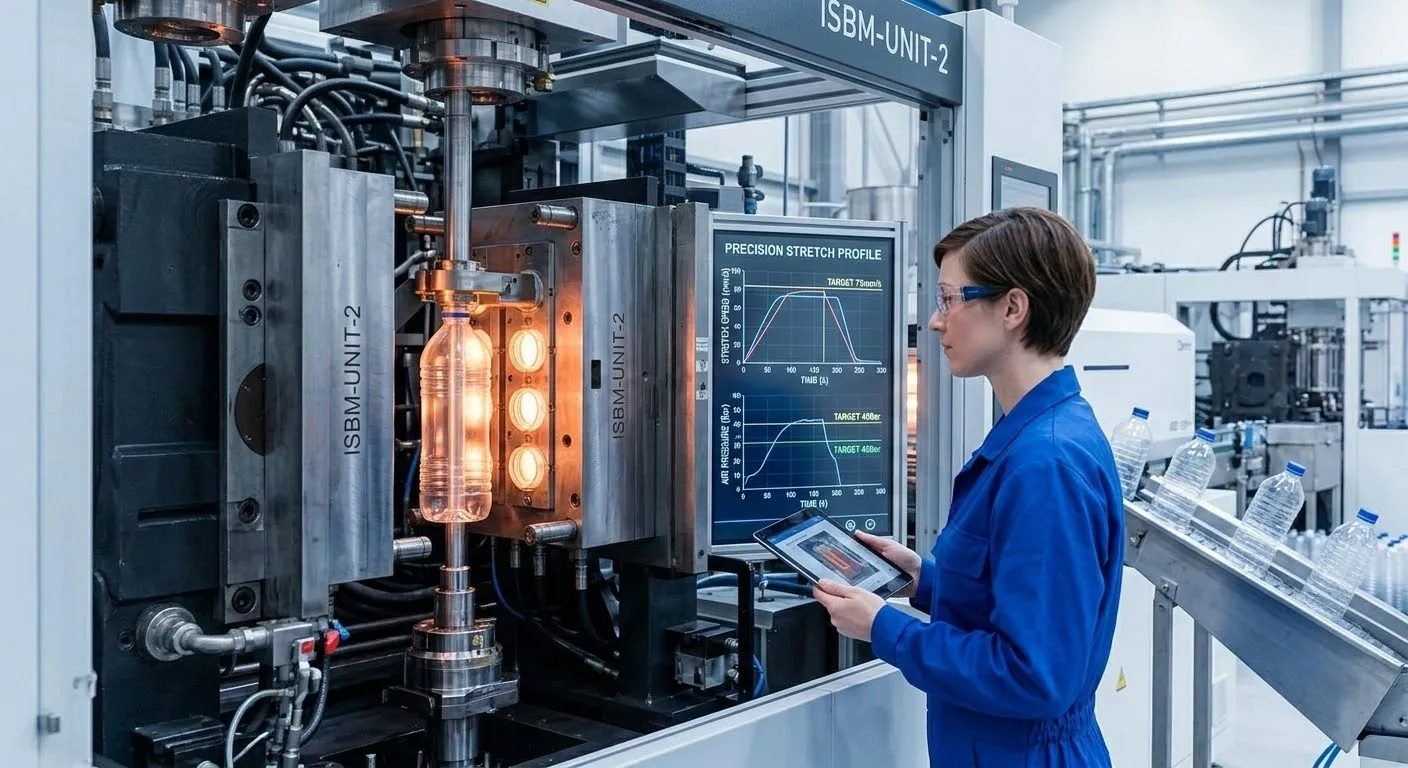
The Stretch-Blow Station: Mechanical and Pneumatic Precision
The stretch-blow station is where the defining transformation of the ISBM process occurs, and it comprises several key components working in precise synchronization.
The Stretch Rod Assembly
The stretch rod is a precision-ground, highly polished steel rod that descends into the conditioned preform to force axial elongation. It is actuated by a pneumatic cylinder, a hydraulic cylinder, or, in advanced servo-driven machines like the EP-HGY150-V4-EV, a precision ballscrew driven by a servo motor. The servo-controlled rod allows programmable motion profiles, including acceleration, constant velocity, and deceleration phases, enabling gentle contact with the preform base. The rod is often internally cooled to prevent heat buildup from friction. Its diameter, tip geometry, and stroke length are custom-designed for each specific preform and container combination, making it a critical engineered component.
The Blow Mold Cavity and Pneumatic System
The blow mold cavity forms the final container shape. It is machined from high-grade steel and polished to an extreme mirror finish to impart the glass-like aesthetic required for premium packaging. The mold incorporates precision venting channels to allow trapped air to escape as the plastic inflates. The pneumatic system consists of high-pressure air circuits, proportional pressure regulators, and fast-acting solenoid valves that control the pre-blow and final blow air. The timing of these valves, adjustable in milliseconds, is critical to achieving a defect-free container. The blow mold is also water-cooled to quickly stabilize the container before ejection. The قالبهای بادی کششی تزریقی تک مرحلهای سفارشی from Ever-Power integrate these features into a cohesive system that ensures perfect container formation.
Ejection Robotics and Take-Out System
Once the container is formed and cooled, the blow mold opens, and the finished container must be rapidly removed. Robotic take-out arms or mechanical grippers, synchronized with the machine’s indexing cycle, grasp the bottle by its neck finish and transfer it to a conveyor or collection bin. This ejection system must operate swiftly and gently. On high-cavitation double-row machines like the