What does ISBM stand for in the plastic industry?
The station count on an ISBM machine is not a simple proxy for output — it determines which operations the machine can perform per cycle, which bottle geometries it can handle, and how precisely it controls preform temperature. Specifying the wrong station count means either leaving performance on the table or paying for capability that never gets used. This guide explains what each station configuration actually does and which production scenarios each fits.
What Each Station Does
Every ISBM machine has a rotary table that indexes through its stations once per machine cycle. Each position runs a specific operation simultaneously — while one set of preforms is being injected, another is being conditioned, and a third is being blown.
Station 1 — Injection: Resin plasticised and injected into the preform mould. This station sets preform wall thickness, weight, and neck geometry. Injection is the longest single operation in the cycle.
Station 2 — Conditioning (4-station and 6-station only): The preform, still on the mandrel, passes through an infrared heating zone where its axial temperature profile is adjusted before blowing. This step enables complex bottle geometries — petaloid bases, wide-shoulder designs, oval bodies — to be produced with acceptable wall thickness distribution.
Station 3 — Stretch-Blow: The stretch rod extends and high-pressure air expands the preform into the blow mould, locking in molecular orientation. Blow time is typically 0.5–2.0 seconds.
Station 4 (6-station) — Post-Blow Cooling: The blown bottle remains in a cooling station before ejection, allowing the blow mould to open sooner and enabling a shorter overall cycle while the bottle achieves dimensional stability.
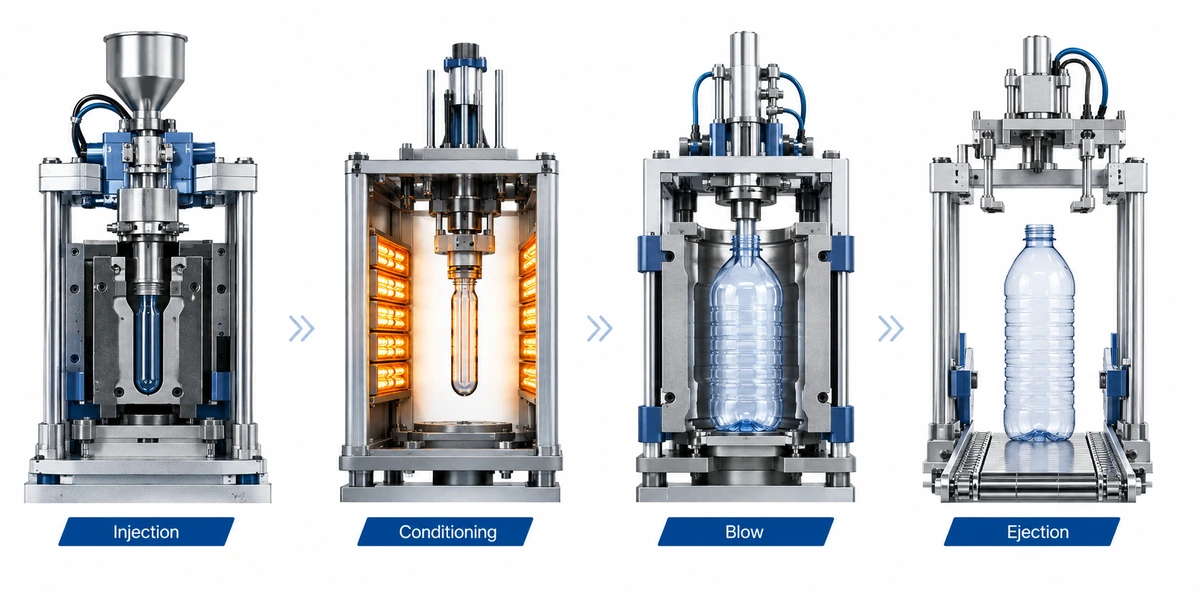
Rotary table layout for a 4-station ISBM machine — injection, conditioning, stretch-blow, and ejection operating simultaneously on indexed positions.
3-Station Machines: Compact and Direct
A 3-station machine performs injection, stretch-blow, and ejection — no dedicated conditioning step. This is the simplest and most cost-effective ISBM configuration. It is the right choice when:
- Bottle geometry is simple — round cross-section, standard shoulder, straightforward base
- Wall thickness does not need fine-tuning beyond what injection temperature alone provides
- Floor space is constrained — 3-station machines have a smaller footprint than 4-station equivalents
- Capital budget is limited — 3-station machines represent the lowest entry cost into ISBM production
Ever-Power’s EP-HGY50-V3-EV is a full-servo 3-station machine with a 50 kN injection clamp, suited to pharmaceutical, cosmetic, and small food containers up to approximately 500 ml with 1–2 cavities.
4-Station Machines: The Industry Standard
Four-station machines represent the dominant configuration in industrial ISBM production, covering the widest range of applications with the best balance of output, flexibility, and process control. The conditioning station between injection and blow enables:
- Precise axial temperature profiling — heat concentrated in the body while the neck stays cool, or concentrated at the shoulder for pronounced contours
- Better wall thickness uniformity on complex shapes — particularly for wide bases, contoured bodies, or integral handles
- Higher output through increased mould cooling time relative to the injection cycle
Ever-Power’s 4-station range covers injection clamping forces from 100 kN to 400 kN: the EP-HGY150-V4, EP-HGY150-V4-EV, EP-HGY200-V4, EP-HGY200-V4-B, EP-HGY250-V4, EP-HGY250-V4-B, EP-HGY650-V4, EP-BPET-70V4, and EP-BPET-125V4.
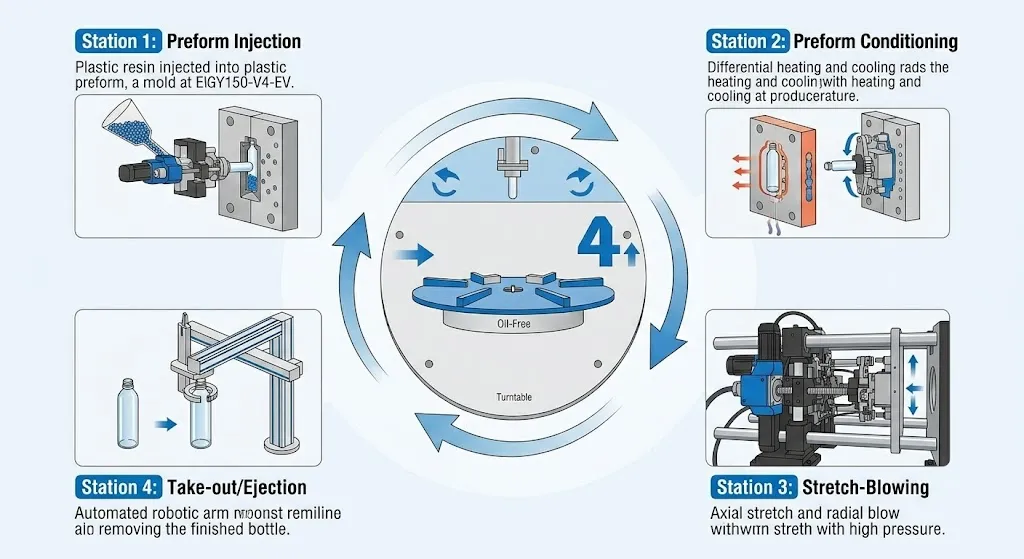
Sequential 4-station process on the EP-HGY150-V4-EV — each indexed position operates simultaneously, so conditioning time equals injection time.
6-Station Machines: High Throughput and Complex Shapes
Six-station machines add two further positions — typically a second conditioning stage and a dedicated post-blow cooling station. The EP-HGYS280-V6 is Ever-Power’s 6-station model, designed for applications requiring either very high cycle speeds or exceptional wall thickness control on demanding geometries.
The two conditioning stations allow a two-zone infrared profile — a coarser adjustment at station 2 followed by a fine-tuning step at station 3 — before the preform reaches the blow station. This level of control is used in premium cosmetic packaging, containers with tight weight tolerance specifications, and designs requiring hot-fill heat-setting.
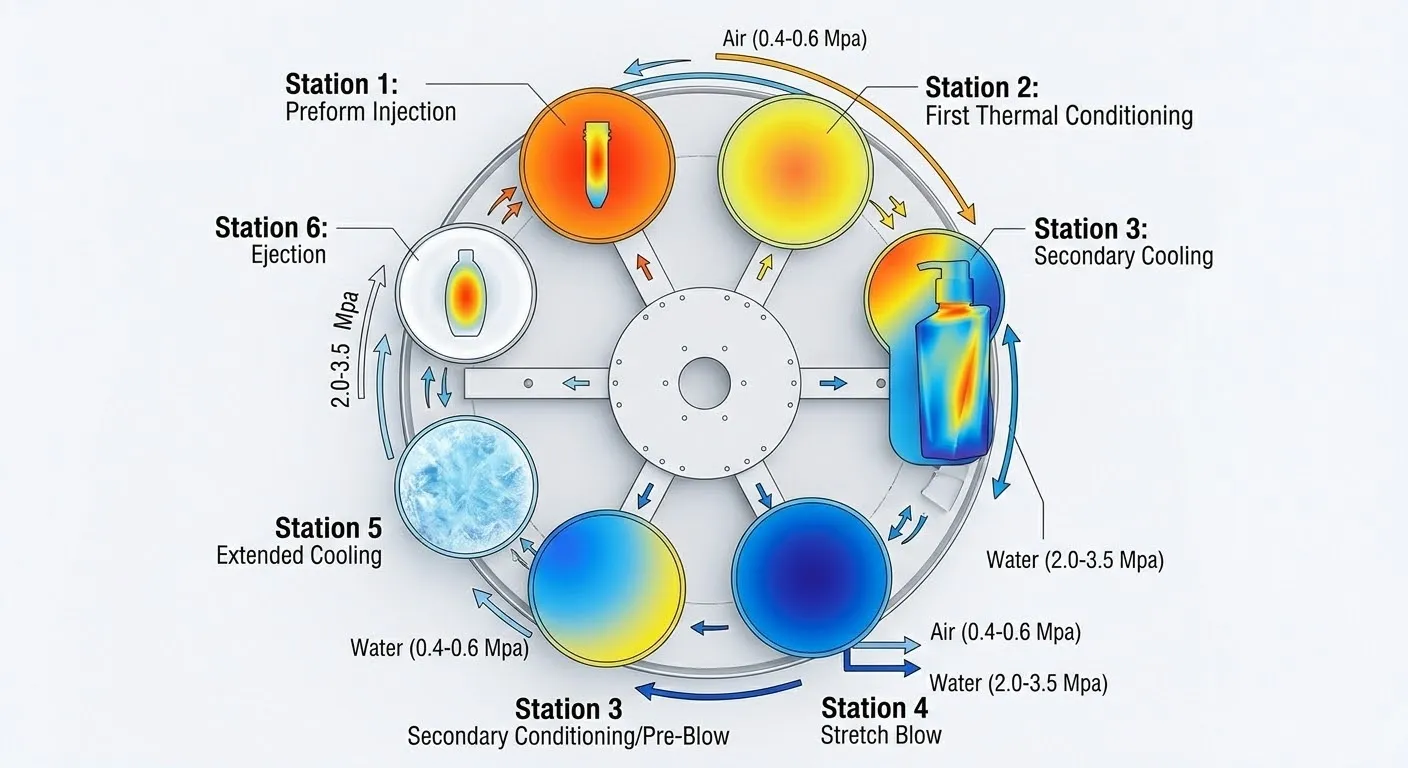
6-station ISBM process — injection, dual conditioning, stretching, blowing, cooling, and ejection operating in parallel, enabling higher cycle rates on complex bottle geometries.
Configuration Selection at a Glance
| Requirement | 3 estaciones | 4 estaciones | 6-Station |
|---|---|---|---|
| Simple round bottles | Ideal | Yes | Yes (overkill) |
| Formas complejas | Limited | Standard | Best |
| Maximum cycle speed | Moderado | Bien | Highest |
| Capital cost | Lowest | Mid | Highest |
| Hot-fill / heat-set applications | Not recommended | Possible | Optimal |
Not sure which station count fits your production plan?
Share your bottle drawing, target output, and resin type with Ever-Power and we will identify the optimal machine configuration with a cycle time estimate.
See technical details on our 3, 4, and 6-station ISBM machine models, or explore how mould design interacts with station count to determine achievable bottle complexity.
How Station Count Affects Mould Design
The station count influences mould design in ways that go beyond the machine’s mechanical configuration. On a 3-station machine, the preform must arrive at the blow station with a temperature profile derived entirely from the injection moulding step — controlled through barrel temperature, injection speed, cooling time, and mould temperature. On a 4-station machine, the conditioning station allows the preform to be reheated in zones after ejection from the preform mould, which means the preform mould can be designed to cool more aggressively (shorter cycle time) knowing that any temperature adjustment needed for blowing will be applied at the conditioning station.
This difference has a practical implication for mould cost and design complexity: 4-station machines allow the use of simpler preform moulds with less precise internal temperature zoning, because the conditioning station compensates for any axial temperature non-uniformity introduced during injection cooling. On 3-station machines, the preform mould must achieve the correct axial temperature gradient on its own, which requires more precise cooling channel design and may require a longer overall cooling time to achieve an acceptable profile.
Cycle Time Comparison
The relationship between station count and cycle time is counterintuitive for buyers who assume that more stations means a longer cycle. In practice, the opposite is often true for complex bottles. On a 3-station machine producing a difficult bottle geometry, the operator must run a long cooling time in the preform mould to achieve a usable temperature profile for blowing — which extends the overall cycle. On a 4-station machine, the preform mould can be opened sooner (shorter cooling) because the conditioning station will correct the temperature profile. The result is a faster overall cycle on the 4-station machine for the same complex bottle.
For simple, thin-walled bottles — a 250-ml cylindrical water bottle with uniform wall thickness, for example — a 3-station machine can be faster than a 4-station equivalent because the conditioning step adds index time that is not needed.
Energy Consumption by Station Count
All else being equal, more stations means more actuators, more cooling circuits, and more infrared heaters — and therefore higher installed power. However, modern servo-driven 4-station machines (such as the EP-HGY150-V4-EV) consume significantly less energy per bottle than older fixed-hydraulic 3-station machines, because the servo drive’s energy-on-demand operation more than offsets the additional station’s power requirement. When comparing machine energy consumption, always compare energy per thousand bottles produced — not installed kW — to account for cycle time and output differences between configurations.
Preguntas frecuentes
Can a 3-station machine be upgraded to 4 stations?
No. The station count is determined by the machine’s rotary table design and the number of indexed positions built into the machine at manufacture. Adding a station would require replacing the entire rotary table and associated drive and control systems — essentially building a new machine. If you anticipate needing 4-station capability, specify a 4-station machine from the outset.
Does a 6-station machine always produce more output than a 4-station machine?
Not necessarily. For simple bottle geometries, a 4-station machine can be faster than a 6-station equivalent because the two additional stations add index time without contributing additional cooling or conditioning time for straightforward containers. The 6-station advantage is in complex bottle geometries and hot-fill applications, where the additional conditioning and cooling time enable a usable cycle that a 4-station machine cannot achieve without unacceptably long injection-station hold times.
What is the smallest bottle a 4-station ISBM machine can produce?
This depends on the machine’s minimum shot weight and injection unit capability, not the station count. The EP-HGY150-V4, for example, can produce bottles as small as 30–50 ml when the mould is designed for small cavities. The practical minimum on most 4-station machines is determined by the minimum controllable shot weight of the injection unit rather than the blow station geometry.
Which Ever-Power model covers the widest bottle size range?
The EP-HGY250-V4 and EP-HGY250-V4-B cover a broad range from approximately 200 ml to 5 litres with appropriate mould tooling. For containers above 5 litres, the EP-HGY650-V4 with its 400 kN injection clamp extends the range to approximately 10 litres. Contact Ever-Power with your specific bottle dimensions and we will confirm the right model.