
How does a stretch rod work in blow molding?
The stretch rod is the mechanical component that distinguishes injection stretch blow moulding (ISBM) from injection blow moulding (IBM) and extrusion blow moulding (EBM). It is a precision-ground steel rod that descends into the warm preform at the blow station and mechanically extends it axially — pushing the base downward — before high-pressure blow air expands it radially. The combination of axial extension by the stretch rod and radial expansion by blow air produces biaxial molecular orientation, which is the physical property responsible for PET bottles’ glass-like clarity, high strength at low wall thickness, and CO₂ barrier performance.
The Stretch Rod’s Role in the ISBM Cycle
At the blow station, the preform — still on its mandrel and at the correct conditioning temperature — is enclosed within the closed blow mould. The stretch rod enters the preform through its open neck and contacts the preform base dome with a controlled, flat tip. The rod then extends downward at a controlled speed (typically 1–2 m/s), pushing the preform base toward the bottom of the blow mould cavity and elongating the preform body. This is the axial stretch step.
Simultaneously with or immediately after the stretch rod contact, low-pressure pre-blow air (typically 6–10 bar) is introduced through the blow pin to begin inflating the preform radially — preventing it from folding or collapsing inward as it is extended. The stretch rod continues to travel until the preform base contacts the bottom of the blow mould. High-pressure blow air (25–40 bar) is then introduced to complete the radial expansion of the preform body against the mould wall, forming the finished bottle shape. The stretch rod is withdrawn after the bottle is fully blown and the mould continues to cool the bottle before opening.
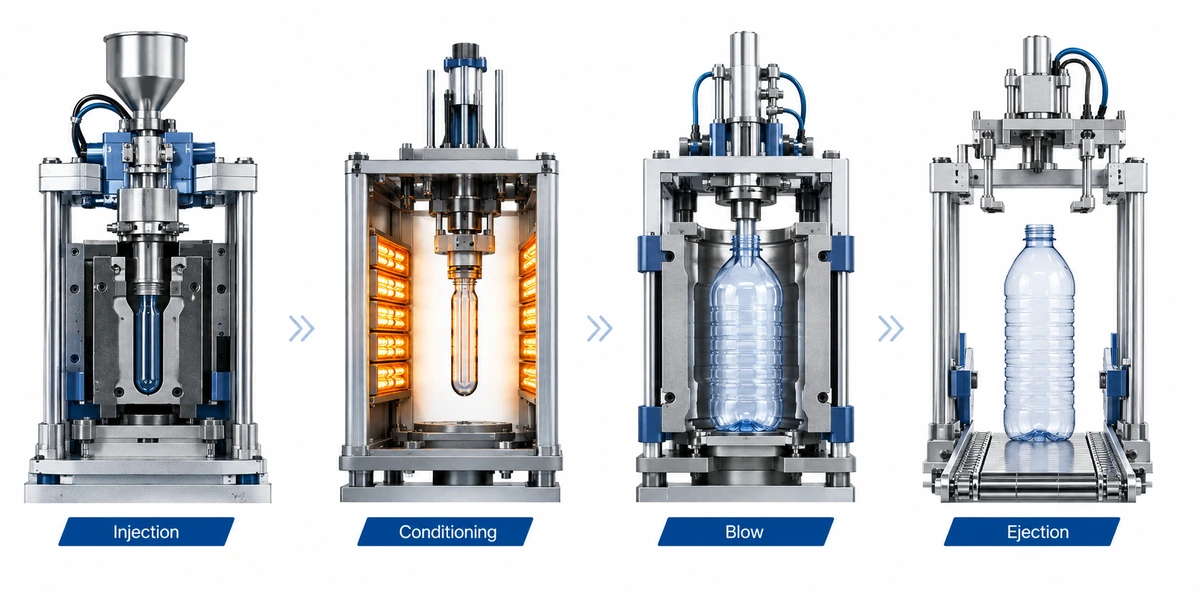
ISBM blow station — the stretch rod contacts the preform base and extends axially while pre-blow and blow air expand the preform radially, producing simultaneous biaxial orientation.
¿Por qué importa la orientación biaxial?
The stretch rod’s axial extension and the blow air’s radial expansion together align the PET polymer chains simultaneously in two directions. This biaxial alignment is fundamentally different from the random chain arrangement in unoriented amorphous PET. The oriented chains are much more resistant to deformation and light scattering than randomly arranged chains, producing the following properties in the finished bottle:
- Resistencia a la tracción 2–3 times higher than unoriented PET at equivalent wall thickness, enabling wall thicknesses of 0.2–0.4 mm that could not support the bottle’s internal pressure or handling loads if unoriented
- Claridad óptica above 90% light transmittance — the aligned chains scatter much less light than randomly arranged chains, producing the glass-like appearance characteristic of ISBM PET bottles
- CO₂ barrier sufficient for carbonated beverages — the dense, oriented chain packing reduces the diffusion rate of CO₂ molecules through the bottle wall
- Resistencia al impacto por caída to 1.5 m when filled with water — the oriented chains distribute impact energy across a large area rather than concentrating it at a failure point
Without the stretch rod, IBM and EBM machines produce bottles by air inflation alone. The resulting containers are unoriented (amorphous) PET or HDPE, which are hazy or opaque, heavier for the same volume, and lack the mechanical and barrier properties of oriented PET.
Stretch Rod Control Parameters
The stretch rod is controlled by several parameters that must be correctly set for each bottle format. These parameters are saved in the machine’s recipe system and recalled with the mould changeover:
| Parámetro | Typical Range | Effect if Incorrect |
|---|---|---|
| Rod extension speed | 1.0–2.0 m/s | Too fast: preform tears; too slow: uneven orientation |
| Rod extension distance | Set by bottle height | Too short: base not fully formed; too long: rod hits mould |
| Pre-blow onset timing | 5–30% of stroke | Too late: preform collapses inward during stretch |
| Rod tip geometry | Flat, hemispherical, or tapered | Wrong geometry: uneven base thickness or gate mark |
| Rod diameter | Matched to preform ID | Too large: rod contacts preform wall; too small: poor control |
Axial Stretch Ratio: What It Is and How to Control It
The axial stretch ratio is the ratio of the finished bottle height to the stretched preform body length (approximately the preform body length before stretching). For standard PET water bottles, the axial stretch ratio is typically 2.5–3.5:1. Too low a stretch ratio produces insufficient axial orientation, resulting in a weaker bottle with lower clarity in the body area. Too high a stretch ratio (above approximately 3.5:1 for standard PET) causes stress whitening — a white haze in the over-stretched zone, most commonly visible at the base or lower sidewall, caused by the polymer chains exceeding their extensibility limit and beginning to develop micro-voids rather than orient further.
The axial stretch ratio is set by the relationship between the preform body length and the bottle height, which is fixed at the mould design stage. It cannot be changed in production without a different mould. The stretch rod travel distance is set to match the bottle height, and is not independently adjustable as a process variable — it simply must reach the mould base. The rate of rod travel, however, affects how quickly the axial orientation develops and interacts with the pre-blow pressure, making rod speed an important process variable for bottles with complex base geometries.
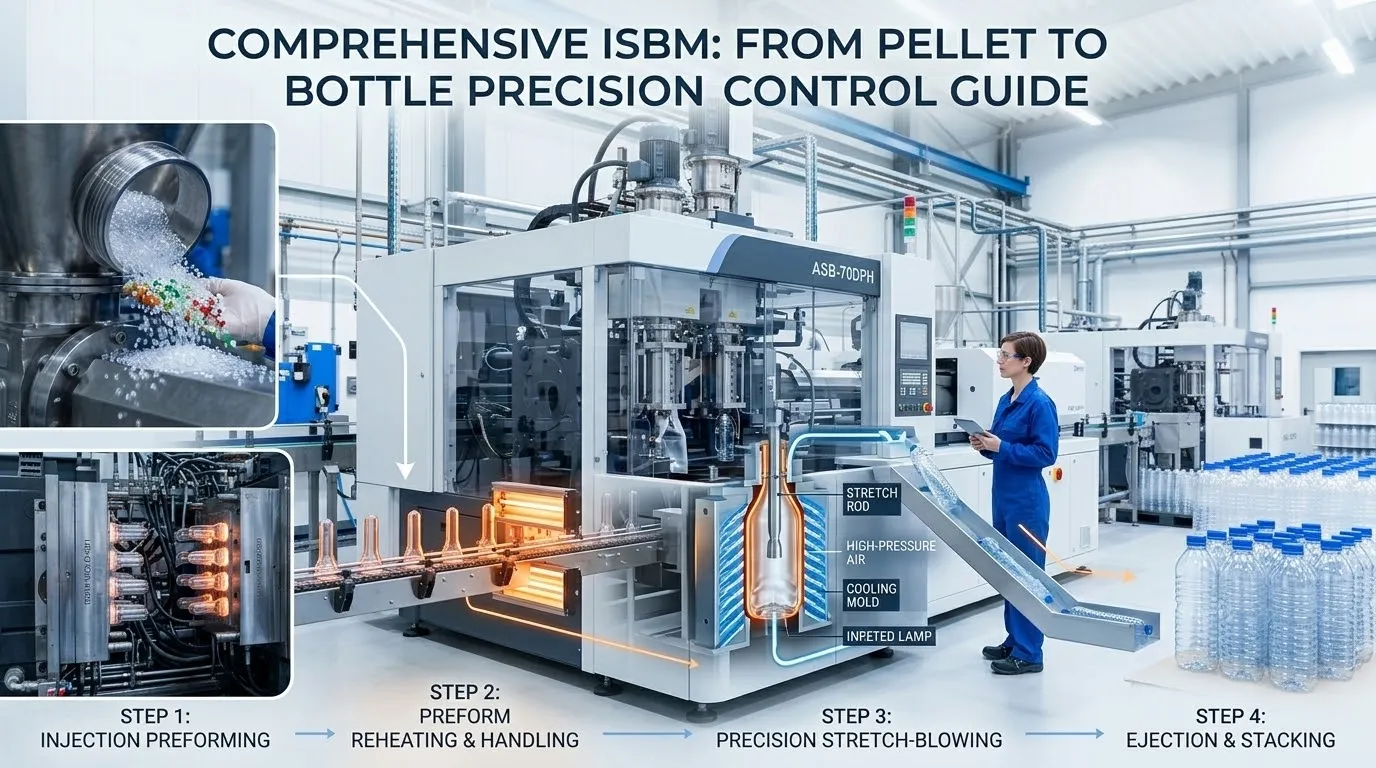
ISBM process parameter map including stretch rod control — rod speed, pre-blow timing, and high-pressure blow onset together determine the biaxial orientation achieved in the finished bottle.
Need technical support on stretch rod parameters for a new bottle format?
Ever-Power provides full process documentation and commissioning support for all EP-HGY and EP-BPET installations, including stretch rod parameter development for new bottle formats. Contact our process team with your preform and bottle drawings.
Ver el completo EP-HGY ISBM machine range with stretch rod specifications, or explore opciones de moldes personalizados where preform length and bottle height are designed to achieve the correct axial stretch ratio for your container.
Preguntas frecuentes
How is the stretch rod maintained?
The stretch rod requires periodic inspection for straightness (a bent rod produces asymmetric bottles), tip condition (wear or damage to the tip produces uneven base thickness), and seal condition (the rod travels through a pneumatic or mechanical seal in the blow pin; worn seals allow blow air leakage that reduces effective blow pressure). Stretch rod replacement is typically scheduled every 500,000–2,000,000 cycles depending on material and tip geometry. Ever-Power includes stretch rod maintenance schedule and spare rod specifications in the machine documentation package.
Can the stretch rod be adjusted for different bottle heights?
The stretch rod travel distance can be adjusted within a range on ISBM machines to accommodate different bottle heights during a mould changeover. The adjustment sets the rod’s maximum extension distance to match the new bottle’s base position in the blow mould. A different stretch rod may also be required if the new bottle format has a significantly different body diameter or preform neck insert geometry. Ever-Power provides a stretch rod change procedure and format-specific rod parameters with each mould set supplied.
What is the difference between stretch ratio and blow ratio?
Stretch ratio refers to the axial direction: finished bottle height divided by stretched preform body length, typically 2.5–3.5:1 for standard PET. Blow ratio (or hoop ratio) refers to the radial direction: finished bottle body diameter divided by preform body outer diameter, typically 3–5.5:1 for standard PET. Together, the axial stretch ratio and the hoop blow ratio determine the degree of biaxial orientation in the finished bottle. Optimum bottle performance occurs when both ratios are within the range that produces full orientation without exceeding the resin’s extensibility limit in either direction.
Common Stretch Rod Problems and How to Correct Them
When the stretch rod parameters are incorrectly set, or when the rod develops wear or damage, specific bottle defects appear that help diagnose the problem. Understanding the relationship between stretch rod condition and bottle quality defects allows operators to diagnose and correct issues quickly without involving engineering support for every quality deviation.
Stress whitening at the base: the most common stretch rod-related defect. White haze at the bottle base indicates that the axial stretch ratio has been exceeded — the polymer chains at the base have passed their orientation limit and begun to develop micro-voids. Corrective action: reduce the rod extension distance (if adjustable) or redesign the preform with a longer body to reduce the axial ratio. This defect is a mould design issue, not a rod maintenance issue, if the rod is undamaged.
Asymmetric base: if the bottle base is thicker on one side than the other, the stretch rod may be bent, misaligned relative to the blow mould centreline, or worn on one side of the tip. Inspect the rod for straightness and tip condition; replace if deformed. Also check that the mandrel-to-blow-mould alignment is correct and that the blow mould is closing symmetrically around the preform.
Preform base not reaching mould bottom: the base zone of the finished bottle appears heavier than designed, and the container is too short. The rod extension distance is set shorter than the bottle height requires, or the rod speed is too slow relative to the pre-blow onset, allowing the base to start inflating before the rod has completed its travel. Adjust rod extension distance and pre-blow timing as per the machine’s process setup procedure.
Hazy sidewall despite correct conditioning temperature: if the rod speed is too fast relative to the pre-blow onset, the preform body can be partially cooled by contact with the mould wall before it is fully expanded radially. This produces areas of lower orientation with associated haze. Adjusting the pre-blow onset timing earlier (relative to rod travel) allows the preform to inflate radially before it cools against the mould wall.