注塑成型和吹塑成型有什么区别?
Injection moulding and blow moulding are both thermoplastic forming processes, but they produce fundamentally different types of parts and serve completely different applications. Injection moulding produces solid plastic components. Blow moulding produces hollow containers. Understanding this distinction — and where one-step ISBM sits between them — is essential before specifying equipment for any plastics production operation.
Injection Moulding: Solid Parts
In standard injection moulding, molten plastic is injected under high pressure into a closed mould cavity. The mould defines the external and internal geometry of the part completely — the plastic fills the entire mould space and solidifies against the mould walls. The result is a solid plastic component: a cap, a gear, a housing, a medical device part, or a preform for downstream blow moulding. Injection moulding cannot produce hollow containers because the process has no mechanism to create enclosed internal volume.
Blow Moulding: Hollow Containers
Blow moulding produces hollow plastic containers by inflating a warm plastic tube or preform against the internal walls of a closed mould using air pressure. The plastic stretches to conform to the mould shape, producing a thin-walled hollow part. The internal volume is created by the air pressure. The three main types of blow moulding are extrusion blow moulding (EBM), injection blow moulding (IBM), and injection stretch blow moulding (ISBM).
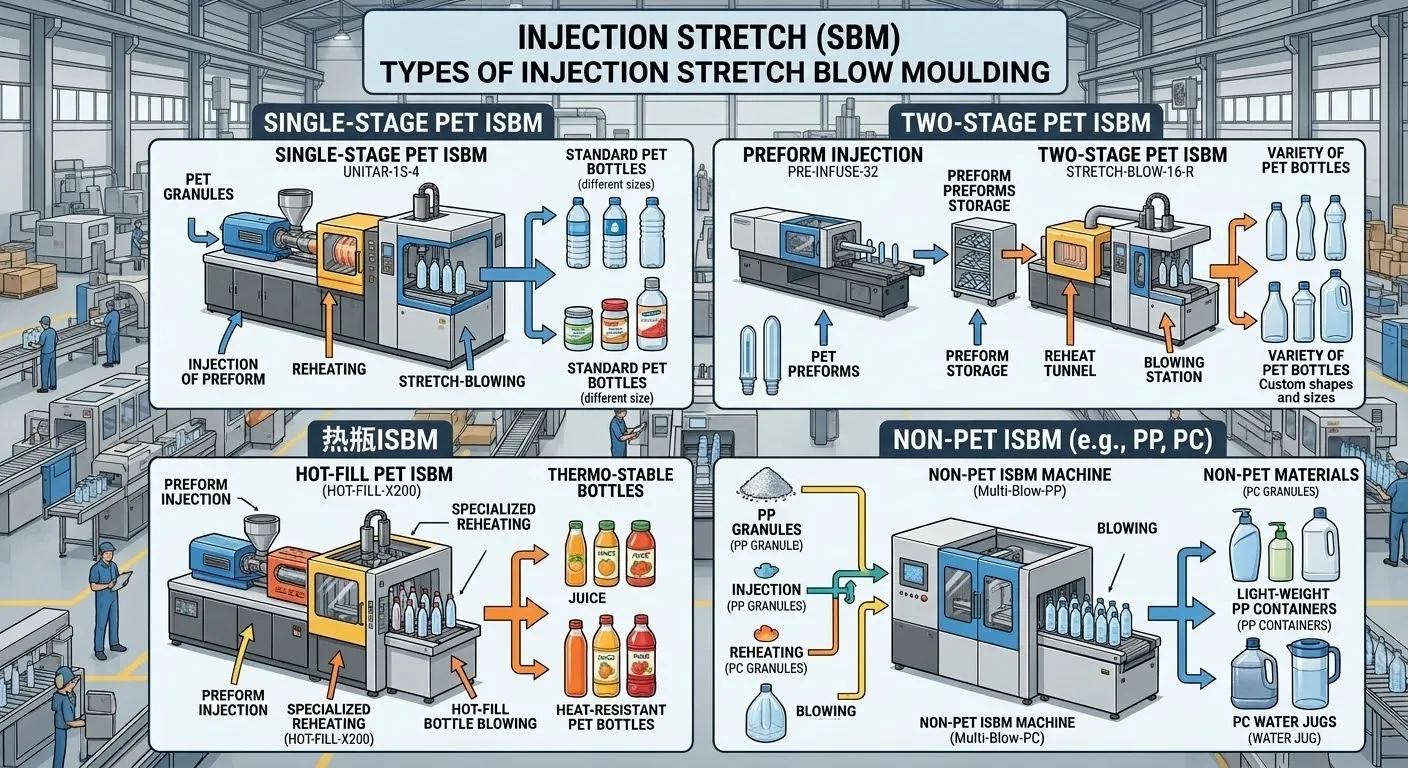
Blow moulding process types — all produce hollow containers through air-pressure inflation, with ISBM adding biaxial molecular orientation for superior bottle performance.
Key Differences at a Glance
| Attribute | Injection Moulding | Blow Moulding (ISBM) |
|---|---|---|
| Output type | Solid or near-solid parts | Hollow containers |
| Forming mechanism | High-pressure melt fills closed mould | Air pressure expands preform against mould |
| Wall thickness | Set by mould geometry, can be thick | 0.2–0.5 mm, determined by stretch ratio |
| Molecular orientation | None (isotropic) | Biaxial (ISBM) — stronger and clearer |
| Typical applications | Caps, closures, housings, preforms | Bottles, jars, vials, containers |
| Common resins | ABS, PA, PC, PP, PET, many others | PET, PP, PETG, HDPE, PC |
Where One-Step ISBM Combines Both Processes
One-step ISBM integrates injection moulding and blow moulding in a single machine. At the injection station, the preform is injection moulded from resin pellets. At the blow station, the still-warm preform is stretched and blown into the finished bottle. Both processes happen in sequence on the same rotary table within the same machine cycle — one machine, one operator, one resin input, finished bottles out.
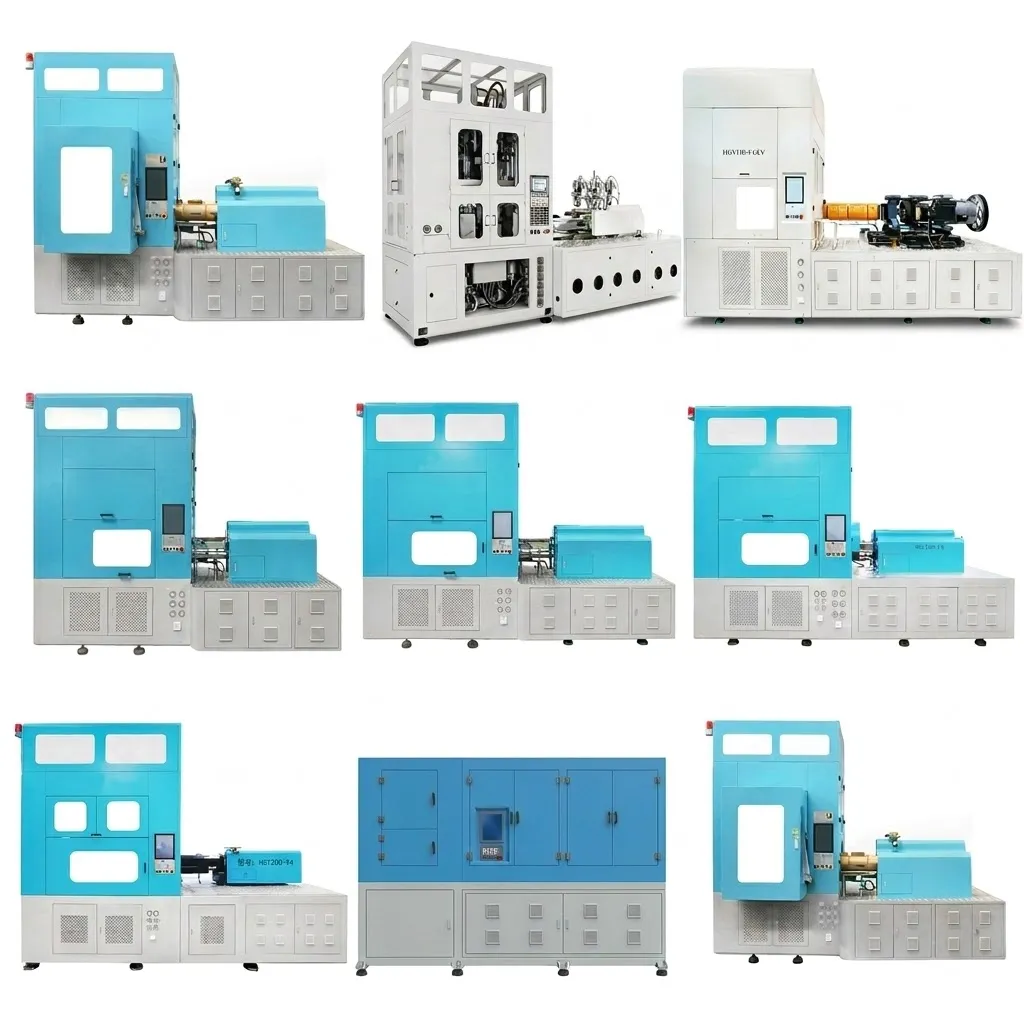
Container range from one-step ISBM — the process combines injection moulding (preform formation) and blow moulding (container shaping) in a single integrated cycle.
Which Process Do You Need?
If you need solid plastic parts, specify an injection moulding machine. If you need finished hollow bottles or containers, specify a blow moulding machine. For the simplest capital structure with no intermediate preform supply chain, specify a one-step ISBM machine: pellets in, finished bottles out.
Need a one-step ISBM machine for finished bottle production?
Ever-Power supplies one-step ISBM machines covering 30 ml to 10-litre containers in PET, PP, and PETG. Send your bottle specification for a 24-hour response.
See the full EP-HGY and EP-BPET ISBM machine range, or explore custom mould options for your container format.
常见问题解答
Can an injection moulding machine also produce bottles?
A standard injection moulding machine cannot produce finished bottles directly. It can produce preforms that are later blown in a separate machine (two-step process). A one-step ISBM machine integrates injection and blow in the same platform and produces finished bottles directly from resin pellets, but it is purpose-built for this and is not a standard injection moulding machine.
Why can ISBM produce lighter bottles than injection moulding?
Because biaxial molecular orientation in ISBM dramatically increases the structural strength of the container wall, allowing it to be blown to wall thicknesses of 0.2–0.5 mm while still meeting structural requirements. An injection-moulded PET container at the same volume would need walls of 2–5 mm to achieve equivalent performance, requiring 10–20 times more resin. ISBM’s light-weighting is a direct result of the orientation it produces.
What is the injection moulding step in a one-step ISBM machine?
In a one-step ISBM machine, the injection step produces a thick-walled preform — a tube closed at one end with the finished neck geometry already formed. The preform is then transferred, still warm, to the conditioning and blow stations where it is stretched and inflated into the final bottle. The injection step is mechanically identical to standard injection moulding but produces an intermediate preform rather than a finished part.
Why Buyers Confuse the Two Processes
Confusion between injection moulding and blow moulding in procurement arises partly because “injection moulding” is sometimes used loosely to mean any plastics forming process that uses injection pressure — including the injection step in ISBM. When a supplier describes their ISBM machine as “an injection moulding machine,” they are technically correct that injection moulding is one of its steps, but the machine’s output is hollow containers, not solid parts. Always confirm the output type when evaluating plastics machinery options. The question to ask is simple: “What comes out of this machine?” If the answer is solid parts, it is an injection moulding machine. If the answer is finished hollow bottles or containers, it is a blow moulding machine regardless of how the intermediate is formed.
Capital Structure Comparison: Two-Step vs One-Step for Bottle Production
For a buyer who wants to produce finished PET bottles and is evaluating capital structure options, the comparison is between: (A) a standalone injection moulding machine to produce preforms plus a separate reheat stretch blow moulding machine to blow them into bottles (two-step); and (B) a single one-step ISBM machine that integrates both in one cycle. Option A requires two machines, two sets of moulds, preform storage and handling infrastructure, and coordinated scheduling. Option B requires one machine, one mould set (preform and blow mould in the same machine), no preform storage, and simpler production management. For most buyers at volumes up to 10,000 bottles per hour, option B — one-step ISBM — offers simpler, more compact, and more capital-efficient bottle production.
Resin Efficiency: The Biggest Economic Difference Between the Processes
The most impactful economic difference between injection moulding and blow moulding for container production is resin efficiency. An injection-moulded PET container at 500 ml would require 40–60 g of PET to achieve adequate structural performance. An ISBM-produced 500 ml PET water bottle weighs 8–10 g. This 5–7.5 times difference in resin use per unit means that, for container production, ISBM is dramatically more material-efficient than injection moulding. Biaxial orientation — the mechanism that enables this light-weighting — is only achievable through the blow moulding step; injection moulding alone cannot produce it. For buyers who previously assumed that injection moulding could replace blow moulding for container production by simply injecting into a hollow cavity, this resin efficiency difference explains why blow moulding is the only practical process for producing commercially viable lightweight containers.
The Role of Molecular Orientation in Distinguishing the Two Processes
The deepest technical difference between injection moulding and blow moulding (specifically ISBM) lies at the molecular level. Standard injection moulding produces solid parts with randomly oriented polymer chains — the molecular structure is isotropic, meaning properties are the same in all directions. This is appropriate for solid parts where strength in multiple directions and consistent shrinkage are the design priorities.
ISBM produces hollow containers with biaxially oriented polymer chains — aligned in both the axial and hoop directions by the simultaneous stretch-and-blow operation. This biaxial orientation transforms the mechanical properties of the container wall: tensile strength increases up to 3 times, optical clarity rises above 90% light transmittance (versus hazy or translucent for unoriented PET), and the container can be produced at wall thicknesses of 0.2–0.5 mm rather than the 2–5 mm required for injection-moulded containers at equivalent structural performance. The entire value proposition of PET bottle production — light weight, clarity, barrier performance, recyclability — depends on this biaxial orientation that only ISBM (and not standard injection moulding) produces.
Tooling Differences: Injection Mould vs ISBM Mould Set
The tooling used in standard injection moulding and ISBM reflects their different purposes. A standard injection mould is a closed cavity-and-core tool that shapes a solid or near-solid part on all surfaces, typically in steel or pre-hardened steel, with cooling channels to remove heat from the solidifying part. An ISBM mould set is a two-part system: a preform injection mould (which produces the intermediate preform, not the finished part) and a blow mould (which shapes the final bottle through air pressure against the mould wall). The preform injection mould in ISBM is structurally similar to a standard injection mould, but it is designed to produce a very specific preform geometry rather than a finished product, and it includes a hot runner system to minimise gate vestige. The blow mould is much lighter than a standard injection mould because it operates at lower pressure (25–40 bar blow air versus 800–2,000 bar injection pressure) and is commonly made from aluminium rather than steel.
How to Start the Supplier Evaluation Process
For buyers new to ISBM equipment procurement, the process of selecting a machine and mould supplier can seem daunting. The practical starting point is not a supplier shortlist but a clear container specification: define the bottle volume, neck finish, resin, target weight, required output, and any application-specific requirements (pharmaceutical GMP, hot-fill, cleanroom compatibility) before approaching any supplier. With a complete container specification in hand, you can obtain meaningful and comparable quotations from multiple suppliers, because each quotation will be based on the same technical inputs.
Ever-Power’s pre-sales process begins with a technical review of the customer’s container specification. Our applications engineering team assesses the specification against our machine range, recommends the appropriate model (station count, clamping force, drive system), and provides a preliminary mould feasibility assessment — all at no charge and typically within 24–48 hours of receiving the specification. This preliminary assessment allows buyers to understand the likely machine and mould configuration, and the associated investment, before committing to a detailed quotation process.
Ever-Power’s Full ISBM Product Range
Ever-Power’s complete one-step ISBM machine range covers every major application in pharmaceutical, cosmetic, food, beverage, and industrial container production:
| Model | 车站 | Clamp (kN) | Container Range | Drive |
|---|---|---|---|---|
| EP-HGY50-V3-EV | 3 | 50 | 30–500 毫升 | Full servo |
| EP-HGY150-V4 | 4 | 150 | 100 ml–2 L | Servo-hydraulic |
| EP-HGY150-V4-EV | 4 | 150 | 100 ml–2 L | Full servo |
| EP-HGY200-V4 | 4 | 200 | 200 ml–3 L | Servo-hydraulic |
| EP-HGY200-V4-B | 4 | 200 | 200 ml–3 L (handle) | Servo-hydraulic |
| EP-HGY250-V4 | 4 | 250 | 500 ml–5 L | Servo-hydraulic |
| EP-HGYS280-V6 | 6 | 280 | Complex shapes | Servo-hydraulic |
| EP-HGY650-V4 | 4 | 400 | 2–10 L | Servo-hydraulic |
| EP-BPET-70V4 | 4 | 200 | 500 ml–3 L (PET) | Servo-hydraulic |
| EP-BPET-94V3 | 3 | 250 | 1–5 L (PET) | Servo-hydraulic |
| EP-BPET-125V4 | 4 | 400 | 5–10 L (PET) | Servo-hydraulic |
For full technical specifications for each model, visit the EP-HGY and EP-BPET product pages. For application-specific guidance, contact our team at isbmmolding.com/contact-us or email [email protected]. We respond within 24 hours to all technical enquiries.
Material and Resin Considerations for Each Process
The resin options available in injection moulding and blow moulding differ in part because of the different thermal and pressure conditions each process applies. Injection moulding can process virtually every thermoplastic resin — including engineering resins with high melt viscosity such as polycarbonate (PC), polyamide (PA), and POM — because the high injection pressures (800–2,000 bar) force even viscous melts into complex cavities.
Blow moulding works best with resins that have sufficient melt strength to hold their shape during the blow expansion — PET, PP, HDPE, and PETG. PET, which dominates ISBM bottle production, is processed at 270–295 °C with a narrow processing window and strict moisture control requirements. Its excellent stretch characteristics in the 90–115 °C conditioning window are what make it ideal for biaxial orientation in ISBM. No blow moulding process can match injection moulding for resin diversity, but for PET and PP container production, no injection moulding process can match ISBM for material efficiency and container performance.
Additional Considerations When Specifying Equipment
Beyond the technical differences in output type and forming mechanism, buyers comparing injection moulding and blow moulding — or evaluating one-step ISBM against other options — should factor in three operational considerations that affect daily production economics: footprint, utilities, and operator skill requirements.
One-step ISBM machines have a compact footprint because the entire production process from pellets to finished bottles occurs within a single integrated platform. A typical EP-HGY150-V4 occupies approximately 3×4 metres of floor space. Utilities required are electrical power (3-phase, 380–415 V), compressed air for blow (25–40 bar, from a dedicated high-pressure compressor), low-pressure instrument air (6–8 bar), and chilled water for blow mould cooling (8–12 °C). Operator requirements for a running ISBM machine are typically one trained operator per shift for monitoring and quality checks, with a process engineer on call for parameter adjustments on format changes.