
Preform Engineering and Quality Assurance
What Factors Affect the Quality of ISBM Preforms?
A comprehensive engineering analysis of the material, thermal, mechanical, and mold design factors that govern preform quality and directly determine the success or failure of the subsequent stretch blow molding process.
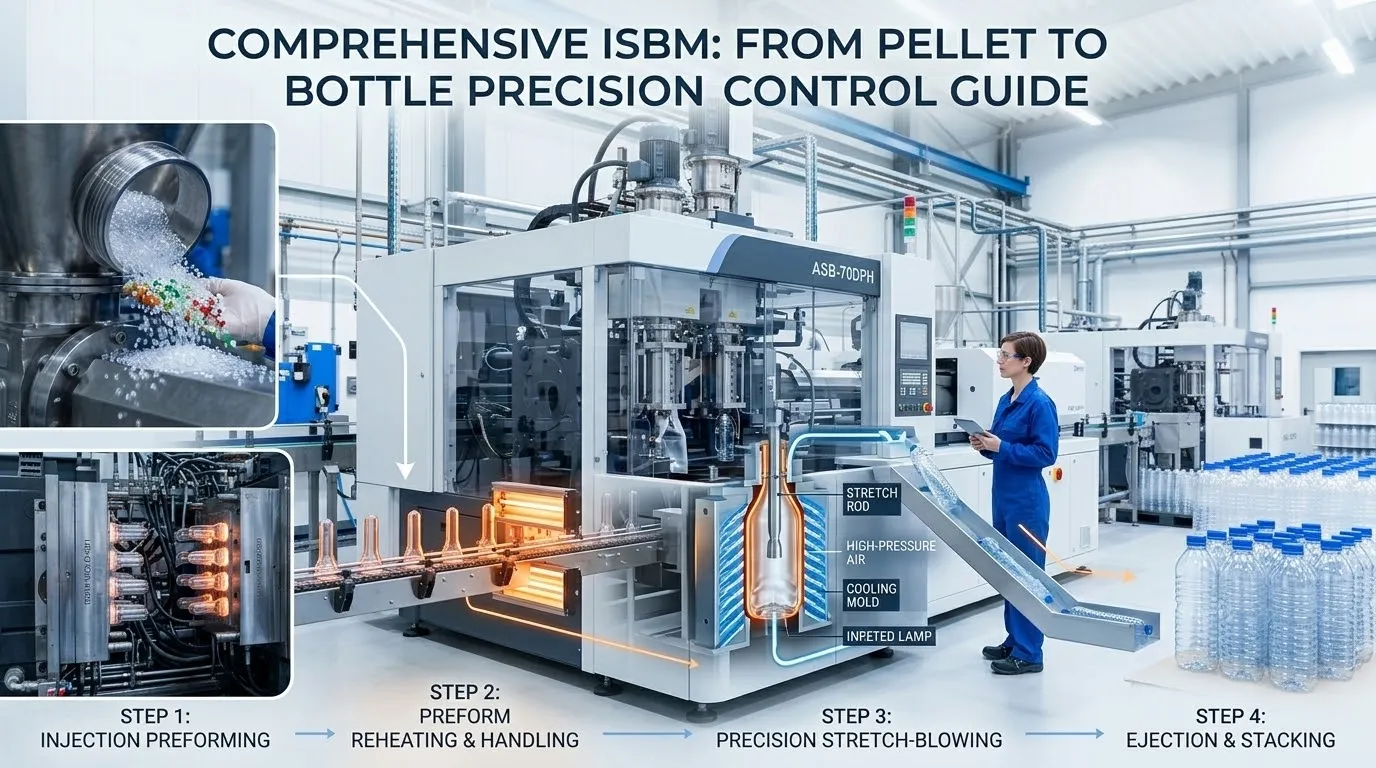
The Preform as the Deterministic Foundation of Container Quality
In the injection stretch blow molding process, the preform is far more than an intermediate product. It is the deterministic blueprint that encodes the destiny of the finished container. Every geometric feature of the preform, its wall thickness profile, its degree of amorphous clarity, its dimensional precision, and its internal stress state will be faithfully transmitted and amplified through the subsequent conditioning and stretch-blow steps. A preform with a poorly designed axial thickness profile will inevitably produce a container with uneven wall thickness, regardless of how perfectly the conditioning and stretch parameters are set. A preform with thermal haze from inadequate injection mold cooling will produce a hazy container that no amount of stretching can clarify. At 永恒之力, a globally recognized Brazilian ISBM manufacturer, our engineering philosophy recognizes that preform quality is the single most leveraged point of control in the entire manufacturing chain. Investments in preform quality, through precise machine control, optimized mold design, and rigorous material management, pay dividends at every subsequent stage of production.
The factors that affect ISBM preform quality span the entire injection molding phase of the cycle. They begin with the raw material itself, its intrinsic viscosity, its moisture content, and its thermal history. They continue through the plasticization process in the injection barrel, where melt temperature homogeneity and the avoidance of shear-induced degradation are paramount. They reach their culmination in the injection mold, where the preform geometry is formed, the polymer is rapidly quenched to the amorphous state, and the preform is cooled sufficiently for ejection. Each of these domains contains multiple interacting variables that must be controlled with precision to consistently produce preforms of the required quality. This comprehensive engineering analysis will dissect each of these quality factors, explaining the physics that govern them and the machine parameters and mold design features that control them on advanced platforms like the EP-HGY150-V4 四工位机床 以及伺服驱动 EP-HGY150-V4-EV全伺服机.
Mastering the factors that influence preform quality is the foundation upon which a zero-defect ISBM operation is built. This guide provides the complete engineering framework to achieve that mastery.
Material Factors: Resin Quality, Moisture Content, and Intrinsic Viscosity
The quality of an ISBM preform is fundamentally limited by the quality of the raw material entering the injection barrel. Material-related defects cannot be corrected by downstream process adjustments.
Moisture Content and the Catastrophic Effects of Hydrolysis
The single most consequential material factor affecting preform quality is the moisture content of the PET resin. PET is profoundly hygroscopic. If the pellets are not aggressively dried to a moisture content below 50 parts per million, and ideally below 30 ppm, the combination of processing temperatures around 280 degrees Celsius and trapped water triggers hydrolysis. This chemical reaction severs the ester linkages in the polymer backbone, permanently reducing the intrinsic viscosity of the material. A preform molded from hydrolyzed PET will have a lower molecular weight, reduced melt strength, and a diminished capacity for strain-induced crystallization. The visual manifestation is a dull, persistent, grayish haze that cannot be eliminated by adjusting the conditioning or stretch parameters. The preform will also be mechanically weak and may fail during the stretch-blow phase. Prevention requires a desiccant dehumidifying dryer that delivers air with a dew point of negative 40 degrees Celsius, dried at the resin manufacturer’s recommended temperature for the specified duration. The dryer performance must be verified regularly with a dew point meter. The dried resin must be conveyed to the machine hopper in a closed, dry-air-purged system. Any breach in this drying and handling chain will compromise every preform produced until the problem is corrected. For facilities processing rPET, the incoming flake must be rigorously tested for moisture and IV before being introduced into the drying system, as rPET is often more variable and may have been exposed to moisture during storage and transport.
Intrinsic Viscosity, Copolymer Content, and rPET Variability
The intrinsic viscosity of the PET resin, measured in deciliters per gram, is a fundamental determinant of preform quality. Higher IV grades, typically 0.80 to 0.84 dL/g, provide greater melt strength, better resistance to degradation, and a higher natural stretch ratio, making them suitable for large-format containers and those requiring extreme stretch ratios. Lower IV grades, such as 0.72 to 0.76 dL/g, flow more easily and may be preferred for thin-walled, high-speed applications, but they are more sensitive to thermal degradation and have a reduced stretch capability. The copolymer content of the PET, typically isophthalic acid or cyclohexane dimethanol, is incorporated to slow the crystallization rate and widen the processing window. Preforms molded from copolymer-modified PET are easier to quench to a clear, amorphous state. For rPET, the IV is typically lower and more variable than virgin resin. This variability directly affects preform quality if not managed. The servo-driven injection unit on the EP-HGY150-V4-EV performs real-time closed-loop pressure and velocity adjustments to compensate for rPET viscosity fluctuations, maintaining consistent preform weight and dimensions despite the material variability. Blending rPET with a consistent percentage of virgin resin stabilizes the average IV and is a standard practice for maintaining preform quality in high-rPET-content production.

Melt Quality Factors: Temperature Homogeneity and Shear History
The quality of the molten PET as it enters the preform mold cavity is governed by the thermal and shear history it experiences in the injection barrel and hot runner manifold.
🔥Barrel Temperature Profile and Melt Homogeneity
The barrel of the injection unit is divided into multiple independently controlled heating zones, typically the rear, middle, front, and nozzle zones. The temperature setpoint for each zone must be carefully established to produce a homogeneous melt at the correct temperature. If the barrel temperatures are too low, the PET will not be completely melted, and unmelted particles will appear as crystalline white spots in the preform. If the temperatures are too high, the PET will thermally degrade, reducing its IV and potentially generating acetaldehyde, which imparts a sweet taste to the container contents, a critical defect for beverage applications. The temperature profile should generally increase from the rear to the front of the barrel, with the nozzle temperature set slightly below the front zone to prevent drooling. The actual melt temperature should be verified periodically with a needle pyrometer inserted into a purged melt sample. The melt temperature should be within the range recommended by the resin manufacturer, typically 270 to 290 degrees Celsius for standard bottle-grade PET. Excessive screw rotation speed generates frictional shear heat that can overheat the melt locally, even if the barrel heater setpoints appear correct. Reducing the screw RPM, within the constraints of the cycle time, reduces this shear heating and helps maintain a uniform, undegraded melt. On machines like the EP-BPET-125V4, precise control over these thermal and mechanical parameters is essential for consistent preform quality.
⚙️Injection Speed, Hold Pressure, and Hot Runner Balance
The injection speed profile determines how the melt fills the preform cavity. A speed that is too slow will cause the melt front to cool prematurely, creating flow marks and internal weld lines that compromise preform strength and optical quality. A speed that is too fast can cause jetting, where the melt shoots directly to the far end of the cavity without forming a stable flow front, entrapping air and creating surface defects. The injection speed should be profiled to fill the cavity rapidly but smoothly. After the cavity is filled, a hold pressure is applied to compensate for the volumetric shrinkage of the cooling plastic. The hold pressure magnitude and duration are critical for preform quality. Insufficient hold pressure results in sink marks, voids, and dimensional inaccuracy. Excessive hold pressure over-packs the preform, creating high residual stress and making ejection difficult. The hot runner manifold must deliver melt at identical temperature and pressure to every cavity. Any imbalance in the hot runner will produce preforms with different weights, dimensions, and thermal histories, leading to cavity-to-cavity variation in the finished containers. For high-cavitation molds used on double-row machines like the EP-HGY250-V4-B, the hot runner balance must be verified and, if necessary, adjusted to ensure that every preform in every cavity is identical in weight and quality.
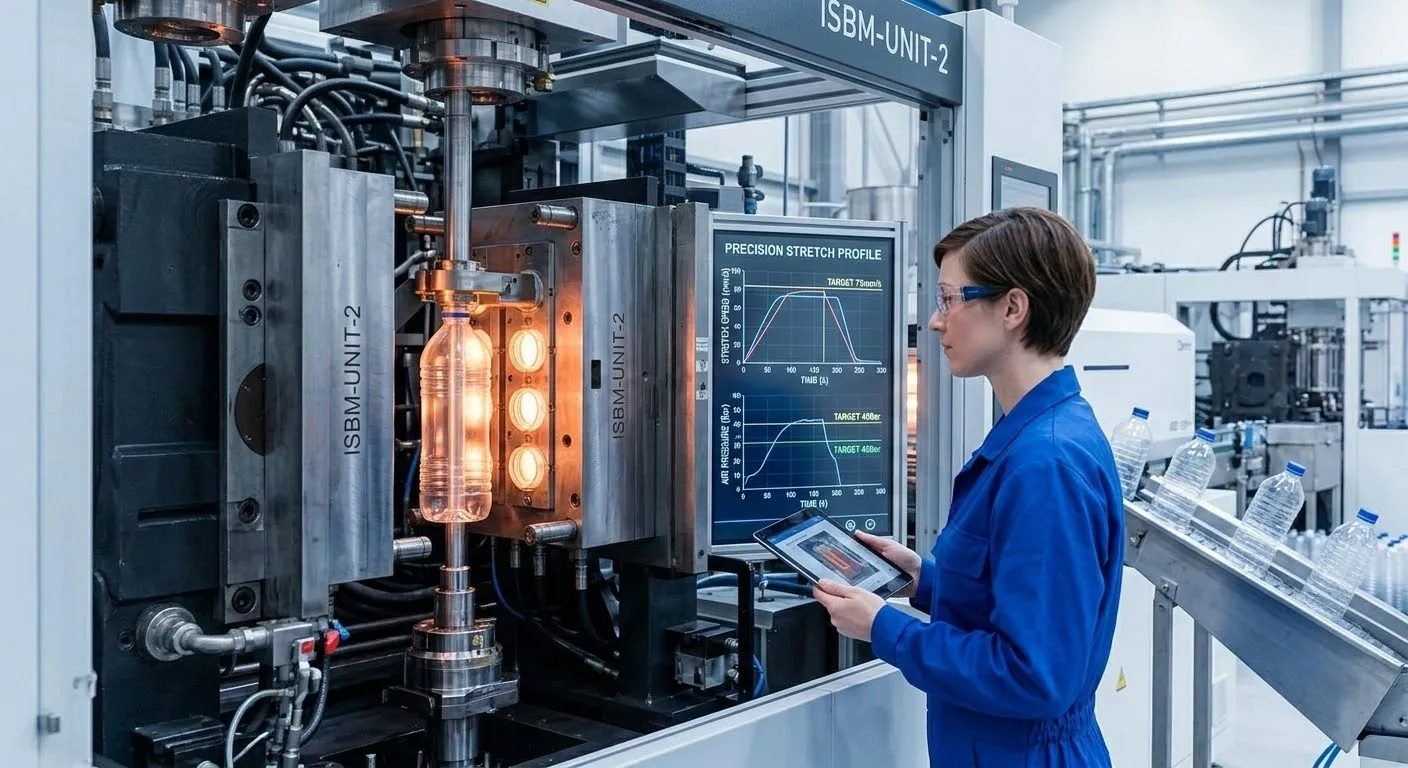
Injection Mold Design and Cooling Factors
The injection mold is the precision tool that shapes the preform and extracts heat from the molten polymer. Its design and condition are paramount determinants of preform quality.
❄️Conformal Cooling and Amorphous Clarity Preservation
The most critical function of the injection mold is to rapidly and uniformly quench the molten PET to the amorphous state. The mold cooling system must extract heat from the preform at a rate that prevents spherulite crystal nucleation and growth. The cooling channels in the mold must be designed as conformal channels that follow the contour of the preform cavity, ensuring that every region of the preform surface is cooled uniformly. The cooling water must be delivered at a temperature of 6 to 10 degrees Celsius and at a flow rate sufficient to ensure turbulent flow, which maximizes heat transfer. Any blockage in a cooling channel, from mineral scale or debris, will create a localized hot spot on the preform that will crystallize hazily. Regular flow testing and ultrasonic descaling of cooling channels are essential maintenance procedures. The gate region of the preform, being the thickest and hottest area, is the most prone to thermal haze. The mold design must incorporate aggressive cooling at the gate, often using a high-conductivity beryllium-copper gate insert. The 定制一步注塑拉伸吹塑模具 from Ever-Power are engineered with hyper-aggressive conformal cooling channels that maximize heat extraction and preserve the pristine amorphous clarity of the preform. The cooling time on the machine must be set sufficiently long to ensure the preform core temperature has dropped below the glass transition temperature before ejection. If the preform is ejected too hot, the residual heat will trigger thermal crystallization in the seconds after ejection, producing a hazy preform.
📐Dimensional Precision, Surface Finish, and Gate Design
The dimensional precision of the preform is a direct function of the mold cavity dimensions and the stability of the injection process. The preform body diameter, length, and wall thickness profile must be within tight tolerances to ensure consistent stretching behavior in the blow station. The neck finish dimensions, including the thread profile and the sealing surface, are particularly critical because they must mate with the closure on the filling line. Any deviation in neck finish dimensions will cause capping failures, a catastrophic quality issue. The mold cavity surface finish affects preform quality. A highly polished cavity surface produces a preform with a smooth, glossy exterior that stretches uniformly. A worn or scratched cavity surface will produce preforms with surface imperfections that can initiate stress cracking during stretching. The injection gate design, the point where the melt enters the cavity, influences the gate vestige on the preform base and the flow pattern into the cavity. A gate that is too small will cause excessive shear heating and a visible hazy spot. A gate that is too large will leave an excessive vestige that must be trimmed. For high-volume production, maintaining dimensional precision across all cavities on machines like the EP-HGY200-V4 requires regular mold inspection and preventive maintenance.

Preform Geometry, rPET Adaptations, and Ejection Quality
The designed geometry of the preform, its adaptation for recycled content, and the quality of its ejection from the mold are final, critical determinants of preform quality.
Axial Thickness Profile and Stretch Ratio Compatibility
The preform axial thickness profile must be engineered to deliver the correct amount of material to each region of the final container. This profile is calculated using finite element simulation of the stretch blow process and is machined into the injection mold core and cavity. A preform with an incorrectly designed thickness profile will inevitably produce containers with uneven wall thickness, regardless of how well the conditioning and stretch parameters are optimized. The preform body diameter and length determine the radial and axial stretch ratios. These ratios must be within the natural stretch limits of the specific PET grade. A preform designed with a stretch ratio that is too aggressive will produce stress whitening. A preform designed with a stretch ratio that is too conservative will not achieve the required biaxial orientation for strength. The preform design must also account for the thermal behavior of the material during conditioning. A preform with a very thick wall may require more conditioning time to reach a uniform stretching temperature. If this time exceeds the machine cycle, the preform design must be modified or the cycle time must be extended, impacting productivity. The design of high-quality preforms is a core engineering competency, supported by the mold design expertise at 永恒之力.
rPET Preform Design Adaptations and Quality Challenges
Preforms designed for high-rPET content require specific adaptations to maintain quality. rPET has a lower and more variable IV, reducing its natural stretch limit. The preform must be designed with a more conservative planar stretch ratio, typically not exceeding 10, to avoid tearing during stretching. The preform wall may need to be slightly thicker to provide sufficient material for the reduced stretch. The gate design should be generous to minimize shear heating during injection, which can degrade the already thermally stressed rPET. The injection mold cooling must be particularly aggressive because rPET, with its shorter chain length, is more prone to thermal crystallization. The servo-driven injection control of the EP-HGY150-V4-EV compensates for rPET viscosity fluctuations, maintaining consistent preform weight and dimensions. Ejection quality is also a preform quality factor. The preform must release cleanly from the mold core without sticking or distortion. The core pin must have an adequate draft angle and a polished surface finish. The ejection mechanism must apply uniform force to the neck ring without bending or cracking the still-warm preform. Any deformation during ejection will be permanently set in the preform and will cause stretching irregularities in the blow station.
EP-HGY250-V4 和紧凑型 EP-BPET-70V4 are engineered with the thermal and mechanical precision to deliver consistent preform quality across every cavity and every cycle. The integration of these machines with 定制一步注塑拉伸吹塑模具 ensures that the preform design, the mold cooling, and the injection process are all optimized as a unified system, producing preforms of uncompromising quality that form the foundation for flawless container production.

Master Preform Quality to Build the Foundation for Flawless Container Production
The quality of an ISBM preform is determined by a complex interplay of material, thermal, mechanical, and geometric factors. Moisture content, intrinsic viscosity, melt temperature homogeneity, injection speed and hold pressure, mold cooling efficiency, cavity surface finish, gate design, axial thickness profile, and ejection mechanics all exert a direct influence on the preform’s amorphous clarity, dimensional accuracy, and internal stress state. Each of these factors must be understood and controlled with precision to consistently produce preforms that will stretch into flawless, high-performance containers. At 永恒之力我们采用一体化的机械设计方法, 定制一步注塑拉伸吹塑模具, and process engineering provides manufacturers with the tools and the knowledge to master every factor that affects preform quality, establishing the foundation for zero-defect ISBM production.