ISBM Technology Evolution and Investment Strategy
与传统机器相比,全电动ISBM机器有哪些优点和缺点?
A rigorous engineering and economic comparison of servo-driven electric actuation versus hydraulic power systems in injection stretch blow molding, examining precision, energy consumption, total cost of ownership, and application suitability.
The Paradigm Shift from Hydraulic to Electric Actuation in ISBM
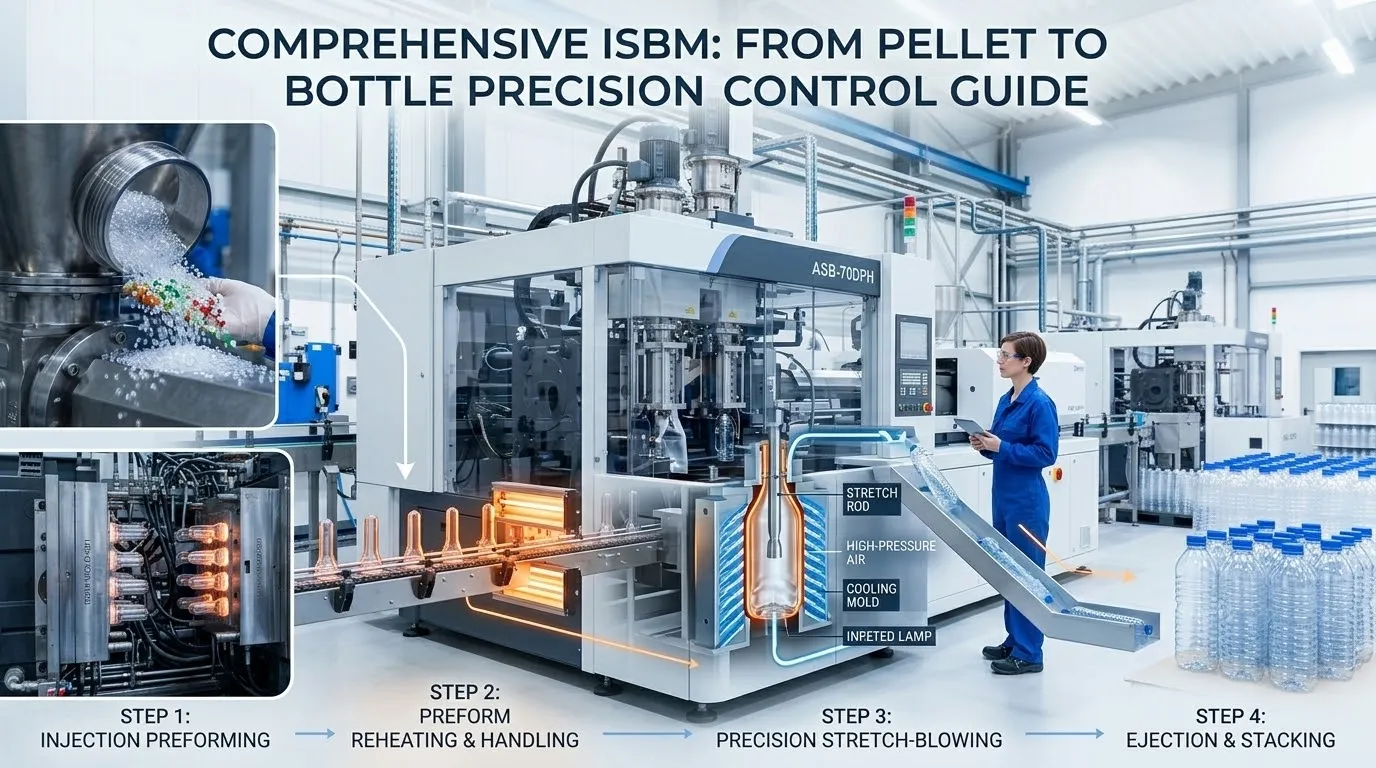
The injection stretch blow molding industry is undergoing a fundamental technological transformation. For decades, hydraulic power systems were the undisputed standard for actuating the injection unit, clamp, stretch rod, and rotary table of ISBM machines. Today, a new generation of all-electric ISBM machines, driven by precision servo motors and ball screws, is challenging this orthodoxy. For packaging manufacturers, plant managers, and procurement executives, understanding the advantages and disadvantages of all-electric ISBM machines compared to traditional hydraulic machines is now a critical competency for making informed capital investment decisions. At 永恒之力, a globally recognized Brazilian manufacturer of ISBM equipment, our engineering team has developed both hydraulic and fully electric platforms, giving us unique, hands-on insight into the real-world performance tradeoffs of each technology.
The distinction between all-electric and traditional hydraulic ISBM machines is not merely a matter of the power source. It represents a fundamental divergence in machine architecture, control philosophy, energy consumption profile, precision capability, maintenance requirements, and operational cost structure. A traditional hydraulic machine uses an electric motor to drive a hydraulic pump, which pressurizes oil that is then directed through valves to actuate cylinders and motors. An all-electric machine replaces this entire hydraulic circuit with individual servo motors connected directly to the mechanical elements they drive, such as the injection screw, the clamp toggle, and the stretch rod. This seemingly simple substitution has profound and cascading implications for every aspect of machine performance. This comprehensive analysis will rigorously compare all-electric and traditional hydraulic ISBM technologies across every dimension that matters to a packaging operation: precision and repeatability, energy efficiency, cycle time and productivity, cleanliness and environmental impact, maintenance complexity, capital cost, and suitability for processing post-consumer recycled PET.
We will reference specific Ever-Power machine platforms to ground this comparison in real engineering data. The traditional hydraulic EP-HGY150-V4 四工位机床 represents the proven, robust hydraulic architecture that has served the industry for decades. Its all-electric counterpart, the EP-HGY150-V4-EV全伺服机, embodies the latest in servo-driven precision. By examining these two machines side by side, we can extract the fundamental truths about the advantages and disadvantages of the all-electric approach.
Advantage: Superior Precision, Control, and Repeatability
The most compelling advantage of all-electric ISBM machines over their traditional hydraulic counterparts is the transformative improvement in motion control precision and shot-to-shot repeatability.
Closed-Loop Servo Control Without Hydraulic Variability
In a hydraulic machine, the commanded motion is transmitted through a fluid medium. Hydraulic oil is compressible, its viscosity changes with temperature, and the response of proportional valves is subject to hysteresis and deadband. These factors introduce inherent variability into every motion. An all-electric machine eliminates this entire layer of uncertainty. A servo motor connected directly to a ball screw or a rack and pinion system moves with a direct, rigid mechanical connection. The motor’s encoder provides real-time position feedback measured in microns, and the drive performs closed-loop corrections in microseconds. On the EP-HGY150-V4-EV, this translates into injection shot weights that are consistent within fractions of a gram across millions of cycles, and stretch rod positioning that is repeatable to within microns. For premium packaging applications where visual perfection and dimensional consistency are non-negotiable, this level of control is a decisive advantage.
Programmable Motion Profiles for Process Optimization
All-electric machines offer a degree of programmable motion flexibility that hydraulic systems simply cannot match. The injection velocity profile, hold pressure transition, stretch rod acceleration and deceleration, and clamp open/close speed can all be programmed as smooth, multi-segment curves. On a hydraulic machine, these motions are typically approximated by discrete valve settings. On a servo-driven machine, the motion can be precisely tailored to the rheological behavior of the specific PET grade being processed. This is particularly valuable when processing rPET, which exhibits different elongation viscosity than virgin material. The ability to program a gentle, decelerating stretch rod profile to accommodate the brittleness of high-rPET content preforms is a capability unique to all-electric platforms like the compact EP-HGY50-V3-EV.
Advantage: Transformative Energy Efficiency and Reduced Operating Cost
Perhaps the most widely cited advantage of all-electric ISBM machines is their dramatically lower energy consumption compared to traditional hydraulic systems.
⚡On-Demand Power Versus Constant Pump Draw
A traditional hydraulic ISBM machine operates a pump that runs continuously whenever the machine is powered on, even during idle portions of the cycle or when the machine is waiting for an operator intervention. This pump circulates oil through the system, consuming a baseline level of electrical power that can represent a significant portion of the machine’s total energy consumption. An all-electric machine, by contrast, consumes power only when a servo motor is actively moving. During the cooling phase of the injection cycle, or when the preform is being thermally conditioned, the servo motors are stationary and draw negligible power. The energy savings are substantial and well-documented. Independent studies and field data from installations of machines like the EP-HGY150-V4-EV consistently demonstrate energy consumption reductions of 30 to 60 percent compared to equivalent hydraulic models producing the same container at the same cycle time. Over a ten-year operational life, these energy savings can cumulatively exceed the initial price premium of the all-electric machine.
🌡️Eliminating Hydraulic Oil Cooling Loads
A hydraulic system generates significant waste heat. The pump itself is not perfectly efficient, and every time high-pressure oil is throttled through a valve, its energy is converted into heat. This heat must be removed from the oil by a water-cooled or air-cooled heat exchanger to prevent the oil from degrading and to maintain consistent viscosity. This cooling system itself consumes additional energy. An all-electric machine generates dramatically less waste heat because there is no hydraulic oil being continuously circulated and throttled. The servo motors and drives are highly efficient, typically exceeding 90 percent efficiency in converting electrical power to mechanical motion, and they produce relatively little heat. For factories operating in warm climates, the reduction in air conditioning load from eliminating the hydraulic heat source can be a significant secondary energy saving. This also contributes to a more comfortable and safer working environment for machine operators.
Advantage: Cleanroom Compatibility and Environmental Benefits
For pharmaceutical, medical, and high-end cosmetic packaging applications, the cleanliness advantage of all-electric ISBM machines is a decisive factor in the selection process.
🧪Elimination of Hydraulic Oil Contamination Risk
A traditional hydraulic ISBM machine contains tens or even hundreds of liters of hydraulic oil circulating under high pressure through hoses, fittings, valves, and cylinders. Despite the best maintenance practices, hydraulic leaks are an ever-present risk. A pinhole leak in a hydraulic hose can create an aerosolized mist of oil that settles on surrounding surfaces, including the preforms and finished containers. For pharmaceutical packaging, any trace of hydraulic oil contamination is a critical quality failure that can trigger a product recall. An all-electric machine entirely eliminates this risk. There is no hydraulic oil on the machine. The only lubrication points are sealed, food-grade grease systems on the ball screws and linear guides. This inherent cleanliness makes all-electric machines the preferred choice for cleanroom ISBM applications, such as those served by the EP-HGY50-V3-EV, which can be configured for ISO Class 7 or Class 8 cleanroom environments with minimal additional preparation.
🔇Reduced Noise and Improved Operator Environment
Hydraulic power units are inherently noisy. The combination of the electric motor driving the pump, the pump itself, and the turbulent flow of high-pressure oil through valves and piping generates a constant background noise level that typically ranges from 75 to 85 decibels. Extended exposure to this noise level requires hearing protection and contributes to operator fatigue. An all-electric ISBM machine operates remarkably quietly. The servo motors emit a high-frequency whine only during active motion, and the overall sound pressure level is typically 15 to 20 decibels lower than an equivalent hydraulic machine. This quieter operation improves the working environment, facilitates verbal communication on the factory floor, and can reduce the need for costly sound enclosure measures. For factories aiming to improve their workplace ergonomics and operator satisfaction, the noise reduction of all-electric technology is a meaningful, if often underappreciated, advantage.
The Disadvantages: Capital Cost, Complexity, and Application Limitations
For a balanced assessment, the genuine disadvantages of all-electric ISBM machines compared to traditional hydraulic systems must be candidly examined.
Higher Initial Capital Investment
The most significant disadvantage of all-electric ISBM technology is its higher upfront purchase price. Servo motors, precision ball screws, and sophisticated multi-axis motion controllers are inherently more expensive components than the hydraulic pumps, valves, and cylinders they replace. The price premium for an all-electric machine like the EP-HGY150-V4-EV over its hydraulic equivalent, the EP-HGY150-V4, can range from 20 to 40 percent depending on the specific configuration and options. For a capital-constrained operation or a startup facility, this higher initial outlay can be a barrier to entry. However, a rigorous total cost of ownership analysis, factoring in the energy savings, reduced maintenance costs, and potentially higher productivity over the machine’s ten to fifteen year life, often demonstrates that the all-electric machine is the more economical choice in the long run. The decision hinges on the organization’s cost of capital and its time horizon for return on investment.
Technical Complexity and Specialized Maintenance Skills
While all-electric machines eliminate the maintenance burden of hydraulic oil, filters, and hoses, they introduce a different maintenance paradigm. Servo drives, encoders, and motion controllers are sophisticated electronic systems. Diagnosing an intermittent encoder fault or tuning a servo drive’s PID parameters requires a different skill set than troubleshooting a hydraulic valve. The maintenance team must be trained in electromechanical systems and servo drive technology. For facilities with a long-established expertise in hydraulic maintenance, transitioning to an all-electric fleet involves a workforce training investment. However, it should be noted that the diagnostic capabilities of modern servo drives are extensive. The drive itself often provides detailed fault codes and can log performance data, making troubleshooting more systematic than the sometimes intuitive art of hydraulic diagnostics. The EP-HGY200-V4 hydraulic machine, for example, is maintained by technicians with traditional fluid power skills, while the all-electric equivalent demands proficiency with digital drive systems.
Force Limitations at the Extreme High End
For the very largest ISBM applications, such as producing five-liter or larger containers on high-cavitation molds, hydraulic actuation still holds a practical advantage in terms of delivered force density. A hydraulic cylinder can generate immense force from a relatively compact package. Achieving the equivalent clamp force with an all-electric toggle and servo motor system becomes increasingly challenging and expensive as the force requirement escalates. This is why the industrial-scale