ISBM Process Architecture Comparison
What Is the Difference Between Single-Stage and Two-Stage ISBM?
A comprehensive technical comparison of integrated one-step processing versus the fragmented preform-reheat methodology, exploring thermodynamic efficiency, molecular architecture, and the economic calculus that defines modern packaging manufacturing.
The Fundamental Divide in Injection Stretch Blow Molding Technology
In the global landscape of PET container manufacturing, the decision between single-stage and two-stage ISBM is one of the most consequential strategic choices a packaging operation can make. This is not a subtle nuance in machine configuration; it represents a fundamental divergence in manufacturing philosophy, thermodynamic management, and capital allocation. At Ever-Power, a premier Brazilian ISBM manufacturer and global authority on polymer processing, our engineering teams guide clients through this critical decision daily, ensuring that the selected architecture aligns perfectly with their production volumes, container complexity, and sustainability mandates.
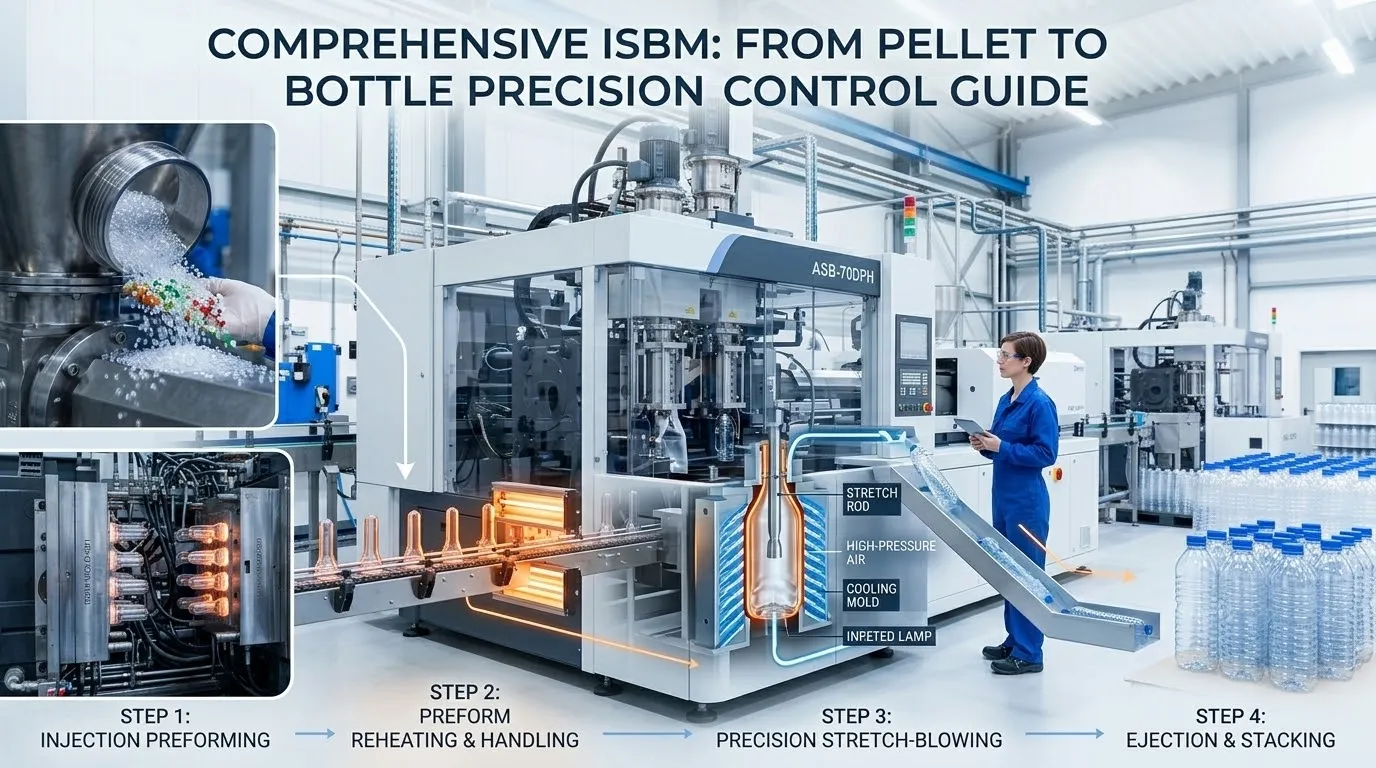
The distinction between single-stage and two-stage ISBM can be summarized succinctly: in a single-stage system, the preform is injection molded, thermally conditioned, stretch-blown, and ejected within one continuous, thermally integrated machine cell. In a two-stage system, these operations are separated into two entirely independent machines. The first machine injection molds preforms, which are cooled completely to ambient temperature, often stored for days or weeks, and then fed into a second machine that reheats them and stretch-blows them into finished containers. However, this deceptively simple summary masks a vast ocean of engineering implications that affect every aspect of production, from energy consumption and container quality to factory floor layout and the ability to process recycled resin.
This exhaustive technical dissertation will dissect the single-stage versus two-stage ISBM comparison across multiple critical dimensions: thermodynamic continuity, molecular architecture and container performance, energy economics, process flexibility, quality defect signatures, and the increasingly vital domain of post-consumer recycled PET processing. We will explore why premium brands producing cosmetics packaging, pharmaceutical containers, and high-end beverage bottles overwhelmingly gravitate toward machines like the EP-HGY150-V4 4-Station Machine for their single-stage operations, while high-volume commodity water bottle producers may opt for the sheer throughput of a two-stage line.
Single-Stage ISBM: The Thermally Integrated Manufacturing Cell
The single-stage ISBM process is defined by the preservation of latent thermal energy throughout the entire production sequence, from pellet to finished container.
Thermal Continuity and Latent Heat Utilization
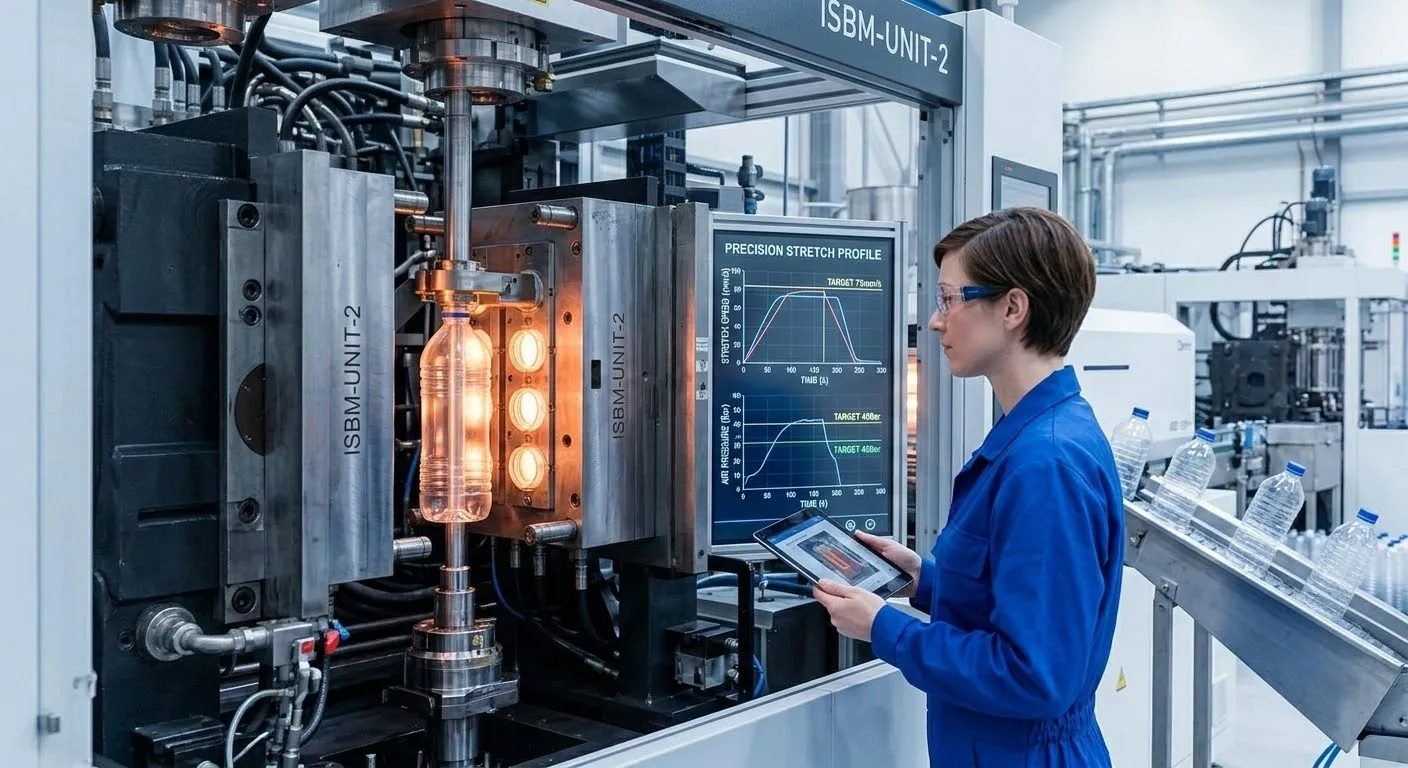
The defining characteristic of single-stage ISBM is that the preform never cools completely to room temperature. When the molten PET is injected into the chilled preform mold, it is rapidly quenched to a solid but still hot amorphous state. This preform, containing significant latent core heat, is immediately transferred via robotic clamps or a rotary indexing table to the conditioning station. Because the preform starts from an elevated temperature, the conditioning station only needs to fine-tune the thermal profile, gently raising or lowering specific zones to achieve the precise stretching temperature. This thermal continuity translates directly into a massive energy efficiency advantage. The system does not need to expend the enormous energy required to reheat a completely cold, solid preform back through its glass transition temperature and into its rubbery stretching range. For facilities operating machines like the EP-BPET-70V4, this energy saving is a significant contributor to reduced operational expenditure and a smaller carbon footprint.
Superior Molecular Architecture via Gentle Conditioning
Because the single-stage process avoids the violent thermal shock of reheating a completely cold preform, it produces a container with a fundamentally superior molecular architecture. In a two-stage system, the cold preform must be subjected to intense infrared radiation to bring its surface to the stretching temperature. This often results in a temperature gradient where the outer skin of the preform is hotter than the core, or vice versa. When this thermally imbalanced preform is stretched, the strain-induced crystallization occurs unevenly, leading to regions of differential orientation and residual internal stress. The single-stage process, by gently conditioning a preform that already possesses a homogeneous internal temperature profile, allows the biaxial stretching to induce perfectly uniform crystallization. The result is a container with fewer internal stress concentrations, higher resistance to environmental stress cracking, and a more consistent, glass-like optical clarity that is the hallmark of premium packaging.
Two-Stage ISBM: The Decoupled Production Paradigm
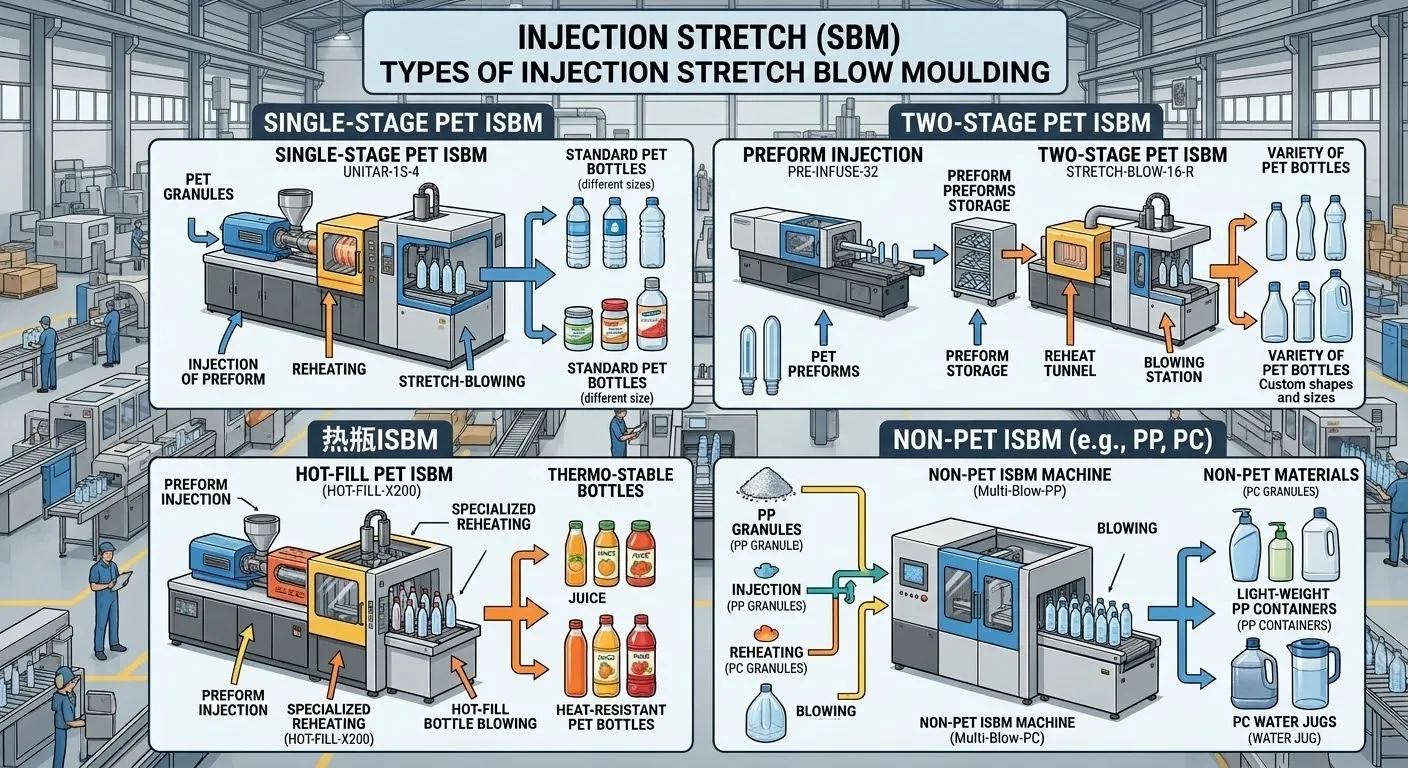
The two-stage ISBM process, also widely referred to as the reheat-stretch-blow process, severs the thermal link between preform manufacturing and container blowing. This decoupling creates a fundamentally different set of operational characteristics, advantages, and limitations.
🏭Independent Preform Injection Molding
In the first stage, a standard high-speed injection molding machine produces preforms. These machines are optimized for one task only: melting PET and injecting it into multi-cavity preform molds as rapidly as possible. The preforms are cooled completely to ambient temperature, ejected, and typically accumulated in large storage silos or gaylord boxes. Because the preform molding step is completely independent of the blowing step, it can be run at its maximum throughput without any dependence on the cycle time of a stretch-blow station. Preforms can be manufactured in one location, even in a different country, and shipped to a separate blow molding facility. This logistical flexibility is the primary advantage of the two-stage approach and makes it suitable for high-volume, standardized container production where dedicated preform manufacturing plants supply multiple satellite blowing operations.
☀️Infrared Reheating and Its Thermodynamic Consequences
The second stage machine, the reheat-stretch-blow molder, receives cold preforms from storage. These preforms must be brought from room temperature to approximately 105 degrees Celsius in their body region while keeping the neck finish cool and rigid. This is accomplished by passing the preforms on mandrels through a tunnel of intense infrared heating elements. The reheating step is the defining technical challenge of the two-stage process. Infrared radiation heats the preform primarily from the outside in, creating an unavoidable temperature gradient. The surface of the preform unavoidably reaches a higher temperature than the core. If the heater power is too aggressive, the surface can overheat and begin to crystallize thermally, causing a permanent haze, while the core remains too stiff to stretch uniformly. Sophisticated two-stage machines use multiple heating zones, reflective ovens, and equilibration periods to minimize this gradient, but it cannot be entirely eliminated. The thermal shock of this reheating also consumes a significant amount of energy, representing a permanent operating cost penalty compared to the single-stage approach.
Head-to-Head Comparison: Single-Stage vs. Two-Stage ISBM
The differences between these two architectures impact every aspect of production, from container quality and energy consumption to floor space utilization and the ability to process recycled materials.
Energy Consumption and Carbon Footprint
Single-Stage: This architecture leverages the latent heat already present in the injection-molded preform. The conditioning station only needs to fine-tune the temperature, resulting in significantly lower specific energy consumption per bottle. This translates to a smaller carbon footprint and lower operating costs. Two-Stage: Requires a massive energy input to reheat a completely cold, solid preform from room temperature through its glass transition and into a pliable state. The infrared ovens consume substantial electrical power continuously, representing a permanent energy penalty. For operations prioritizing sustainability and energy cost reduction, the single-stage process on machines like the EP-HGY150-V4-EV Full Servo offers a decisive advantage.
Container Quality and Optical Brilliance
Single-Stage: The gentle, homogeneous thermal conditioning produces containers with consistently superior optical clarity, fewer internal stress concentrations, and a higher resistance to environmental stress cracking. The molecular orientation is exceptionally uniform. Two-Stage: The unavoidable temperature gradients from infrared reheating can lead to differential orientation, a subtle but permanent haze, and localized regions of internal stress. While modern two-stage machines minimize these effects, the single-stage process inherently produces a more perfect container. This is why premium cosmetic, pharmaceutical, and spirits brands overwhelmingly specify single-stage production on equipment like the EP-BPET-125V4.
Throughput, Layout, and Logistical Flexibility
Single-Stage: The integrated cell has a fixed ratio of injection to blowing stations. Throughput is determined by the cycle time of the complete four-station sequence. The cell occupies a compact footprint but is a monolithic production unit. Two-Stage: The decoupled nature allows each stage to be optimized independently for maximum throughput. A high-speed injection molder can supply preforms to multiple blow molders. Preforms can be manufactured centrally and shipped globally. This flexibility is valuable for high-volume commodity production, but it comes at the cost of increased logistical complexity, storage space, and the risk of preform contamination during handling and transport. The single-stage approach eliminates this entire logistics chain and its associated costs and quality risks.
The rPET Challenge and Process Flexibility Considerations
The global sustainability drive toward incorporating post-consumer recycled PET has exposed a critical difference between single-stage and two-stage ISBM architectures.
♻️Single-Stage rPET Processing with Adaptive Servo Control
Recycled PET resin exhibits a lower and more variable intrinsic viscosity, making it more sensitive to thermal degradation and more challenging to stretch uniformly. The single-stage process, with its gentle thermal handling and the ability to adjust conditioning and stretching parameters in real-time, has proven far more accommodating to high rPET content. Advanced servo-driven machines like the EP-HGY50-V3-EV incorporate closed-loop injection control that instantaneously adjusts pressure and velocity to compensate for the fluctuating viscosity of rPET, ensuring consistent preform quality. The stretch rod motion profile can be programmed to accommodate the more brittle elongation behavior of recycled material. This adaptability makes single-stage ISBM the preferred platform for brands pursuing ambitious recycled content goals for premium packaging.
🔧Two-Stage Limitations with Variable rPET
In a two-stage system, the cold preform must absorb infrared energy uniformly to reach the stretching temperature. However, rPET often contains microscopic contaminants and color variations that alter its thermal absorption characteristics. A dark speck in an otherwise clear preform will absorb more infrared energy and create a localized hot spot, which during stretching can lead to a blowout or severe wall thinning. The reheating oven’s fixed heating profile cannot adapt to these material inconsistencies in real-time. This fundamental limitation makes it more difficult to achieve high rPT content reliably in a two-stage process. For complex container geometries requiring custom mold integration, the Custom One-Step Injection Stretch Blow Moulds from Ever-Power are engineered specifically to work in concert with single-stage machines, producing containers that maintain their visual and structural integrity even with high recycled content.
Mold Integration and Scaling Strategies for High-Volume Production
When scaling up for massive production volumes, the architectural differences between single-stage and two-stage ISBM become even more pronounced. In a two-stage system, scaling means faster injection molders with more cavities and faster reheat-blow molders. These are independent optimization exercises. In a single-stage system, scaling requires the coordinated multiplication of all four stations within one cell.
- 🏗️
Single-Stage Double-Row Architectures: To achieve high throughput within the single-stage paradigm, Ever-Power has engineered advanced double-row machines such as the EP-HGY250-V4-B Double-Row 4-Station Machine and the EP-HGY200-V4-B. These platforms multiply the number of cavities while maintaining perfect thermal synchronization across all stations. The challenge of ensuring that every preform experiences the identical thermal history, stretch rod motion, and blow air profile across a wider platen is substantial, but the result is a compact cell that delivers high output without sacrificing the quality advantages of single-stage processing. For operations requiring massive preform payloads, the EP-HGY650-V4 represents the pinnacle of integrated single-stage throughput.
- ⚙️
The Role of Proprietary Mold Integration: The effectiveness of either single-stage or two-stage ISBM is ultimately governed by the quality of the mold tooling. The Custom One-Step Injection Stretch Blow Moulds designed and manufactured in-house by Ever-Power incorporate hyper-aggressive conformal cooling channels, perfectly matched hot runner manifolds, and mirror-polished blow cavities. This integrated approach to machine and mold engineering is what allows single-stage ISBM to consistently outperform two-stage systems in container quality, even at high throughputs.

Distinct Defect Signatures and Factory Floor Considerations
The two architectures present different troubleshooting challenges and have distinct implications for factory layout, workforce training, and operational complexity.
Defect Signatures
Single-Stage: Defects are typically related to the thermal balance within the integrated cell. Stress whitening indicates the preform was too cold during stretching. Thermal haze indicates excessive heat from the injection barrel or insufficient cooling. These are diagnosed by analyzing the entire thermal history. Two-Stage: Defects often originate from the reheating oven. Uneven wall distribution can be caused by a failed heater element creating a cold stripe on the preform. Surface haze can be caused by the oven temperature being set too high. Diagnosing a two-stage problem requires checking both the preform molding history and the reheat-blow parameters, adding a layer of complexity. On the EP-HGY200-V4, the integrated control system allows technicians to trace a defect through all four stations in one unified interface, a significant diagnostic advantage.
Factory Layout and Operational Simplicity
Single-Stage: A single machine replaces an entire line of injection molder, conveyor, storage silo, and reheat-blow molder. This dramatically reduces the required factory floor space, simplifies the utility connections, and eliminates the logistical complexity of preform handling and storage. The workforce needs to be trained on one integrated machine. Two-Stage: Requires a larger footprint, more complex material handling systems, and a workforce trained on separate injection molding and blow molding operations. The preform storage and transport system adds cost, requires climate-controlled warehouse space to prevent moisture absorption, and introduces the risk of dust contamination that can cause black specks in the finished containers. The compact, all-in-one nature of the single-stage ISBM cell is a compelling advantage for operations seeking simplicity and a lean manufacturing footprint.
Choosing Between Single-Stage and Two-Stage ISBM: A Strategic Imperative
The difference between single-stage and two-stage ISBM is not merely technical. It is a strategic decision that defines your operation’s energy efficiency, product quality ceiling, rPET processing capability, and factory floor footprint. The single-stage process, with its thermal continuity and integrated architecture, delivers superior container quality, lower energy consumption, and a simpler, more compact production line. It is the technology of choice for premium packaging markets where visual perfection and structural integrity are non-negotiable. The two-stage process offers logistical flexibility and independent throughput optimization, making it suitable for high-volume commodity production where the absolute highest optical quality is not the primary driver. At Ever-Power, our engineering team has architected a comprehensive range of single-stage platforms, from the versatile EP-HGY150-V4 to the industrial-scale EP-HGY650-V4, that embody the full advantages of the single-stage philosophy. When container quality, energy efficiency, and the ability to seamlessly incorporate rPET are your top priorities, the single-stage advantage is definitive.