ISBM Productivity Optimization and Lean Manufacturing
Як можна скоротити час циклу без шкоди для якості?
A comprehensive process optimization guide detailing servo-driven motion overlap, accelerated mold cooling, optimized conditioning profiles, and parallel station balancing strategies that safely shave seconds off the ISBM cycle while maintaining or improving container quality.
The Productivity Imperative in Modern ISBM Manufacturing
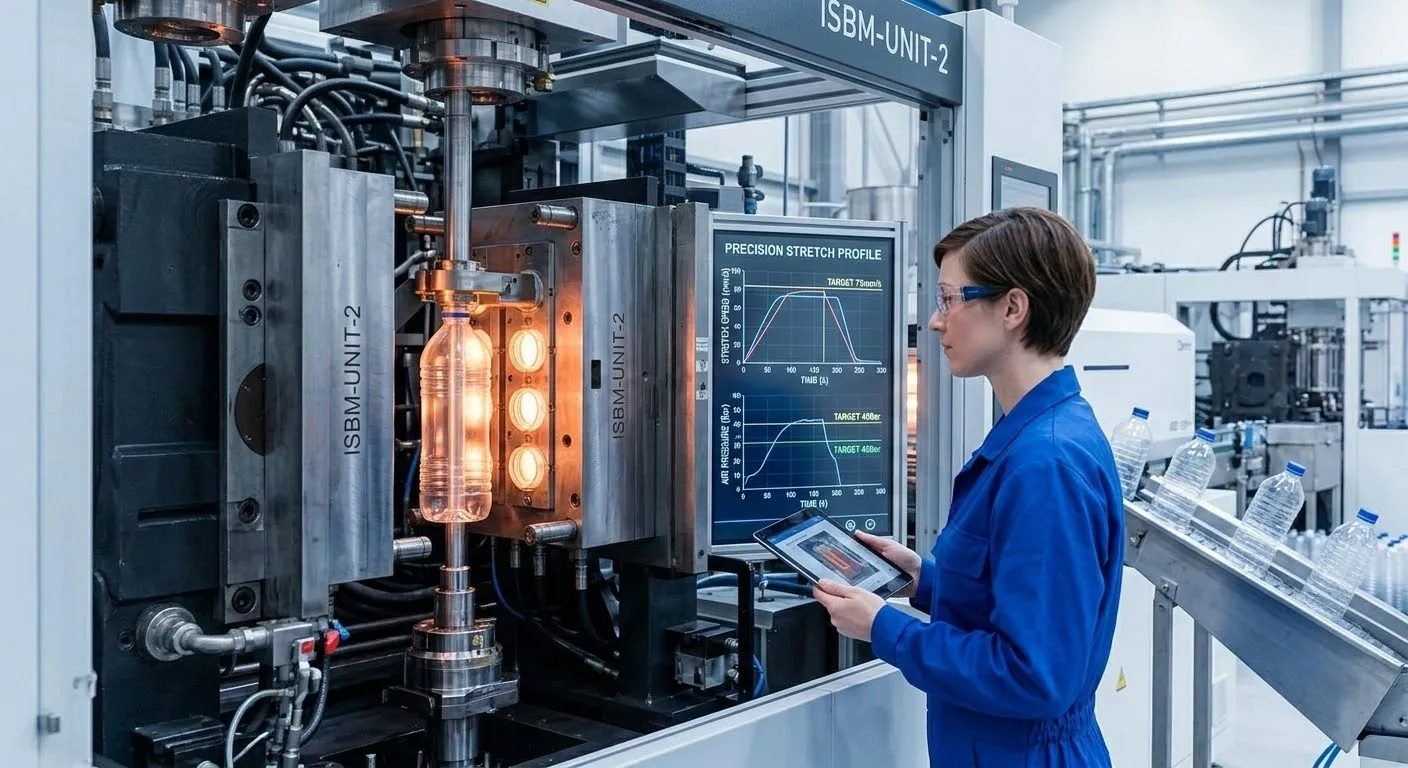
In the fiercely competitive landscape of PET container manufacturing, cycle time is the single most powerful lever of productivity. A reduction of even half a second per cycle, seemingly insignificant on the stopwatch, translates into thousands of additional containers produced per day, hundreds of thousands per month, and millions per year from the same machine, the same mold, the same floor space, and the same labor. However, the pursuit of faster cycle times carries an inherent risk. Pushed too aggressively, speed becomes the enemy of quality. Cooling time reduced below the minimum necessary produces hazy preforms. Injection speed increased beyond the material’s tolerance creates shear degradation and black specks. Stretch rod velocity pushed too high tears the preform base. The art and science of ISBM process optimization lies in finding the precise balance point where cycle time is minimized while every container continues to meet the required quality specifications. At Вічна Сила, a globally recognized Brazilian ISBM manufacturer, our machine platforms are engineered with the speed, precision, and control capabilities that enable aggressive cycle time reduction without compromising the container quality that premium markets demand.
Reducing cycle time without compromising quality is not achieved by simply turning a speed dial. It requires a systematic analysis of every segment of the machine cycle: injection fill time, hold time, cooling time, conditioning time, stretch-blow time, and ejection time. Each segment has a minimum duration determined by the physics of the process—the time required for the melt to fill the cavity without degrading, for the preform to cool below its glass transition temperature, for the preform body to reach a uniform stretching temperature, and for the container to stabilize in the blow mold. These minimum times are not fixed. They can be reduced through machine technology, mold design, and process optimization. Servo-electric actuation enables faster motions and safe overlapping of sequential events. Advanced mold cooling technology extracts heat more rapidly. Optimized conditioning profiles achieve the target preform temperature in less time. Balancing the station times ensures that no single station is the bottleneck. This comprehensive guide will explore each of these cycle time reduction strategies, explaining the engineering principles and the practical implementation steps on machines like the servo-driven EP-HGY150-V4-EV Повний сервопривід і висока продуктивність Дворядний 4-станційний верстат EP-HGY250-V4-B.
The ability to safely and productively reduce cycle time is a core competency of a world-class ISBM operation. This guide provides the complete engineering framework to develop that competency.
Servo-Electric Motion Overlap and High-Speed Sequencing
The most impactful strategy for reducing cycle time without compromising quality is the exploitation of servo-electric actuation to execute motion overlap and high-speed sequencing that is impossible with hydraulic systems.
Safe Motion Overlap Enabled by Independent Digital Control
In a conventional hydraulic ISBM machine, motions are typically executed sequentially. The clamp must be fully closed before injection begins. Injection must be complete, including hold pressure, before the clamp can begin to open. The rotary table must be fully indexed and stopped before the next station’s motions can begin. This sequential operation is necessary because hydraulic systems lack the precise, real-time position feedback required to safely overlap motions without risk of collision. All-electric servo-driven machines fundamentally change this paradigm. Every motion axis, the clamp, the injection screw, the stretch rod, and the rotary table, is controlled by a digital motion controller that knows the exact position, velocity, and acceleration of every axis at every millisecond. This enables safe, programmed motion overlap. The clamp can begin to open while the stretch rod is still retracting, because the controller guarantees a safe distance between them. The rotary table can begin its index motion while the ejection robot is still clearing the mold area. The injection screw can begin its recovery rotation while the clamp is still opening. Each of these overlaps saves tenths of a second that accumulate into significant cycle time reductions. A saving of 0.1 seconds per station motion, multiplied by four stations, reduces the total cycle by 0.4 seconds. Over a year of continuous production, this translates into a substantial increase in output. On the EP-HGY150-V4-EV, with its premium Yaskawa and WEICHI servo systems, these overlapping motion profiles are programmed as standard, delivering cycle times that hydraulic machines cannot match. The quality of the containers is not compromised because the stretching, cooling, and conditioning durations are maintained at their optimal values. Only the non-value-adding motion time is reduced.
High-Speed Clamp and Rotary Table Indexing
Beyond motion overlap, servo-electric actuation enables faster individual motion segments. A servo-driven clamp can open and close more rapidly than a hydraulic clamp because the servo motor can accelerate and decelerate with higher torque and faster response than a hydraulic cylinder, which is limited by the flow rate of the proportional valve and the compressibility of the oil. Similarly, a servo-driven rotary table can index more quickly and stop more precisely. The Taiwan TSUNTIEN reducers used in Ever-Power machines transmit this servo power with high efficiency and minimal backlash. These faster individual motions directly reduce the non-productive portion of the cycle. However, speed must be balanced against mechanical stress. Excessive acceleration can cause vibration, positioning errors, and premature wear of bearings and guide rails. The motion profiles should be optimized to achieve the maximum safe speed for each axis. The acceleration and deceleration ramps should be set to values that avoid mechanical shock. The servo drives on the EP-HGY150-V4-EV allow these profiles to be tuned with precision, achieving the optimal balance of speed and smoothness. The result is a machine that operates at a significantly faster cycle rate than a hydraulic equivalent, producing more containers per hour with the same number of cavities, and doing so with motions that are smoother and more controlled, actually reducing mechanical stress on the machine and the tooling. This is a pure productivity gain that does not affect the thermal or stretching processes that determine container quality.
Cooling and Conditioning Optimization Without Quality Sacrifice
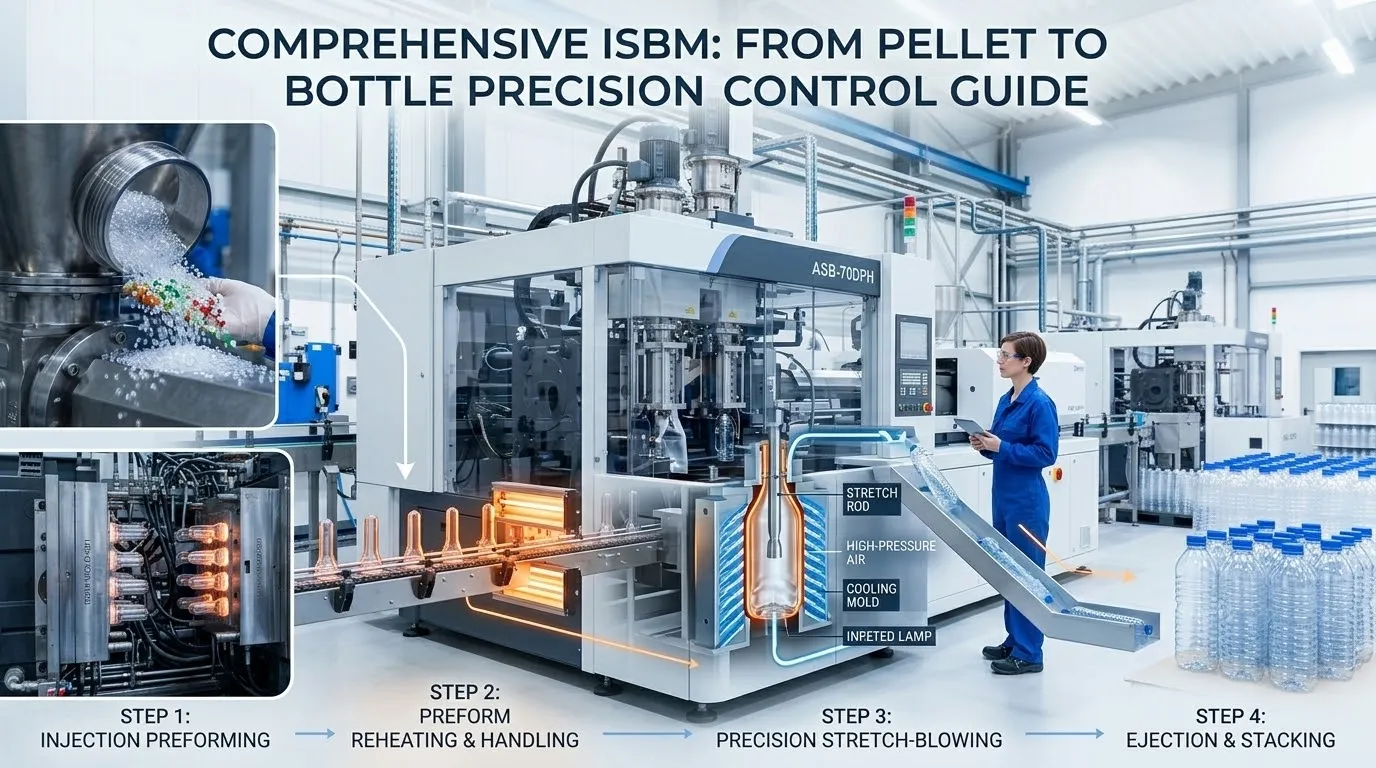
The cooling time in the injection station and the conditioning time in the conditioning station are often the longest segments of the ISBM cycle. Reducing these times without compromising preform quality requires a scientific approach.
❄️Accelerated Mold Cooling Through Conformal Channels and Chiller Optimization
The injection mold cooling time is determined by the rate at which heat can be extracted from the molten PET to cool the preform below its glass transition temperature. This rate is a function of the mold cooling channel design, the cooling water temperature, and the cooling water flow rate. To reduce cooling time without risking thermal haze from incomplete quenching, the cooling system must be optimized. The mold cooling channels should be conformal, following the contour of the preform cavity to provide uniform, close-proximity cooling to every region of the preform. The cooling water temperature should be maintained at the low end of the recommended range, 6 to 8 degrees Celsius. The water flow rate must be sufficient to ensure fully turbulent flow, which maximizes the heat transfer coefficient. The flow should be verified at each mold cooling circuit. Any partially blocked channel, due to mineral scale or debris, will reduce local cooling and force the overall cooling time to be extended. Regular ultrasonic descaling of the mold cooling channels is an essential practice for maintaining minimum cooling times. The chiller capacity must be adequate for the heat load. An undersized chiller will allow the water temperature to rise under sustained production, gradually increasing the required cooling time. The Спеціальні форми для видування з розтягуванням під одним кроком from Ever-Power are designed with hyper-aggressive conformal cooling that minimizes the cooling time required to achieve a fully amorphous, haze-free preform. By investing in mold cooling optimization, the cooling time can often be reduced by 1 to 2 seconds without any increase in preform haze.
🌡️Conditioning Time Reduction Through Optimized Thermal Profiles
The conditioning time must be sufficient to bring the preform body to a uniform temperature within the stretching window. This time is determined by the thermal diffusivity of the PET, the wall thickness of the preform, and the temperature difference between the conditioning pot and the preform. To reduce conditioning time, the conditioning pot temperature can be increased, as a larger temperature difference drives faster heat transfer. However, this approach has limits. If the pot temperature is too high, the preform surface may overheat and begin to crystallize before the core reaches the target temperature. The optimal strategy is to use a stepped conditioning profile. The first conditioning station, on a six-station machine like the EP-HGYS280-V6, can be set to a higher temperature to rapidly heat the preform surface. The second conditioning station can be set to a lower, soaking temperature that allows the heat to equilibrate through the wall without overheating the surface. This two-stage approach can achieve the target temperature uniformity in less total time than a single-stage soak. The preform design also influences conditioning time. A preform with a thinner wall will heat through more quickly. For the same final container, a preform with a larger diameter and correspondingly thinner wall will require less conditioning time, at the expense of a higher radial stretch ratio. These trade-offs should be evaluated during the preform design phase. By optimizing the conditioning profile and the preform geometry, the conditioning time can often be reduced by 10 to 20 percent without any loss of stretching uniformity or container quality.
Station Balancing, Injection Optimization, and rPET Cycle Time Strategies
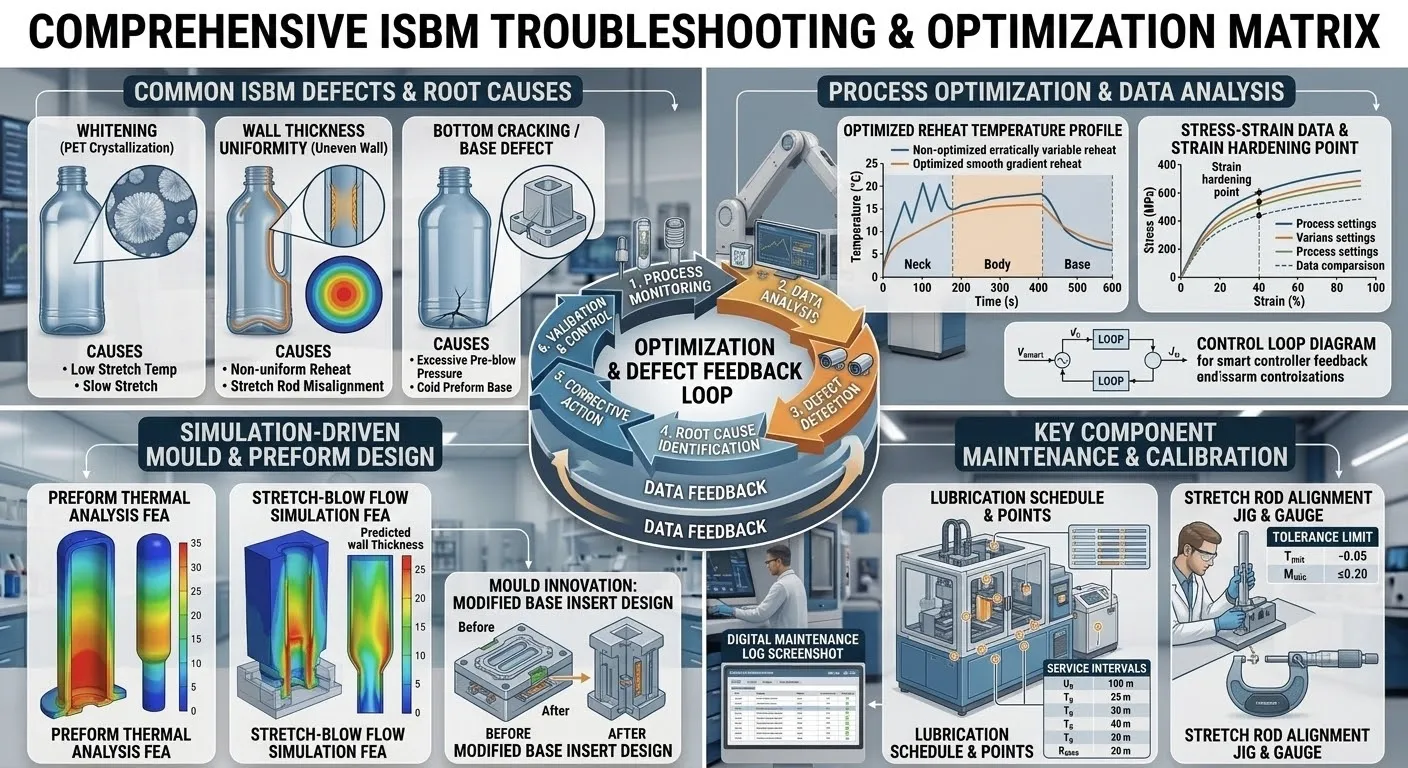
The overall cycle time of an ISBM machine is determined by the slowest station. Balancing station times and optimizing the injection phase are essential for maximizing throughput.
Identifying and Eliminating the Bottleneck Station
The ISBM cycle is a parallel process. While one station is injecting, another is conditioning, another is stretch-blowing, and another is ejecting. The cycle time of the entire machine is determined by the station with the longest cycle segment. To reduce the overall cycle time, the bottleneck station must be identified and its time reduced. The station times should be measured accurately, either from the machine’s cycle time display or by direct observation with a stopwatch. The injection cooling time is often the bottleneck, particularly for thick-walled preforms. The conditioning time may be the bottleneck for preforms that require a long thermal soak. The stretch-blow time is rarely the bottleneck, as the stretching and blowing actions are typically quite fast. Once the bottleneck is identified, the strategies discussed in this guide are applied to that specific station. If cooling is the bottleneck, mold cooling optimization is the focus. If conditioning is the bottleneck, conditioning profile optimization is the focus. The bottleneck may shift as improvements are made. The process of measurement, identification, and optimization is iterative. On high-cavitation machines like the EP-HGY250-V4-B, the bottleneck may vary between cavities if there is an imbalance in the hot runner or the cooling system. Cavity-specific cycle time analysis may be necessary to identify and correct these imbalances.
rPET Cycle Time Considerations and Injection Speed Profiling
When processing rPET, cycle time reduction must be approached with additional caution. rPET has a lower IV and is more thermally sensitive. Reducing the cooling time excessively can lead to thermal haze, as rPET crystallizes faster than virgin PET. Reducing the injection time by increasing injection speed can cause excessive shear heating, which degrades the rPET further and can generate acetaldehyde. The optimal approach for rPET is to use profiled injection speeds: a moderate initial speed to establish a stable flow front without jetting, followed by a higher speed to fill the bulk of the cavity, and then a reduced speed at the end of fill to ensure a smooth transition to hold pressure. This profile minimizes the total injection time while avoiding excessive shear. The hold pressure time can often be reduced for rPET because the lower-IV material requires less packing. However, the hold pressure magnitude should be verified to be sufficient to prevent shrinkage voids. The servo-driven injection on the EP-HGY150-V4-EV provides the precise, programmable injection profiles necessary to optimize speed and quality simultaneously for rPET. For operations running both virgin and rPET, the optimized parameter sets should be stored in the machine controller and recalled for each material, ensuring that the cycle time is always minimized for the specific material being processed without compromising the quality standards of the application.
EP-HGY200-V4 provide the process stability and control necessary for consistent, high-speed production. The integration of these machines with Ever-Power’s Спеціальні форми для видування з розтягуванням під одним кроком ensures that the mold cooling and the machine’s thermal control are optimized for the fastest possible cycle times without sacrificing the clarity, strength, and dimensional accuracy of the containers.
Achieve Maximum Throughput Without Sacrificing Container Excellence
Reducing ISBM cycle time without compromising quality is a systematic engineering discipline that leverages servo-electric motion overlap, accelerated mold cooling, optimized conditioning profiles, balanced station times, and material-specific injection strategies. Each of these approaches reduces the non-value-added time in the cycle while preserving, or even enhancing, the thermal and mechanical conditions that determine container clarity, strength, and dimensional accuracy. At Вічна Сила, наші передові платформи машин, включаючи сервопривідні EP-HGY150-V4-EV, the six-station EP-HGYS280-V6, and our optimized Спеціальні форми для видування з розтягуванням під одним кроком, are engineered to deliver the speed, precision, and thermal control that enable aggressive cycle time reduction while maintaining the container quality that defines premium packaging.