Injection stretch blow moulding (ISBM) is a manufacturing process that converts plastic resin into finished hollow containers in a single, continuous sequence. Unlike processes that require a separately manufactured preform, one-step ISBM takes raw pellets and produces a finished bottle without intermediate handling or storage — making it the preferred choice for short runs, complex shapes, and applications where contamination control matters.
Что происходит внутри установки ISBM?
At its core, ISBM merges two distinct plastics-forming technologies into one platform. First, molten resin — typically PET, PP, or PETG — is injected into a preform mould. The resulting thick-walled tube, known as a preform, is retained on the machine’s mandrel and transferred — still warm — to a blow station, where a stretch rod elongates it axially while high-pressure air expands it radially into the final bottle shape.
The key physical event is biaxial molecular orientation. When PET is stretched in two directions simultaneously at the right temperature, the polymer chains align in both axes. This alignment gives PET bottles their glass-like clarity, their resistance to carbonation pressure, and their ability to be blow-moulded down to wall thicknesses of under 0.3 mm without pinholing.
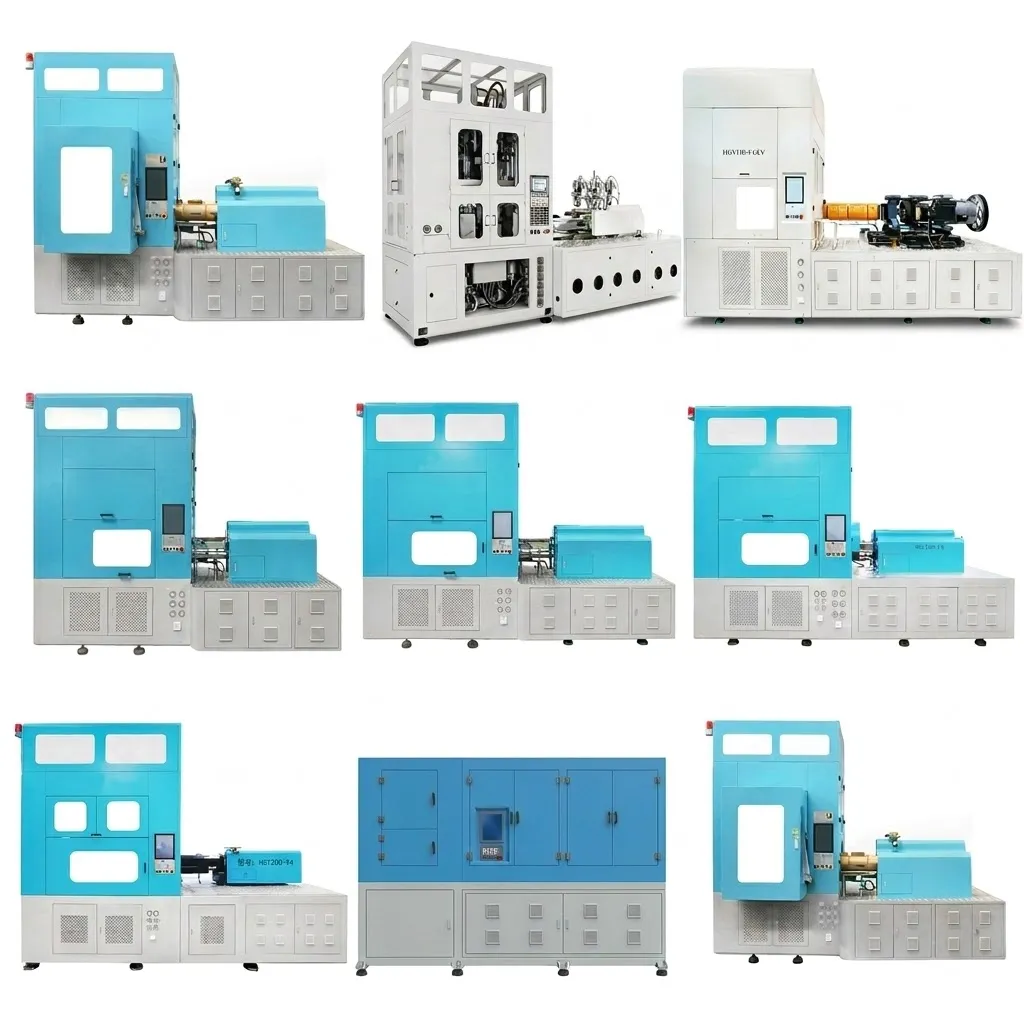
Overview of ISBM machine configurations — 3-station, 4-station, and 6-station designs handle different volume and complexity requirements.
Три основополагающие станции
Every ISBM machine performs the same three core operations on a rotating table. Each position runs simultaneously — so while one set of preforms is being injected, another is being conditioned, and a third is being blown.
| Станция | Операция | Ключевая управляющая переменная |
|---|---|---|
| Инъекция | Смола впрыскивается в полость заготовки, охлаждается до температуры извлечения. | Давление впрыска, температура плавления, время выдержки. |
| Растягивающий удар | Растягивающий стержень выдвигается; воздух высокого давления расширяет заготовку, прижимая ее к выдувной форме. | Rod speed, pre-blow delay, blow pressure (25–40 bar) |
| Выброс | Форма открывается; готовая бутылка извлекается конвейером или передаточным рычагом. | Температура охлаждения пресс-формы, время извлечения. |
Four-station machines add a dedicated conditioning station between injection and blow. This position allows fine-tuning of the preform’s axial temperature profile using infrared heaters — critical for complex shoulder shapes or asymmetric sidewall thickness. Six-station designs go further, adding post-blow cooling to enable higher cycle speeds without dimensional instability at ejection.
Одноступенчатая ISBM против двухступенчатого повторного продува
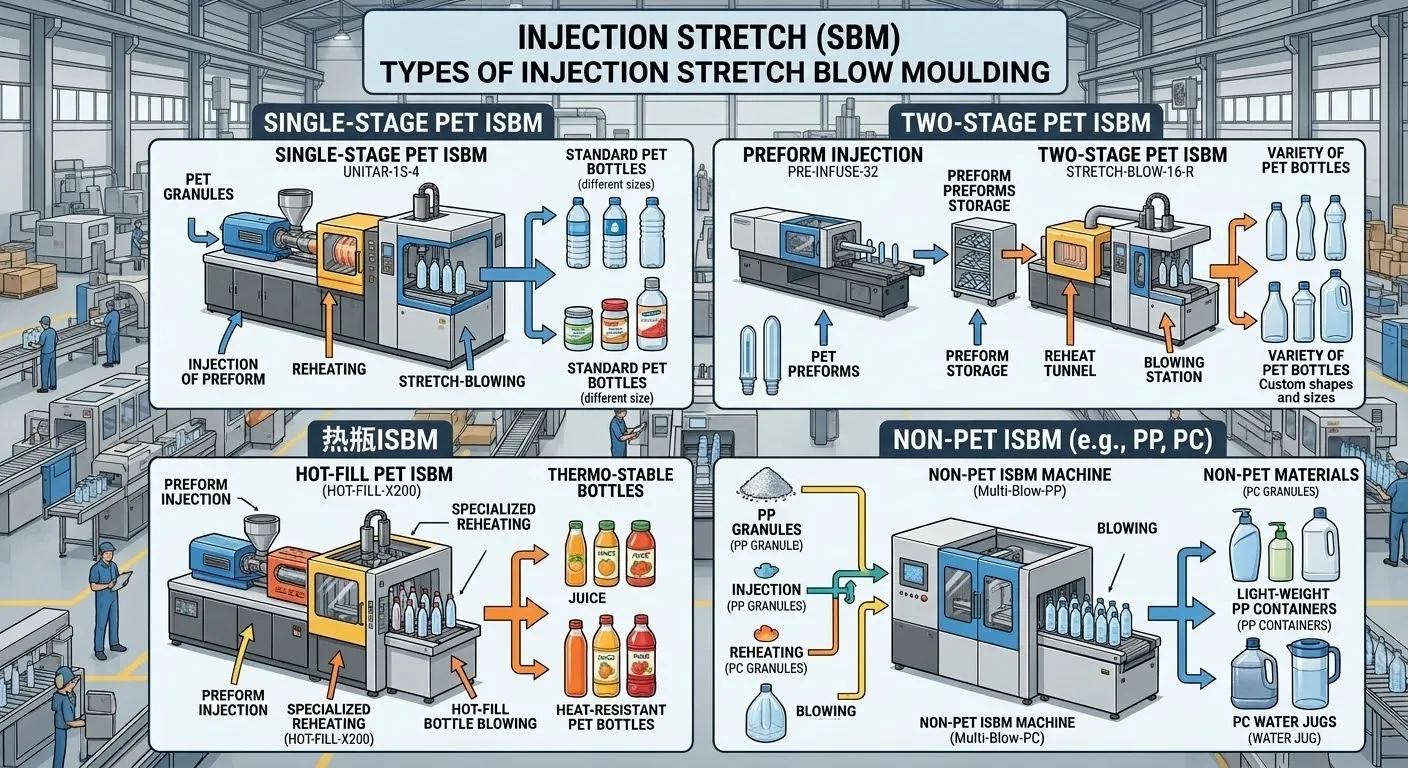
Технология ISBM существует в двух технологических форматах, и терминология часто вызывает путаницу. Различие заключается в происхождении термина «преформа»:
- Одношаговый ISBM — resin pellets enter; finished bottles exit. The preform never leaves the machine, never cools fully, never risks contamination. Preferred for pharmaceutical, cosmetic, and specialty food packaging.
- Двухэтапный (повторный нагрев) — preforms are manufactured separately, stored, and reheated in a standalone blow moulding machine. Very high throughput at scale, but the preform is heated twice, adding energy cost.
- IBM (литье под давлением с выдувом) — similar to ISBM but without the stretch step. Produces heavier, less-oriented bottles. Common for pharmaceutical vials and HDPE containers.
Product range achievable with ISBM — from 10 ml pharmaceutical vials to 10-litre edible oil containers, all from a single platform.
Как определяются характеристики машин ISBM
При сравнении машин четыре показателя выполняют большую часть работы по определению характеристик:
Усилие смыкания при впрыске (кН) — determines maximum preform wall thickness and volume without flash. Ever-Power’s EP-HGY series ranges from 50 kN (EP-HGY50-V3-EV) to 400 kN (EP-HGY650-V4).
Максимальная масса дроби (г) — sets the upper limit on bottle wall weight at a given cavity count. A 150-gram shot across two cavities allows up to 75 g per bottle, covering most 1–2 litre PET containers.
Количество кариесов — the number of bottles produced per cycle. More cavities means higher hourly output but a larger mould investment and tighter process control requirements.
Давление на станции продувки — typically 25–40 bar on standard machines, rising to 60 bar for high-barrier specialty applications.
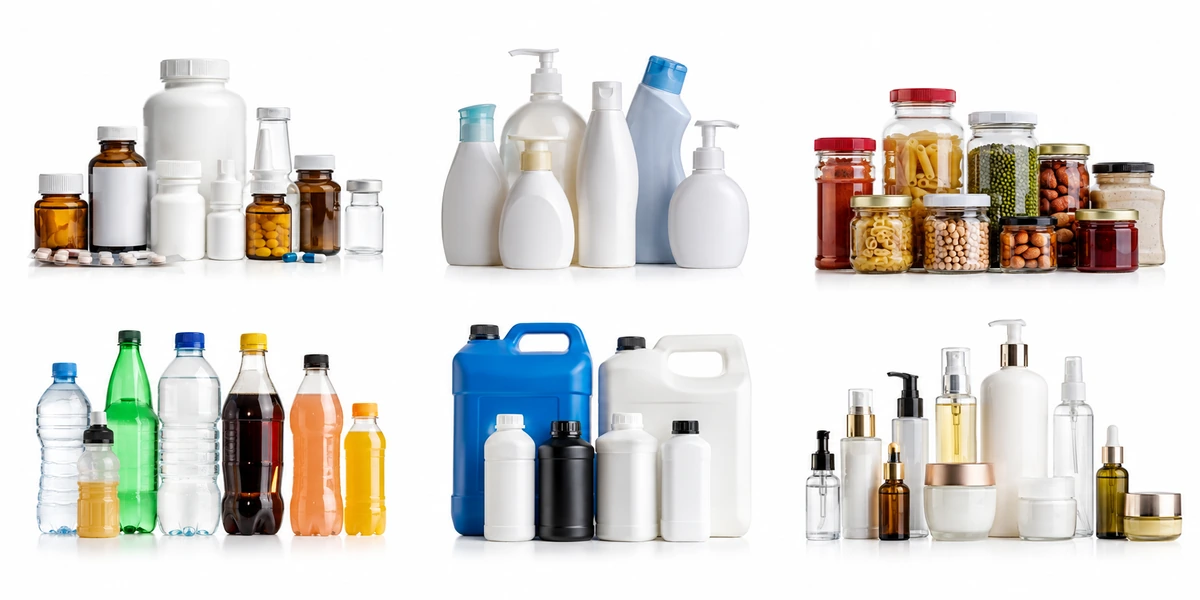
Application sectors served by ISBM technology — pharmaceutical, food and beverage, personal care, and industrial chemical packaging.
Готовы подобрать подходящую машину ISBM для вашего производства?
Ever-Power’s technical team can match machine configuration to your bottle dimensions, resin, and target output within 24 hours.
Основные выводы
Технология ISBM является предпочтительным методом производства, когда производителю необходимы высокопрозрачные, легкие и точно изготовленные по размерам контейнеры из ПЭТ или ПП без необходимости поддерживать отдельный склад заготовок. Более подробную информацию о работе процесса можно найти в нашем разделе «Технология ISBM». Серия 4-позиционных станков EP-HGY, или свяжитесь с нашей командой разработчиков приложений. чтобы обсудить ваши требования к контейнерам.
Экономическое обоснование одношагового межсистемного баллистического модуля
For manufacturers entering the PET bottle market for the first time, the economic argument for one-step ISBM is straightforward: a single machine replaces two separate production units (a preform injection machine and a standalone blow moulder), requires less floor space, and produces a cleaner product with fewer operator touchpoints. The absence of a preform storage and handling step also means that the risk of preform contamination — a significant concern in pharmaceutical and infant food packaging — is eliminated by design rather than controlled by procedure.
The trade-off is that one-step machines have lower maximum throughput than two-step reheat blow systems at very high volumes. A large two-step SBM machine can run 20,000–40,000 bottles per hour in multi-cavity mode. One-step ISBM machines typically top out at 5,000–12,000 bottles per hour depending on bottle size and cavity count. For most mid-volume producers — particularly in emerging markets and specialty niches — this output range is more than adequate, and the capital and operational simplicity of the one-step platform more than offsets the throughput ceiling.
Варианты материалов: помимо ПЭТ
Хотя ПЭТ-пластик доминирует в производстве ISBM по объему, три других полимера также регулярно обрабатываются на одностадийных машинах ISBM, и для каждого из них существует свой набор технологических требований:
ПП (полипропилен) — processed at a higher melt temperature than PET (typically 200–230 °C) and with a wider orientation temperature window. PP bottles are opaque or translucent, lighter than PET at equivalent wall thickness, and compatible with hot-fill at temperatures up to 120 °C. Commonly used for edible oil, condiment, and pharmaceutical containers where PET’s transparency is not required.
ПЭТГ (полиэтилентерефталатгликоль) — a copolymer of PET with lower haze, higher surface gloss, and better amorphous processability than standard PET. PETG does not crystallise during blow moulding even if the temperature window is slightly exceeded, which gives operators a more forgiving process. Its principal application is premium cosmetic packaging where glass-like appearance is critical.
Поликарбонат (ПК) — high optical clarity, excellent impact resistance, and a heat deflection temperature that allows autoclaving. Processed at significantly higher barrel temperatures (270–320 °C) and with different stretch parameters than PET. Applications include laboratory ware, reusable water bottles, and medical device packaging. Note that PC use in food contact packaging has been declining due to regulatory restrictions on bisphenol A in some markets.
Справочник по ключевым терминам
| Срок | Определение |
|---|---|
| Преформа | Толстостенная туба, изготовленная методом литья под давлением; промежуточная форма между смолой и готовой бутылкой. |
| Двуосная ориентация | Молекулярная ориентация в двух перпендикулярных направлениях (осевом и окружном), которая укрепляет и осветляет готовую бутылку. |
| Коэффициент взрыва (BUR) | Отношение диаметра готовой бутылки к диаметру корпуса заготовки, описывающее степень радиального расширения. |
| Станция кондиционирования | The 4-station ISBM station that uses infrared heaters to adjust the preform’s axial temperature profile before blowing |
ISBM в контексте устойчивой упаковки
PET containers produced by ISBM are among the most widely recycled plastic packaging formats globally. In most markets with developed collection infrastructure, post-consumer PET bottles have recycling rates of 50–80%, and recycled PET (rPET) is routinely incorporated into new bottle production at rates of 25–100% depending on regulatory requirements and resin availability. The one-step ISBM process contributes to this recyclability because the finished bottle contains only one resin type with no multi-layer barrier coatings or adhesive labels that would complicate sorting and reprocessing.
Lightweighting through ISBM is also a direct sustainability lever. Because biaxially oriented PET is structurally more efficient than unoriented PET, ISBM-produced bottles use less resin per unit of contained volume than any other PET forming process. A 500-ml ISBM water bottle weighing 8–10 g uses approximately 60% less PET than an equivalent bottle produced by injection moulding alone. Over the lifetime of a production line producing millions of bottles, this resin reduction represents a substantial reduction in carbon footprint, both in manufacturing and in transport due to lower filled-bottle weight.
Часто задаваемые вопросы
Какие виды пластмасс можно перерабатывать на машине ISBM?
The most commonly processed resins are PET (polyethylene terephthalate), PP (polypropylene), PETG (polyethylene terephthalate glycol), and PC (polycarbonate). Each resin has its own orientation temperature window and process requirements. PET is by far the most common — it accounts for the majority of ISBM production globally — but Ever-Power’s EP-HGY machines are configured to process PP and PETG as well.
Сколько бутылок в час производит машина ISBM?
Output depends on bottle volume, cavity count, and machine configuration. A 2-cavity 4-station machine producing 500-ml PET water bottles typically achieves 2,000–3,500 bottles per hour. A 6-cavity large-format machine can reach 8,000–12,000 per hour for smaller containers. Ever-Power will confirm specific output estimates for your bottle and cavity count before purchase.
В чём разница между одноэтапной и двухэтапной ISBM?
In one-step ISBM, resin pellets enter the machine and finished bottles exit — no preform storage or handling step in between. In two-step (reheat stretch blow moulding), preforms are manufactured separately, cooled, stored, and later reheated for blowing. One-step is preferred for pharmaceutical, cosmetic, and short-run applications; two-step is used for very high-volume commodity bottle production.
Как запросить ценовое предложение на станок ISBM?
Свяжитесь с компанией Ever-Power по адресу: isbmmolding.com/contact-us или по электронной почте [email protected] Укажите чертеж вашей бутылки, тип смолы, целевую производительность и любые специфические требования к применению. Наша команда ответит в течение 24 часов, предоставив рекомендации по оборудованию и предварительное ценовое предложение.