ISBM and IBM are two related but fundamentally different blow moulding processes. Both start with an injection-moulded preform. Both produce a finished hollow container. But what happens between those two points — specifically, whether a mechanical stretch rod is used — determines the molecular structure of the finished bottle, its physical performance, and which applications it serves. Choosing the wrong process carries a real cost: not just in capital, but in the ongoing cost of containers that underperform their specification.
The Core Mechanical Difference
IBM — injection blow moulding — uses a three-station rotary machine. At station one, resin is injected around a core rod to form a preform. At station two, the preform (still on the core rod) transfers into the blow mould, and air pressure inflates it against the mould wall. At station three, the finished bottle is stripped from the core rod and ejected. There is no stretch rod, no axial extension of the preform, and no biaxial molecular orientation. The bottle’s wall structure is essentially isotropic — properties are the same in all directions, and relatively modest.
ISBM — injection stretch blow moulding — adds a mechanical stretch rod to the blow station. Before high-pressure air is introduced, this rod descends into the preform and physically extends it axially, typically to 2.5–3.5 times its injection length. Radial blow air then expands the material in the hoop direction simultaneously. The result is biaxial molecular orientation — fundamentally stronger, clearer, and lighter than the unoriented structure produced by IBM.
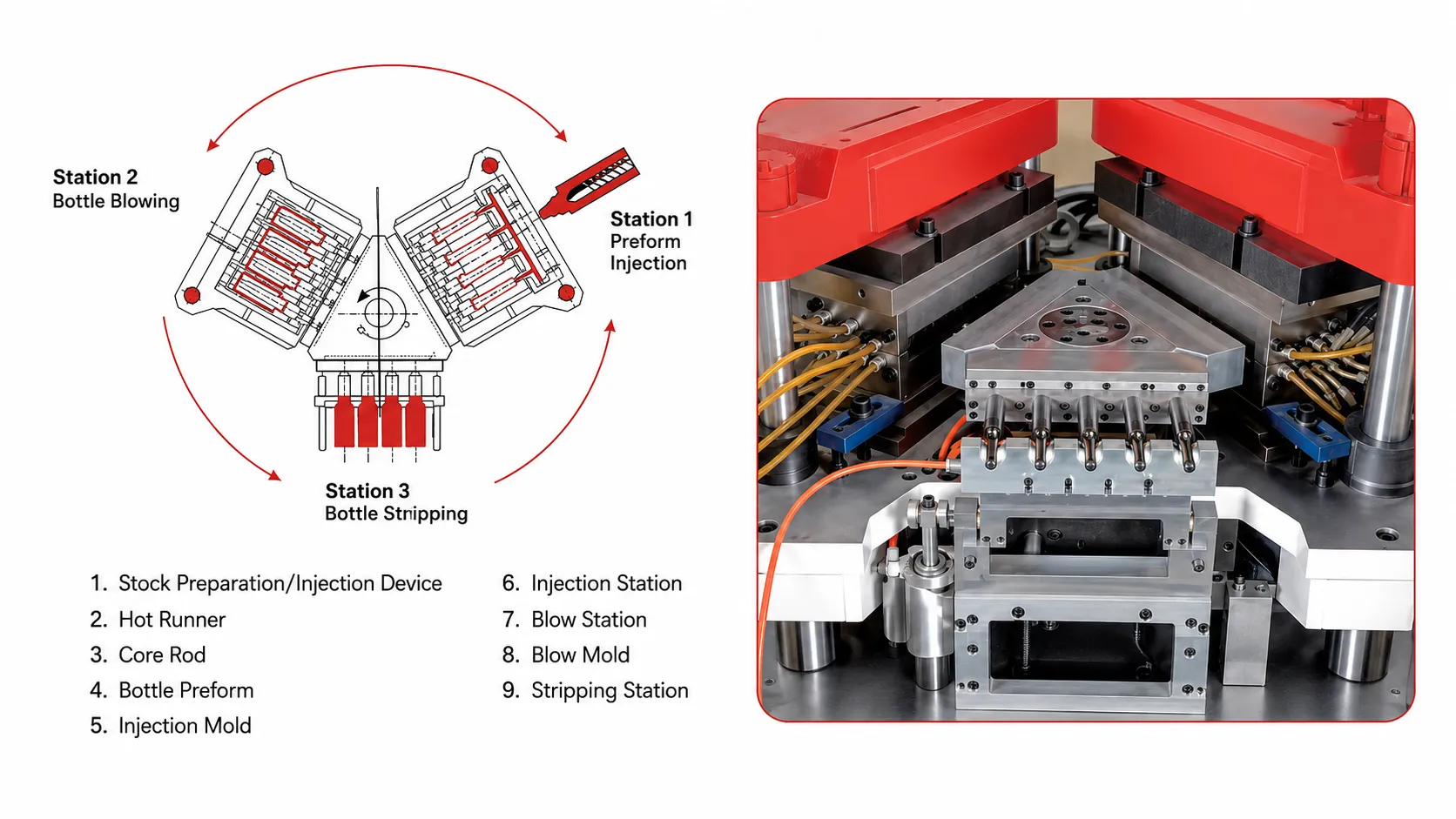
IBM operating principle — the three-station injection-blow sequence showing core rod transfer from injection to blow station, with no axial stretch rod.
Performance Differences: What the Data Shows
The performance gap between IBM and ISBM output is not marginal. It is significant enough to determine whether a container passes or fails its application specification:
| Performance Metric | IBM Output | ISBM Output |
|---|---|---|
| Typical wall thickness | 0.8–2.0 mm | 0.2–0.5 mm |
| Optical clarity (PET) | Translucent to hazy | Glass-clear, >90% transmittance |
| CO₂ barrier (500 ml) | Not suitable for CSD | Up to 6-month CSD shelf life |
| Drop impact (filled) | Limited | 1.5 m drop test standard |
| Weight vs equal-volume container | 30–50% heavier | Lighter — more resin-efficient |
Where IBM Still Makes Sense
Despite ISBM’s performance advantages, IBM remains the correct choice for a defined range of applications:
- Pharmaceutical vials and dropper bottles — small HDPE or PP containers, 5–250 ml, where clarity is not required and dimensional precision at the neck finish is the priority.
- Small cosmetic bottles with complex neck geometry — IBM’s core rod produces exceptionally precise neck dimensions, valuable where threaded closures must seal reliably at low torque.
- Containers below 10 ml — at very small volumes, the stretch ratios achievable by ISBM become difficult to control reliably.
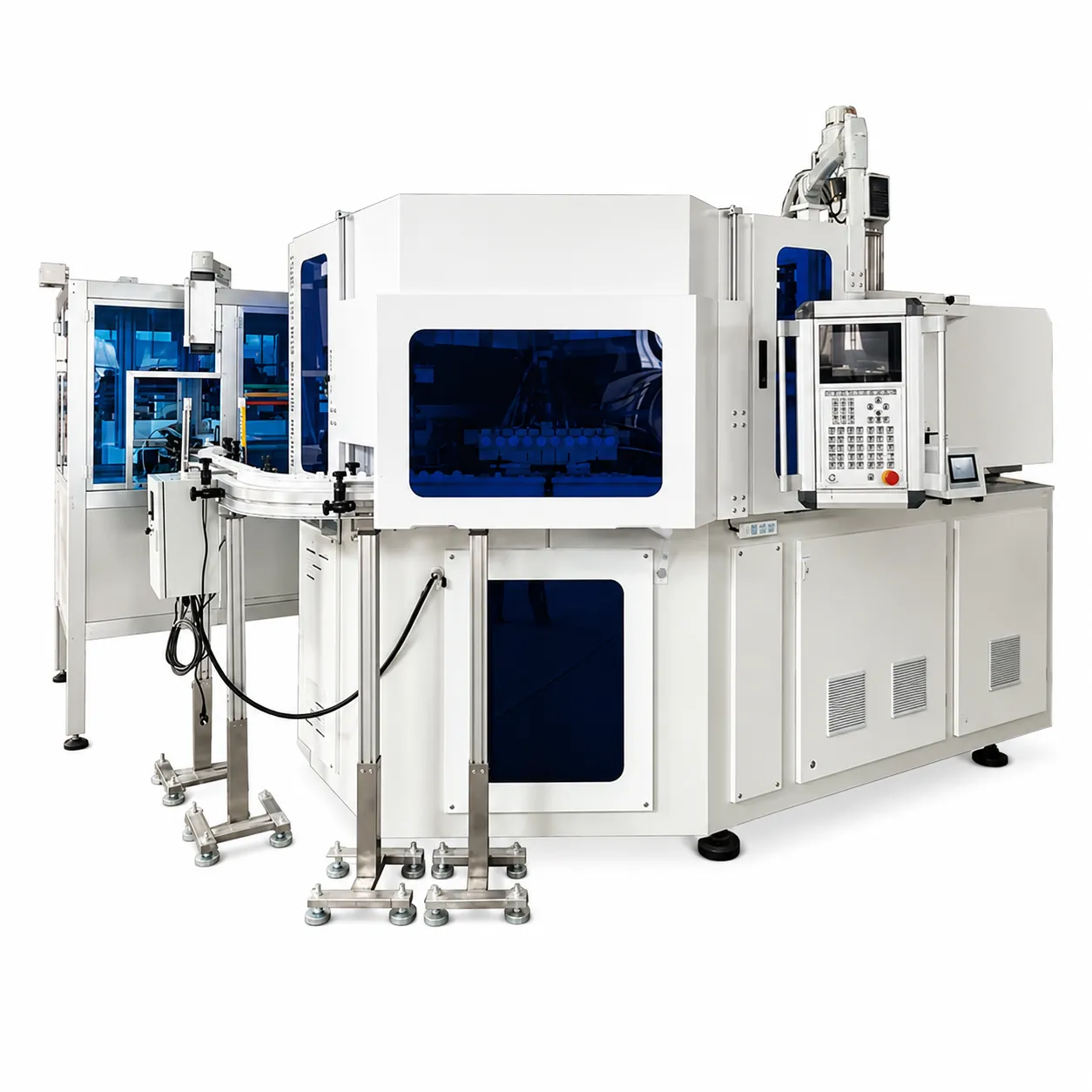
Ever-Power EP-IBM60HE — high-efficiency IBM machine for pharmaceutical vials, dropper bottles, and small HDPE personal care containers.
Where ISBM Is the Clear Choice
ISBM dominates wherever a container must combine light weight, high clarity, adequate barrier properties, and structural strength:
- PET water and juice bottles, 100 ml to 5 litres
- Carbonated soft drink bottles requiring CO₂ barrier
- Premium cosmetic PETG or PET flacons with high surface gloss
- Oral solid dose pharmaceutical bottles in modern PP or PET designs
- Edible oil containers, 1–5 litres, often in PP for hot-fill compatibility
Capital Cost and Return on Investment
IBM machines are typically less expensive at a given cavity count. However, total cost of ownership must include the value of the finished container. ISBM produces a lighter, higher-value container from the same resin weight. For a PET water bottle, ISBM output can be 20–30% lighter than IBM output at equivalent structural performance — which translates directly into raw material savings over the machine’s lifetime.
A buyer producing 2 million 500-ml bottles per month, reducing bottle weight by 2 g through switching from IBM to ISBM output, saves approximately 4 tonnes of PET per month — significant at current resin prices.
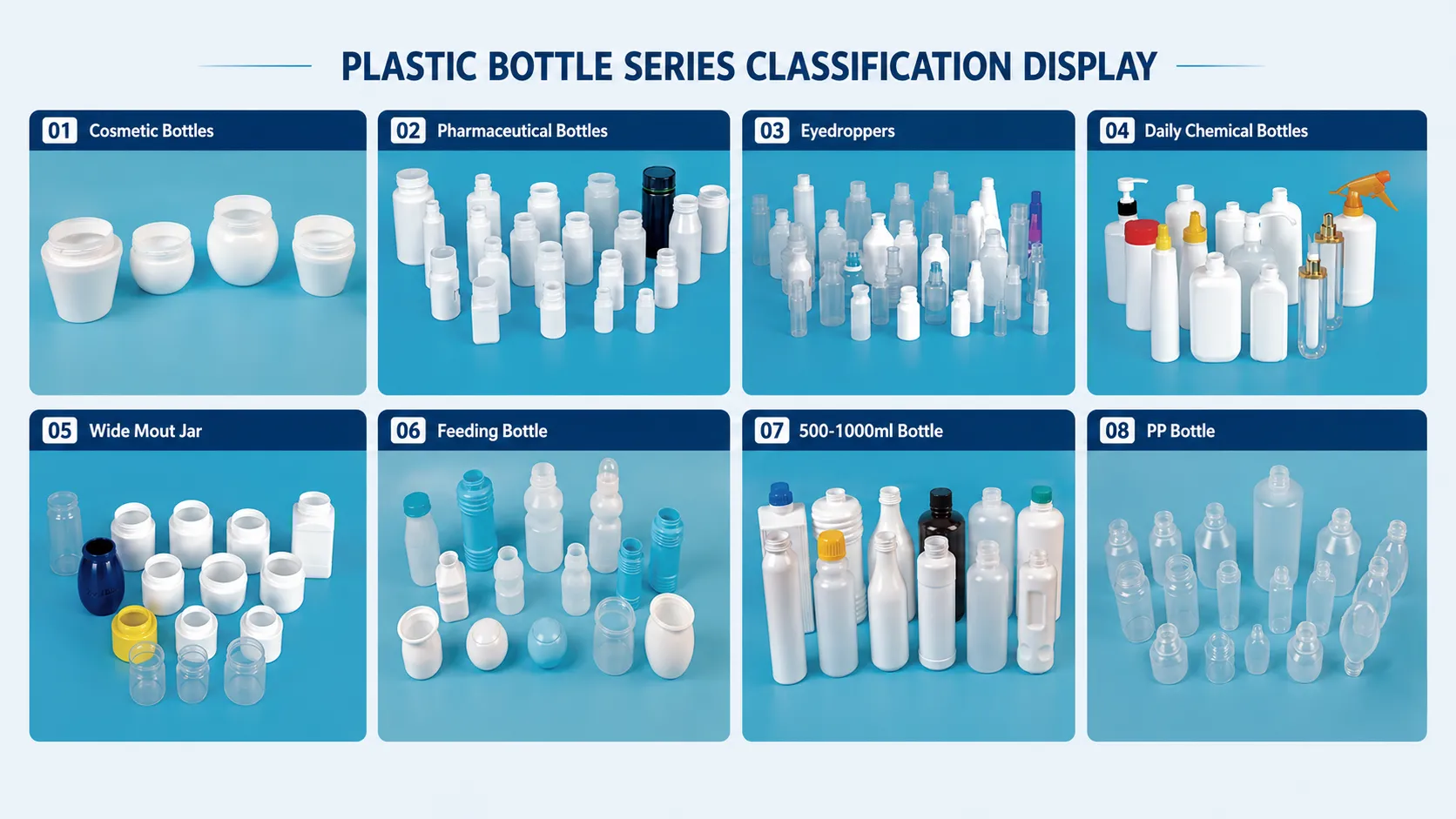
Application range for IBM technology — pharmaceutical vials, dropper bottles, nasal sprays, and small HDPE personal care containers where biaxial orientation is not required.
Unsure whether IBM or ISBM is right for your container?
Ever-Power supplies both IBM and ISBM machines. Send us your bottle specification and we will recommend the optimal process and machine model for your application.
Explore the full Ever-Power ISBM machine range or review our custom mould capabilities to understand how machine and mould combine to determine your final bottle specification.
One-Step vs Two-Step: The Third Dimension of the Comparison
Both IBM and ISBM can be operated as one-step processes, where the injection and blow operations are integrated in the same machine using the same thermal cycle. But ISBM also exists in a two-step version (reheat stretch blow moulding), where preforms are produced in a separate injection moulding machine, cooled, stored, and later reheated for blowing in a dedicated blow moulder.
One-step is generally preferred for pharmaceutical and medical packaging (no intermediate handling = lower contamination risk), short to medium production runs, and companies entering bottle production without an existing preform supply chain. Two-step reheat blow is preferred for very high-volume commodity production — water and CSD bottles at 20,000+ bottles per hour — where the capital investment in two separate machines is justified by output.
Process Flexibility: Format Changeover in Practice
One practical advantage of one-step ISBM over IBM that deserves specific attention is format changeover flexibility. In one-step ISBM, changing from one bottle format to another requires changing the preform mould and the blow mould simultaneously — but both moulds are on the same machine, so the changeover is a single maintenance event. On a well-designed machine with quick-clamp tooling, this can be accomplished in under two hours.
IBM machines also have straightforward changeovers, but the core rod assembly is more complex than an ISBM mandrel system, and neck finish changes — from, say, a 24-mm PCO thread to a 28-mm DIN thread — require both core rod and neck split replacement. On machines where the core rod assembly is integral to the rotating table, a neck finish change can require partial disassembly of the machine head.
For contract manufacturers producing multiple bottle formats on a single production line, one-step ISBM offers the best combination of format flexibility and changeover simplicity across the widest range of bottle sizes and resin types.
Process Summary: Decision Framework
| Scenario | Recommended Process | Key Reason |
|---|---|---|
| Clear PET water / juice 0.5–5 L | One-step ISBM | Clarity, barrier, and light-weighting all require biaxial orientation |
| HDPE pharma dropper 10–100 ml | IBM | Precise neck dimension, HDPE resin compatibility, clarity not required |
| Premium PETG cosmetic flacon | One-step ISBM (6-station) | Complex geometry and premium surface finish require conditioning control |
| Large-volume commodity CSD 50M+ bph | Two-step RSBM | Scale economics favour two-step above this volume threshold |
Supplier Evaluation: IBM vs ISBM Claims
In some markets, the terms IBM and ISBM are used interchangeably by equipment suppliers — sometimes incorrectly and sometimes deliberately to obscure process limitations. A buyer purchasing what they believe to be an ISBM machine and receiving an IBM machine — without a stretch rod — will produce containers that fail clarity, barrier, and weight specifications without knowing why.
The most reliable way to verify the process a machine performs is to request a sample bottle produced by the specific machine model you are evaluating, processed in the resin and at the wall thickness you intend to run. Test that bottle for: optical haze (unoriented PET hazes above 2% at 0.3 mm wall thickness; oriented PET is clear at the same thickness); axial and hoop tensile strength; and CO₂ permeability if your application requires barrier. These tests will definitively confirm whether the machine produced a biaxially oriented container (ISBM) or an unoriented container (IBM). A supplier who is unable or unwilling to provide test samples should not receive a purchase order for equipment producing safety- or performance-critical containers.
Часто задаваемые вопросы
Can an IBM machine be upgraded to ISBM?
Generally no. IBM and ISBM machines are fundamentally different in mechanical design. An IBM machine uses a rotating core rod mandrel on which the preform is formed and blown in one piece; an ISBM machine uses a separate mandrel and a stretch rod mechanism at the blow station. Retrofitting a stretch rod to an IBM machine would require redesigning the blow station and the rotary table — in practice, this is never cost-effective compared to purchasing the correct machine type.
Which process is better for high-clarity cosmetic bottles?
ISBM, typically using PETG resin. The biaxial orientation produced by ISBM gives cosmetic bottles their glass-like surface clarity. IBM produces less-oriented bottles with lower clarity. For the premium surface finish required in high-end cosmetics, ISBM with PETG on a 4-station or 6-station machine with dual conditioning zones is the standard.
Does Ever-Power supply both IBM and ISBM machines?
Yes. Ever-Power’s EP-IBM series covers injection blow moulding machines for pharmaceutical vials, dropper bottles, and small HDPE containers. The EP-HGY and EP-BPET series cover one-step ISBM from 3-station compact machines (EP-HGY50-V3-EV) to 4-station mid-range (EP-HGY150-V4 through EP-BPET-125V4) and 6-station premium (EP-HGYS280-V6). Contact our team to discuss which process suits your application.
Is ISBM suitable for carbonated soft drink bottles?
Yes. ISBM with PET at IV 0.78–0.84 dL/g and appropriate stretch ratios produces bottles with adequate CO₂ barrier for CSD shelf lives of 3–6 months depending on bottle weight and carbonation level. IBM cannot produce CSD bottles because unoriented PET does not provide sufficient CO₂ barrier performance at commercial bottle weights.