Circular Economy and Sustainable ISBM Processing
Can Recycled PET (rPET) Be Used in Injection Stretch Blow Molding?
A definitive engineering and sustainability guide analyzing the technical feasibility, processing adaptations, quality considerations, and economic viability of incorporating post-consumer recycled polyethylene terephthalate into the ISBM process at blend ratios up to 100 percent.
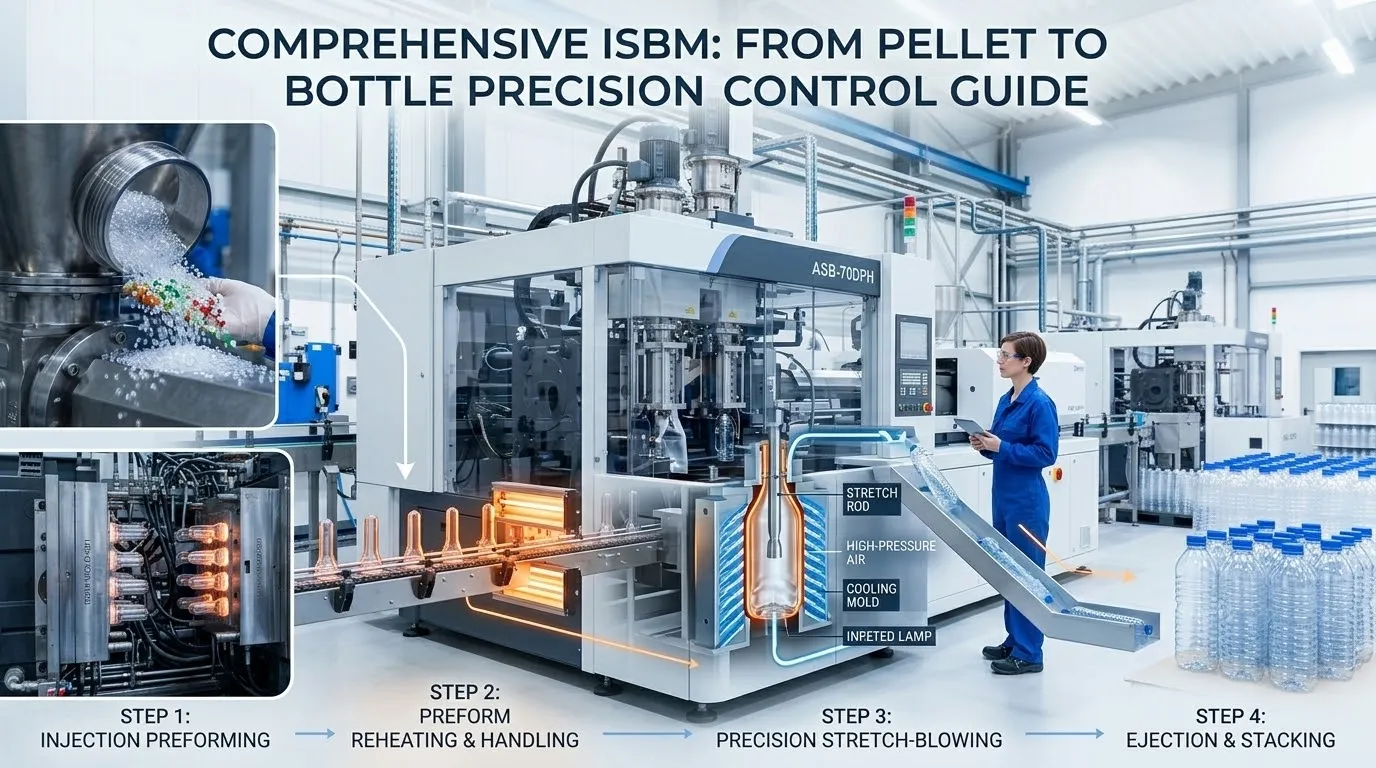
The Definitive Answer: Yes, rPET Can and Should Be Used in ISBM
The question of whether recycled PET can be used in injection stretch blow molding is no longer a matter of technical speculation. It is a firmly established reality of modern packaging manufacturing. Post-consumer recycled PET is not only compatible with the ISBM process; it is rapidly becoming the dominant feedstock for many container applications, driven by a confluence of sustainability mandates, brand owner commitments to circular economy principles, regulatory requirements for recycled content, and the economic imperative to reduce dependence on virgin fossil-fuel-derived resin. At Ever-Power, a globally recognized Brazilian ISBM manufacturer with over two decades of polymer processing expertise, our machine platforms are specifically engineered to process rPET at blend ratios from 25 percent to 100 percent, delivering container quality that meets or exceeds the specifications demanded by the world’s most discerning consumer packaged goods brands.
However, the successful use of rPET in ISBM is not a simple drop-in substitution. rPET is a fundamentally different material than virgin PET, with a lower average molecular weight, a broader distribution of chain lengths, a thermal history that has partially degraded the polymer, and the presence of residual contaminants from its previous life as a beverage bottle or food container. These differences manifest as a lower and more variable intrinsic viscosity, faster crystallization kinetics, a different color and clarity profile, and a greater sensitivity to thermal degradation during reprocessing. Successfully processing rPET in ISBM requires a comprehensive understanding of these material characteristics and the implementation of specific adaptations in machine configuration, process parameters, and quality control procedures. This exhaustive guide will address every aspect of rPET processing in ISBM, from material sourcing and preparation through machine parameter optimization to quality validation, providing a complete engineering framework for the successful integration of recycled content into premium container production on machines like the Máquina servo completa EP-HGY150-V4-EV e a alta produção Máquina de 4 estações de fileira dupla EP-HGY250-V4-B.
The journey to high-quality rPET ISBM production is a journey of understanding and controlling variability. This guide provides the complete roadmap for that journey.
Understanding rPET Material Characteristics and Their ISBM Processing Implications
The successful use of rPET in ISBM begins with a thorough understanding of how recycled material differs from virgin resin and how those differences affect every stage of the process.
Intrinsic Viscosity Reduction and Chain Length Distribution
The most technically significant difference between rPET and virgin PET is the reduction in intrinsic viscosity. Virgin bottle-grade PET typically has an IV of 0.80 to 0.84 dL/g. rPET, depending on the source, the recycling process, and the number of times the material has been recycled, typically has an IV ranging from 0.65 to 0.78 dL/g. This reduction in IV reflects a lower average molecular weight, meaning the polymer chains are shorter on average. The shorter chains provide less entanglement and lower melt strength. During injection, the lower-IV rPET flows more easily, but it is also more prone to drooling from the nozzle and to flashing in the mold if the injection pressure is not adjusted. During stretching, the lower-IV rPET has a reduced natural stretch limit. The planar stretch ratio must typically be reduced to a maximum of 9 to 11, compared to 12 to 14 for virgin PET, to avoid tearing and stress whitening. The broader distribution of chain lengths in rPET, a consequence of the mixture of bottles from different sources and with different thermal histories, means that the material does not have a single, well-defined melting point or crystallization temperature. This variability must be accommodated by the machine’s adaptive control systems. The servo-driven injection unit on the EP-HGY150-V4-EV is specifically designed to compensate for this IV variability in real-time, adjusting injection pressure and velocity to maintain consistent preform weight and dimensions despite the fluctuating melt viscosity.
Thermal Sensitivity, Color Variation, and Contaminant Presence
rPET is more thermally sensitive than virgin PET. The polymer chains have already been subjected to at least one full cycle of melting, processing, and degradation, and they have less resistance to further thermal breakdown. The barrel and hot runner temperatures for rPET should be reduced by 5 to 10 degrees Celsius compared to virgin PET settings, typically operating in the range of 265 to 280 degrees Celsius. The screw rotation speed should be reduced to minimize shear heating. The residence time of the melt in the barrel should be minimized by matching the shot size to the barrel capacity and avoiding extended periods of idle operation with the barrel heated. rPET also exhibits color variation. The recycled flakes come from bottles that may have been clear, light blue, green, or amber, and even after sorting and washing, a slight color cast may be present. For clear container applications, rPET is typically blended with virgin PET to dilute the color, or the rPET is sourced from a high-quality, color-sorted stream. Residual contaminants, despite the best recycling processes, may be present in rPET. These can include trace amounts of labels, adhesives, barrier coatings, and other polymers that were not completely separated during recycling. These contaminants can cause black specks, surface defects, or localized variations in stretching behavior. Rigorous incoming material inspection, including melt filtration during the rPET pelletizing process, is essential for minimizing contaminant-related defects. The Moldes personalizados de injeção e sopro em uma única etapa from Ever-Power can be engineered with enhanced venting and gate designs to accommodate the specific flow characteristics of rPET.
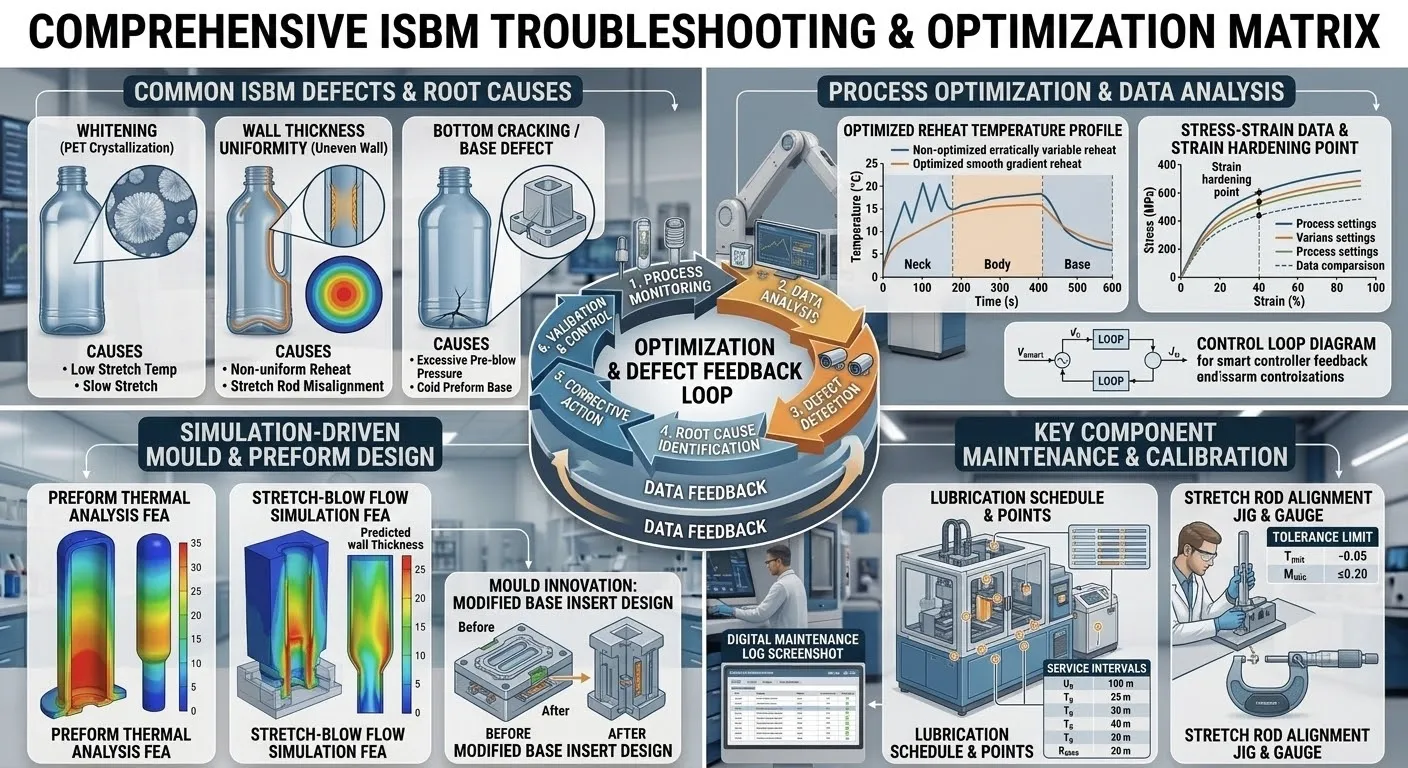
Machine Configuration and Process Parameter Adaptations for rPET
Successfully processing rPET in ISBM requires specific adaptations to the machine configuration, the process parameter setpoints, and the quality control protocols.
⚙️Injection and Thermal Parameter Adjustments for rPET
The injection parameters must be adjusted to accommodate rPET’s lower melt viscosity. The injection speed should be reduced to prevent jetting and to ensure a smooth melt front that fills the preform cavity without entrapping air. The hold pressure should be reduced, as excessive hold pressure can over-pack the preform and cause ejection difficulties. The cooling time may need to be extended because rPET’s faster crystallization kinetics mean that the preform must be cooled more aggressively to prevent thermal haze. The injection mold cooling water temperature should be maintained at the lower end of the range, 6 to 8 degrees Celsius, and the flow rate verified to ensure turbulent flow. The barrel temperature profile should be reduced by 5 to 10 degrees Celsius compared to virgin PET. The hot runner temperature should similarly be reduced. The conditioning pot temperature for rPET typically needs to be increased by 5 to 10 degrees Celsius compared to virgin PET. The lower-IV rPET requires a slightly higher temperature to achieve the same chain mobility for stretching. However, this elevated temperature must be carefully balanced against the increased risk of thermal crystallization. The processing window is narrower. On the EP-HGY200-V4, precise temperature control is essential for maintaining the preform within this narrow optimal window. The stretch rod velocity should be reduced, and the pre-blow pressure should be lowered to provide a gentler stretching profile that accommodates rPET’s reduced elongation tolerance. The programmable motion profiles of servo-driven machines are particularly valuable here, allowing the stretch rod to decelerate as it approaches the end of its stroke, minimizing the peak strain rate on the more brittle rPET.
📐Stretch Ratio Redesign and Preform Geometry Considerations
The preform design for rPET processing must be adapted to the material’s reduced natural stretch limit. The planar stretch ratio should be conservatively designed, typically not exceeding 9 to 11, compared to 12 to 14 for virgin PET. This may require the preform to have a larger starting diameter or a shorter body length, which will increase the preform weight. The increased weight is the material cost penalty of using rPET at high percentages, but it is often offset by the lower cost of rPET feedstock compared to virgin resin. The axial thickness profile of the preform may also need adjustment. Regions of the preform that will undergo high stretch should be thickened to provide additional material, reducing the local stretch ratio in those regions. The preform base design should be reviewed to ensure that the gate region, which is the thickest and hottest area, can be adequately cooled to prevent thermal haze. Finite element simulation of the stretch blow process is an essential tool for optimizing the preform geometry for rPET. The simulation allows the designer to predict the local stretch ratios and to identify any regions where the ratio exceeds the rPET’s limit. The EP-HGYS280-V6 with its dual conditioning stations provides the extended thermal preparation capability that is often beneficial for rPET preforms, allowing the preform to be brought to a uniform stretching temperature without overheating the surface.
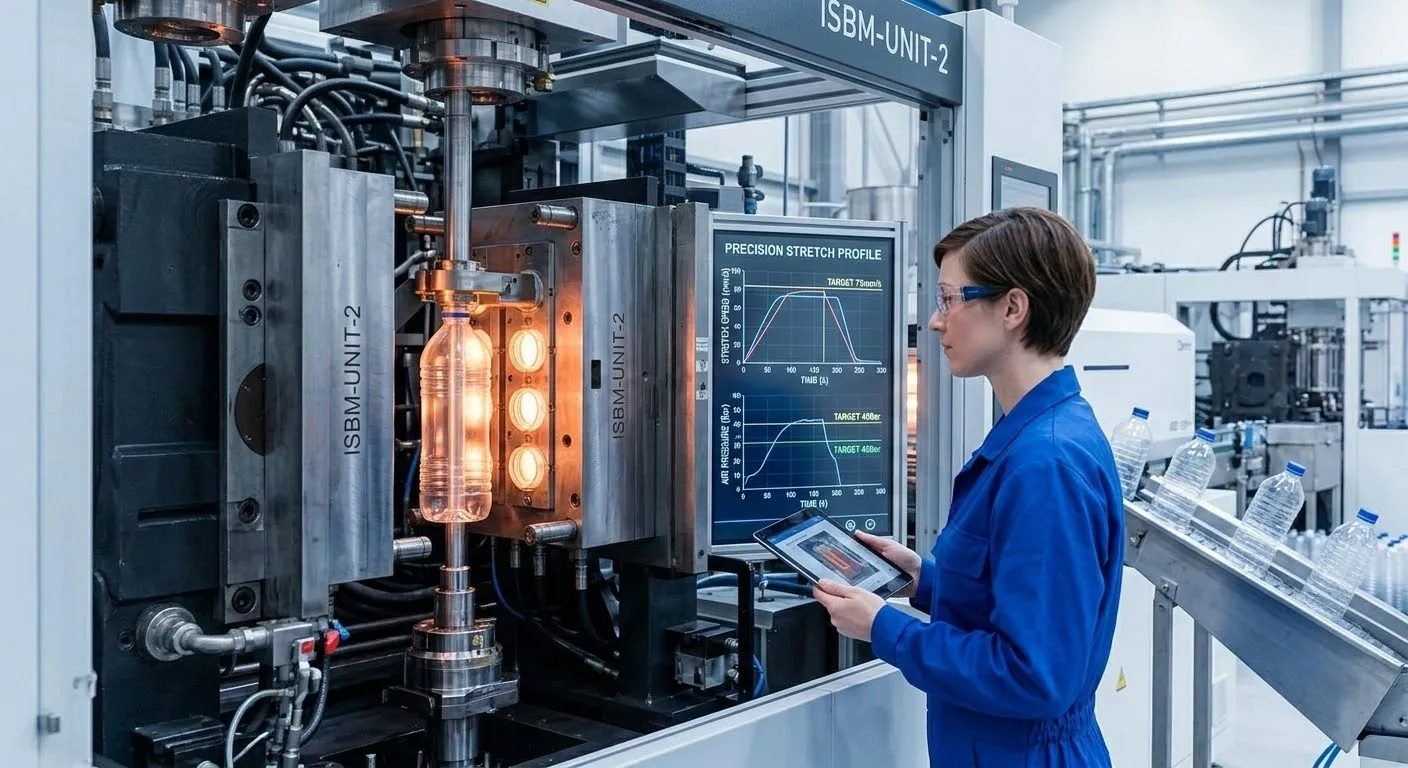
Quality Validation, Economic Viability, and the Path to 100 Percent rPET
The successful use of rPET in ISBM requires not only technical feasibility but also economic viability and a rigorous quality validation framework to ensure that the containers meet the performance standards of the target application.
Quality Testing Protocols for rPET Containers
Containers produced with rPET must undergo the same rigorous quality testing as virgin PET containers, with additional attention to parameters that are affected by the reduced IV and the potential presence of contaminants. Visual clarity should be measured with a haze meter, and the results compared against the specification for the application. For premium water and CSD bottles, a haze level below 5 percent is typically required. rPET containers may exhibit a slightly higher baseline haze, and the blend ratio and process parameters should be optimized to minimize this. Mechanical performance testing, including top load strength, burst pressure, and drop impact resistance, must be performed on a statistically significant sample. The reduced orientation capability of rPET may result in slightly lower values for these metrics, and the preform design or process parameters may need adjustment to compensate. Acetaldehyde content is a critical parameter for beverage applications. rPET can have a higher residual AA level due to its thermal history, and the processing temperatures must be carefully controlled to avoid generating additional AA. Color measurement should be performed to ensure that any slight yellowing or graying of the rPET is within acceptable limits. Barrier performance, measured by the carbon dioxide transmission rate for CSD bottles or the oxygen transmission rate for oxygen-sensitive products, may be slightly reduced in rPET containers. The stretch ratio and the degree of strain-induced crystallinity should be optimized to maximize barrier properties. The EP-HGY150-V4-EV provides the process consistency necessary to meet these quality standards on a repeatable basis.
Economic Viability and Blend Ratio Optimization
The economic viability of rPET in ISBM is determined by the relative cost of rPET feedstock versus virgin PET, the yield loss associated with the higher scrap rate that may initially be experienced during the learning curve, and the market premium that the brand owner may be willing to pay for recycled content. In many markets, rPET is available at a discount to virgin PET, making the use of rPET economically attractive even before considering sustainability benefits. The optimal blend ratio is determined by balancing the cost savings against the quality and processing implications. A 25 to 50 percent rPET blend is often the starting point for facilities new to rPET processing, as the virgin PET buffers the variability of the rPET and the process adaptations are less extreme. As experience is gained and the process is optimized, the blend ratio can be increased. Many leading ISBM operations are now producing containers with 75 to 100 percent rPET content, meeting the performance specifications of even demanding carbonated beverage applications. The key enabler of high-rPET-content production is the adaptive control capability of modern servo-driven machines, which can compensate for material variability in real-time and maintain consistent preform and container quality across the entire production run.
EP-HGY250-V4 e o compacto EP-BPET-70V4 are engineered with the thermal and mechanical precision, as well as the adaptive control capabilities, necessary to process rPET at commercially viable production rates and quality levels. The integration of these machines with Ever-Power’s Moldes personalizados de injeção e sopro em uma única etapa ensures that the mold tooling is optimized for the specific flow and cooling requirements of rPET, providing a complete, integrated solution for rPET ISBM production.
Embrace rPET for Sustainable, High-Performance ISBM Container Production
The answer to the question of whether recycled PET can be used in injection stretch blow molding is an unequivocal yes. rPET is not only compatible with the ISBM process; it is the material of the future for sustainable packaging. Successfully processing rPET requires a comprehensive understanding of its material characteristics, the implementation of specific machine and process adaptations, and a rigorous quality validation framework. With the right equipment, including advanced servo-driven platforms like the EP-HGY150-V4-EV e a alta produção EP-HGY250-V4-B, and precision-engineered Moldes personalizados de injeção e sopro em uma única etapa, manufacturers can confidently incorporate rPET at blend ratios up to 100 percent, delivering containers that meet the quality, performance, and sustainability standards demanded by the global packaging market. At Ever-Power, our two decades of ISBM expertise and our commitment to innovation are dedicated to enabling our customers to succeed in the circular economy.