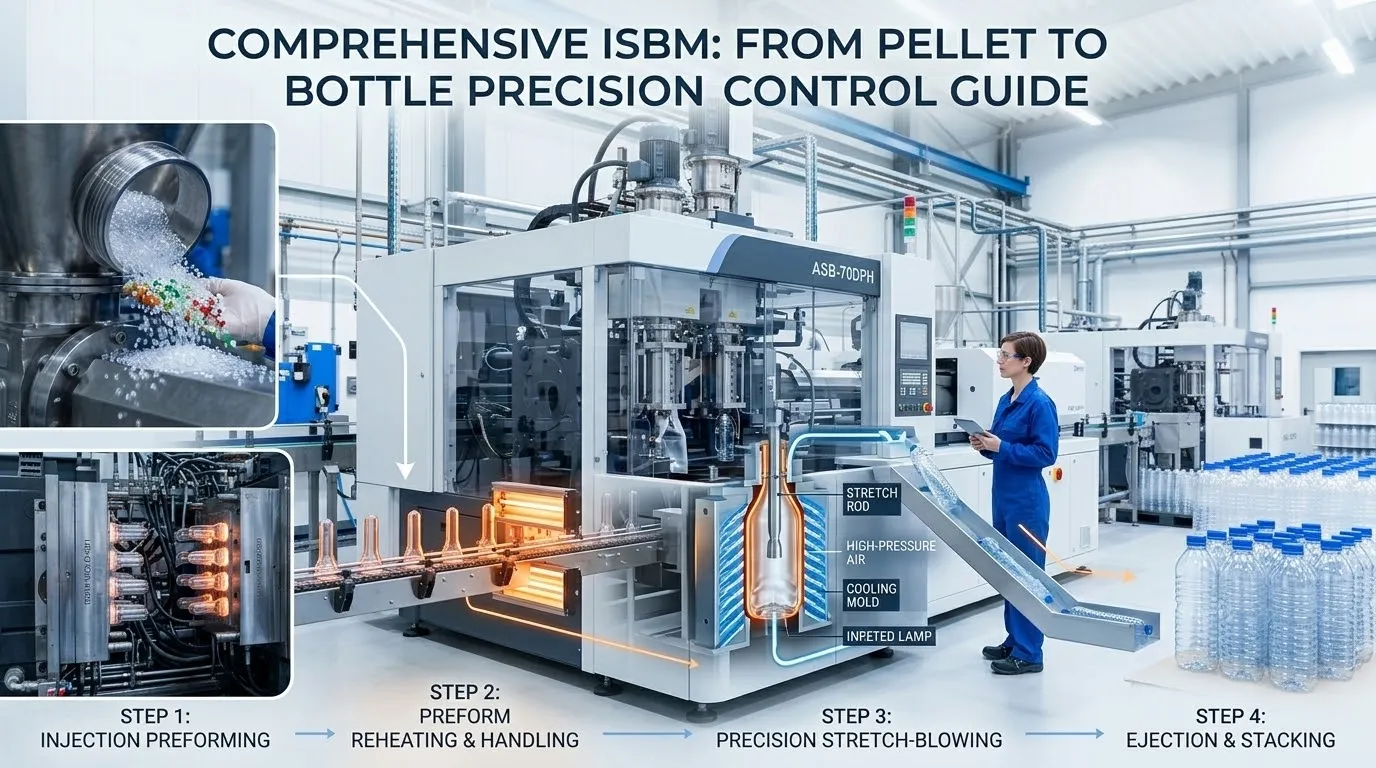
The decision between one-step and two-step injection stretch blow moulding is one of the most consequential choices a packaging producer makes — and one that is frequently made on the basis of incomplete information. The two processes look similar from the outside: both produce biaxially oriented PET or PETG containers. But the internal economics, quality outcomes, capital requirements, and operational profiles are substantially different, and they favour different production contexts.
This article makes the comparison explicit. It covers how the two processes work mechanically, what the energy economics look like across realistic production scenarios, where container quality differs and where it does not, and what the capital and operational cost profile of each technology looks like over a typical machine life. It concludes with a decision framework for identifying which process fits a given application.
Ever-Power manufactures one-step ISBM machines exclusively. This article presents the comparison on its technical and commercial merits, including the scenarios where two-step is the better choice — because the right machine for your application is the right machine, and we would rather you understand the landscape accurately than discover a mismatch after purchase.
How Each Process Works
Both processes produce biaxially oriented containers — but through fundamentally different production architectures
The Energy Difference: Why One-Step Uses ~40% Less
The reheating step in two-step processing is not a minor inefficiency — it is a structurally unavoidable energy cost that compounds across every container produced
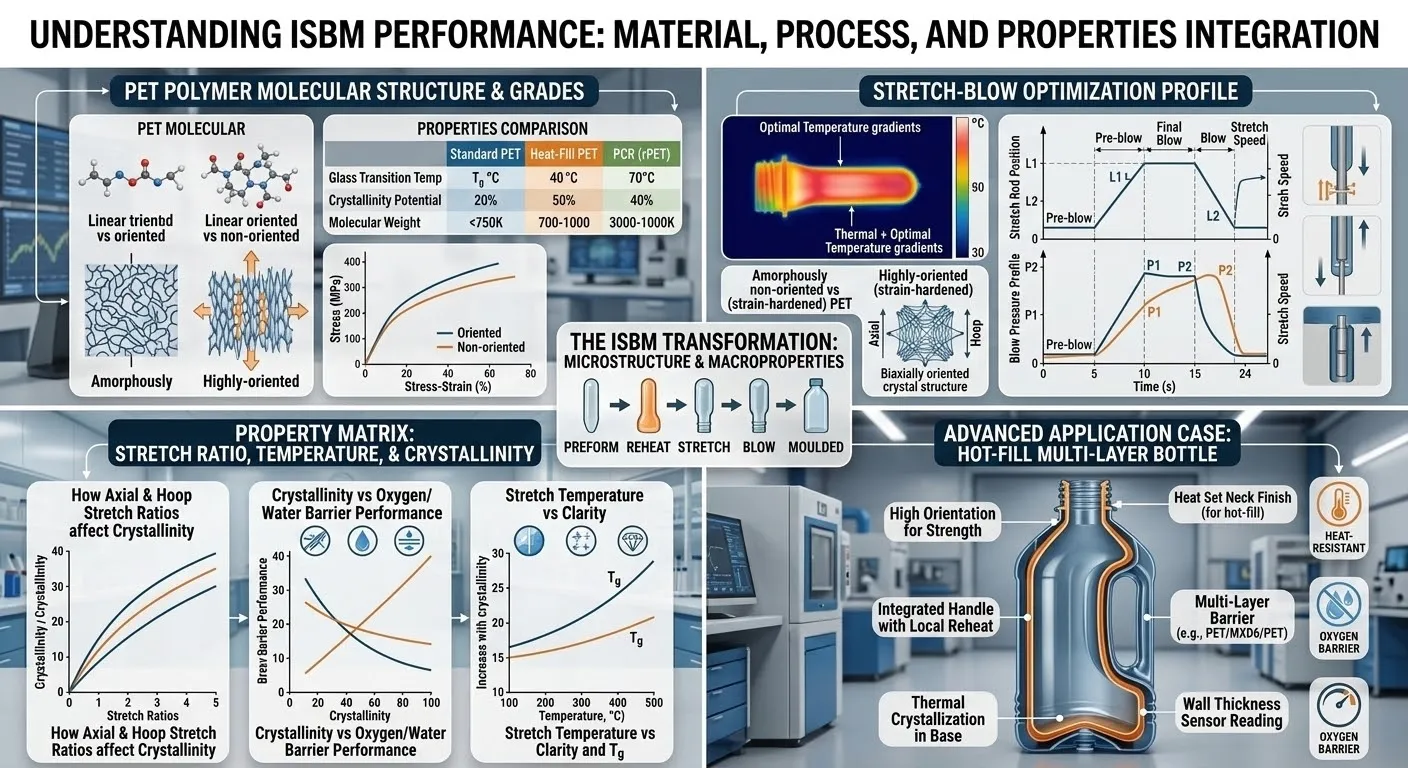
The physics of the energy comparison are straightforward. A PET preform injected at approximately 270°C and blowing temperature of around 100–110°C retains a substantial fraction of its injection thermal energy when it reaches the blow station in a one-step machine — energy that would otherwise be wasted. In a two-step process, the preform is cooled to room temperature (approximately 23°C) and must then be reheated to 100–110°C by infrared lamps before blowing. The energy required for this reheat cycle is a direct addition to the energy cost per container, with no corresponding benefit to container quality.
Across a typical production run, this structural difference produces an energy saving of approximately 40 percent per container for one-step vs two-step, all other factors being equal. For full-servo one-step machines (the EP-HGY150-V4-EV and EP-HGY50-V3-EV), the saving is further compounded by the elimination of hydraulic pump idle losses — servo motors draw power only when moving, while hydraulic pumps run continuously regardless of machine activity.
The practical consequence in production economics: at an electricity cost of $0.15/kWh and a production volume of 500,000 containers per year, the energy saving from one-step vs two-step represents roughly $8,000–12,000 in annual electricity cost for a typical cosmetic container size and wall thickness. Over a 10-year machine life, this compounds to $80,000–120,000 in energy savings — a meaningful contribution to the total cost of ownership comparison between the two technologies.
Injection heat used directly for blowing
No reheat cycle required
Injection heat + reheat from ambient
IR oven energy is unavoidable overhead
Where Quality Differs — and Where It Does Not
Both processes produce biaxially oriented containers — but one-step has structural advantages in three specific quality dimensions
Neck Thread Precision
One-Step Advantage
In one-step ISBM, the neck thread is formed by injection moulding — the same process that makes the preform. The thread geometry is set by the injection mould’s neck ring, which is machined to ±0.02 mm. In two-step reheat SBM, the neck is also formed by injection — but the preform neck is exposed to ambient handling, storage, and reheating before the container is produced. Minor dimensional variation from thermal cycling is possible. For pharmaceutical packaging where thread-to-closure engagement tolerance is critical, one-step’s unbroken thermal chain gives it a quality advantage.
Contamination Control
One-Step Advantage
In one-step, the preform is never exposed to the ambient environment between injection and blowing. It travels inside the machine. In two-step, preforms are cooled, ejected, conveyed, stored in bags or boxes, and later manually or automatically loaded into the reheat machine. Each handling step represents a contamination exposure event. For pharmaceutical oral liquid bottles, ophthalmic containers, and baby products — all applications where GMP contamination control is a regulatory requirement — one-step’s closed-loop architecture is a significant advantage that simplifies validation and reduces contamination risk.
Complex Shape Capability
One-Step Advantage
Four-station one-step machines have a dedicated temperature conditioning station that can apply differential heating to specific zones of the preform before blowing. This zone-selective conditioning is what allows 4-station machines to produce oval, square, and heavy-walled containers with uniform wall thickness — shapes that two-step reheat machines can produce but with less precise wall distribution control. For premium cosmetic packaging where asymmetrical container geometry is a design requirement, the 4-station one-step architecture is meaningfully superior.
Output Rate for Standard Round Bottles
Two-Step Advantage
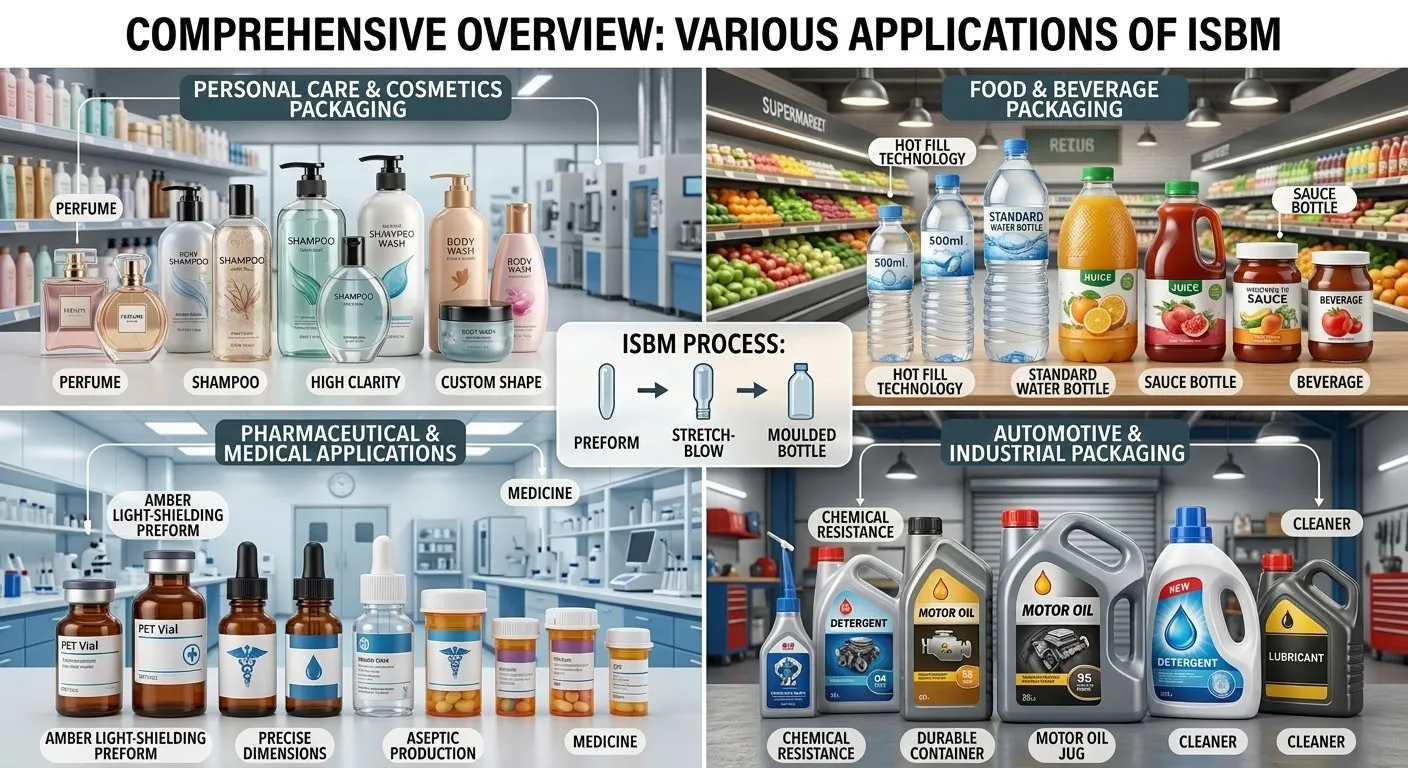
For standard round PET bottles — water bottles, CSD bottles, commodity food containers — high-speed two-step machines running 16, 24, or 32 cavities at speeds above 1,000 bottles per hour per cavity can substantially outperform one-step machines in total output. The one-step cycle is limited by the injection phase, while two-step blowing machines can run considerably faster because they are not injection-limited. If your application is high-volume standard bottles and throughput is the primary metric, two-step is likely the right process — one-step will produce a better container, but not necessarily enough better to justify the throughput disadvantage at scale.
Capital and Operational Cost Comparison
The upfront capital picture favours one-step, but the correct comparison is total cost of ownership across the machine’s operating life
Which Process Is Right for Your Application?
Five questions that determine which technology fits your production context
Round → either process works. Non-round (oval, square, flat), heavy-walled, or complex base geometry → one-step 4-station is strongly preferred. The differential conditioning of a 4-station machine is what makes uniform wall distribution in complex shapes achievable at production quality.
Cosmetics, pharmaceuticals, baby products, premium food → one-step. The contamination control, neck thread precision, and complex shape capability all favour one-step for these sectors. Commodity beverage, water, bulk food → evaluate two-step if volume is the primary metric and container complexity is low.
One-step is commercially viable from relatively small volumes — 50,000 containers/year for high-value cosmetic containers — up to several million containers/year. Two-step’s throughput advantage becomes significant above approximately 5 million standard containers per year. At lower volumes, one-step’s single-machine capital cost advantage and energy saving typically dominate the comparison.
Yes → one-step full-servo (EP-HGY150-V4-EV). The closed-loop process and oil-free servo platform together satisfy cleanroom contamination control requirements that two-step processes — with their preform storage, handling, and IR oven exposure — cannot match without elaborate secondary containment infrastructure.
If you have existing ASB-12M or Aoki 250 series moulds, Ever-Power’s one-step machines offer a direct upgrade path that protects your tooling investment. The EP-HGY150-V4 accepts ASB-12M mold bases. The EP-HGY200-V4-B accepts Aoki 250 mold bases directly. This makes the one-step upgrade economics significantly more attractive than they might appear on a machine-only basis.
Four Machines. Every One-Step Application Covered.
From compact single-cavity cosmetic production to heavy-tonnage pharmaceutical and large-format food packaging
EP-HGY50-V3-EV
Compact 3-station full servo. PET/PETG round bottles up to 2500 ml. Lowest capital cost in range. 40% energy saving vs hydraulic. ASB-12M tooling compatible.
EP-HGY150-V4
Most versatile in range. 150 KN / 200 KN. Full cosmetic range — PETG jars, oval bottles, Tritan. ASB-12M mold compatible. PET, PETG, PC, Tritan, PP.
EP-HGY150-V4-EV
Oil-free full servo. 10-axis, 102.8 KW. Class 100,000 cleanroom. Pharmaceutical and premium cosmetic. Same mold compatibility as V4.
EP-HGY200-V4 / V4-B
300 KN, 13-ton. Large-format containers up to 2500 ml. Aoki 250 mold compatible. 480 cm³ injection volume.
Ready to Evaluate One-Step for Your Application?
Tell us your container shape, resin, annual volume, and current process. Our engineering team will give you an honest technical and commercial assessment of whether one-step ISBM fits — and if it does, which machine configuration is appropriate.
Frequently Asked Questions
Energy figures and quality comparisons in this article reflect measured production experience and standard industry benchmarks. Specific outcomes vary with container design, resin grade, and machine configuration. Ever-Power manufactures one-step ISBM machines only — this comparison is presented on its technical and commercial merits. Contact [email protected] or view our full machine range to discuss your application.