Optical Quality and Surface Perfection in ISBM
How Can ISBM Be Used to Achieve Higher Transparency and Surface Quality?
A comprehensive engineering guide to mastering the thermodynamic, kinematic, and tooling parameters that deliver glass-like optical brilliance and flawless surface finish on PET and alternative polymer containers.
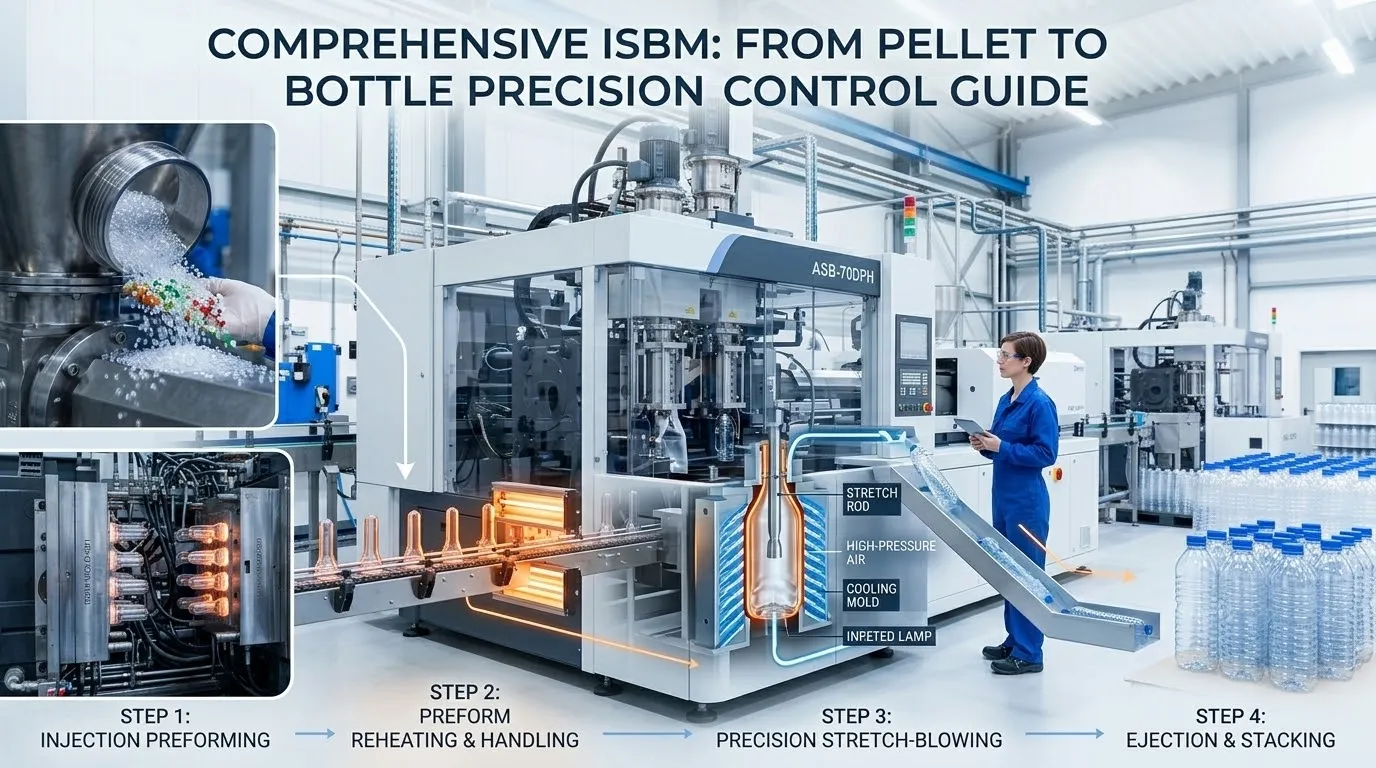
Optical Perfection as a Competitive Imperative in ISBM Packaging
In the premium tiers of the global packaging market, the transparency and surface quality of a plastic container are not secondary aesthetic attributes. They are the primary visual signals that communicate product purity, brand integrity, and manufacturing excellence to the consumer. A cosmetic serum bottle that gleams with the flawless, colorless brilliance of polished glass conveys luxury and trustworthiness. A carbonated beverage bottle that is perfectly transparent with a smooth, reflection-free surface telegraphs refreshment and quality. Any deviation, a faint milky haze, a pearlescent sheen, surface pits, or flow marks, immediately degrades the consumer’s perception of the product inside. For manufacturers serving these demanding markets, achieving the highest possible transparency and surface quality through the Injection Stretch Blow Molding process is not a process optimization exercise. It is a strategic business imperative. At Ever-Power, a globally recognized Brazilian ISBM manufacturer, our entire machine and mold engineering philosophy is oriented around the relentless pursuit of optical perfection.
The ISBM process is uniquely positioned to deliver containers of extraordinary transparency because its defining mechanism, biaxial stretching under precise thermal conditions, naturally produces a molecular architecture that scatters virtually no visible light. However, this potential is only realized when every step of the process is rigorously controlled. Transparency defects in ISBM bottles fall into two broad thermodynamic categories: stress whitening, caused by stretching material that is too cold, and thermal crystallization haze, caused by overheating the material and allowing uncontrolled spherulite crystal growth. Surface quality is governed by an equally complex interplay of factors, including the mirror finish of the blow mold cavity, the effectiveness of mold venting, the absence of melt fracture during injection, and the prevention of surface contamination from degraded polymer or external particulates. This comprehensive technical guide will dissect the engineering principles and machine parameters that enable ISBM to achieve superlative transparency and surface quality, referencing advanced Ever-Power platforms such as the EP-HGY150-V4 4-Station Machine and the servo-driven EP-HGY150-V4-EV Full Servo Machine.
Mastering the levers that control transparency and surface finish is the hallmark of an elite ISBM operation. It transforms the process from one that merely forms containers into one that creates packaging of uncompromising visual perfection. This guide provides the engineering roadmap to achieve that transformation.
Eliminating Stress Whitening: Stretching Within the Polymer’s Elastic Window
Stress whitening, or pearlescence, is the most common transparency defect in ISBM and is entirely preventable when the preform is conditioned to the correct temperature and stretched at the appropriate rate.
Precise Conditioning to the Optimal Stretching Temperature
Stress whitening occurs when the polymer is forced to stretch while its molecular chains lack sufficient thermal mobility to uncoil and slide past one another. The material tears on a microscopic level, creating millions of nano-voids that scatter light and produce a milky, pearlescent appearance. The root cause is invariably that the preform was too cold when it entered the stretch-blow station. The corrective action is to elevate the conditioning temperature, allowing the polymer chains the mobility they need to orient smoothly. However, the temperature increase must be executed with surgical precision. If the temperature is raised too high, the process crosses into the region where thermal crystallization begins, trading stress whitening for an equally undesirable thermal haze. The optimal conditioning temperature for PET is typically in the range of 95 to 110 degrees Celsius, depending on the specific resin grade and the container geometry. Machines like the EP-BPET-125V4 provide the precise, single-degree increment control over conditioning pot temperatures necessary to hit this narrow thermal window consistently across every cycle. The conditioning time must also be sufficient to allow the temperature to equilibrate through the entire wall thickness of the preform. A preform whose surface is at the correct temperature but whose core remains cold will still exhibit stress whitening in the interior layers, visible as a faint internal haze.
Controlling Stretch Rate to Avoid Strain-Induced Damage
Even at the correct temperature, the polymer can be damaged if it is stretched too rapidly. The strain rate, how quickly the material is deformed, influences its mechanical response. At high strain rates, polymers tend to behave in a more brittle manner. The stretch rod velocity and the pre-blow pressure ramp rate must be controlled to keep the strain rate within the material’s tolerance. A stretch rod that descends too rapidly can hammer the preform base, creating a localized region of extreme strain that manifests as stress whitening at the center of the container base. A pre-blow that inflates the preform too aggressively can cause the shoulder region to balloon outward at a rate that exceeds the polymer’s ability to flow, creating a band of pearlescence around the upper body. On servo-driven machines like the EP-HGY150-V4-EV, the stretch rod motion can be programmed with a gentle acceleration and a controlled deceleration as it reaches the end of its stroke, minimizing the peak strain rate. The pre-blow pressure and its timing relative to the stretch rod position are adjustable in millisecond increments, allowing the operator to synchronize the mechanical and pneumatic forces to achieve a smooth, non-damaging stretch profile.

Preventing Thermal Crystallization Haze: Controlling Heat at Every Stage
Thermal crystallization haze is a fundamentally different defect from stress whitening, and its prevention requires a systematic assault on excessive heat at every stage of the process.
🔥Minimizing Melt Temperature and Shear Heat in the Injection Unit
Thermal haze originates most often in the injection barrel and hot runner manifold. If the PET melt is overheated, the polymer chains gain enough thermal energy to begin spontaneously folding into organized spherulite crystals. These crystals, once formed, cannot be eliminated by subsequent stretching. The preform emerges from the injection mold already containing the seeds of haze. Prevention begins with the barrel temperature profile. The rear, middle, and front zones of the barrel should be set to the minimum temperatures that produce a homogeneous melt, typically 270 to 285 degrees Celsius for standard PET grades. The hot runner manifold temperature should be similarly minimized. Excessive screw rotation speed generates frictional shear heat that can overheat the melt locally, even if the barrel heater setpoints are correct. Reducing the screw RPM, within the constraints of the cycle time, reduces this shear heating. The injection speed should be fast enough to fill the cavity before the melt freezes but not so fast that it generates excessive shear at the gate, which can cause localized overheating and a visible hazy spot at the center of the preform base. On machines like the EP-HGY200-V4, precise control over these injection parameters is essential for melt quality.
❄️Aggressive and Uniform Injection Mold Quenching
The most critical defense against thermal haze is the rapid, uniform quenching of the molten PET in the injection mold. The preform must be cooled from approximately 280 degrees Celsius to below the glass transition temperature of 75 degrees Celsius in a matter of seconds, freezing the polymer chains in their amorphous state before crystals can nucleate. This demands an injection mold with highly efficient conformal cooling channels through which chilled water, typically at 6 to 10 degrees Celsius, circulates at high flow rates. The cooling must be uniform. Any region of the mold that is inadequately cooled will produce a preform with a localized hot spot that will crystallize hazily. The thickest region of the preform, the injection gate area, is the most prone to thermal haze because it retains heat the longest. The mold design must incorporate aggressive cooling at the gate, often using a high-conductivity beryllium-copper gate insert. The cooling time on the machine must be set sufficiently long to extract the core heat from the preform before it is ejected. If the machine cycle is pushed too fast, the preforms will emerge with internal heat that will immediately trigger crystallization, producing a dense, foggy haze visible throughout the container. The Custom One-Step Injection Stretch Blow Moulds from Ever-Power are engineered with hyper-aggressive conformal cooling to ensure every preform is perfectly quenched.

Achieving Flawless Surface Quality: Mold Polish, Venting, and Material Purity
Surface quality is governed by a different set of factors than bulk transparency. The container surface replicates the blow mold interior, and any imperfection in that surface is imprinted onto every bottle.
✨The Mirror Polish Imperative for Blow Mold Cavities
The surface of the blow mold cavity is the die that stamps the final surface finish onto the container. To achieve a glass-like, high-gloss surface, the mold cavity must be polished to an extreme mirror finish, typically an SPI A1 or A2 finish, with a surface roughness measured in fractions of a micron. Any tool mark, scratch, or pit on the mold surface, even if invisible to the naked eye, will be replicated on the hot, inflating PET. The polishing process is a highly skilled, multi-step operation that progresses through successively finer abrasives, culminating in a diamond polish. The polishing must be uniform across the entire cavity surface, including complex contours, radii, and engraved logo areas. Any variation in the polish will create a variation in the surface gloss of the container. For high-cavitation molds used on double-row machines like the EP-HGY250-V4-B, the polish must be perfectly consistent across every cavity to ensure that every bottle in a production run exhibits the identical premium surface finish. The mold material itself is selected for its polishability. High-grade, corrosion-resistant tool steels are preferred because they can take and hold a high polish over millions of cycles without pitting or degrading.
💨Eliminating Surface Defects Through Venting and Material Purity
Surface defects such as pits, dimples, or burn marks are often caused by trapped air between the inflating preform and the mold wall. As the preform expands, it must push the air in the cavity out through the mold vents. If the venting is inadequate, air becomes trapped and compressed, creating a pocket of high-pressure air that prevents the plastic from fully contacting the mold. The result is a surface depression or a localized burn mark from the heat of the compressed air. The mold must incorporate precision venting channels, often microscopically thin, that allow air to escape rapidly from all areas of the cavity. Surface quality can also be compromised by particulate contamination. Black specks, which are visible dark spots on the container surface, are caused by degraded, carbonized polymer that has been resident in the hot runner or barrel for too long. Preventing black specks requires diligent purging procedures, avoiding excessive melt temperatures that accelerate polymer degradation, and maintaining a scrupulously clean resin handling system. For rPET processing, the risk of contamination is higher, and the servo-driven injection consistency of the EP-HGY150-V4-EV helps minimize residence time variations that can lead to degradation.

Material Selection and rPET Processing for Optimal Transparency
The choice of polymer grade and the processing adaptations required for recycled content have a direct impact on the achievable transparency and surface quality of the finished container.
Selecting PET Grades for Maximum Clarity
Not all PET grades are equal in their clarity potential. Bottle-grade PET resins are specifically formulated with low levels of copolymer, typically isophthalic acid or cyclohexane dimethanol, to slow down the crystallization rate and widen the processing window for achieving an amorphous preform. Higher intrinsic viscosity grades provide better melt strength and are less prone to degradation, which can cause yellowing that degrades transparency. The preform designer must specify a resin grade that is appropriate for the container’s stretch ratio and wall thickness. For the highest transparency applications, such as luxury cosmetics or premium spirits bottles, a PET grade with the lowest possible acetaldehyde generation and the highest clarity rating is selected. Processing these high-clarity grades on machines like the EP-BPET-70V4 demands careful adherence to the resin manufacturer’s recommended temperature and drying specifications to preserve their optical properties.
Overcoming the Transparency Challenges of rPET