Berapa biaya pembuatan cetakan tiup (blow mold) biasanya?
Blow mould cost varies widely depending on process type, cavity count, mould material, and container geometry. For one-step ISBM production — used for pharmaceutical, cosmetic, food, and beverage PET and PP containers — the mould investment covers three components: the preform mould, the blow mould, and the stretch rod. Understanding what drives the cost of each component is essential before committing to in-house container production.
The Three Components of an ISBM Mould Set
Preform mould — the most complex component; injection-moulds the preform body, base, and neck thread. Includes hot runner, cooling channels, and neck splits. The preform mould is the largest single cost in the set.
Blow mould — defines the bottle’s final external geometry, surface texture, and base shape. Includes a cooling circuit to remove heat from the blown container. Material selection (aluminium, BeCu, or steel) determines both cost and mould life.
Batang peregang — the mechanical rod that extends the preform axially at the blow station. Length and tip geometry are matched to the specific preform and bottle dimensions. Lower cost than the moulds but must be ordered with them.
Indicative ISBM Mould Set Costs
| Configuration | Blow Mould Material | Indicative Cost (USD) |
|---|---|---|
| 1-cavity, simple geometry | Aluminium | USD 12,000–25,000 |
| 2-cavity, standard PET bottle | Aluminium | USD 20.000–40.000 |
| 4-cavity, standard PET bottle | Aluminium | USD 35,000–60,000 |
| 2-cavity, complex cosmetic shape | Beryllium copper | USD 35,000–65,000 |
| 6-cavity, high-output production | Steel or BeCu | USD 60,000–100,000+ |
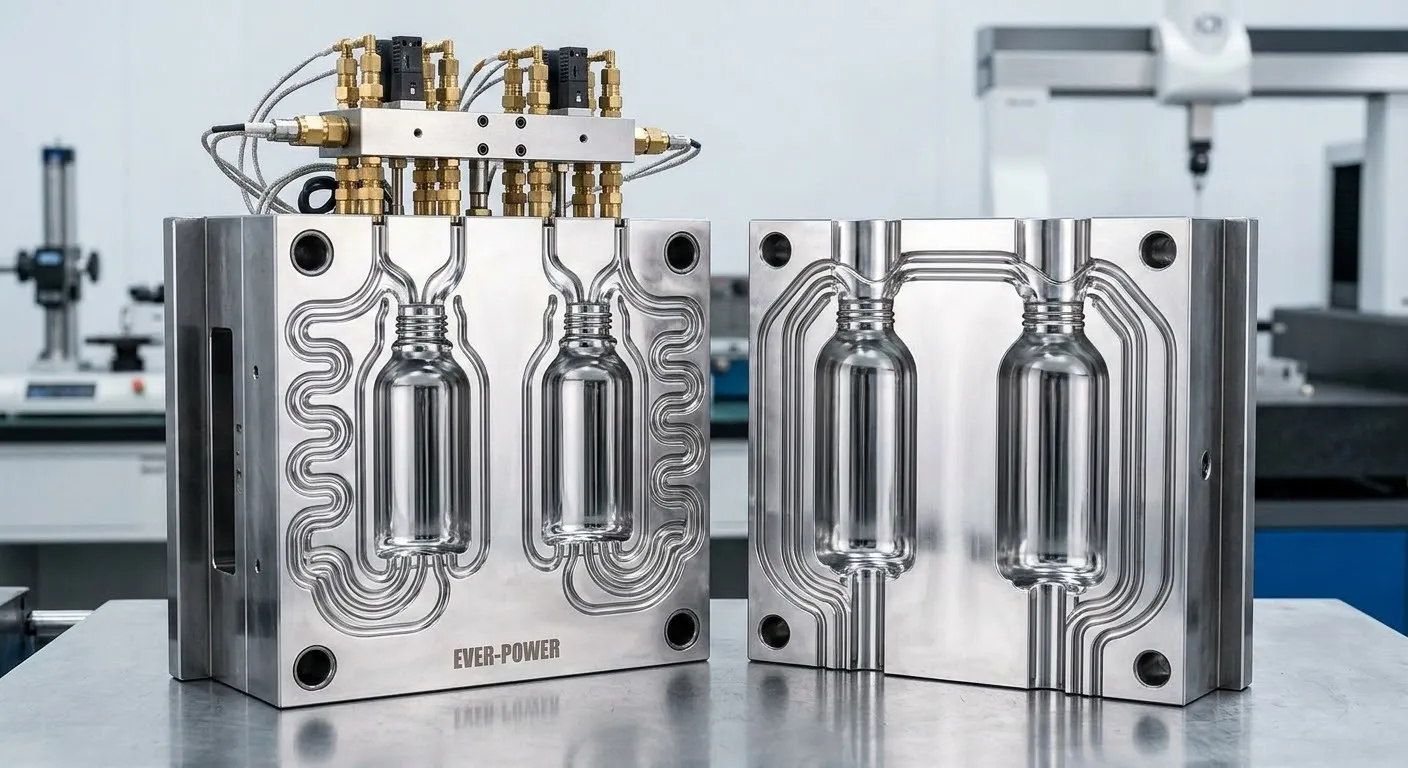
High-precision ISBM preform mould with mirror-finish cavity — required for pharmaceutical and premium cosmetic applications; adds to mould cost vs standard finish.
Key Factors That Drive Mould Cost
- Cavity count — each additional cavity adds a preform cavity, a blow cavity, and a hot runner circuit; cost scales roughly linearly
- Mould material — BeCu and hardened steel blow moulds cost more than aluminium but last 3–10 times longer
- Surface finish — pharmaceutical and cosmetic applications often specify mirror-finish preform cavities (Ra ≤ 0.05 μm), requiring additional polishing time
- Bottle complexity — contoured bodies, embossed logos, petaloid bases, and handles all add machining time
- Lead time — expedited manufacture carries a 15–30% premium over standard lead times
Mould Life and Cost per Bottle
The mould investment is amortised over production volume. Aluminium blow moulds are rated 500,000–1,000,000 cycles; BeCu for 1–3 million; hardened steel for 3 million and above. At 1 million bottles and a USD 30,000 mould cost, the mould adds USD 0.03 per bottle — a small fraction of the container selling price.
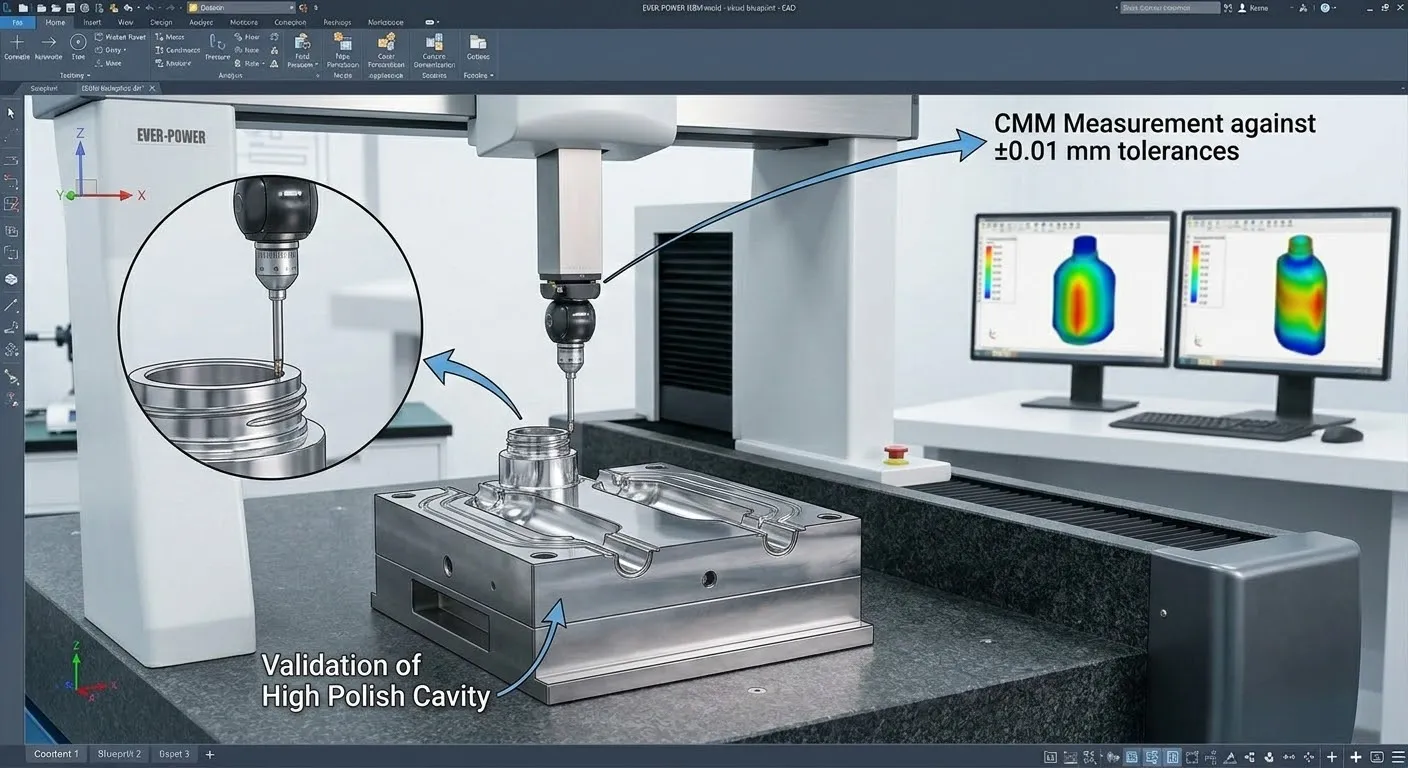
Ever-Power custom mould manufacturing — CNC machining, EDM finishing, and quality inspection for ISBM preform and blow mould production.
Need a mould quotation for your container format?
Ever-Power designs and manufactures custom ISBM mould sets matched to our EP-HGY machines. Send your bottle drawing for a feasibility review and quotation within 48 hours.
Jelajahi full custom ISBM mould range, or review the machine range to confirm which model your mould needs to fit before ordering.
Pertanyaan yang Sering Diajukan
Can I use my existing mould on a new ISBM machine?
Possibly, but it requires verification. Moulds are designed to fit specific machine platen dimensions and mandrel geometry. If the replacement machine is the same model, existing moulds typically fit. If the machine model changes, confirm dimensional compatibility by providing your mould drawings to the new machine supplier before purchase. Ever-Power provides a mould interface specification document for all EP-HGY and EP-BPET machines.
How long does it take to manufacture a custom ISBM mould?
Standard 1–2 cavity mould sets typically have a lead time of 45–75 days from design approval to first sample. More complex 4–6 cavity moulds with premium surface finish may require 90–120 days. Order the mould immediately after signing the machine contract to avoid it becoming the critical path for your installation timeline.
Should I order my mould from the machine manufacturer or separately?
Ordering from the machine manufacturer is lower risk for first-time ISBM installations because the mould is designed and tested on the actual machine, eliminating interface compatibility risk and providing a single point of accountability. For experienced operators with established mould-making relationships, third-party moulds are viable provided the mould maker receives the machine’s full interface specification.