How ISBM Differs from Traditional Injection Molding and Blow Molding
A Comprehensive Engineering Breakdown of One-Step Polymer Processing Technology Versus Legacy Methods
In the demanding landscape of modern plastic packaging, the selection of a manufacturing process is not merely a technical decision—it is a strategic cornerstone that dictates product quality, production efficiency, and brand perception. For decades, traditional injection molding and conventional blow molding have served as the workhorses of the polymer industry. However, the emergence of Injection Stretch Blow Molding has redefined the boundaries of what is physically achievable with polyethylene terephthalate and other semi-crystalline resins. At Ever-Power, a globally recognized authority in Brazilian ISBM manufacturing, our engineering teams consistently encounter a fundamental question from clients transitioning from legacy systems: How does ISBM differ from traditional injection molding and blow molding?
This query unlocks a vast, intricate universe of polymer thermodynamics, mechanical engineering, and economic calculus. The ISBM process, particularly in its single-stage configuration, is not a simple hybrid; it is a sophisticated, synchronized ballet of thermal conditioning and mechanical force that generates containers with unparalleled optical clarity and structural integrity. This exhaustive discourse will dissect the profound differences between these methodologies, explore the underlying principles of strain-induced crystallization, and demonstrate why modern, high-performance packaging mandates a departure from conventional techniques. We will traverse the technical nuances of process architecture, material behavior, and operational efficiency, providing a masterclass for facility managers and procurement specialists seeking to elevate their manufacturing ecosystems.
The Foundational Trio: Defining the Three Distinct Manufacturing Paradigms
To understand the revolutionary leap that ISBM represents, one must first establish a rigorous definition of the conventional processes against which it competes. While all three involve the transformation of raw polymer granules into a hollow vessel, the sequence of thermodynamic events and the resultant molecular architecture are fundamentally divergent.
Traditional Injection Molding
A process where molten polymer is injected under high pressure into a closed, water-cooled steel mold. The plastic solidifies into the exact negative shape of the cavity. For packaging, this method typically produces preforms—thick, test-tube-like intermediates—rather than finished hollow containers directly. The part is fully amorphous and requires a secondary reheating and blowing operation to become a bottle in a two-stage system.
Extrusion Blow Molding
A continuous process where a molten tube of plastic, called a parison, is extruded downward. Two mold halves close around the parison, and compressed air inflates it against the cavity walls. The plastic remains in a molten, unoriented state throughout. This method is common for opaque, handle-bearing containers like milk jugs or shampoo bottles, but it lacks the optical brilliance required for premium markets.
What Is Single-Stage Injection Stretch Blow Molding?
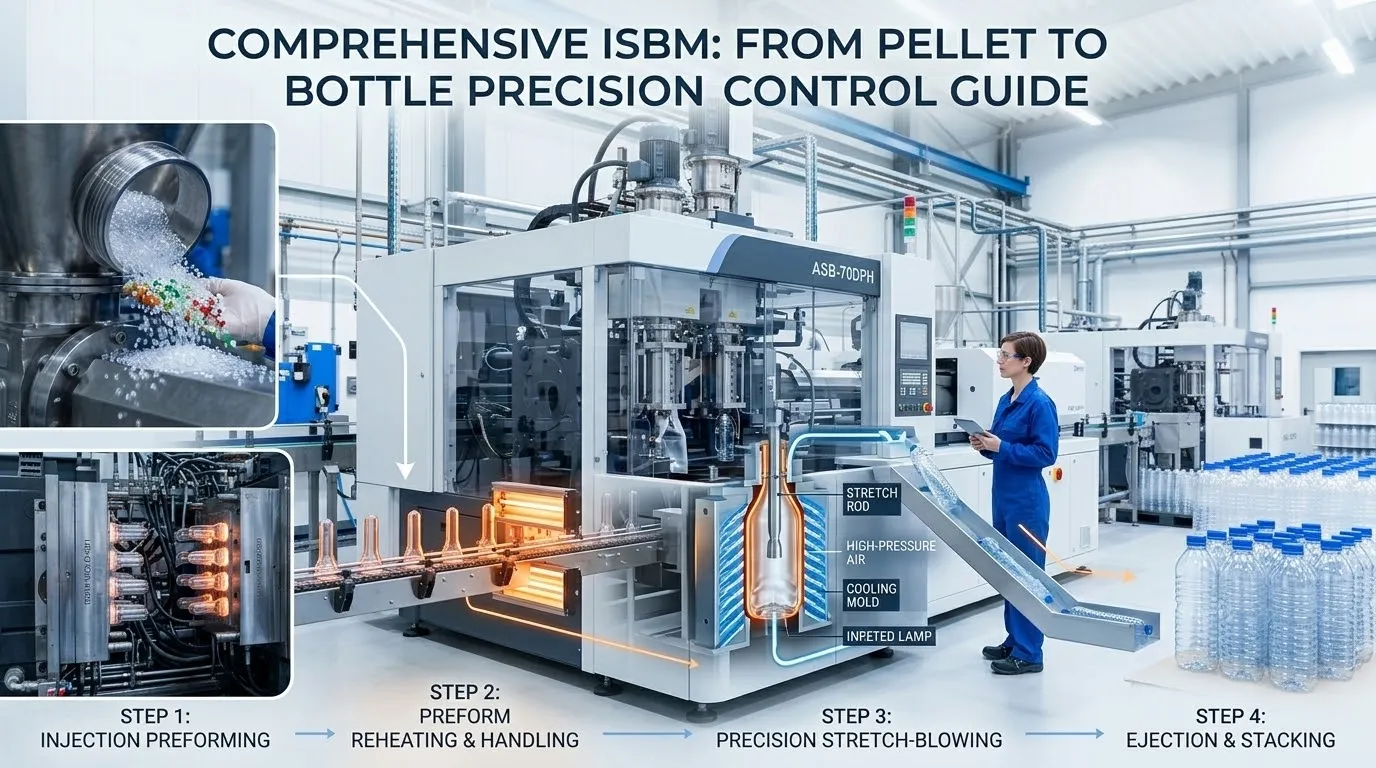
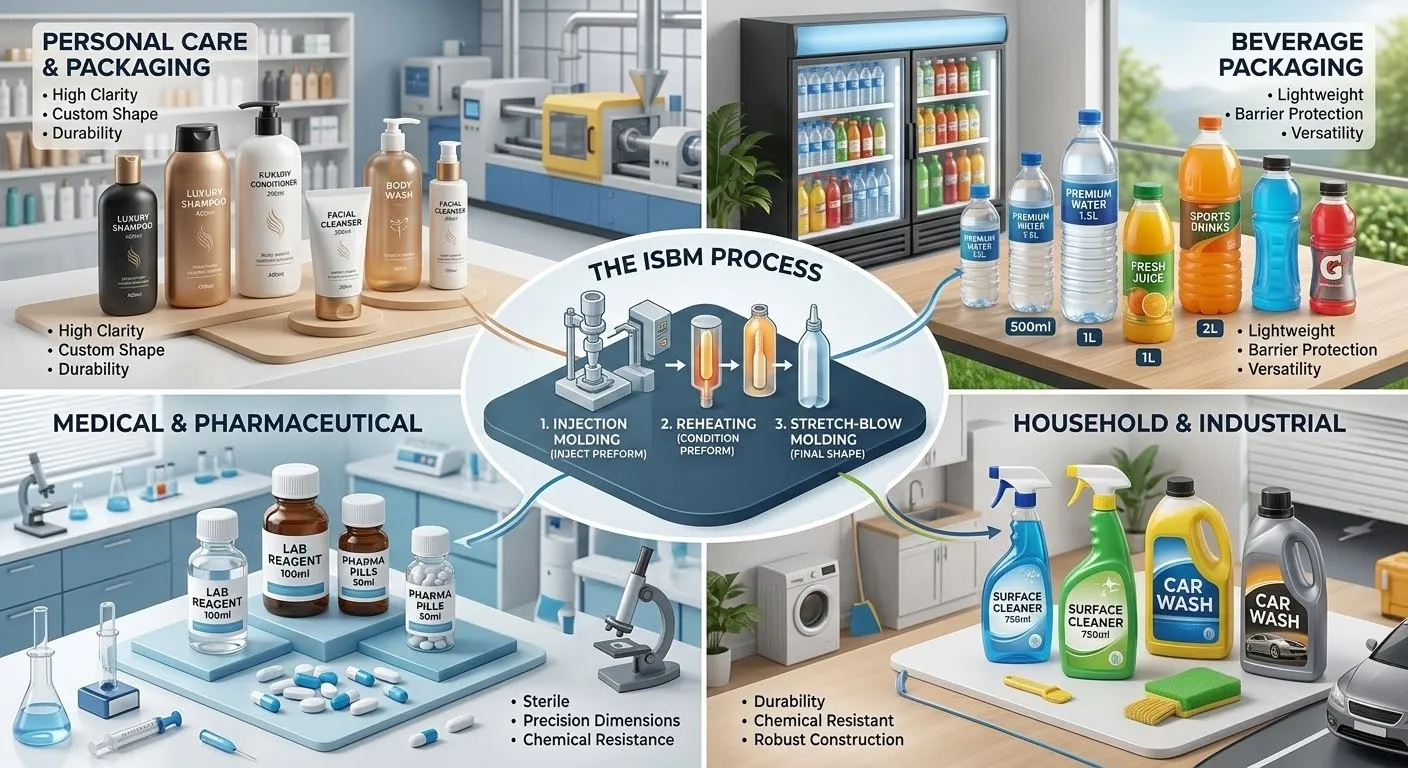
The single-stage ISBM process is a self-contained manufacturing cell that orchestrates injection, conditioning, stretch-blow, and ejection within one unified machine platform. Unlike the two-stage method where preforms are injection molded, cooled to ambient temperature, stored for days, and then reheated in a separate reheat-stretch-blow machine, the single-stage approach preserves latent heat from the initial injection cycle. This thermal continuity is the secret behind the process’s unprecedented energy efficiency and superior material properties.
On advanced machinery like the EP-HGY150-V4 4-Station Machine, the preform is injected, rapidly quenched to a precise amorphous state, and then transferred while still containing strategic core heat to a conditioning station. There, it is thermally profiled to its ideal glass transition temperature. A mechanical stretch rod and high-pressure air then force the material to undergo biaxial orientation, creating a container of extraordinary strength and clarity. This sequential integration eliminates the energy penalty of completely cooling and then reheating the polymer, while simultaneously producing bottles that are virtually free of the internal stress marks that plague two-stage products.
Critical Technical Differentiators: ISBM vs. Traditional Processes
🔬 Molecular Orientation and Strength
The most profound difference lies in the molecular architecture of the final product. Traditional injection molding produces a preform with randomly oriented, amorphous polymer chains. Extrusion blow molding inflates a molten parison, generating only minimal, uniaxial orientation in the machine direction. ISBM, however, induces biaxial orientation—stretching the polymer in both the axial direction via the stretch rod and the radial direction via blow air. This process, known as strain-induced crystallization, aligns the polymer chains into a tightly packed, cross-linked lattice. The resulting structure exhibits dramatically enhanced tensile strength, drop impact resistance, and gas barrier properties. A bottle produced on a EP-BPET-125V4 will withstand internal carbonation pressures and survive drops from heights that would shatter a comparable extrusion-blown container.
🎨 Optical Clarity and Aesthetic Perfection
Extrusion blow molding invariably leaves witness lines, parting line flash, and a slight waviness due to the swelling of the extruded parison. Traditional two-stage processes subject the cold preform to a harsh, infrared reheating profile that can cause surface degradation and a subtle, permanent haze. The single-stage ISBM process, by handling the preform while it is still warm from the injection mold, avoids these thermal shocks. When executed on precision-engineered platforms like the EP-BPET-70V4, the result is a container with a mirror-like, glassy brilliance that is non-negotiable for luxury cosmetics and premium spirits.
Process Architecture and Thermal Precision
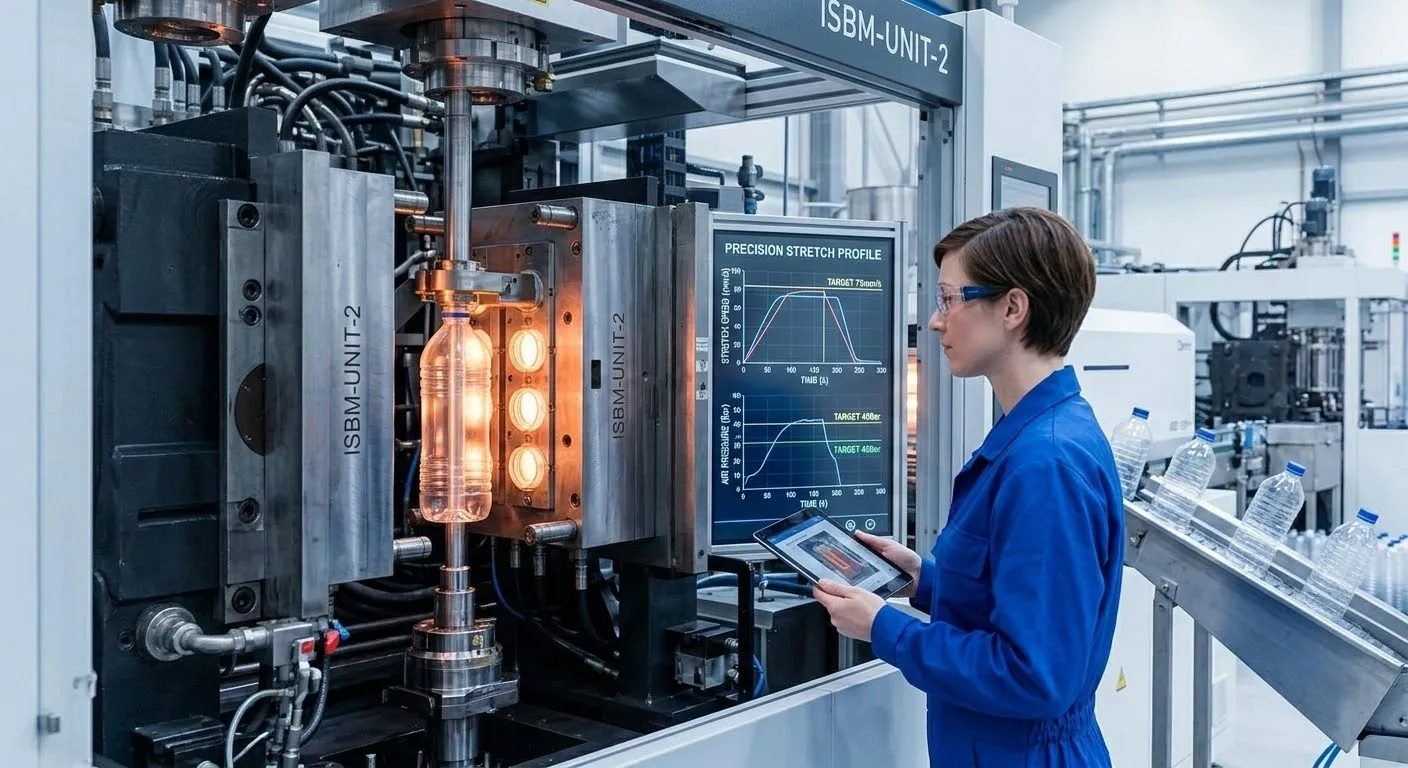
Traditional blow molding is often a continuous extrusion process, making it challenging to control the exact wall thickness distribution of the final product. The parison sags under its own weight, leading to a natural thinning at the top of the container. ISBM, conversely, is a discrete, indexed process. Every single preform is injected with exacting precision regarding shot weight and gate geometry. The conditioning station then employs circulating thermal fluids to adjust the temperature of specific preform zones with surgical accuracy.
For manufacturers of highly asymmetric containers or those requiring thick bases for stability, the revolutionary EP-HGYS280-V6 6-Station Machine offers dual conditioning workstations. This allows the base of the preform to be cooled significantly while the body is heated, a level of geometric control utterly unattainable with the simple, uniform heating ovens of a two-stage system or the gravity-dependent parison of extrusion blow molding.
⚙️ Cycle Integration and Energy Economics
A traditional two-stage operation requires two massive, independent machines—an injection molder and a reheat-blow molder—linked by a costly and vulnerable logistics chain. Preforms must be transported, stored in silos, and protected from moisture and dust. The energy required to heat a cold preform from room temperature back up to its stretching temperature is enormous. The single-stage ISBM process sidesteps this entire energy sink. By utilizing the latent heat already present in the injection-molded preform, the system achieves a significant reduction in specific energy consumption per bottle. This is not merely an operational cost saving; it is a substantial reduction in the carbon footprint of the packaging, aligning with global sustainability directives.
Material Versatility and the rPET Challenge
Extrusion blow molding is forgiving of material viscosity swings; it can process a wide range of polyolefins like HDPE and PP with relative ease. Traditional injection molding for preforms demands high Intrinsic Viscosity PET to ensure the preform can survive the subsequent reheating and stretching. ISBM occupies a uniquely demanding, high-performance niche. It primarily targets PET, but it can also accommodate PP and other semi-crystalline resins. The key difference is that ISBM actively exploits the crystallization behavior of the polymer, whereas traditional blow molding merely freezes a molten shape.
The modern push for Post-Consumer Recycled PET (rPET) integration has exposed the fragility of two-stage processes. The fluctuating molecular weight and inconsistent thermal history of rPET flakes cause uneven reheating in a linear oven, leading to catastrophic blowouts and pervasive haze. Advanced ISBM platforms, however, like the fully electric EP-HGY150-V4-EV Full Servo Machine, utilize closed-loop servo injection control. The drive system instantaneously modulates injection pressure and velocity to compensate for the dropping melt viscosity of rPET, delivering perfect preform consistency where a standard hydraulic machine would fail. This makes single-stage ISBM the technology of choice for brands aggressively pursuing circular economy goals.
The Critical Role of Proprietary Molding Integration
A common pitfall when transitioning from traditional injection molding to ISBM is the assumption that molds are interchangeable commodities. In conventional injection molding, the mold is a static negative cavity; in ISBM, the mold is an active thermal exchange partner. The Custom One-Step Injection Stretch Blow Moulds designed by Ever-Power incorporate hyper-aggressive conformal cooling channels that precisely quench the preform to an amorphous state in milliseconds, preventing the spontaneous thermal crystallization that causes haze. This is fundamentally different from the cooling requirements of a traditional preform mold, which only needs to produce a solid part.
Furthermore, the blow mold cavities in ISBM are polished to an extreme mirror finish to impart the glass-like aesthetic that extrusion blow molding’s texturing can never replicate. The integration between the machine’s hot runner manifold, the injection gate geometry, and the stretch rod kinematics is a cohesive system. Using non-native, third-party tooling on a high-precision ISBM machine is the leading cause of pearlescence and structural failure, a problem virtually unknown in simpler extrusion blow molding setups.
Defect Signatures and Diagnostic Philosophy
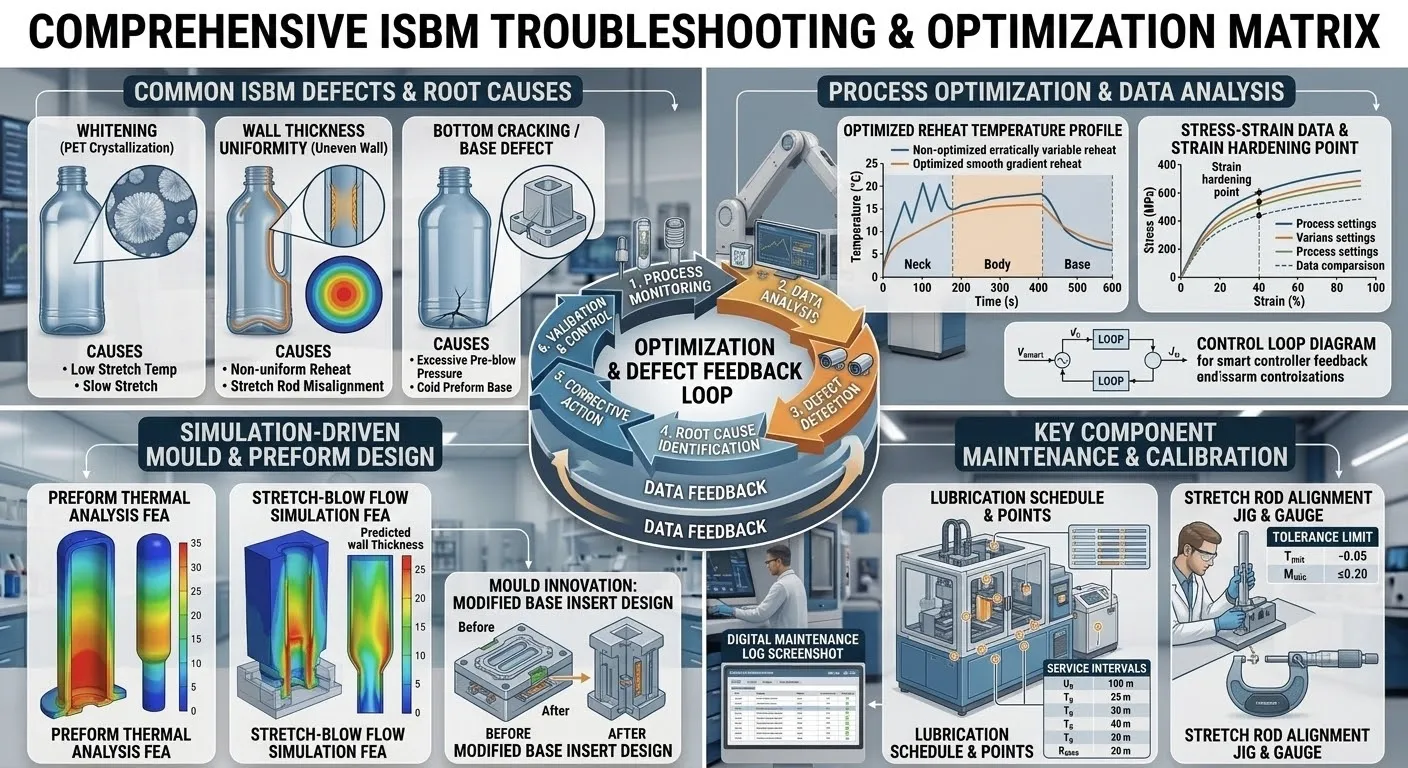
Troubleshooting an ISBM machine requires a fundamentally different mindset than servicing a traditional injection molder or extrusion blow molder. In traditional injection molding, defects like short shots or flash are related to pressure, temperature, or clamp tonnage. In ISBM, a hazy bottle can have two diametrically opposed root causes—it is either too cold (stress whitening) or too hot (thermal crystallization).
The diagnostic blueprint for an ISBM technician involves a deep analysis of the preform’s thermal history across all four stations. On equipment like the EP-HGY250-V4, operators must distinguish between a pneumatic timing anomaly in the blow station and a localized cooling channel blockage in the injection cavity. Extrusion blow molding, by contrast, more commonly presents problems like parison curl, die lines, or inconsistent wall thickness due to extruder surging—mechanical issues with a very different genesis. This sophistication makes ISBM the domain of elite polymer engineers, whereas traditional methods can often be managed with less specialized labor.
Scaling for High-Volume Production: Architecture Variations
For massive industrial throughput, traditional injection molding and blow molding are often scaled by simply adding more cavities or running faster cycle times. ISBM scaling is more nuanced due to the thermal interdependency of the stations. Ever-Power’s double-row architectures, such as the EP-HGY250-V4-B Double-Row 4-Station Machine or the EP-HGY200-V4-B, address the challenge of high cavitation while maintaining thermal uniformity. In a traditional injection molder, a 32-cavity tool simply requires a larger clamp and bigger barrel. In a double-row ISBM system, the distribution of conditioned preforms must be perfectly synchronized, and the hot runner manifold must deliver identical thermal and shear histories to every single nozzle, regardless of its position on the manifold. This engineering complexity is absent from the more straightforward scaling of conventional extrusion lines.
The result, however, is a production density that traditional methods cannot match. A single compact ISBM cell can replace an entire sprawling line of an injection molder, a cooling conveyor, a reheating oven, and a blow molder, freeing up valuable factory floor space and drastically reducing the logistical complexity of the manufacturing workflow.
ISBM vs Traditional Injection and Blow Molding: A Direct Comparison
To crystallize these complex engineering principles, we present a direct attribute comparison. Traditional injection molding requires an entirely separate, energy-intensive reheating step to create a bottle. Extrusion blow molding generates a container directly from the melt but cannot achieve the biaxial strength or optical brilliance of ISBM. The single-stage ISBM process stands alone in its ability to transform a molten pellet into a perfectly oriented, market-ready container within a single, thermally efficient cell.
🔹 Traditional Injection
- Produces preforms, not bottles
- Amorphous, unoriented structure
- Requires reheating for blow step
- Very high preform precision
- Two-stage energy penalty
🔹 Extrusion Blow
- Direct from melt to bottle
- Minimal molecular orientation
- Suitable for HDPE/PP handles
- Poor optical clarity
- Continuous parison process
✅ Single-Stage ISBM
- One cell, pellet to bottle
- Biaxial strain-induced strength
- Superior gas barrier properties
- Glass-like clarity for PET
- Lowest energy per container
Secure a Decisive Competitive Advantage with Integrated ISBM Technology
The divergence between ISBM and traditional processing methods is not a subtle nuance; it is a chasm that defines the very feasibility of producing modern, high-performance, sustainable packaging. Understanding how ISBM differs from traditional injection molding and blow molding empowers decision-makers to select a technology that eliminates process fragmentation, maximizes material properties, and delivers a finished product of uncompromising quality. At Ever-Power, our fully integrated single-stage cells, from the compact EP-HGY50-V3-EV to the industrial-scale EP-HGY650-V4, are engineered to deliver this transformative efficiency.