What is hot fill blow molding and how does it work?
Hot fill blow moulding — also called heat-set stretch blow moulding — is a variant of the standard ISBM process that produces PET bottles capable of being filled with hot product at temperatures of 85–95 °C without deforming. The key difference from standard ISBM is the blow mould temperature: standard (cold-fill) ISBM runs the blow mould at 8–12 °C to cool the bottle rapidly after blowing; hot-fill ISBM runs the blow mould at 100–130 °C to induce partial crystallisation in the PET bottle wall during the blow step. This crystallisation — called heat-setting — gives the bottle dimensional stability at hot-fill temperatures.
Why Standard PET Bottles Cannot Be Hot-Filled
Standard amorphous PET bottles produced by cold-fill ISBM are dimensionally unstable above approximately 60–65 °C — the glass transition temperature (Tg) of PET. Above Tg, the amorphous polymer chains in the bottle wall soften and can deform under the internal pressure and gravity of a hot-filled product. A standard cold-fill PET bottle filled with hot juice at 90 °C will shrink, wrinkle, and distort within seconds of filling, making it commercially unacceptable. Hot-fill packaging requires either a heat-set PET bottle, an HDPE or PP bottle (which are inherently more thermally stable than amorphous PET above Tg), or a glass bottle.
How Heat-Setting Works
Heat-setting is the induction of limited, controlled crystallisation in the PET bottle wall by holding the blown bottle against a hot mould surface for a defined time. PET crystallises when held above its crystallisation onset temperature (approximately 130–140 °C) for sufficient time. In the heat-set ISBM process, the blow mould is heated to 100–130 °C, and the blown bottle is held against the mould wall for 2–6 seconds longer than in standard cold-fill production. During this hold time, the PET bottle wall develops a degree of crystallinity of 25–35%, measured by density or DSC analysis.
The crystallised PET has a Tg approximately 10–15 °C higher than amorphous PET due to the constraints imposed by the crystal structure on chain mobility. More importantly, the crystallised regions do not soften as readily as amorphous regions above Tg, giving the heat-set bottle dimensional stability at fill temperatures that would distort a standard cold-fill bottle. Heat-set bottles can be filled at up to 90–95 °C (depending on the degree of heat-setting) without significant dimensional change, though they still experience modest shrinkage (1–3% of bottle volume) on cooling from fill temperature to ambient, which must be accommodated by bottle design with vacuum panels or sufficient headspace.
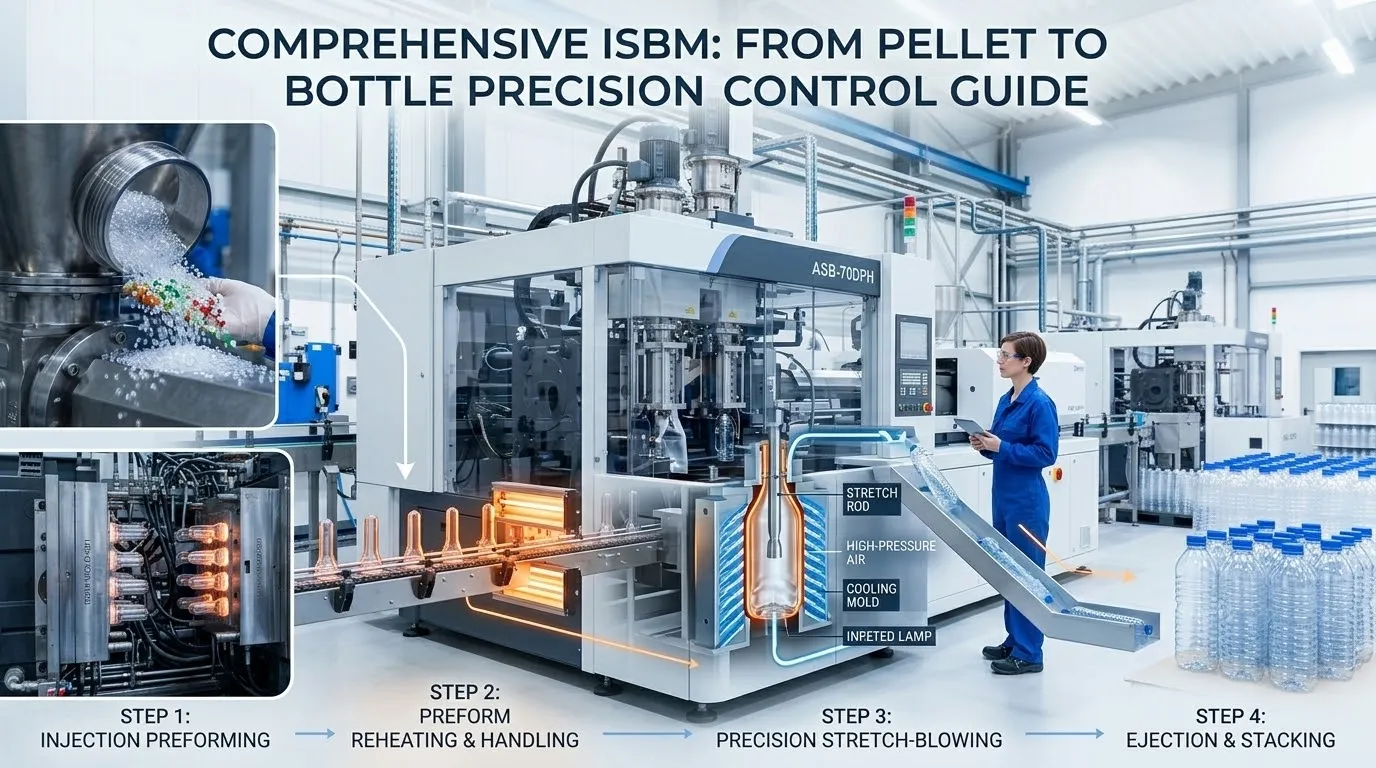
ISBM process parameters for hot-fill heat-set production — blow mould temperature is the critical parameter that differentiates heat-set from cold-fill ISBM production.
Products Filled by the Hot-Fill Process
Hot-fill is used for beverages and food products that require heat treatment for pasteurisation or sterilisation during filling:
- Juice beverages: orange juice, apple juice, tropical juice blends (fill temperature 85–92 °C)
- Tea and ready-to-drink tea: black tea, green tea, iced tea (fill temperature 85–90 °C)
- Sports and isotonic drinks: electrolyte beverages, vitamin drinks (fill temperature 85–90 °C)
- Dairy beverages: flavoured milk, meal replacement drinks (fill temperature 80–90 °C)
- Condiments and sauces: ketchup, salsa, pasta sauce, salad dressing (fill temperature 75–90 °C)
Machine Requirements for Hot-Fill ISBM
Running hot-fill production on an ISBM machine requires modifications to the standard cold-fill configuration:
| Component | Standard Cold-Fill | Hot-Fill Requirement |
|---|---|---|
| Blow mould cooling circuit | Chilled water at 8–12 °C | Hot water or thermal oil at 100–130 °C |
| Blow mould material | Aluminium (standard) | Beryllium copper or steel (better thermal conductivity and thermal fatigue resistance) |
| Blow time in mould | 2–4 seconds | 4–8 seconds (extended for heat-setting) |
| Preform weight | Standard | Typically 10–20% heavier than cold-fill equivalent for same volume |
| Bottle design | Standard | Vacuum panels or grip zones required to absorb post-fill shrinkage |
Heat-Set vs Cold-Fill: Which Is Right for Your Application?
The choice between heat-set and cold-fill ISBM is determined by the fill temperature. If the product is filled at ambient temperature or below 60 °C, standard cold-fill ISBM is correct. If the product is filled at 65–95 °C for pasteurisation (most juice, tea, sauce, and dairy beverage applications), heat-set ISBM is required. Products filled above 95 °C (retort sterilisation) are not suitable for PET in ISBM, and require either glass or retort-grade PP/HDPE containers.
It is not possible to use a standard cold-fill ISBM mould for hot-fill applications simply by raising the fill temperature — the mould cooling circuit and material must be configured for hot-fill from the outset. If you are planning both cold-fill and hot-fill production on the same machine, inform Ever-Power at the time of ordering so both mould sets can be correctly designed and the machine’s cooling circuit configured to support switching between hot and cold mould temperatures between production runs.
Planning a hot-fill PET bottle production line?
Ever-Power can configure EP-HGY machines and design heat-set mould sets for hot-fill applications from 250 ml to 2 litres. Send your fill temperature, bottle volume, and annual volume for a machine and mould recommendation within 24 hours.
देखें water and beverage container applications page for examples, or browse the मशीनों की पूरी श्रृंखला for technical specifications.
अक्सर पूछे जाने वाले प्रश्नों
Can I run both hot-fill and cold-fill on the same ISBM machine?
Yes, if the machine is configured to support both mould temperature regimes. The blow mould cooling circuit must be switchable between chilled water (for cold-fill) and hot water or thermal oil (for heat-set). Different mould sets are required for cold-fill and hot-fill bottles even for the same container volume, because the bottle design differs (hot-fill bottles need vacuum panels or grip features; cold-fill bottles do not). The machine configuration for dual hot/cold capability should be specified at order time.
Does heat-setting affect bottle clarity?
Yes, slightly. The partial crystallisation induced by heat-setting produces a marginal increase in haze compared to a cold-fill ISBM bottle of the same PET grade. Standard heat-set bottles maintain acceptable clarity for juice and tea beverages (light transmittance typically 80–87% compared to 88–92% for cold-fill equivalents). For applications where maximum clarity is critical alongside hot-fill capability, PETG or specialised low-haze hot-fill PET grades can be used, though at higher material cost.
What is the difference between hot-fill and aseptic filling?
Hot-fill relies on the temperature of the product itself to pasteurise the container contents and seal by steam sterilisation as the cap is applied. The product is filled hot (85–95 °C) and cooled in the sealed bottle. Aseptic filling sterilises the container separately (typically with hydrogen peroxide vapour or electron beam treatment) and fills commercially sterile product into the sterile container in a sterile environment at ambient temperature. Aseptic filling does not require a heat-set bottle and uses standard cold-fill ISBM PET containers. Hot-fill and aseptic are both used for juice and tea, but represent different filling line investments and different operational requirements.
Hot-Fill Bottle Design: Vacuum Panels and Grip Features
Hot-fill PET bottles require specific design features that cold-fill bottles do not need, because the filled and sealed bottle cools from fill temperature (85–95 °C) to ambient (20–25 °C) after capping, contracting the internal gas volume and creating a partial vacuum inside the sealed bottle. Without design features to accommodate this vacuum, the bottle sidewall will collapse or distort as the vacuum develops during cooling — an unacceptable appearance for a retail product.
Vacuum panels are flat or concave zones designed into the bottle sidewall that flex inward in a controlled, symmetric manner as the internal vacuum develops during cooling. They are sized and positioned to accommodate the specific volume contraction expected for the container size and fill temperature, and they give the finished bottle its characteristic appearance — most hot-fill juice and tea bottles have visible flat panel zones alternating with curved grip areas around the bottle circumference. Grip features (recessed or raised zones around the bottle body) serve the dual function of structural reinforcement (improving the bottle’s resistance to sidewall collapse between panels) and consumer ergonomics (making the bottle easier to hold and pour).
Hot-fill bottle design is a specialised engineering exercise that requires knowledge of the specific fill temperature, fill volume, headspace volume, closure torque, and expected cooling conditions. Ever-Power’s mould design team can provide hot-fill bottle design guidance and finite element analysis of vacuum panel performance as part of the mould feasibility study for hot-fill applications. The blow mould design for heat-set production also differs from cold-fill moulds in material and construction: beryllium copper inserts or high-thermal-conductivity tool steel are used instead of aluminium, and the mould must be designed for the hot-water or thermal oil heating system rather than the chilled-water cooling system of a standard blow mould.
Aseptic vs Hot-Fill vs Cold-Fill: Choosing the Right Process for Your Product
Beverage and food producers choosing a PET container production process must align the container specification with the filling technology they are using or plan to install. The three common approaches are cold-fill (ambient fill temperature), hot-fill (fill at 85–95 °C), and aseptic (sterilised container filled with commercially sterile product at ambient temperature). Each requires a different container design and, in the case of hot-fill, a different machine configuration.
Cold-fill is the simplest case: the container is filled at ambient temperature with a product that does not require heat treatment at filling (still water, ambient-fill beverages, oil, sauces that have been separately pasteurised). A standard ISBM cold-fill bottle with no vacuum panels is correct. Hot-fill is used for products that are thermally processed during filling to achieve commercial sterility or extended shelf life — juice, tea, sports drinks, and sauces filled at 85–95 °C. A heat-set ISBM bottle with vacuum panels is required. Aseptic filling treats the container and the product separately and brings them together in a sterile environment; the container does not need to withstand elevated fill temperatures and uses a standard cold-fill ISBM bottle, but the filling line and container handling must meet pharmaceutical-grade sterility standards.
For producers planning to use one-step ISBM machines for hot-fill applications, the machine order must specify: heat-set-capable blow mould (hot-water or thermal oil mould temperature control rather than chilled water); blow mould material suitable for repeated thermal cycling at 100–130 °C; and extended blow time (4–8 seconds vs 2–4 seconds for cold-fill) to allow adequate heat-setting residence time. The preform design for hot-fill is also typically 10–20% heavier than the cold-fill equivalent for the same container volume, to provide additional wall thickness for heat resistance. Ever-Power provides complete hot-fill machine and mould configurations on request; specify your fill temperature, product type, and target bottle volume when contacting our applications team.