Was macht eine Spritzgießmaschine?
An injection moulding machine converts raw thermoplastic resin pellets into finished plastic parts or containers through a controlled cycle of melting, injecting, cooling, and ejecting. The specific function — and the type of finished part produced — depends entirely on the machine type. Standard injection moulding machines produce solid plastic components. One-step injection stretch blow moulding (ISBM) machines produce finished hollow containers, going from resin pellets to finished bottles in a single integrated cycle. Understanding what each machine type does, and what it cannot do, is essential before specifying plastics manufacturing equipment.
What a Standard Injection Moulding Machine Does
A standard injection moulding machine performs four sequential operations in each production cycle. First, plastic resin pellets are fed from a hopper into a heated barrel where a rotating screw melts and conveys them forward, building up a measured shot of molten plastic. Second, the screw advances axially, injecting the molten plastic under high pressure (800–2,000 bar) into a closed mould cavity that defines the part’s geometry. Third, the plastic cools and solidifies against the mould walls while the screw rotates to prepare the next shot. Fourth, the mould opens and the finished solid part is ejected by ejector pins.
This cycle produces solid plastic parts: automotive components, consumer electronics housings, medical device parts, caps and closures, gears, and preforms for downstream blow moulding. The mould defines every surface of the finished part completely — there is no mechanism to create enclosed internal volume, so standard injection moulding cannot produce finished hollow bottles.
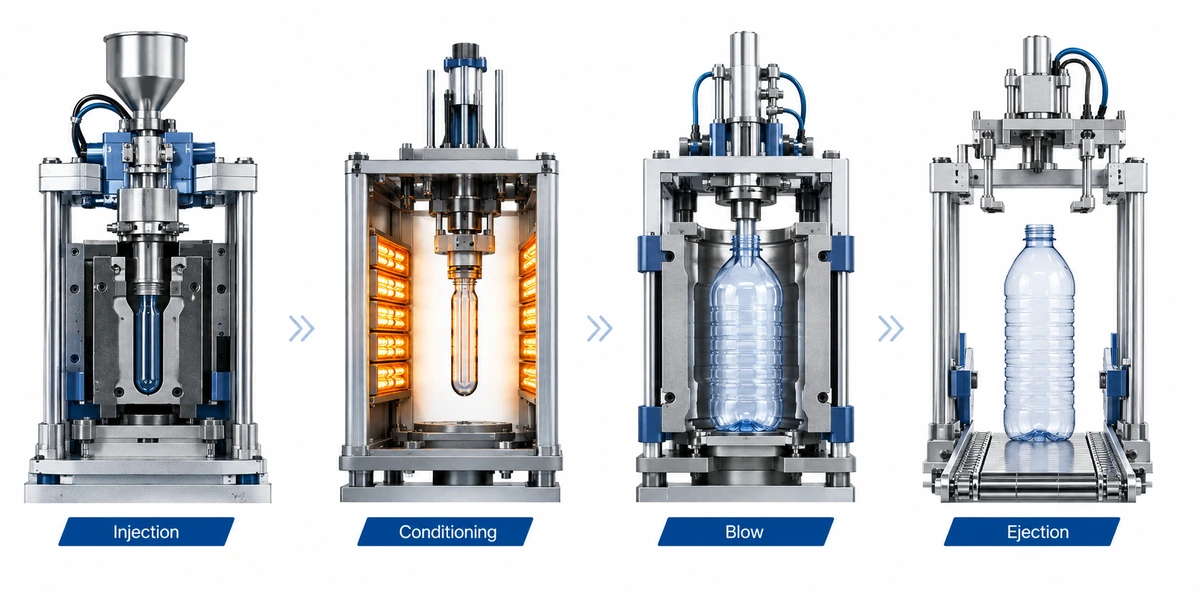
4-station one-step ISBM machine process — all four stations (injection, conditioning, stretch-blow, ejection) operate simultaneously on different preforms within each machine cycle.
What a One-Step ISBM Machine Does
A one-step ISBM machine does something fundamentally different from a standard injection moulding machine: it converts raw resin pellets into finished hollow bottles through an integrated sequence of four steps, all occurring within a single machine on a rotating table. At any given moment, four different preforms are at four different stages of the process simultaneously — one being injected, one being conditioned, one being stretched and blown, and one being ejected as a finished bottle.
The four steps in a one-step ISBM cycle are:
- Station 1 — Injection: molten resin is injected into the preform mould, forming a thick-walled tube with the finished neck geometry already moulded. This is the longest step in the cycle.
- Station 2 — Conditioning: the preform body is heated by multi-zone infrared heaters to the optimum stretch temperature (90–115 °C for PET) while the neck zone is kept cool to preserve the thread geometry.
- Station 3 — Stretch and Blow: a mechanical stretch rod extends the preform axially to 2.5–3.5 times its injection length; simultaneously, high-pressure air (25–40 bar) inflates it radially against the blow mould walls. This simultaneous axial and radial expansion produces biaxial molecular orientation — the property that gives ISBM bottles their clarity, strength, and light weight.
- Station 4 — Ejection: the finished, cooled bottle is released from the mandrel and exits to a conveyor for downstream filling, capping, and labelling.
What Biaxial Orientation Does for the Finished Bottle
The stretch-and-blow step in ISBM is not merely a shaping operation — it fundamentally changes the molecular structure of the PET or PP. When the stretch rod extends the preform and the blow air expands it, the polymer chains align simultaneously in two directions: axially (along the bottle’s length) and radially (around its circumference). This biaxial alignment produces properties that unoriented plastic cannot match:
- Tensile strength up to 3 times higher than unoriented PET at the same wall thickness, enabling wall thicknesses of 0.2–0.5 mm
- Optical clarity above 90% light transmittance — glass-like appearance
- CO₂ barrier performance sufficient for carbonated beverages
- Drop impact resistance to 1.5 m when filled, for standard 500 ml PET bottles
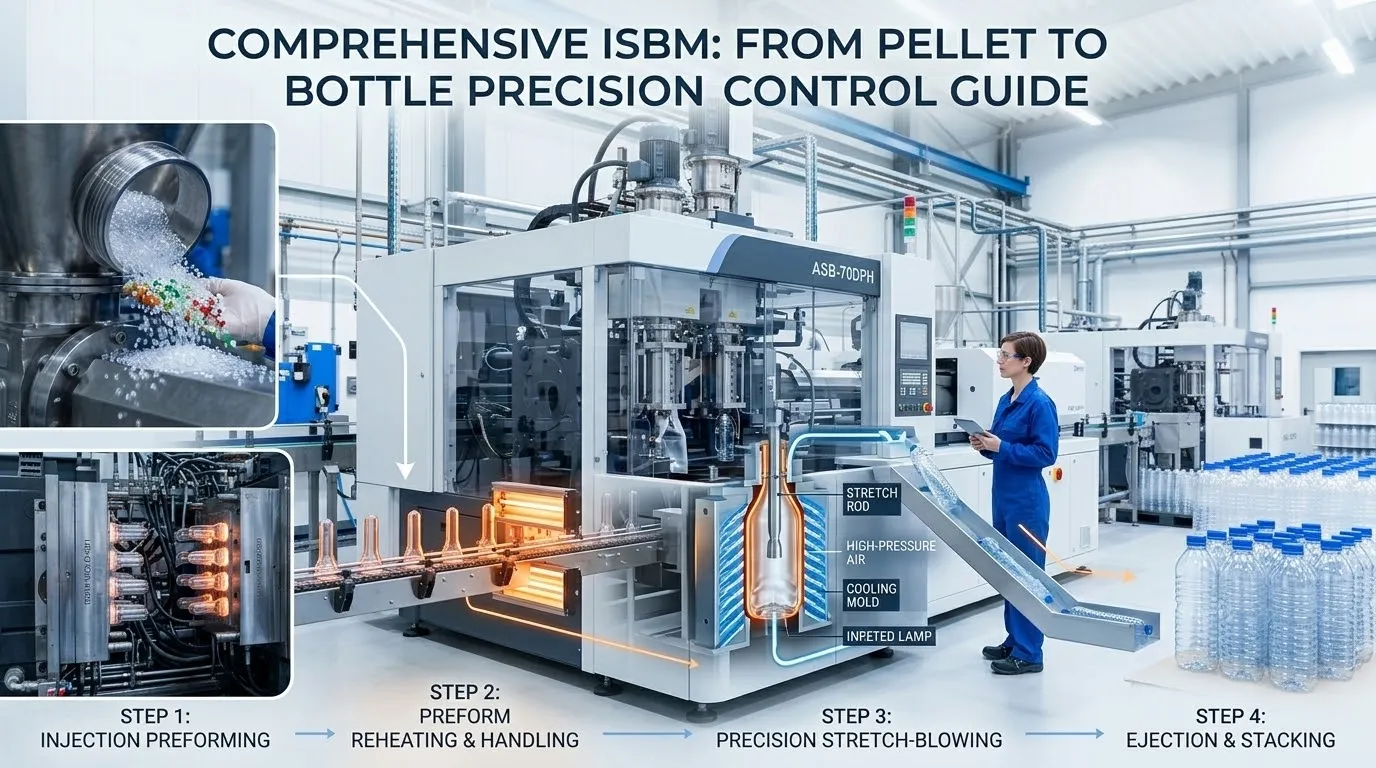
Complete ISBM process from resin pellet to finished bottle — the machine performs injection, conditioning, stretch, blow, cooling, and ejection in one integrated cycle.
Applications: What ISBM Machines Produce
One-step ISBM machines are used to produce finished PET, PP, and PETG containers across a wide range of packaging sectors. Ever-Power’s EP-HGY and EP-BPET series covers applications including:
| Application Sector | Containertyp | Typical Volume | Resin |
|---|---|---|---|
| Pharmazeutische | Oral solid dose bottles, vials | 30–500 ml | PET, PETG, PP |
| Cosmetic & personal care | Flacons, lotion bottles, shampoo | 50 ml–1 L | PET, PETG, PP |
| Food & beverage | Water, juice, edible oil, condiments | 250 ml–5 L | PET, PP |
| Industrial & agrochemical | Chemical containers, pesticide bottles | 1–10 L | PET, PP |
| Household | Cleaning products, detergent | 500 ml–3 L | PET, PP |
What a Standard Injection Moulding Machine Cannot Do
A standard injection moulding machine cannot produce finished hollow bottles, no matter how it is configured. It can produce preforms — which are then blown in a separate machine in a two-step process — but it cannot complete the blow step internally. Buyers who purchase a general injection moulding machine expecting to produce finished bottles will find that an additional blow moulding machine (or a one-step ISBM machine that replaces both) is required. This is one of the most common and expensive specification errors in plastics packaging equipment procurement.
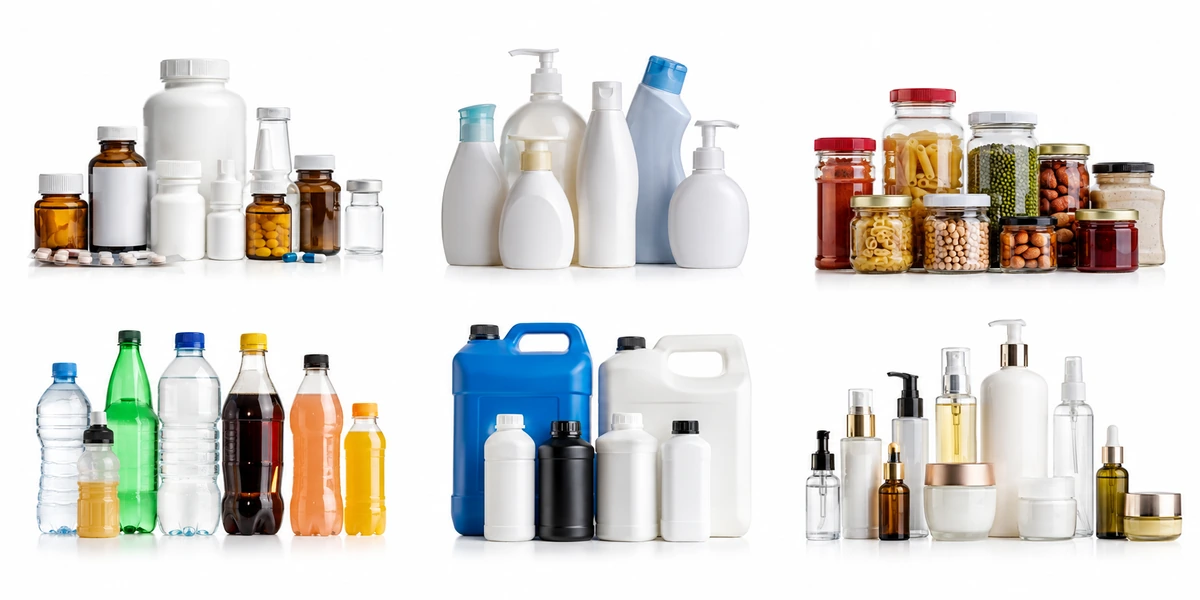
Container range produced by Ever-Power EP-HGY ISBM machines — pharmaceutical, cosmetic, food, beverage, and industrial packaging from 30 ml to 10 litres.
Want to see what a one-step ISBM machine can produce for your container?
Send Ever-Power your bottle specification and resin type. Our applications team will confirm the right machine model and produce an indicative output and cycle time estimate within 24 hours.
See what ISBM machines produce across specific sectors: water, beverage and chemical containers, cosmetic and personal care, Und food jars and cans.
Häufig gestellte Fragen
Can one ISBM machine produce different bottle formats?
Yes, but each bottle format requires its own mould set (preform mould, blow mould, and stretch rod). Changing from one bottle format to another requires a mould changeover, which typically takes 1–2 hours on a modern ISBM machine. Process parameters (conditioning temperatures, stretch rod speed, blow pressure) are saved as recipes and recalled for each mould, reducing the time needed to re-establish stable production after a changeover.
How many bottles per hour does an ISBM machine produce?
Output depends on bottle volume, wall thickness, cavity count, and station configuration. As a general guide: a 2-cavity EP-HGY150-V4 produces approximately 1,200–2,000 bottles per hour for 500 ml PET water bottles; a 4-cavity EP-HGY200-V4 produces approximately 2,400–4,000 bottles per hour for the same format. Larger bottles (2–5 litres) run at lower rates due to longer blow and cooling times. Contact Ever-Power with your specific bottle for a guaranteed cycle time estimate.
Does ISBM work with recycled PET (rPET)?
Yes, EP-HGY machines can process rPET at blends of up to 50% rPET with virgin PET in most applications, and higher percentages for some non-food applications. rPET typically has lower and more variable intrinsic viscosity (IV) than virgin PET, which requires tighter drying control and may require adjustment of injection temperature and blow parameters. Confirm your planned rPET specification with Ever-Power’s process team before finalising machine and mould design for rPET applications.
How ISBM Machine Precision Affects Bottle Quality
The precision of an ISBM machine’s process control determines the consistency of every bottle it produces. Shot-to-shot weight variation, wall thickness distribution, and bottle dimensional accuracy are all direct consequences of how precisely the machine controls injection speed, pack pressure, conditioning temperature, stretch rod force and speed, and blow pressure across consecutive cycles. On servo-driven machines, closed-loop control on each axis allows the machine to correct deviations from the setpoint within fractions of a second — producing tighter weight and dimension distribution than fixed-speed hydraulic machines where pressure variations compound across the cycle.
For pharmaceutical applications, bottle weight variation is a quality attribute: regulatory guidelines for pharmaceutical primary packaging specify maximum allowable weight variation as an indicator of wall thickness uniformity. A one-step ISBM machine with servo-controlled injection and blow axes can typically achieve shot-to-shot weight variation of less than 0.5% across a sustained production run. This performance level is critical for pharmaceutical producers who must demonstrate container consistency in regulatory submissions and batch release testing. EP-HGY full-servo machines are specifically designed for pharmaceutical and high-precision cosmetic applications where this level of process control is required.
Integration with Downstream Filling and Packaging Equipment
A one-step ISBM machine does not operate in isolation — it is the upstream component of a packaging line that includes bottle conveyance, filling, capping, labelling, and palletising. The interface between the ISBM machine and downstream equipment is a significant practical consideration that should be addressed during machine specification, not after installation. Key integration points include: output conveyor speed and orientation (bottles must exit in a consistent orientation for downstream conveyance); bottle accumulation capacity between the ISBM machine and the filler (to buffer the difference in output rate if the filling speed is lower than the bottle production rate); and clean air or nitrogen blanketing of the conveyor between bottle ejection and filling entry for pharmaceutical and sensitive food applications.
Ever-Power can advise on output conveyor and accumulation table configuration for all EP-HGY and EP-BPET machine installations. For turnkey packaging line projects where the ISBM machine is one component of a fully integrated filling line, Ever-Power can coordinate machine interface specifications with the filling equipment supplier to ensure compatibility before installation begins. This coordination is particularly important for pharmaceutical installations where regulatory requirements may specify cleaning and environmental controls for the entire line from bottle production through filling and capping.