What causes common defects in blow molded PET bottles?
Defects in blow-moulded PET bottles produced by one-step ISBM machines are almost always process-related rather than material-related — meaning they are caused by incorrect parameter settings, worn tooling, or inadequate resin preparation rather than by inherent limitations of PET or the ISBM process. Understanding the cause of each defect and the specific corrective action required allows operators to resolve quality issues at the machine without engineering support for routine deviations. This guide covers the most common ISBM bottle defects, their root causes, and the corrective actions for each.
Defect 1: Stress Whitening
Stress whitening appears as a white or milky haze in the bottle’s base zone, lower sidewall, or shoulder, and is caused by exceeding the local stretch ratio — the PET polymer chains have passed their orientation limit and begun to develop micro-voids rather than continue to orient. Micro-voids scatter light, producing the white appearance. Stress whitening is a structural concern as well as a visual defect: the micro-voided zone is weaker than correctly oriented PET and may fail under drop impact or pressure.
Causes: axial stretch ratio too high (preform body too short for the bottle height); preform body temperature too low at the base zone when the stretch rod contacts it (inadequate conditioning in the base zone); stretch rod speed too fast relative to the pre-blow onset; or resin IV too low (degraded resin cannot orient to the required ratio).
Corrective actions: increase conditioning heater power at the base zone of the preform (if using a 4-station machine); reduce stretch rod speed; advance the pre-blow onset relative to stretch rod travel; check resin drying conditions and IV of the processed resin. If the defect persists after process adjustment, the preform body may need to be redesigned with a longer body to reduce the axial stretch ratio.
Defect 2: Hazy Sidewall (in an Otherwise Clear Bottle)
Localised haze in the sidewall of an otherwise clear ISBM bottle — not the base-zone whitening of stress whitening — is typically caused by incorrect conditioning temperature in the affected zone. PET must be in the orientation window (90–115 °C at the preform surface) for the blow step to produce full biaxial orientation and maximum clarity. If a zone of the preform is too cold when blown, it will not orient fully, producing a hazy band in the corresponding zone of the finished bottle.
Causes: conditioning heater zone setpoint too low in the hazy area; conditioning residence time too short (machine cycle time too fast for the conditioning station to reach the target temperature at full production speed); uneven heater element performance (one or more heater elements failing).
Corrective actions: increase the setpoint of the conditioning heater zone corresponding to the hazy area of the finished bottle; check each heater element for correct operation; reduce machine speed slightly to allow more conditioning residence time per cycle. Monitor preform surface temperature with an infrared thermometer after conditioning to verify the actual temperature profile.
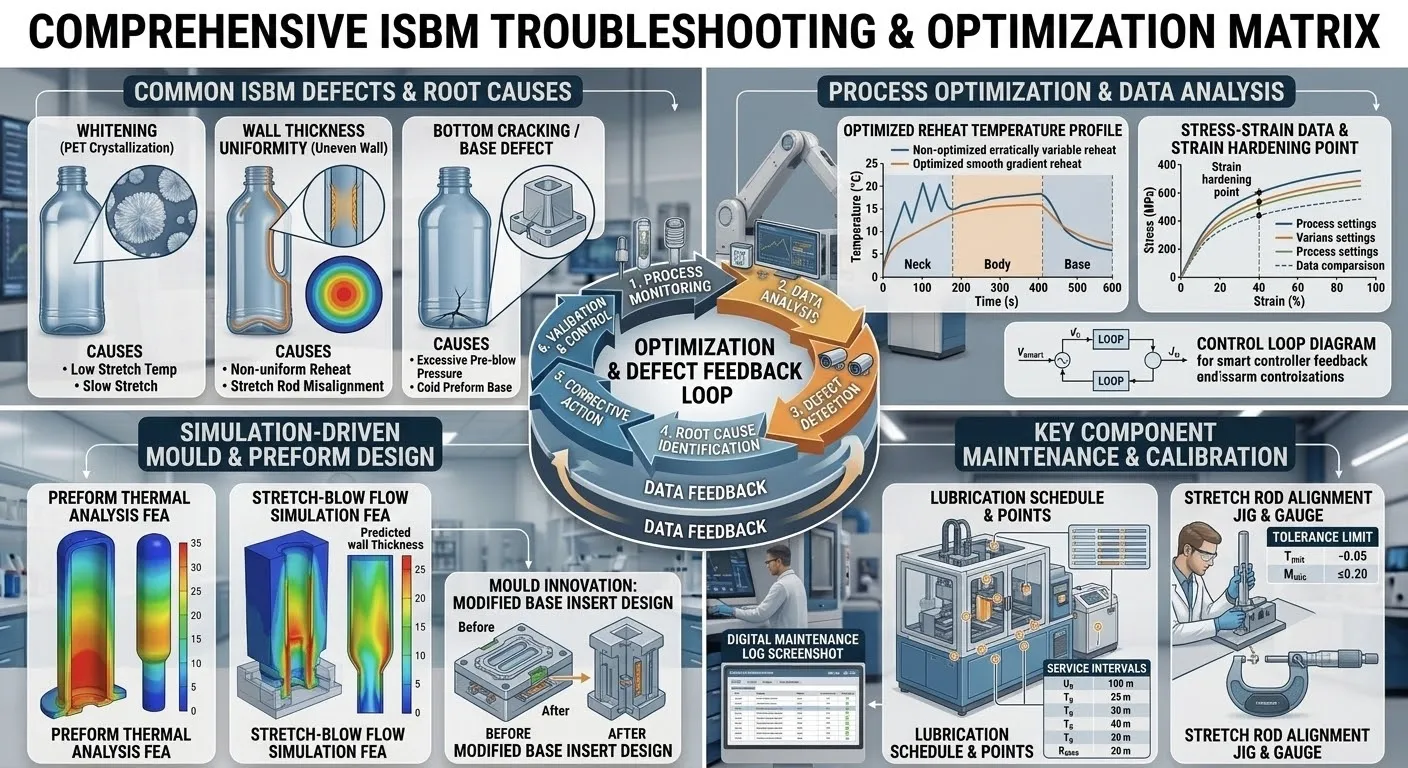
ISBM process optimisation and defect troubleshooting matrix — most PET bottle defects have specific, correctable root causes in process parameters or tooling condition.
Defect 3: Gate Mark / Gate Vestige
The gate mark is a protrusion or rough area at the centre of the bottle base, corresponding to the injection gate point on the preform mould. A small gate vestige is normal and acceptable; an oversized, protruding, or rough gate vestige is a mould maintenance issue or an injection parameter issue.
Causes: worn or eroded gate tip on the preform mould hot runner; gate tip orifice diameter too large (either from wear or original design); melt temperature too low, causing incomplete gate freeze-off and stringing; or inadequate cooling time in the injection mould causing the gate to remain molten when the mould opens and the preform is ejected.
Corrective actions: inspect and replace the hot runner gate tip; confirm injection melt temperature is within the PET processing window (270–295 °C); increase cooling time in the injection mould by 0.5–1 second increments until gate vestige is stable. If the gate tip has been replaced and the defect persists, review the gate tip orifice diameter specification with the mould supplier.
Defect 4: Uneven Wall Thickness
Uneven wall thickness — one side of the bottle significantly thicker or thinner than the opposite side (pearlescence or champagne effect on the thin side, excessive weight on the thick side) — is caused by asymmetric preform conditioning temperature, misalignment of the stretch rod to the preform’s centreline, or a non-symmetric preform body wall thickness from the injection mould.
Causes: conditioning heater zone imbalance (one side of the preform heats faster than the other due to heater position or output differences); stretch rod bent or misaligned (producing asymmetric axial stretch that drives material preferentially to one side); or uneven preform body wall thickness from a mould cavity with uneven cooling or a worn core.
Corrective actions: measure preform surface temperature at multiple points around the circumference after conditioning to check for asymmetry; check stretch rod straightness and alignment; measure preform wall thickness at multiple circumferential positions to check for injection mould asymmetry. Each of these checks narrows the root cause to either the conditioning station, the stretch rod, or the injection mould.
Defect 5: Neck Finish Flash or Dimensional Non-Conformance
Flash at the preform parting line (a thin film of PET at the mould parting surface), or neck finish dimensions outside the closure specification, indicate either a mould condition issue or an injection parameter issue.
Flash causes: insufficient injection clamping force (mould opening against injection pressure); worn parting surface on the neck splits or cavity (reducing the contact area that seals the mould); or oversized shot weight forcing melt into the parting gap. Corrective actions: increase injection clamping force if within the machine’s capacity; inspect and reface or replace worn neck split parting surfaces; verify shot weight against the preform specification.
Dimensional non-conformance causes: worn or thermally distorted neck splits (changing the effective neck cavity dimensions); mould cooling imbalance causing the neck to be ejected above the specified temperature and distort on release; or incorrect injection pack pressure causing dimensional variation in the neck finish. Corrective actions: gauge the neck finish with the appropriate thread gauge and support ledge gauge; measure neck split cavity dimensions against the drawing; check injection mould cooling water temperature and flow rate in the neck zone.
Defect 6: Bottle Weight Variation
Consistent bottle weight is a quality requirement for pharmaceutical and cosmetic containers, where weight is a proxy for wall thickness uniformity. Weight variation above 0.5% of nominal (shot-to-shot) indicates injection process instability.
Causes: inconsistent shot size from the injection unit (screw check valve wear allowing back-leakage); resin feed variation (bridging in the hopper, moisture variation from inadequate drying); or injection speed and pack pressure variation from servo drive instability or hydraulic pressure variation on older machines. Corrective actions: measure shot weight for 30 consecutive cycles to quantify the variation; check screw check valve condition; verify dryer performance (dew point, temperature, residence time); review injection unit calibration. On servo-hydraulic machines, inconsistent shot weight often traces to screw check valve wear, which is a scheduled replacement item.
Experiencing quality issues on your ISBM machine?
Ever-Power’s process support team provides remote and on-site troubleshooting assistance for EP-HGY and EP-BPET machines. Send us your defect description and machine data for a diagnostic response within 24 hours.
For detailed process setup guidance, see the EP-HGY machine range pages, or contact us to arrange on-site process training and troubleshooting support for your installation.
Häufig gestellte Fragen
How do I tell if a PET bottle defect is a resin problem or a process problem?
The most reliable way to distinguish resin from process as the root cause is to run the same process parameters with a confirmed-good batch of dried resin and compare the output. If the defect disappears with the new resin batch, the original resin was defective (degraded IV, moisture contamination, or contaminated with a different resin). If the defect persists with the new resin, the cause is process-related and the parameters need to be reviewed. In practice, the majority of ISBM bottle defects are process-related rather than resin-related, because ISBM-grade PET from reputable suppliers is highly consistent.
Can a defect in the blow mould cause pearlescence in the bottle body?
Yes. Pearlescence — a pearl-like surface appearance from very fine micro-cracks or voids at the bottle surface — can be caused by a blow mould cavity surface that is too rough, scratched, or corroded, which impedes smooth contact between the expanding preform and the mould wall during blowing. The mould surface roughness promotes surface tearing at the micro scale as the PET expands against it. Corrective action: polish the affected area of the blow mould cavity. If the mould surface cannot be polished adequately (because it is in a cooling channel zone or has severe corrosion), the mould cavity may need refurbishment or replacement.
What is the best way to document and track bottle defects in ISBM production?
A structured defect tracking system records: the defect type; the frequency (defects per thousand bottles); the machine parameters at the time of occurrence; the lot number of the resin in use; the mould set in use; and the corrective action taken and its outcome. This record enables pattern recognition: if a specific defect recurs with a specific mould set after a certain number of cycles, it points to tooling wear; if it recurs with a specific resin lot, it points to raw material variability. Statistical process control (SPC) charts of bottle weight and wall thickness, run continuously during production, detect trends toward defect-forming conditions before the defect itself appears, allowing preventive parameter adjustment rather than reactive correction.