ISBM Process Troubleshooting and Corrective Engineering
How Can You Resolve Issues Like Uneven Wall Thickness Shrinkage or Distortion in ISBM?
A systematic corrective action guide providing step-by-step diagnostic pathways and parameter adjustment methodologies to eliminate material distribution problems, post-mold dimensional instability, and geometric warpage in injection stretch blow molded containers.
The Systematic Approach to Resolving Dimensional Defects in ISBM
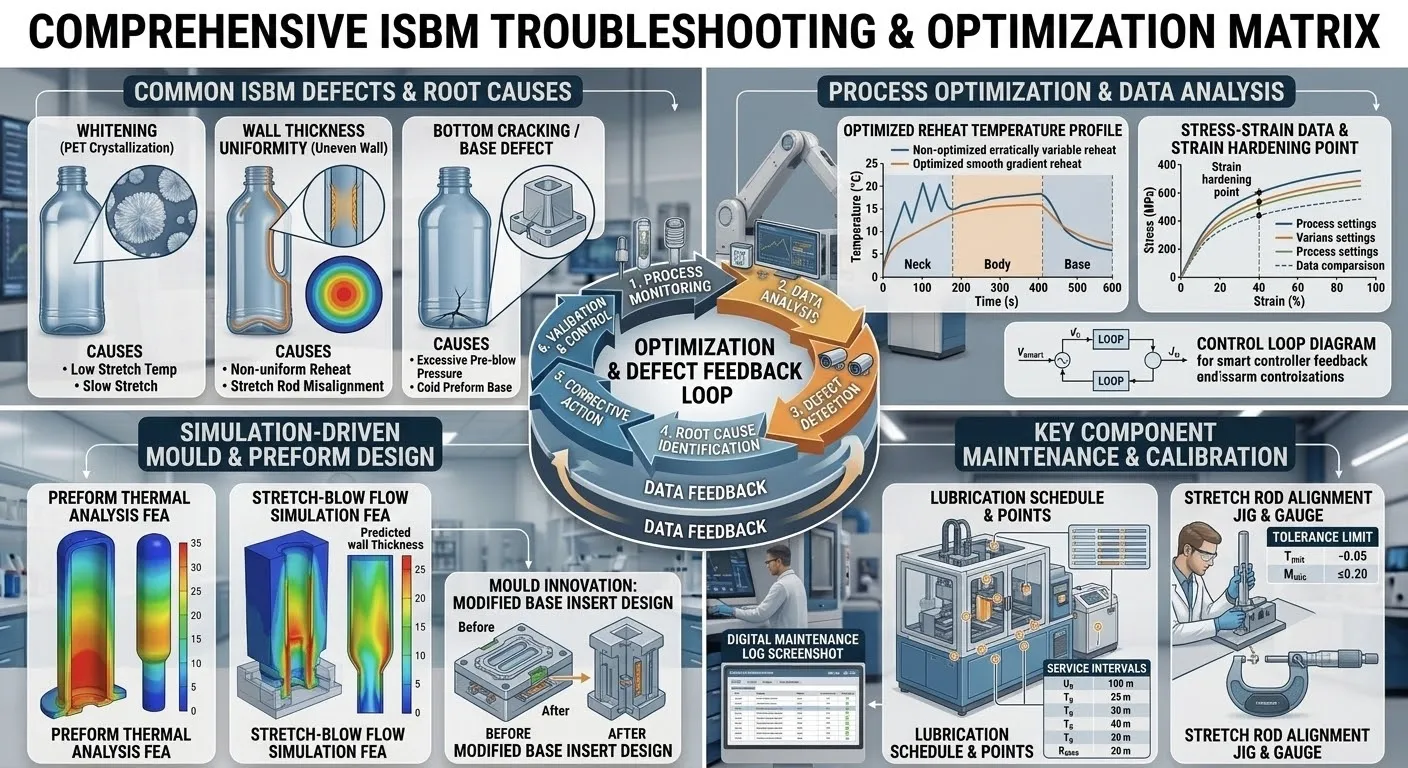
Uneven wall thickness, post-molding shrinkage, and geometric distortion are among the most frustrating and economically damaging quality defects in injection stretch blow molding production. Unlike a simple optical defect such as haze, which may be tolerable in certain non-premium applications, dimensional defects directly compromise the container’s functionality. A bottle with an uneven wall thickness will have weak spots that fail under top load or internal pressure. A container that shrinks after molding will not meet its labeled volume specification. A bottle with a distorted, rocking base will fall over on the filling line, causing costly stoppages. These are not problems that can be ignored or downgraded. They demand systematic, root-cause-driven corrective action. At Ever-Power, a globally recognized Brazilian ISBM manufacturer, our process engineering teams have developed rigorous, step-by-step resolution protocols for each of these defect categories, grounded in the thermodynamic and kinematic principles that govern the behavior of PET, PP, and rPET during the stretch blow molding sequence.
Resolving dimensional defects in ISBM requires a disciplined diagnostic methodology. The defect must first be accurately characterized through measurement. A container suspected of uneven wall thickness must be sectioned and the wall thickness mapped at defined heights and circumferential positions. A container exhibiting shrinkage must have its critical dimensions compared against the blow mold cavity dimensions over a defined post-molding time period. A distorted container must be analyzed to determine whether the distortion is symmetric, indicating a global cooling or stress issue, or asymmetric, pointing to a localized problem in the mold or conditioning system. Only once the precise nature and pattern of the defect is understood can the corrective action be targeted effectively. This guide provides the measurement protocols, diagnostic flowcharts, and parameter adjustment strategies necessary to resolve the most common dimensional defects encountered on machines like the EP-HGY150-V4 4-Station Machine and the servo-driven EP-HGY150-V4-EV Full Servo Machine.
Mastering the resolution of these dimensional issues is what separates a reactive production operation from a proactive, zero-defect manufacturing facility. This guide equips you with the engineering knowledge to cross that divide.
Resolving Uneven Wall Thickness: A Step-by-Step Diagnostic and Corrective Protocol
Uneven wall thickness is the most common dimensional defect, and its resolution requires identifying the specific pattern of thickness variation and tracing it to its root cause.
Diagnosing the Pattern: Heavy Base, Thin Shoulder, or Asymmetric Distribution
The first step in resolving uneven wall thickness is to section a representative defective container and measure the wall thickness at multiple defined heights and at multiple points around the circumference at each height. The resulting data reveals a pattern. A heavy base with a thin upper body indicates that the stretch rod is pushing excessive material downward before the radial blow air can distribute it evenly. The corrective action is to reduce the stretch rod stroke length, slow the rod descent velocity, or delay the pre-blow timing so that radial expansion begins earlier in the rod’s travel. Conversely, a thin base with a heavy shoulder indicates the stretch rod is not pushing enough material to the base. The corrective action is to increase the rod stroke, increase its velocity, or delay the pre-blow to allow the rod to deliver more material before radial inflation begins. An asymmetric wall thickness, where one side of the container is consistently thinner than the opposite side, points to a circumferential temperature imbalance in the conditioning station. The conditioning pot on the thinner side may be too hot, causing that region to stretch excessively. Reduce the temperature of the conditioning zone corresponding to the thin side, or increase the temperature on the thick side, to balance material flow. Machines with precise zonal conditioning, such as the EP-HGYS280-V6, provide the independent thermal control necessary to correct these patterns.
Correcting Through Preform Design, Conditioning, and Stretch Parameters
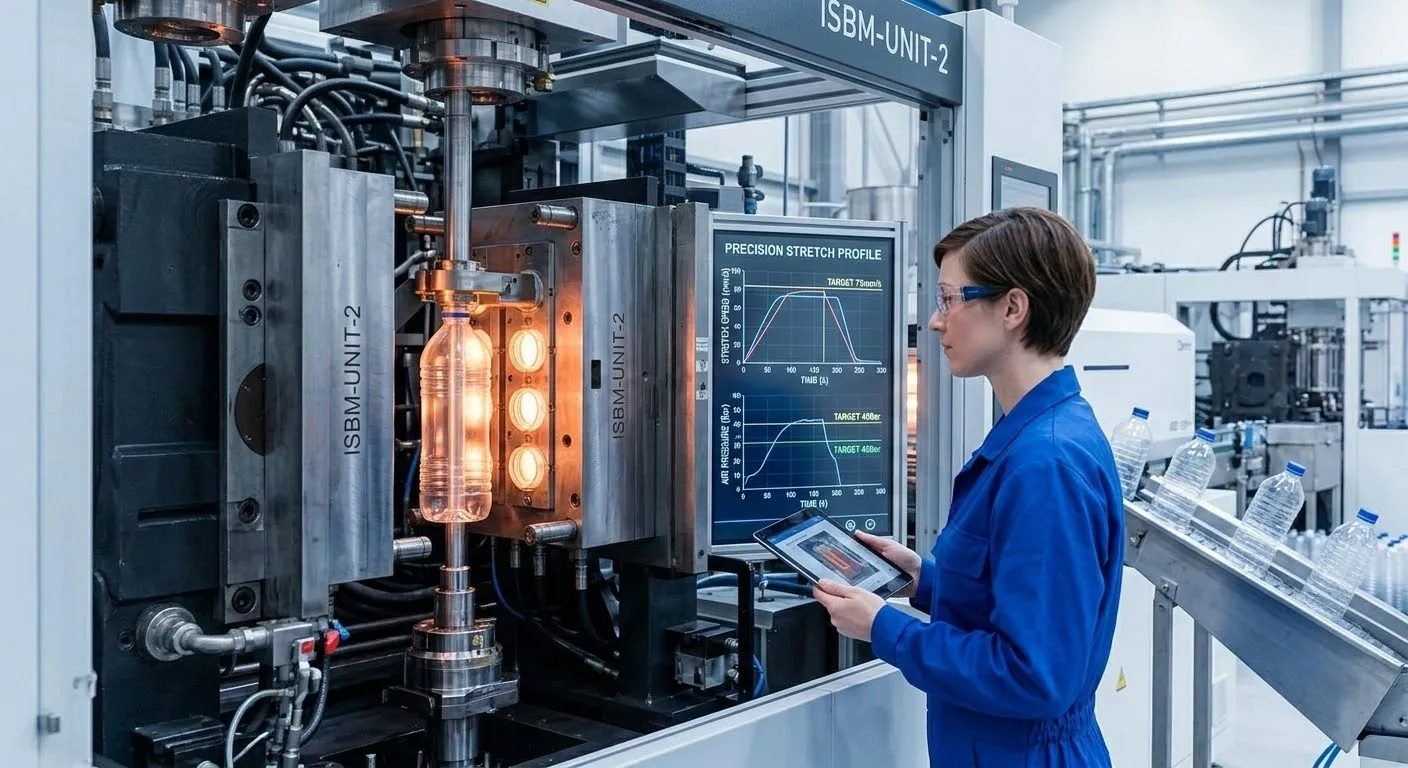
If the wall thickness defect pattern does not respond adequately to conditioning and stretch parameter adjustments, the root cause may lie in the preform design itself. The axial thickness profile of the preform may be inappropriate for the container geometry, delivering too much material to regions that do not need it and too little to regions that do. In this case, the preform must be redesigned, typically through finite element simulation, to optimize the axial thickness profile. The preform body diameter may also need adjustment to achieve a more uniform radial stretch ratio. For complex container shapes, achieving uniform wall thickness may require a combination of preform geometry refinement, circumferential thermal conditioning, and optimized stretch rod kinematics. The servo-driven stretch rod on the EP-HGY150-V4-EV allows the rod motion profile to be tailored to the specific material distribution requirements of the container, including acceleration, constant velocity, and deceleration phases that guide material precisely where it is needed. The pre-blow and final blow timings and pressures must also be optimized in concert with the stretch rod motion. On machines like the EP-BPET-125V4, these pneumatic parameters are adjustable in millisecond increments, providing the fine control necessary to dial in the perfect wall thickness distribution.
Resolving Post-Molding Shrinkage: Stabilizing Container Dimensions
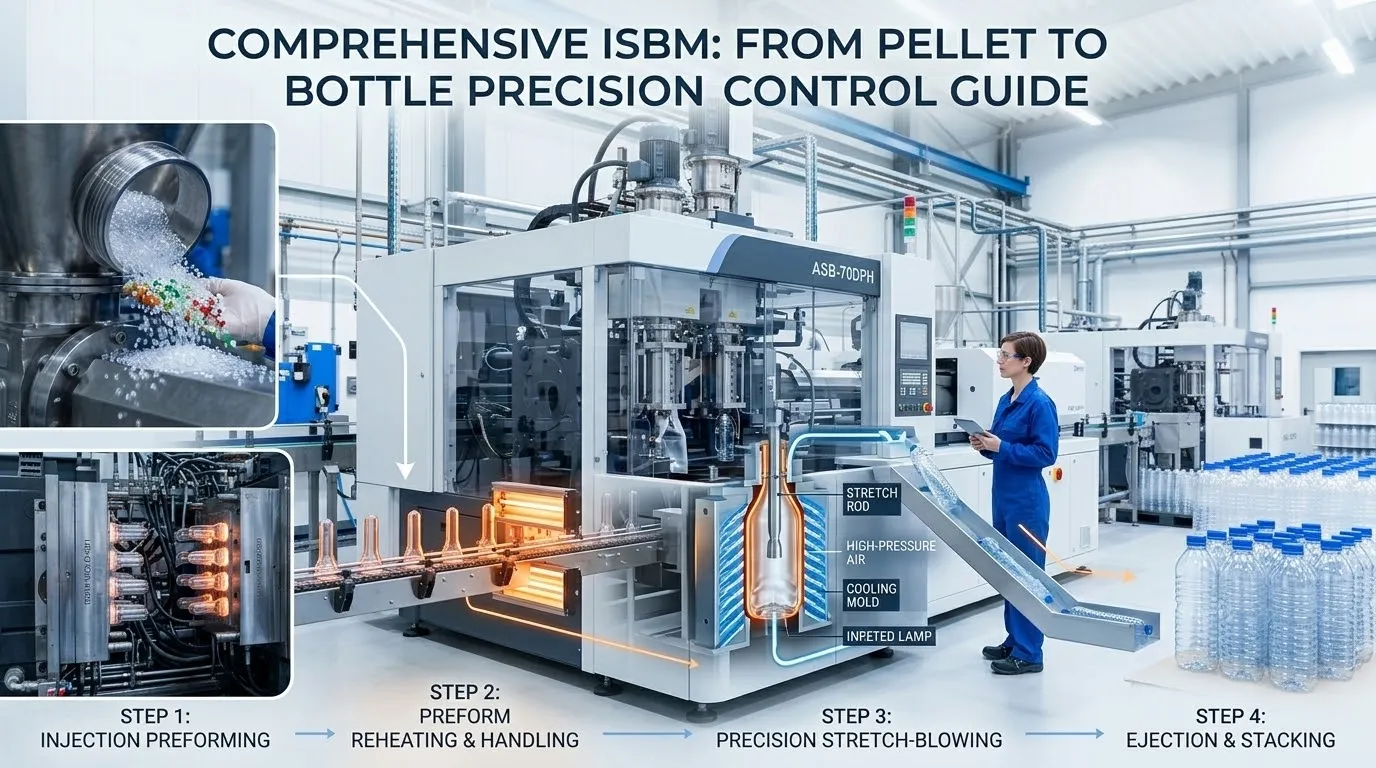
Shrinkage is the reduction in container dimensions that occurs after ejection as the polymer continues to cool and its oriented molecular chains relax. Excessive or non-uniform shrinkage leads to containers that are out of dimensional specification.
❄️The Role of Blow Mold Cooling and Post-Ejection Thermal History
The primary cause of excessive shrinkage is that the container was not sufficiently cooled in the blow mold before ejection. When the blow mold opens, the container is still hot, and as it continues to cool in ambient air, the oriented polymer chains relax, and the material contracts. The solution is to increase the blow mold cooling time. The container must remain in contact with the chilled mold walls until its temperature has dropped sufficiently that the oriented crystalline structure is locked in. The blow mold cooling water temperature should be verified and, if necessary, reduced. The water flow rate through the mold cooling channels should be checked to ensure turbulent flow for maximum heat transfer. For thick-walled containers that retain heat longer, the blow mold may need additional cooling capacity, or the container may require a post-ejection forced-air cooling station. The Custom One-Step Injection Stretch Blow Moulds from Ever-Power are designed with conformal cooling channels that maximize heat extraction from the blow mold cavity, minimizing the cooling time required to achieve dimensional stability.
🧬Residual Stress Relaxation and Orientation Stability
Shrinkage can also be caused by excessive residual stress in the oriented container. If the preform was stretched at a temperature that was too low, or at a stretch ratio that was too aggressive, the oriented polymer chains are under high internal stress. Over time, particularly if the container is exposed to elevated temperatures during storage or filling, these stresses relax, causing the container to shrink. The solution is to increase the conditioning temperature slightly, allowing the chains to orient with less internal stress, or to reduce the planar stretch ratio by modifying the preform geometry. The stretch temperature and stretch ratio must be optimized to achieve the required biaxial orientation for strength while minimizing residual stress. The servo-driven stretch rod and precise conditioning control of the EP-HGY150-V4-EV allow these parameters to be optimized with high precision, minimizing shrinkage while maintaining container strength. For rPET containers, which inherently have higher shrinkage tendencies due to their lower and more variable molecular weight, a slightly higher conditioning temperature and a slightly lower stretch ratio are typically required compared to virgin PET.
Resolving Geometric Distortion: Warpage, Rocker Bottom, and Ovality
Geometric distortion defects such as warpage, rocker bottom, and ovality arise from non-uniform cooling, residual stress, or mechanical ejection problems, and each requires a specific corrective strategy.
🔵Correcting Rocker Bottom and Base Distortion
A rocker bottom, where the container base is convex or uneven and the bottle rocks on a flat surface, is one of the most disruptive dimensional defects because it causes filling line instability. The root cause is almost always non-uniform cooling in the base region of the blow mold, or an imbalance in the stretch rod and pre-blow timing that leaves the base with an uneven material distribution. The corrective protocol begins with verifying that all base cooling channels in the mold are flowing freely and at the correct temperature. If one channel is partially blocked, it will create a hot spot that causes uneven shrinkage. The stretch rod end position should be checked. If the rod extends too far, it can create a thin, stressed center that distorts. If the rod does not extend far enough, the base may not be fully formed. The pre-blow timing must be such that the material is distributed uniformly across the base before the final blow seats it against the mold. Slight adjustments to the pre-blow delay and the final blow pressure can often resolve a rocker bottom issue. For complex footed bases like petaloid designs, the mold venting must be flawless to allow the material to fill the feet completely. The EP-HGY250-V4-B double-row machine, with its high cavitation, demands particular attention to base cooling and venting uniformity across all cavities.
⭕Resolving Warpage and Ovality Through Cooling Balance
Warpage, where the container body bends or twists out of shape, is caused by a temperature imbalance between the two halves of the blow mold, or by the container being ejected while still too hot and cooling asymmetrically in ambient air. The corrective action is to measure the temperature of each mold half using a surface thermocouple or thermal camera. A temperature difference of even a few degrees between the mold halves can cause the plastic to solidify at different rates, with the hotter side continuing to shrink after the cooler side has set. The mold cooling circuits must be balanced to deliver equal water flow and temperature to both halves. If the warpage is severe and consistent in one direction, it may indicate a mechanical misalignment of the mold halves or a problem with the ejection system, where the take-out robot is applying uneven force to the hot container. Ovality in a round container is typically caused by the blow mold itself being out of round, the mold not closing completely, or the container shrinking non-uniformly after ejection. Verifying the mold cavity dimensions and the clamp force is the first step. For high-volume production on machines like the EP-HGY200-V4, periodic mold inspection and preventive maintenance are essential to prevent these mechanical sources of distortion.

Resolution Strategies for Material-Specific Dimensional Challenges
The corrective actions for dimensional defects must be adapted to the specific material being processed, with rPET and PP presenting unique challenges that require tailored resolution strategies.
Adapting Resolution Protocols for rPET
Post-consumer recycled PET is more prone to dimensional variation than virgin resin due to its lower and more variable intrinsic viscosity. Uneven wall thickness in rPET containers often requires a more conservative stretch ratio and a slightly higher conditioning temperature to ensure the lower-IV material is sufficiently pliable to stretch uniformly. Shrinkage in rPET is typically higher than in virgin PET because the shorter molecular chains relax more readily. Resolution involves increasing the blow mold cooling time and reducing the conditioning temperature slightly to minimize residual stress. Distortion in rPET containers can be exacerbated by the presence of contaminants that create localized variations in thermal behavior. The servo-driven injection control of the EP-HGY150-V4-EV helps by compensating for viscosity fluctuations, producing preforms with consistent dimensions and thermal history that are less prone to downstream dimensional defects. When processing high-rPET content, the process window for all parameters narrows, and the corrective actions described in this guide must be applied with even greater precision.
PP-Specific Distortion and Shrinkage Management
Polypropylene containers produced by ISBM exhibit higher shrinkage than PET due to PP’s faster crystallization kinetics and higher coefficient of thermal expansion. Resolving shrinkage in PP containers requires extended blow mold cooling time and, in many cases, a post-molding annealing step where the containers are held at a controlled temperature to allow stress relaxation to occur in a controlled manner. PP is also more prone to warpage because its semi-crystalline structure continues to develop after ejection. Ensuring perfectly balanced mold cooling and, if necessary, using a cooling fixture that holds the container in its intended shape during the critical seconds after ejection are effective resolution strategies. The extended conditioning capability of the EP-HGYS280-V6 allows the PP preform to be brought to a more uniform stretching temperature, which helps minimize residual stress and subsequent distortion. The machine’s precise control over all stretch parameters is particularly valuable for navigating the narrower processing window of PP.
EP-HGY250-V4 and the compact EP-BPET-70V4 incorporate real-time process monitoring capabilities that alert operators to parameter shifts, enabling proactive correction before dimensional defects result in significant scrap. Integrating these monitoring systems with systematic quality sampling and measurement creates a robust defense against the recurrence of uneven wall thickness and distortion problems.
Achieve Dimensional Perfection Through Systematic Defect Resolution
Resolving issues like uneven wall thickness, shrinkage, and distortion in ISBM is a disciplined engineering process that combines precise defect measurement, systematic root cause analysis, and targeted adjustment of preform design, conditioning parameters, stretch rod kinematics, pneumatic timing, and mold cooling. Each defect has a specific signature, and each signature points to a specific corrective pathway. By mastering these diagnostic and resolution protocols, and by leveraging the precision capabilities of advanced Ever-Power machinery including the EP-HGY150-V4, the EP-HGY150-V4-EV, and expertly engineered Custom One-Step Injection Stretch Blow Moulds, manufacturers can transform their dimensional quality and drive scrap rates toward zero.