How to buy an ISBM machine from China?
Buying a one-step ISBM machine from a Chinese manufacturer offers significant price advantages — typically 30–50% below European equivalents at equivalent technical specification — but requires a structured procurement approach to manage supplier qualification, quality verification, import logistics, and after-sales support risks. This guide covers every step of the process for buyers in Ever-Power’s key markets: Brazil, South Korea, Australia, the Netherlands, the UK, and Canada.
Step 1: Qualify the Supplier Before Any Other Discussion
The first and most important step in buying an ISBM machine from China is supplier qualification — confirming that the company you are considering is a legitimate, specialist ISBM machine manufacturer, not a trading company reselling machines from third parties. The qualification steps are:
- Verify manufacturing capability: request the company’s business licence and manufacturing facility address. Confirm the facility is a real production operation, not a warehouse or sales office. A factory visit (in person or by video) is the most reliable verification method.
- Confirm ISBM specialisation: ask what percentage of the company’s production is one-step ISBM machines specifically. General plastics machinery companies that offer ISBM as one of many product lines have less ISBM-specific expertise than dedicated ISBM manufacturers.
- Check installed base and references: ask for a list of installed machines in your country or region, and request contact details for two or three reference customers in your industry who can be contacted directly. A supplier who cannot provide reference customers in your market represents higher risk.
- Verify export experience: confirm the supplier has experience exporting to your country, including knowledge of applicable import duties, CE or applicable local safety certifications, and the documentation required for customs clearance in your market.
Step 2: Request and Evaluate the Technical Quotation
A complete technical quotation from a qualified ISBM machine supplier should include: the specific machine model with full technical specification (injection clamping force, drive system, station count, injection unit capacity, blow station dimensions, installed power, compressed air consumption, chiller capacity requirement); the mould set specification (preform mould design, blow mould design, stretch rod specification) for your specific bottle; all included ancillary equipment; payment terms and schedule; delivery terms (FOB, CIF, or DDP — confirm which and what is included); commissioning scope and timeline; warranty terms; and spare parts availability and pricing for the main wear items.
Compare quotations from three to five suppliers against all of these criteria, not price alone. A quotation that is significantly cheaper than others but omits commissioning, after-sales support, or critical ancillary equipment is not a genuine comparison. Confirm that each supplier’s quoted machine has the same drive system (servo-hydraulic or full-servo), station count, and mould specification before comparing prices.
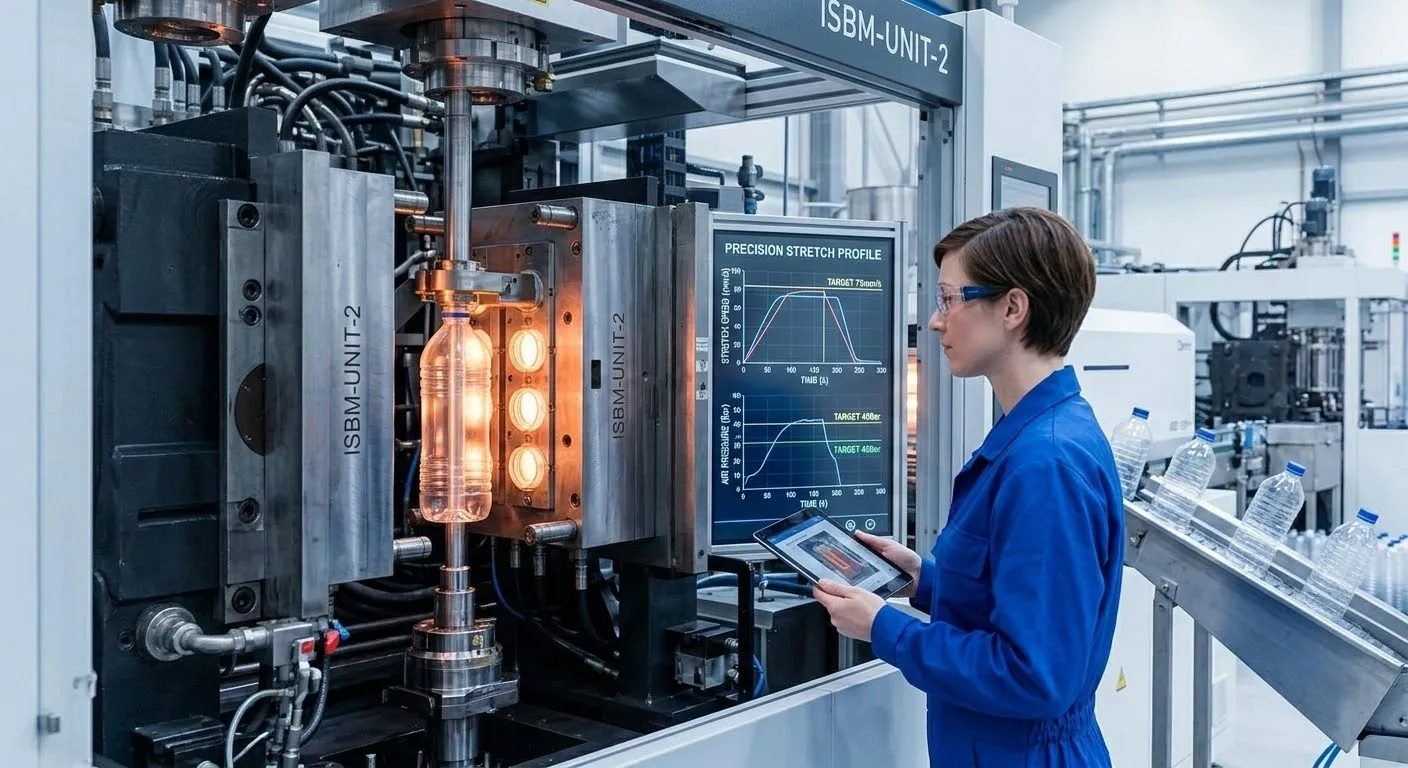
Ever-Power production facility in Hangzhou — a factory visit to verify manufacturing capability and quality control systems is an essential step in purchasing an ISBM machine from China.
Step 3: Conduct a Factory Visit and Machine Demonstration
For a capital purchase of USD 80,000–350,000, a factory visit is a worthwhile investment regardless of travel distance. The factory visit should include: verification of the supplier’s production floor (confirming machines in active manufacture matching the quoted model); a live demonstration of the machine model you are considering, running a bottle similar to your application, with cycle time data logged from the HMI for 30–60 consecutive cycles; bottle samples from the demonstration run for independent dimensional and quality verification; and a review of the quality control systems and acceptance test procedures.
If a factory visit is not possible before the purchase decision, request: a detailed video of the machine in production with the HMI screen visible showing cycle time and process parameters; a set of first-article bottle samples from the machine running your bottle geometry or an equivalent; and a list of installed customers in your country or region with permission to contact them directly.
Step 4: Negotiate Payment Terms and Shipping
Standard payment terms for ISBM machine purchases from Chinese manufacturers are: 30–40% deposit at order placement; 30–40% at factory acceptance test (before shipment); and the balance of 20–40% before or at shipment, or at commissioning completion. This payment structure is negotiable depending on order size and relationship history. For first purchases from a new supplier, retain as much payment as possible until after commissioning sign-off, as this provides the most practical leverage for resolving any performance issues before final payment is released.
Shipping terms should be clearly agreed in the purchase contract. Common terms: FOB (Free On Board) — the buyer arranges and pays for ocean freight, marine insurance, and import duties; CIF (Cost Insurance Freight) — the seller arranges ocean freight and insurance to the destination port; DDP (Delivered Duty Paid) — the seller arranges everything including import duties and delivery to the buyer’s facility. DDP is the most buyer-convenient option but highest cost; FOB gives the buyer more control over logistics cost but requires more procurement involvement. Ever-Power can quote on any of these shipping terms to your port or facility.
Step 5: Import Duties and Regulatory Compliance
ISBM machines imported from China are subject to import duties in most countries. Indicative duty rates: Brazil (commonly 14–20% on machinery imports, with possible ICMS and PIS/COFINS on top, though machinery under specific HS codes may qualify for duty exemptions or reduction — confirm with a Brazilian customs broker); Australia (typically 0–5% on most machinery under the free trade agreement with China); Netherlands/EU (currently 0% for most plastic processing machinery under EU customs schedules); South Korea (0–3% for most machinery, with specific rate depending on HS code). Import duties are the buyer’s responsibility unless DDP terms are agreed. Confirm the applicable HS code for the specific machine with your customs broker before purchase to accurately budget import duty cost.
CE marking is required for machinery sold in the EU and the UK. Ever-Power EP-HGY machines are CE-certified and supplied with CE documentation (Declaration of Conformity, technical file, risk assessment). For Brazil, INMETRO certification may be required depending on the machine category; confirm with your customs broker or regulatory consultant.
Step 6: Plan Installation and Commissioning
Allow 2–4 weeks from port arrival to machine ready for commissioning, accounting for customs clearance, inland transport, and unloading at the facility. Commissioning typically takes 3–7 days and requires that the facility has pre-installed: 3-phase electrical supply at the machine’s specification; compressed air at the machine’s instrument air requirement (6–8 bar); cooling water supply and return connections for the chiller; and the dryer and high-pressure compressor installed and commissioned separately (these can be commissioned before the machine arrives). Ever-Power sends an experienced commissioning engineer who speaks the local language or English to conduct the on-site commissioning, process setup, and operator training.
Ready to buy an ISBM machine from Ever-Power?
Ever-Power is a specialist ISBM machine manufacturer in Hangzhou, China, with export experience to Brazil, South Korea, Australia, the Netherlands, the UK, and Canada. We can guide you through every step from technical specification to factory visit, shipping, and on-site commissioning.
Browse the full EP-HGY and EP-BPET machine range with specifications, or explore custom mould options for your container format.
Frequently Asked Questions
How long does shipping from China take?
Ocean freight from Hangzhou/Shanghai to major ports typically takes: Brazil (Santos): 25–35 days; Australia (Melbourne, Sydney): 18–25 days; Netherlands (Rotterdam): 28–35 days; Canada (Vancouver, Toronto): 20–30 days; South Korea (Busan): 3–5 days. Add 3–7 days for customs clearance at the destination port. Total time from factory acceptance test to machine ready for commissioning is typically 5–9 weeks for most markets.
What warranty does Ever-Power provide on exported machines?
All EP-HGY and EP-BPET machines are supplied with a 12-month parts warranty from commissioning date (or 15 months from factory acceptance test, whichever comes first). The warranty covers defective parts replaced free of charge; labour for on-site warranty repairs is covered for markets where Ever-Power has service partner arrangements. Remote diagnostic support is available for all internet-connected machines. Contact Ever-Power to confirm the specific warranty terms and on-site support arrangements applicable to your country.
Can I get financing for an ISBM machine purchase from China?
Yes. ISBM machine purchases from China are commonly financed through: equipment leasing arranged through local financial institutions in the buyer’s country; documentary letters of credit (LC) through the buyer’s commercial bank; and export credit facilities in some markets. Ever-Power can provide the documentation required for most banking and export credit arrangements. Contact our sales team to discuss the financing options available for your country and transaction size.
Language, Communication, and Technical Documentation
Effective communication with a Chinese ISBM machine manufacturer is a practical challenge that buyers underestimate, particularly for technical specification, commissioning instructions, and after-sales support. The key communication issues to address before purchase are:
Technical specification and contract language: ensure the purchase contract and all technical specifications are documented in English (or your local language where legal requirements mandate it) and Chinese, with both versions reviewed and signed by both parties. Technical terms in machine specifications (clamping force, injection volume, blow air pressure) must be in specific units (kN, cm³, bar) with no ambiguity about whether the value stated is at rated capacity or nominal conditions. Any performance guarantee (cycle time, energy consumption, bottle quality specification) must be in the contract in both languages, not only in email correspondence.
Commissioning language: confirm before purchase whether the commissioning engineer who will be sent to your facility speaks English or your local language. Ever-Power provides English-speaking commissioning engineers for all export markets, and can provide commissioning support in Portuguese for Brazilian customers. For markets where language is a barrier, ensure technical documentation (machine manual, process parameter guidelines, maintenance schedule) is provided in a language accessible to your operators and maintenance team.
After-sales communication: confirm the supplier’s after-sales support channel (email, WhatsApp, WeChat, phone) and response time commitment before purchase. Test the channel during the pre-purchase evaluation by sending a technical question and measuring the response quality and speed. After-sales support quality is difficult to assess from marketing materials; the pre-purchase communication experience is the best predictor of post-purchase support quality.