Які три типи видувного формування?
There are three main types of blow moulding: extrusion blow moulding (EBM), injection blow moulding (IBM), and injection stretch blow moulding (ISBM). Each forms its plastic intermediate differently, producing containers with different performance characteristics, dimensional accuracy, and resin compatibility. The right type depends entirely on the container you need to produce.
Type 1 — Extrusion Blow Moulding (EBM)
A continuous extruder pushes molten plastic through a die, forming a hollow tube called a parison. The mould closes around the parison, pinches the bottom, and blow air inflates it against the mould walls. EBM is used for HDPE containers, automotive fuel tanks, industrial drums, and any large container where an injection-moulded preform would be impractical. It does not produce biaxial molecular orientation and is not used for PET.
Type 2 — Injection Blow Moulding (IBM)
Plastic is injection-moulded around a core rod at station one, forming a precise preform with the finished neck thread already formed. The core rod transfers the preform to the blow station, where air pressure inflates it. No stretch rod is used, so no axial orientation is produced. IBM is the standard process for small pharmaceutical vials, dropper bottles, and HDPE personal care containers where neck precision matters most.
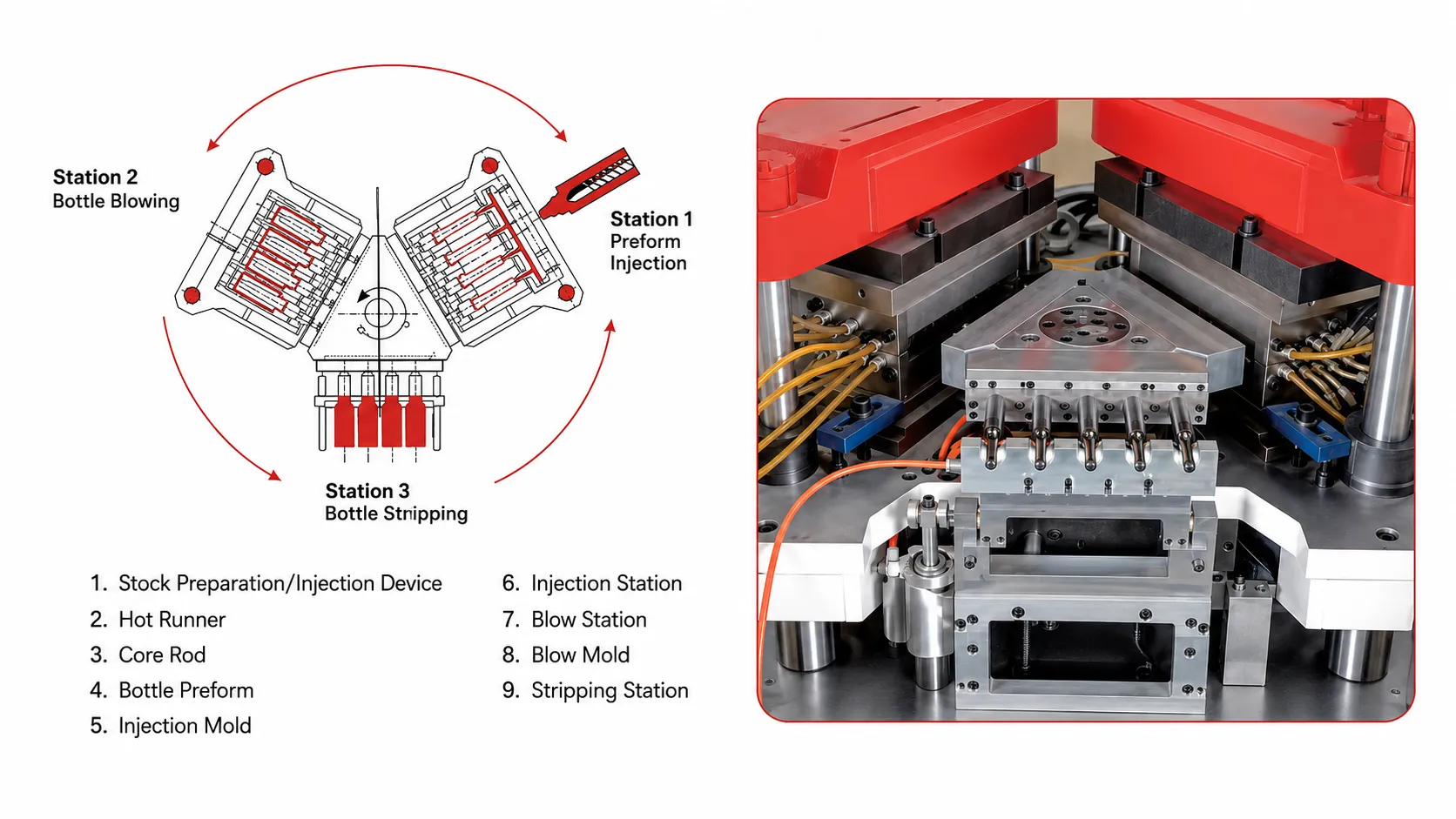
IBM operating principle — preform injection around a core rod, then air inflation at the blow station; no stretch rod, no biaxial orientation.
Type 3 — Injection Stretch Blow Moulding (ISBM)
ISBM adds a mechanical stretch rod to the blow station. Before high-pressure air expands the preform radially, the stretch rod extends it axially to 2.5–3.5 times its injection length. The simultaneous axial stretch and radial blow produce biaxial molecular orientation — the defining feature that gives ISBM containers their glass-like clarity, light weight, and structural strength. ISBM is the process of choice for PET water bottles, CSD bottles, pharmaceutical oral dose containers, cosmetic PETG flacons, and edible oil containers.
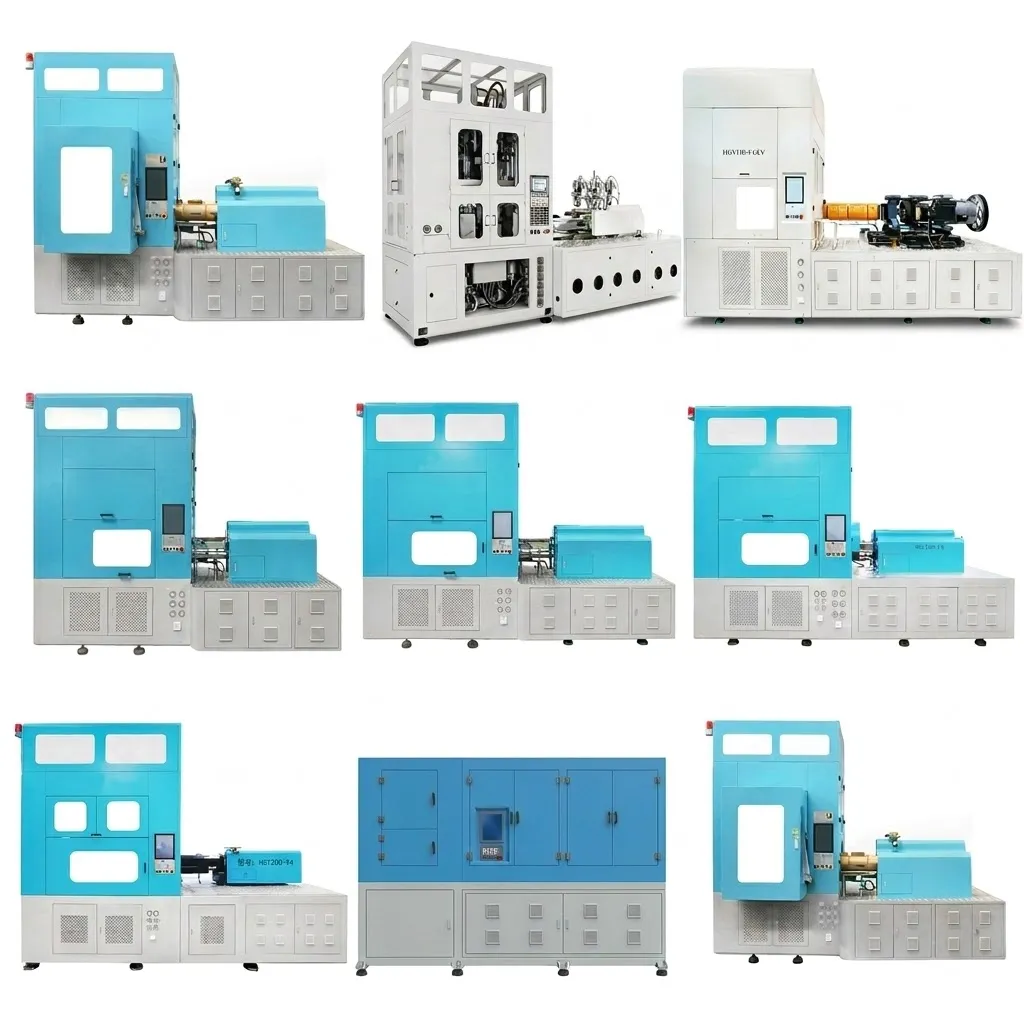
Container range from ISBM — from 30 ml pharmaceutical vials to 10-litre edible oil containers, all produced with biaxial molecular orientation.
Side-by-Side Comparison
| Атрибут | EBM | IBM | ISBM |
|---|---|---|---|
| Intermediate | Extruded parison | Injected preform on core rod | Injected preform on mandrel |
| Stretch rod | No | No | Yes |
| Orientation | Жоден | Жоден | Біаксіальний |
| Typical resins | HDPE, PP, LDPE | HDPE, PP, PC | PET, PP, PETG, PC |
| Size range | Small to very large | 5–500 ml | 30 ml–10 L |
| Clarity | Low | Помірний | Glass-clear (>90%) |
Need to identify the right blow moulding process for your container?
Ever-Power supplies both IBM and one-step ISBM machines. Send your container specification and we will confirm the right process and machine model within 24 hours.
Explore the full one-step ISBM machine range, or review варіанти нестандартних форм for your bottle format.
Часті запитання
Which type is best for PET water bottles?
ISBM is the correct process for PET water bottles at all volumes. Biaxial orientation gives PET water bottles their glass-like clarity, light weight (8–10 g for 500 ml), and structural strength. EBM cannot process PET economically, and IBM produces unoriented PET with insufficient clarity for beverage applications.
Is ISBM the same as stretch blow moulding (SBM)?
The terms overlap. SBM or RSBM typically refers to two-step reheat stretch blow moulding, where preforms made separately are later reheated and blown. ISBM specifically refers to the one-step integrated process. Both produce biaxially oriented containers; the difference is whether the preform is made in the same machine (ISBM) or a separate machine (RSBM).
Can one machine perform all three types of blow moulding?
No. EBM, IBM, and ISBM are mechanically distinct processes requiring purpose-built machines. An EBM machine uses a continuous extruder; an IBM machine uses a core rod rotating table; an ISBM machine uses a mandrel rotating table with a stretch rod at the blow station. The three cannot be combined in a single machine platform.
Resin Compatibility: How Each Type Handles Different Materials
EBM works best with resins that extrude as a continuous melt without sagging — HDPE, LDPE, and PP, whose long molecular chains provide the melt strength needed to support a hanging parison. PET is almost never processed by EBM because its narrow orientation temperature window makes parison extrusion impractical at commercial production rates. IBM processes HDPE and PP predominantly; the core rod limits IBM to relatively short, wide containers because the core rod becomes structurally compromised at high L/D ratios. ISBM, by contrast, uses a separate mandrel for preform transfer — not a core rod remaining in contact during blowing — which allows it to handle a much wider range of preform geometries including tall, slender pharmaceutical bottles.
Capital Cost Comparison Across the Three Types
Machine capital cost varies significantly across the three types at equivalent output capacity. EBM machines for small HDPE containers are typically the least expensive entry point, often available at USD 20,000–80,000. IBM machines for pharmaceutical vials range from USD 30,000–120,000. One-step ISBM machines start at approximately USD 50,000 for compact 3-station models and range to USD 350,000 and above for large-format 4-station servo-hydraulic machines. All three types require additional investment in matched moulds and process ancillaries (compressor, chiller, dryer) beyond the machine price. When comparing total investment across types, include tooling and ancillaries in the comparison — a lower machine price may be offset by higher tooling cost or more complex ancillary requirements.
Application Decision Framework
A practical decision framework for selecting among the three types of blow moulding: if the container is HDPE, large (above 5 litres), or has an integral handle, start with EBM. If it is a small pharmaceutical vial or HDPE dropper bottle where neck precision is paramount, start with IBM. If the container is PET, requires high clarity or light weight, or will be filled with a liquid product (water, beverage, oil, pharmaceutical liquid), start with ISBM. If in doubt, specify the container’s resin, volume, neck finish, required clarity, and fill temperature to an application engineer at Ever-Power — these five parameters almost always resolve the process selection question unambiguously and without additional cost or delay.
The Historical Development of Blow Moulding Types
Understanding how the three types of blow moulding developed historically helps clarify why each occupies its current application niche. Extrusion blow moulding (EBM) is the oldest commercial blow moulding process, developed in the 1940s and 1950s primarily for HDPE milk jugs and household chemical containers. Its simplicity — extrude a parison, clamp the mould, blow air, eject — made it the first viable high-volume process for hollow plastic containers. Injection blow moulding (IBM) was developed in the 1960s and 1970s as a solution for pharmaceutical containers where EBM’s neck finish precision was inadequate and the base pinch seam created contamination concerns. ISBM was developed in the 1970s and 1980s, initially to serve the emerging PET carbonated soft drink bottle market where EBM was impractical with PET and IBM could not achieve the required light weight and CO₂ barrier performance.
Each process was developed because the existing processes were unable to serve a specific combination of container requirements. This historical context is useful because it confirms that the three processes are genuinely complementary rather than competitive — each occupies a specific application space defined by the combination of container size, resin, dimensional precision, and performance that it uniquely serves.
One-Step vs Two-Step within ISBM
Within the ISBM category itself, there is a further distinction between one-step and two-step processing. One-step ISBM, which is what Ever-Power’s EP-HGY and EP-BPET machines perform, integrates injection and blow in the same machine and the same thermal cycle — the preform is never cooled to room temperature between injection and blowing. Two-step ISBM (reheat stretch blow moulding, RSBM) separates the injection and blow steps into different machines: preforms are injection-moulded, cooled, stored, and later reheated and blown in a dedicated blow moulder. Two-step processes dominate at very high volumes (major water and CSD brands) where the decoupling of injection and blow cycles enables very high blow moulding throughput; one-step dominates at mid-volumes and in applications where the single thermal cycle reduces contamination risk or enables more complex preform geometries.
Як розпочати процес оцінки постачальників
Для покупців, які вперше стикаються зі закупівлею обладнання для різьблення по металу (ISBM), процес вибору постачальника машин та прес-форм може здатися складним. Практичною відправною точкою є не короткий список постачальників, а чітка специфікація контейнера: визначте об'єм пляшки, обробку горловини, смолу, цільову вагу, необхідну продуктивність та будь-які вимоги до конкретного застосування (фармацевтична GMP, гаряче розлив, сумісність з чистими приміщеннями), перш ніж звертатися до будь-якого постачальника. Маючи повну специфікацію контейнера, ви можете отримати змістовні та порівнянні цінові пропозиції від кількох постачальників, оскільки кожна цінова пропозиція буде базуватися на однакових технічних даних.
Передпродажний процес Ever-Power починається з технічного огляду специфікації контейнера клієнта. Наша команда інженерів-практиків оцінює специфікацію на відповідність нашому модельному ряду машин, рекомендує відповідну модель (кількість станцій, зусилля затискання, система приводу) та надає попередню оцінку доцільності виготовлення прес-форми — все це безкоштовно та зазвичай протягом 24–48 годин після отримання специфікації. Ця попередня оцінка дозволяє покупцям зрозуміти ймовірну конфігурацію машини та прес-форми, а також пов'язані з ними інвестиції, перш ніж розпочати детальний процес складання цінової пропозиції.
Повний асортимент продукції ISBM від Ever-Power
Повний асортимент одноступеневих машин ISBM від Ever-Power охоплює всі основні сфери застосування у виробництві фармацевтичної, косметичної, харчової, напойної та промислової тари:
| Модель | Станції | Затиск (кН) | Діапазон контейнерів | Диск |
|---|---|---|---|---|
| EP-HGY50-V3-EV | 3 | 50 | 30–500 мл | Повний сервопривід |
| EP-HGY150-V4 | 4 | 150 | 100 мл–2 л | Сервогідравлічний |
| EP-HGY150-V4-EV | 4 | 150 | 100 мл–2 л | Повний сервопривід |
| EP-HGY200-V4 | 4 | 200 | 200 мл–3 л | Сервогідравлічний |
| EP-HGY200-V4-B | 4 | 200 | 200 мл–3 л (ручка) | Сервогідравлічний |
| EP-HGY250-V4 | 4 | 250 | 500 мл–5 л | Сервогідравлічний |
| EP-HGYS280-V6 | 6 | 280 | Складні форми | Сервогідравлічний |
| EP-HGY650-V4 | 4 | 400 | 2–10 л | Сервогідравлічний |
| EP-BPET-70V4 | 4 | 200 | 500 мл–3 л (ПЕТ) | Сервогідравлічний |
| EP-BPET-94V3 | 3 | 250 | 1–5 л (ПЕТ) | Сервогідравлічний |
| EP-BPET-125V4 | 4 | 400 | 5–10 л (ПЕТ) | Сервогідравлічний |
Щоб переглянути повні технічні характеристики кожної моделі, відвідайте Сторінки продуктів EP-HGY та EP-BPETЩоб отримати інструкції щодо конкретного застосування, зверніться до нашої команди за адресою isbmmolding.com/contact-us або надішліть електронного листа на адресу [email protected]. Ми відповідаємо протягом 24 годин на всі технічні запити.
One-Step vs Two-Step ISBM: A Fourth Consideration
Within the ISBM category itself, there is a further distinction between one-step and two-step (reheat) ISBM. One-step ISBM — the process used by Ever-Power’s EP-HGY and EP-BPET series — performs injection, conditioning, stretch, and blow in a single integrated machine. The preform goes from resin pellets to finished bottle without ever leaving the machine or losing its initial thermal energy.
Two-step ISBM, also called reheat stretch blow moulding (RSBM), separates the process into two distinct machines. A preform injection moulding machine produces preforms that are cooled, stored, and then conveyed to a separate reheat blow moulding machine where they are reheated and blown. Two-step is the dominant technology for very high-volume commodity beverage production — large CSD and water bottling plants — because it allows very high output rates by decoupling the injection and blow cycle times. One-step is preferred for pharmaceutical, cosmetic, food, and mid-volume beverage applications because it eliminates preform storage and handling, reduces contamination risk, and requires a simpler capital structure.
Selecting the Right Type for Your Application
The most common buyer error when specifying blow moulding equipment is selecting a machine type based on familiarity or price rather than application fit. A buyer who processes HDPE for household cleaning product bottles may be accustomed to EBM, but switching to PET cosmetic flacons requires a completely different machine type — ISBM — with different mould tooling, different resin handling, and different process parameters. Similarly, a pharmaceutical producer who has used IBM for small HDPE dropper bottles and wants to move to 1-litre PET bottles for oral nutritional supplements needs to understand that IBM does not produce the biaxial orientation or clarity that PET requires in that application — the correct machine is an ISBM.
The rule of thumb: if the container is PET or PETG and requires clarity, light weight, and structural strength, the process is ISBM. If the container is small HDPE or PP and requires neck precision without orientation, the process is IBM. If the container is large, uses a handle, or is made from HDPE at high volume, the process is EBM.