How to start a PET bottle production business?
Starting a PET bottle production business — whether as a standalone contract moulding operation, or as in-house bottle production for an existing filling or packaging business — requires a clear understanding of the capital investment involved, the technical requirements of one-step ISBM production, and the market volume needed to make in-house production economically viable. This guide covers every step from initial market assessment to first commercial production.
Step 1: Market Assessment and Volume Validation
Before any equipment is specified or purchased, validate that your planned production volume justifies the investment. The key calculation is: compare the total annual cost of in-house production (machine amortisation + mould depreciation + resin + energy + labour + maintenance) with the total annual cost of purchasing containers from a supplier. In-house production becomes economically superior when the in-house cost per container is below the purchased container price, which typically occurs at annual volumes above 500,000–1,000,000 bottles per format for pharmaceutical and cosmetic applications, and 1,000,000–3,000,000 for water and food containers where purchased prices are more competitive.
If you are starting a contract moulding business to supply other companies’ packaging needs, assess the market demand in your region for the container types you plan to produce. Pharmaceutical and cosmetic sectors typically pay higher per-unit prices than commodity beverage sectors, but require stricter quality certifications and supply chain requirements. Industrial and agrochemical sectors have high volume but lower per-unit margins. Define your target sector before specifying equipment.
Step 2: Select the Right Machine Type
For PET bottle production, the correct machine type is a one-step injection stretch blow moulding (ISBM) machine. Do not confuse this with a standard injection moulding machine (which produces solid parts or preforms, not finished bottles) or an extrusion blow moulding machine (which processes HDPE, not PET, for most applications). A one-step ISBM machine converts PET resin pellets into finished bottles in a single integrated cycle — no preform storage, no second machine, no reheating energy cost.
Machine selection is driven by the container volume range you plan to produce. Ever-Power’s EP-HGY range covers:
| Діапазон контейнерів | Recommended Model | Система приводу |
|---|---|---|
| 30–500 ml pharmaceutical & cosmetic | EP-HGY50-V3-EV | Повний сервопривід |
| 100 ml–2 L water, pharma, food | EP-HGY150-V4 / V4-EV | Сервогідравлічний / Повний сервопривід |
| 200 ml–3 L beverage, food, cosmetic | EP-HGY200-V4 | Сервогідравлічний |
| 500 ml–5 L edible oil, food | EP-HGY250-V4 | Сервогідравлічний |
| 2–10 L industrial, agrochem | EP-HGY650-V4 | Сервогідравлічний |
Step 3: Budget for the Complete Capital Investment
The machine purchase price is the largest single line item but not the only capital requirement. A complete PET bottle production line for one container format requires:
- ISBM machine: USD 50,000–350,000 depending on model and drive system
- Набір форм на замовлення (preform mould + blow mould + stretch rod): USD 15,000–80,000
- Компресор високого тиску (blow air at 25–40 bar): USD 8,000–25,000
- Адсорбційна сушарка (PET moisture below 50 ppm): USD 4,000–12,000
- Чилер (blow mould cooling at 8–12 °C): USD 5,000–15,000
- Conveyor and accumulation table: USD 3,000–15,000
- QC inspection equipment (bottle gauge, weight scale, wall thickness): USD 2,000–10,000
Total first-format investment: approximately USD 90,000–500,000 depending on machine model and mould complexity. Additional formats require only a new mould set (USD 15,000–80,000 each) on the same machine.
Step 4: Define Facility Requirements
An ISBM production cell requires: floor space of approximately 20–40 m² for the machine, dryer, compressor, and chiller; ceiling height of at least 3.5 m for machine loading and maintenance access; 3-phase electrical supply at 380–415 V (confirm specific voltage with Ever-Power for your country); and a clean, dry production environment (temperature-controlled at 20–30 °C for stable PET processing and resin moisture control). For pharmaceutical applications, the production area must meet the cleanroom classification required by the applicable regulatory standard — typically ISO 8 (Class 100,000) as a minimum for non-sterile pharmaceutical primary packaging.
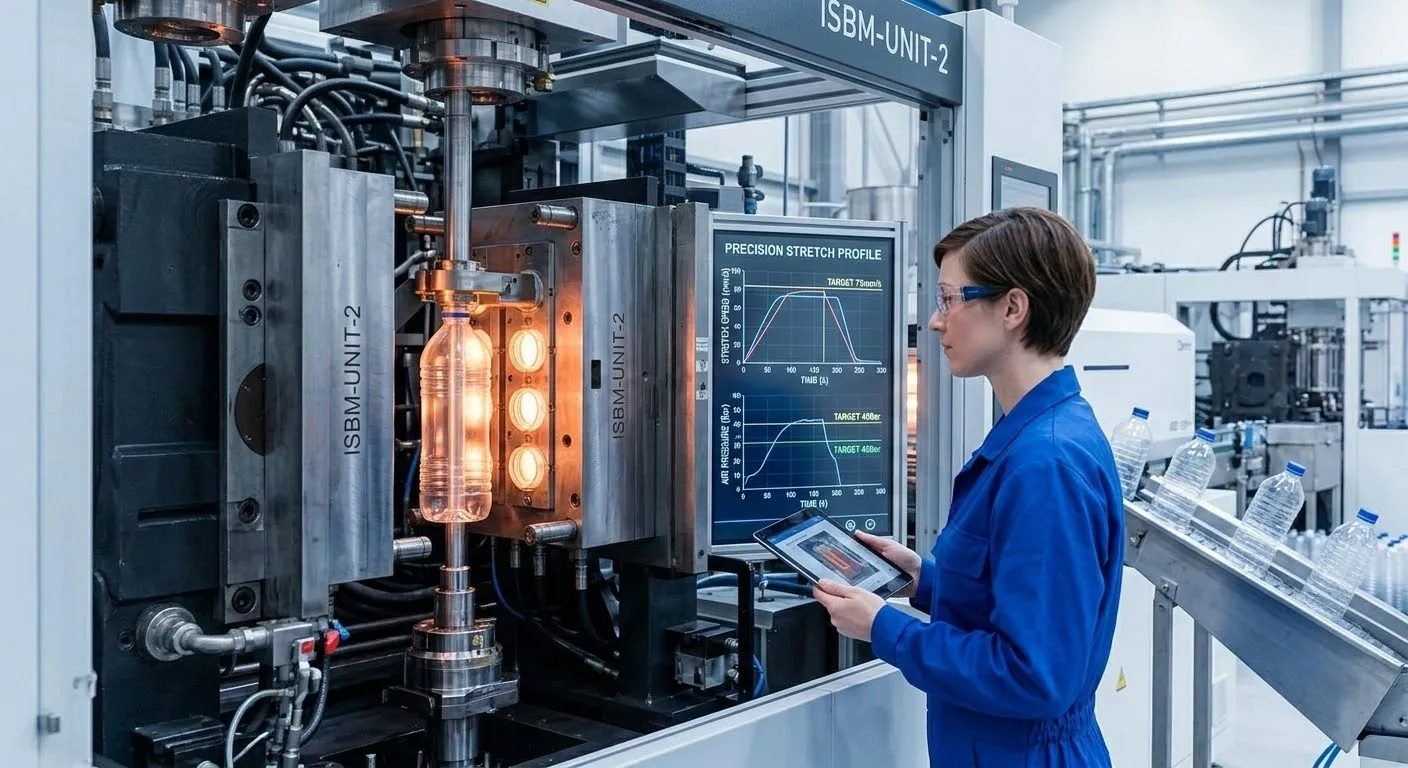
An ISBM production facility — the machine, dryer, compressor, and chiller are compact enough for a 30–40 m² production cell, making in-house PET bottle production accessible at mid-volume scale.
Step 5: Order Machine and Mould Together
Order the machine and mould set from the same supplier whenever possible. This eliminates the interface compatibility risk that arises when a mould from one supplier is fitted to a machine from another, and provides a single point of accountability for first-article bottle quality. Submit your final bottle drawing (with dimensions, wall thickness distribution, and closure specification) to the supplier when placing the order so the preform and blow mould can be designed concurrently with machine manufacture. Allow 90–150 days from order to factory acceptance test for machine manufacture, with mould manufacture running in parallel.
Step 6: Commissioning, Training, and First Production
Commissioning typically takes 3–7 days and covers: machine installation and electrical connection; ancillary equipment connection and verification; mould installation and first-article trial; process parameter development for your specific bottle (injection temperature profile, conditioning heater settings, stretch rod timing, blow pressure, blow timing); and first-article bottle quality verification against specification. Operator training runs concurrently and covers machine operation, quality inspection routines, routine maintenance, and troubleshooting protocols. After commissioning sign-off, the machine is ready for commercial production. Ever-Power includes full commissioning and operator training as standard in the EP-HGY purchase price.
Ready to start planning your PET bottle production business?
Ever-Power can prepare a complete capital investment estimate, production cost model, and machine recommendation for your specific container and volume. Contact our applications team to begin the planning process.
Дивіться full EP-HGY machine rangeабо огляд варіанти нестандартних форм to understand the complete tooling investment for your first container format.
Часті запитання
Do I need a special licence to produce pharmaceutical PET bottles?
Requirements vary by market. In most regulated markets (EU, USA, Brazil ANVISA, South Korea MFDS), producing pharmaceutical primary packaging requires compliance with applicable Good Manufacturing Practice (GMP) standards and may require facility registration or inspection by the relevant regulatory authority. The specific requirements depend on whether you are the pharmaceutical manufacturer producing containers for your own products, or a contract moulding supplier providing containers to pharmaceutical companies. Consult your local regulatory authority or a regulatory affairs advisor before committing to pharmaceutical bottle production.
How long before an ISBM investment pays back?
For a producer replacing purchased containers with in-house production, payback is typically 18–36 months at commercial production volumes. The payback calculation is: total annual saving (purchased container price minus in-house production cost, times annual volume) divided by total capital investment. At higher purchased container prices (pharmaceutical and cosmetic sectors) and higher annual volumes, payback periods are shorter. Ever-Power can calculate the payback period for your specific bottle and purchased container price as part of the pre-sale consultation.
Can one ISBM machine produce multiple different bottle formats?
Yes. A single ISBM machine can produce as many different bottle formats as you have mould sets for, within the machine’s clamp force and platen size limits. Changing from one bottle format to another requires a mould changeover (typically 1–2 hours) and reloading the saved process recipe for that format. Most commercial ISBM operations run 3–10 different formats on the same machine over a production schedule, balancing changeover time against the batch volume for each format.
Regulatory Compliance for PET Bottle Production
Depending on the market and application you are targeting, PET bottle production may be subject to regulatory requirements beyond standard manufacturing quality standards. Pharmaceutical primary packaging requires GMP compliance and may require facility registration with the applicable regulatory authority (FDA in the USA, EMA in the EU, ANVISA in Brazil, MFDS in South Korea). Food-contact packaging must comply with applicable food-contact material regulations, which vary by territory and typically include restrictions on specific additives and migration limits for any substances that could transfer from the packaging into the food or beverage.
For water bottles specifically, the container must comply with the food-contact material regulations of every country where the bottled water is sold. In the EU, this is governed by Regulation (EC) No 1935/2004 and applicable specific measures; in the USA, by FDA 21 CFR Part 177; in Brazil, by ANVISA’s applicable resolution for plastic packaging materials. PET resin manufacturers supply compliance documentation (certificates of conformity, migration test data) for their grades, and ISBM machine operators must maintain records showing that production conditions (drying, melt temperature, residence time) do not compromise the resin’s food-contact status. Ever-Power can advise on the production documentation requirements for food-contact and pharmaceutical PET bottle production as part of the machine commissioning programme.
Staff and Operator Requirements for an ISBM Operation
A one-step ISBM production operation requires skilled operators who understand both injection moulding and blow moulding process principles — since the one-step machine integrates both. The minimum staffing for a commercial ISBM installation is typically: one trained ISBM operator per shift (machine operation, quality inspection, routine maintenance); one process engineer or technician who can adjust parameters, investigate quality deviations, and manage mould changeovers (this may be a shared resource across multiple shifts or machines rather than a dedicated per-shift role); and a maintenance engineer or technician for planned preventive maintenance activities (cleaning, O-ring replacement, wear part inspection). For pharmaceutical applications, a quality assurance representative for batch release and process monitoring adds to the staffing requirement.
Operator training is a significant investment that is often underestimated by first-time ISBM buyers. An operator with no prior ISBM experience typically requires 2–4 weeks of supervised production time to become independently competent at machine operation and quality inspection. Process engineering capability — the ability to diagnose and correct quality deviations by adjusting process parameters — requires 3–6 months of practical experience on the specific machine and bottle formats in production. Ever-Power provides initial operator training during the commissioning process (typically 3–5 days) and can recommend further training resources for operators who need additional development before full independent operation.