ISBM வார்ப்புச் செயல்முறையில் உள்ள படிநிலைகள் யாவை?
The ISBM moulding process — injection stretch blow moulding — converts raw plastic resin into a finished hollow container through a precisely sequenced series of steps. Each step occurs at a dedicated station on the machine’s rotary table, and all stations operate simultaneously on different preforms within the same machine cycle. Understanding what happens at each step, and what controls quality at each point, is essential for anyone operating or specifying ISBM equipment.
Overview: How Many Steps Does ISBM Have?
A one-step ISBM machine performs between three and six steps depending on its station count. Three-station machines perform the minimum required steps — injection, stretch-blow, and ejection. Four-station machines add a dedicated conditioning step. Six-station machines further add post-blow cooling and a second conditioning zone. All configurations produce the same type of finished container; the additional stations enable more precise control over complex bottle geometries and higher cycle speeds.
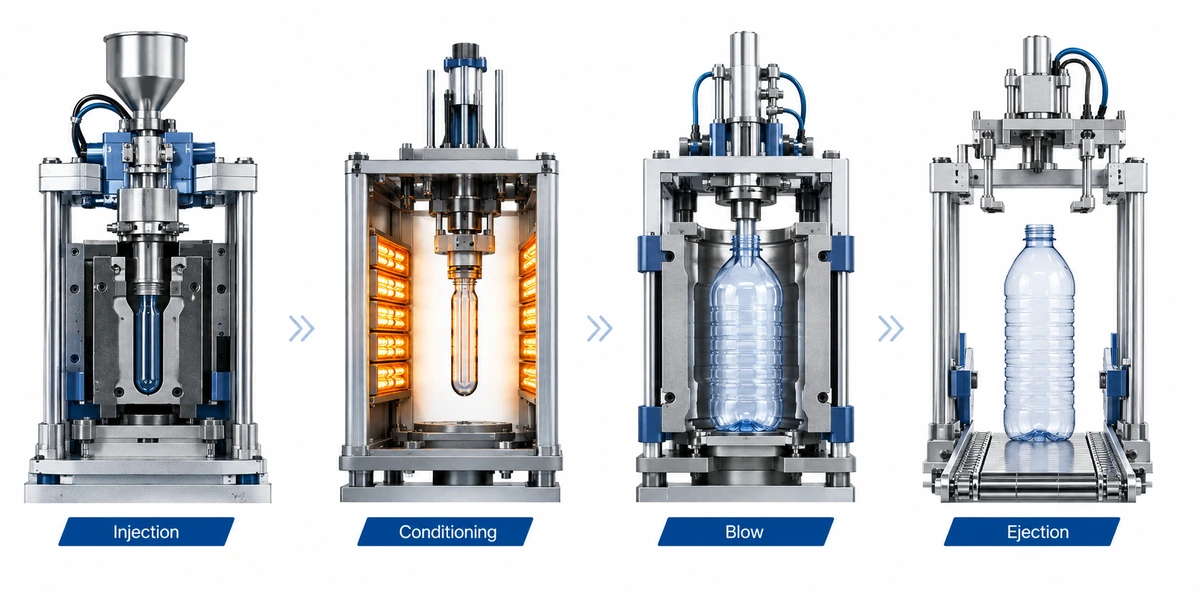
4-station ISBM rotary table — all four steps run simultaneously on different preforms within each machine cycle.
Step 1: Resin Drying and Preparation
Before any ISBM cycle begins, the resin must be prepared correctly. PET — the dominant resin in ISBM production — is hygroscopic: it absorbs moisture from the air. Moisture in the resin causes hydrolytic degradation during processing, reducing intrinsic viscosity (IV) and producing acetaldehyde (AA), a compound that creates off-flavour in food and beverage containers.
Standard PET drying: desiccant dryer at 160–170 °C, minimum 4–6 hours, target moisture below 50 ppm. The dryer’s dew point should be verified at −40 °C or below before processing begins. This step happens upstream of the machine and is not part of the machine cycle itself, but it determines the quality of every bottle the machine produces.
Step 2: Injection — Forming the Preform
The first in-machine step is injection moulding. Dried resin is fed from the hopper into a heated barrel where a reciprocating screw melts and conveys it. The melt — at 270–295 °C for standard PET — is injected at high pressure into the preform mould cavity, forming the thick-walled intermediate tube known as a preform.
Key parameters controlled at this step:
- Melt temperature — 270–295 °C for PET; too high degrades IV and generates AA; too low causes short shots and surface defects
- Injection speed and pressure — determines fill time and packing; insufficient packing causes gate sink and dimensional inaccuracy at the neck finish
- Cooling time in mould — the preform must cool to ejection temperature (60–75 °C) before the mould opens; insufficient cooling causes preform distortion on ejection
- Clamping force — must hold the mould closed against injection pressure; insufficient clamp causes flash on the preform parting line
The injection step is the longest single operation in the ISBM cycle, which is why it occupies a dedicated station regardless of total station count. On the EP-HGY series, injection clamping forces range from 50 kN (EP-HGY50-V3-EV) to 400 kN (EP-HGY650-V4), covering container volumes from 30 ml to 10 litres.
Step 3: Conditioning — Temperature Profile Adjustment (4-Station and 6-Station Only)
On 4-station and 6-station machines, the preform — still on the mandrel — transfers to a conditioning station after ejection from the preform mould. Here, infrared heaters adjust the preform’s axial temperature profile before it reaches the blow station.
PET can only be biaxially oriented within a narrow temperature window: above its glass transition temperature (Tg ≈ 75 °C) but below its crystallisation onset temperature (≈130–140 °C). The conditioning station brings the preform body to 90–115 °C while keeping the neck zone cool (the neck must not deform during blowing).
Individual infrared heater zones can be adjusted independently to concentrate heat at the base zone, shoulder zone, or body zone — allowing the operator to control where material flows preferentially during the blow step. This is what enables complex bottle geometries: wide bases, pronounced shoulders, contoured grips, and integrated handles.
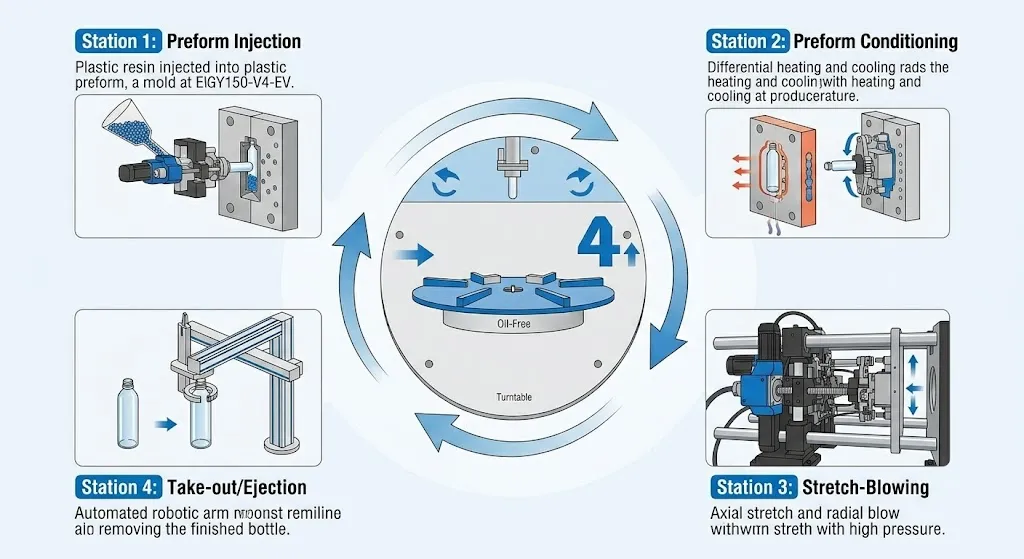
4-station ISBM process sequence on the EP-HGY150-V4-EV — each station operates simultaneously, so conditioning time equals injection time.
Step 4: Stretch — Axial Extension by the Stretch Rod
At the blow station, the mould closes around the preform. A mechanical stretch rod descends into the preform and contacts its base, then extends axially — pushing the base downward at a controlled speed (typically 1–2 m/s). This extends the preform to 2.5–3.5 times its injection length.
The stretch step is what separates ISBM from standard injection blow moulding (IBM). In IBM, there is no stretch rod and no axial orientation — the preform is simply inflated by air pressure. In ISBM, the mechanical stretch rod produces axial molecular orientation before air expansion begins, which is the primary reason ISBM bottles are stronger, clearer, and lighter than IBM bottles at equivalent volumes.
Step 5: Blow — Radial Expansion Against the Mould
Simultaneously with or immediately after the stretch rod extension, high-pressure air (25–40 bar) is introduced through the stretch rod or a separate blow pin. This air pressure expands the preform radially — outward — against the walls of the closed blow mould.
The combination of axial stretching (Step 4) and radial blowing (Step 5) produces biaxial molecular orientation — polymer chains aligned in both the axial and hoop directions simultaneously. This dual orientation is what gives ISBM bottles their characteristic properties:
- Tensile strength up to 3 times higher than unoriented PET at the same wall thickness
- Glass-like optical clarity, with light transmittance above 90%
- CO₂ barrier performance sufficient for carbonated soft drink applications
- Drop impact resistance to 1.5 m when filled
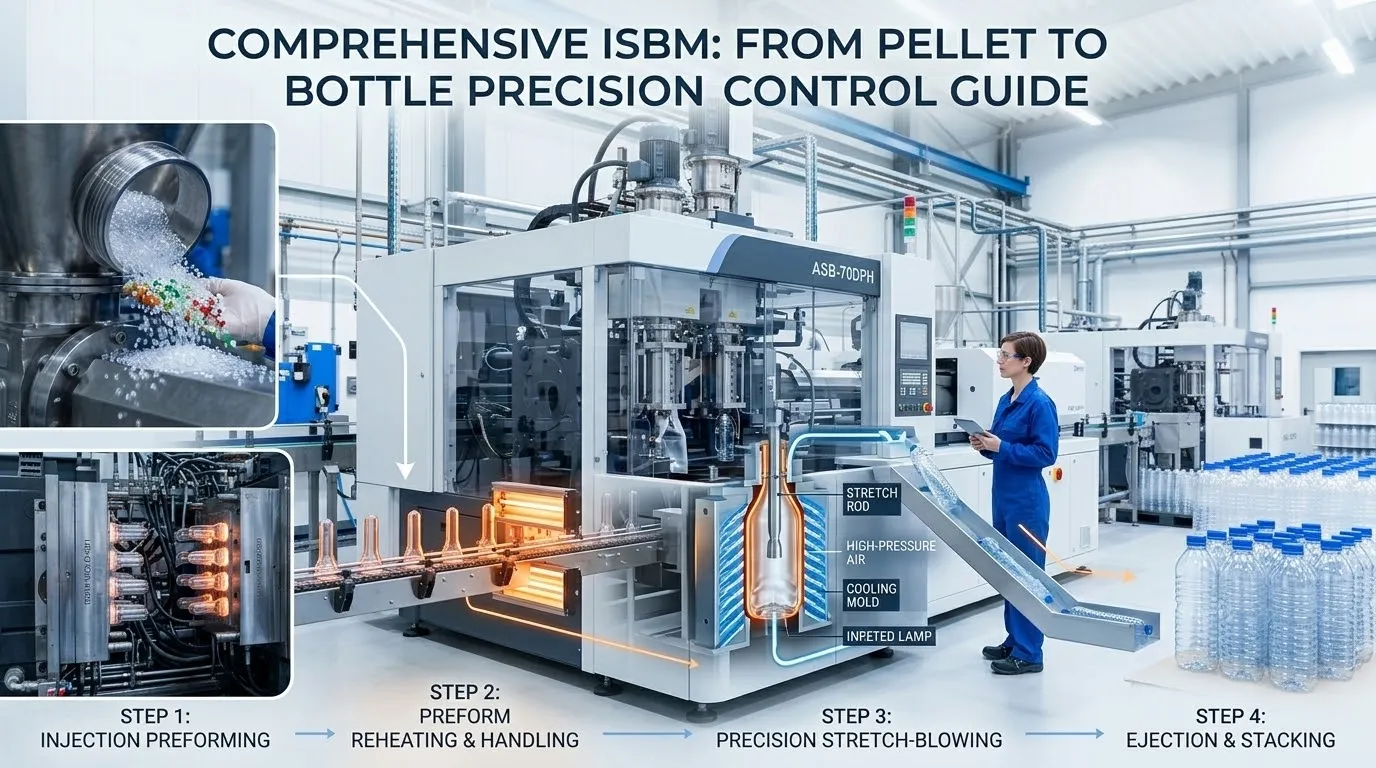
Complete ISBM process parameter map — from resin drying through each station to the finished bottle, with critical control points at each step.
Step 6: Cooling — Freezing the Orientation in Place
After blowing, the bottle is held against the mould wall while the mould removes heat through its internal cooling circuit. Standard blow moulds run chilled water at 8–12 °C. The bottle must cool below its relaxation temperature — typically below 60 °C at the wall surface — before the mould opens, or it will shrink and distort on ejection.
For hot-fill applications (juice, tea, isotonic beverages filled at 85–95 °C), the blow mould runs at 100–120 °C instead of the standard cold temperature. This elevated mould temperature allows limited crystallisation of the PET at the bottle wall during blowing — a process called heat-setting — which gives the bottle thermal stability at fill temperature.
Step 7: Ejection — Finished Bottle Removal
The mould opens and the finished bottle is released from the mandrel. On 3-station and 4-station machines, ejection occurs at the final indexed position before the table rotates back to inject the next set of preforms. On 6-station machines, a dedicated post-blow cooling station between blow and ejection allows the mould to open sooner (shorter blow hold time) while the bottle completes its cooling on the mandrel before ejection, enabling faster overall cycle times without dimensional instability.
From ejection, bottles pass to a conveyor and accumulation table, and then to downstream filling, capping, labelling, and palletising equipment.
Process Step Summary
| Step | Operation | Station | Key Control Parameter |
|---|---|---|---|
| 1 | Resin drying | Upstream | Dryer temp 160–170 °C, dew point −40 °C |
| 2 | ஊசி | Station 1 (all) | Melt temp 270–295 °C, clamp force, pack pressure |
| 3 | Conditioning | Station 2 (4- & 6-station) | IR heater zone temps, preform body target 90–115 °C |
| 4 | Stretch | Blow station | Rod speed, axial ratio 2.5–3.5× |
| 5 | Blow | Blow station | Blow pressure 25–40 bar, pre-blow 6–10 bar, blow time |
| 6 | Cooling | Blow station / post-blow | Mould water temp 8–12 °C (standard) / 100–120 °C (hot-fill) |
| 7 | Ejection | Final station | Ejection timing, conveyor handoff |
Need help optimising your ISBM process parameters?
Ever-Power provides full process documentation and on-site commissioning support for all EP-HGY and EP-BPET installations. Contact our technical team with your bottle specification and resin data.
For full machine specifications covering each station configuration, see the EP-HGY 3, 4 and 6-station ISBM machine range. For mould design that works with each process step, visit the custom ISBM mould page.
அடிக்கடி கேட்கப்படும் கேள்விகள்
How long does one ISBM cycle take?
Cycle time depends on bottle volume, wall thickness, and machine configuration. A 500-ml PET water bottle on a 4-station machine typically cycles in 5–8 seconds. Larger bottles (2–5 litres) may require 10–15 seconds. Since all stations run simultaneously, adding stations does not necessarily increase cycle time — on complex bottles, a 4-station machine can actually be faster than a 3-station because the conditioning station allows shorter injection cooling times.
ஒரு-படி மற்றும் இரு-படி ISBM-க்கு இடையே உள்ள வேறுபாடு என்ன?
In one-step ISBM, all process steps from resin injection to finished bottle ejection occur in the same machine in the same thermal cycle. In two-step ISBM (also called reheat stretch blow moulding), the injection step and the stretch-blow steps are performed in separate machines. Preforms are injected, cooled, stored, and then reheated and blown in a separate blow moulder. One-step is preferred for pharmaceutical, cosmetic, and short-run applications; two-step suits very high-volume commodity production.
Why does ISBM produce clearer bottles than standard injection moulding?
Standard injection moulded PET is amorphous and unoriented — the polymer chains are randomly arranged, which scatters light and produces a hazy or translucent appearance. In ISBM, the simultaneous axial stretch and radial blow align the polymer chains in two directions. This biaxial orientation reduces light scattering and produces the glass-like clarity (above 90% light transmittance) that is characteristic of ISBM-produced PET bottles.
What happens if the stretch ratio is exceeded?
Exceeding the axial stretch ratio (above 3.5× for standard PET) causes stress whitening — a white haze in the over-stretched zone, typically visible at the base or lower sidewall. Exceeding the hoop ratio (above 5.5×) causes sidewall thinning and may produce microcracking or pinholing in the finished bottle. Both defects result from the polymer chains reaching their extensibility limit and beginning to fail rather than orient. The corrective action is to reduce the stretch ratio by adjusting stretch rod travel or pre-blow onset timing.