How many bottles per hour does an ISBM machine produce?
The output rate of a one-step ISBM machine — measured in bottles per hour — depends on four variables that interact with each other: the machine’s cycle time for your specific bottle, the cavity count of the mould set, the bottle volume (which determines how long the blow and cooling steps take), and the station configuration (3-station vs 4-station vs 6-station). Understanding how these variables combine is essential for matching the right machine model to your production requirement before purchase.
How ISBM Output Is Calculated
ISBM output in bottles per hour is calculated from two inputs: cycle time (seconds per cycle) and cavity count (bottles produced per cycle).
Bottles per hour = (3,600 ÷ cycle time in seconds) × cavity count
For example, a 4-station EP-HGY150-V4 running a 500 ml PET water bottle on a 2-cavity mould at a cycle time of 6 seconds produces: (3,600 ÷ 6) × 2 = 1,200 bottles per hour. The same machine with a 4-cavity mould at the same cycle time produces 2,400 bottles per hour. This relationship is linear with cavity count: doubling the cavities doubles the output at constant cycle time.
What Determines Cycle Time
Cycle time is the time from one injection shot to the next. In a one-step ISBM machine, the cycle time is determined by the longest single operation in the machine — typically the injection step, which requires sufficient time for: resin injection (0.5–2 seconds depending on preform weight and cavity count); packing (1–3 seconds to compensate for shrinkage); and cooling in the injection mould (2–8 seconds depending on preform wall thickness). On 4-station machines, the conditioning, blow, and ejection stations all operate in parallel with the injection station, so their durations do not add to the cycle time as long as they complete within the injection station’s time window.
Factors that increase cycle time: larger bottle volume (heavier preform, longer injection and cooling time); thicker preform walls; more cavities per shot (larger total shot volume, longer fill time); and hot-fill applications (blow mould runs hot, requiring longer bottle cooling in the mould before ejection). Factors that decrease cycle time: 6-station configuration (additional post-blow cooling station allows shorter mould dwell time); optimised conditioning profiles; and reduced preform wall thickness through mould design refinement.
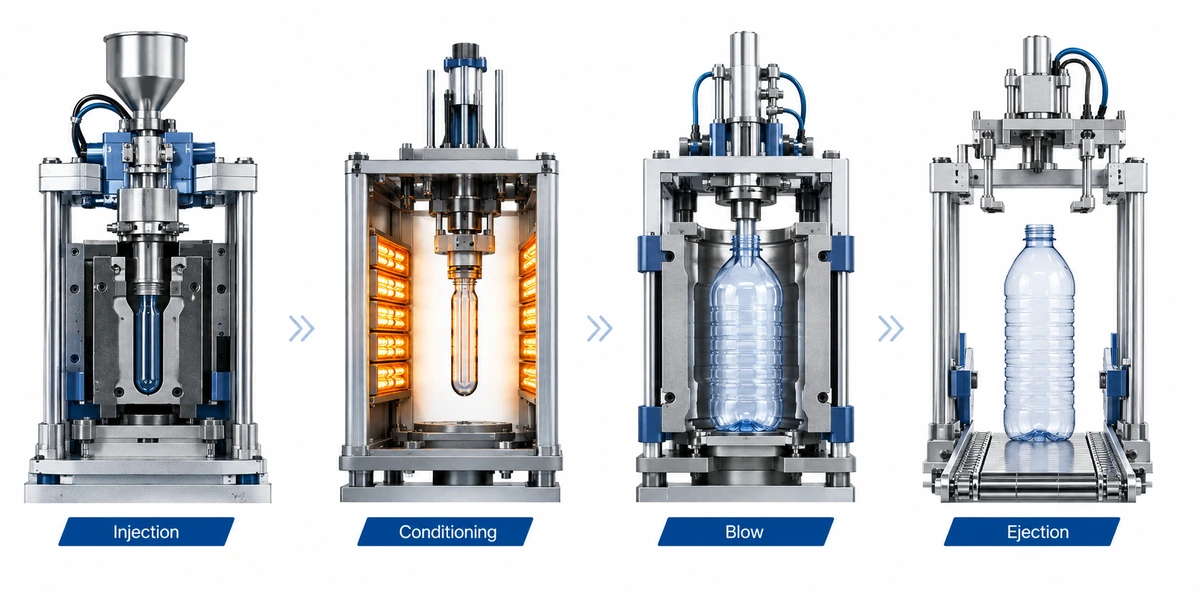
4-station ISBM rotary process — all stations operate simultaneously, so cycle time is determined by the slowest station (typically injection), not the sum of all station times.
Output Rates by Machine Model and Bottle Size
| Maskin | Bottle Volume | Cavities | Cycle Time | Output (bph) |
|---|---|---|---|---|
| EP-HGY50-V3-EV | 100 ml pharma | 2 | 5–7 s | 1,000–1,440 |
| EP-HGY150-V4 | 500 ml water | 2 | 5–7 s | 1,000–1,440 |
| EP-HGY150-V4 | 500 ml water | 4 | 6–8 s | 1,800–2,400 |
| EP-HGY200-V4 | 1 L edible oil | 2 | 8–12 s | 600–900 |
| EP-HGY250-V4 | 5 L container | 1 | 14–20 s | 180–257 |
| EP-HGYS280-V6 | 500 ml complex | 2 | 5–6 s | 1,200–1,440 |
These are illustrative ranges. Actual output depends on the specific preform design, mould cooling efficiency, and process optimisation achieved during commissioning. Always request a guaranteed cycle time for your specific bottle and cavity count from the supplier, confirmed in writing in the purchase contract.
How Cavity Count Affects Output and Investment
Increasing cavity count is the most direct way to increase ISBM output at constant cycle time. However, each additional cavity adds cost to the mould set (each cavity requires additional preform cavity, additional blow cavity, and additional hot runner circuit) and may increase cycle time by adding to the total injection shot volume. The relationship between cavity count and output is approximately linear, but the relationship between cavity count and mould cost is also approximately linear, so the output-per-dollar of mould investment does not improve significantly above 4 cavities for most standard bottle formats.
The practical ceiling for cavity count in one-step ISBM is determined by the machine’s injection unit capacity (maximum shot volume) and the blow station platen size (maximum total mould width for multiple cavities). For small pharmaceutical containers (30–100 ml), 4–6 cavity configurations are common. For larger bottles (500 ml–2 L), 2–4 cavities is the typical range. For very large containers (5–10 L), single-cavity production is standard.
Matching Output to Your Production Requirement
The first step in matching an ISBM machine to your production requirement is calculating the minimum required output in bottles per hour. This is: (annual volume ÷ operating days per year ÷ production hours per day). For example, 3 million bottles per year at 250 operating days and 20 production hours per day requires: 3,000,000 ÷ 250 ÷ 20 = 600 bottles per hour minimum. A 2-cavity EP-HGY150-V4 running 500 ml bottles at 1,000–1,440 bottles per hour provides comfortable headroom above this requirement, allowing for planned maintenance stops and efficiency losses without missing annual production targets.
Always size the machine to 70–80% of rated capacity, not 100%. Running a machine at its absolute maximum rated output 24 hours a day leaves no headroom for format changes, maintenance, and quality checks. A machine sized to 80% of rated capacity at your required output rate will achieve your annual production target reliably while allowing for the operational realities of a packaging production environment.

EP-HGY650-V4 in production — large-format ISBM machine for 2–10 litre containers where single-cavity output is the standard configuration.
Need a guaranteed output rate for your specific bottle and production volume?
Send Ever-Power your bottle drawing, resin, annual volume, and operating schedule. We will recommend the right machine and cavity count with a guaranteed cycle time committed in the purchase contract.
Browse the full EP-HGY and EP-BPET machine range with output specifications, or explore mould options for different cavity counts.
Vanliga frågor
Can I increase output on my existing ISBM machine?
The two ways to increase output on an existing machine are: adding cavities (ordering a new mould set with more cavities, subject to the machine’s injection unit and platen size limits); and reducing cycle time (through process optimisation — reducing cooling time in the injection mould, optimising conditioning temperature profiles, and adjusting blow timing). Reducing cycle time requires careful process development to confirm that bottle quality is maintained at the faster cycle. Adding cavities requires confirming that the machine’s injection unit can deliver adequate shot weight and that the blow station platen has sufficient space for the wider mould.
Is ISBM output sufficient for a filling line?
For most pharmaceutical, cosmetic, food, and industrial filling lines, one-step ISBM output (typically 600–4,000 bottles per hour for a single machine) is well matched to the filling line speed. Pharmaceutical filling lines for liquid oral dosage forms typically run at 50–500 bottles per minute (3,000–30,000 per hour), while small-format cosmetic fillers run at 20–200 bpm. For filling lines running faster than the ISBM machine’s output, a bottle accumulation buffer or multiple ISBM machines feeding a single filler is the standard solution.
How is cycle time verified before machine purchase?
Request that the supplier run your specific bottle (or a bottle with equivalent weight and geometry) on the machine model you are evaluating, and log the actual cycle time from the HMI for 60 consecutive cycles. The average and standard deviation of this data is the actual cycle time for your bottle, not a theoretical estimate. Ask for this logged data in writing and request that it be included as a performance guarantee in the purchase contract. Suppliers who cannot or will not provide this level of verification during the evaluation process represent higher risk than those who do.
Output Planning for Multiple Container Formats
Many ISBM operations produce multiple container formats on the same machine by changing the mould set between production runs. When planning output across multiple formats, the total annual output capacity of the machine must be allocated among all formats, accounting for production time lost during mould changeovers. A mould changeover on a modern ISBM machine typically takes 1–2 hours. If a machine runs five different formats per week with one changeover each, the weekly changeover downtime is 5–10 hours — approximately 10–20% of a 50-hour week. This changeover allowance must be factored into the production schedule when calculating whether a single machine can meet the combined annual volume across all formats.
For operations with high format variety and moderate volumes, a single ISBM machine with multiple mould sets is the most capital-efficient solution. For operations with a single high-volume format and moderate variety, a dedicated machine per format may be justified. Ever-Power can prepare a multi-format production plan for your specific mix of container volumes and annual production targets, identifying the minimum number of machines and mould sets required to meet all formats reliably within your production schedule.
Comparing ISBM Output to Alternative Container Supply Options
Before committing to in-house ISBM production, it is worth comparing the output economics of the machine against the alternative of purchasing containers from a contract blow moulder. The comparison hinges on two numbers: the purchased container price per unit and the in-house production cost per unit. In-house production cost per unit includes resin cost, energy cost, operator cost, machine amortisation, mould depreciation, and maintenance cost, divided by the number of bottles produced per shift.
For most pharmaceutical, cosmetic, and specialty food applications at volumes above 500,000 bottles per year per format, in-house ISBM production delivers a lower cost per container than purchasing, because it eliminates the contract moulder’s margin, overhead, and logistics cost. The crossover point — where in-house production becomes cheaper than purchasing — depends on the specific container price and volume, and can be calculated precisely with the inputs above. Ever-Power provides this cost comparison as part of the pre-sale consultation for any EP-HGY installation.