ISBM Operational Excellence and Sustainability
Como uma máquina ISBM melhora a eficiência energética e a produção?
A comprehensive engineering analysis of thermal continuity, servo-electric actuation, and integrated process architecture that delivers transformative reductions in energy consumption while maximizing container throughput.
The Dual Imperative: Energy Efficiency and Maximized Throughput in Modern ISBM
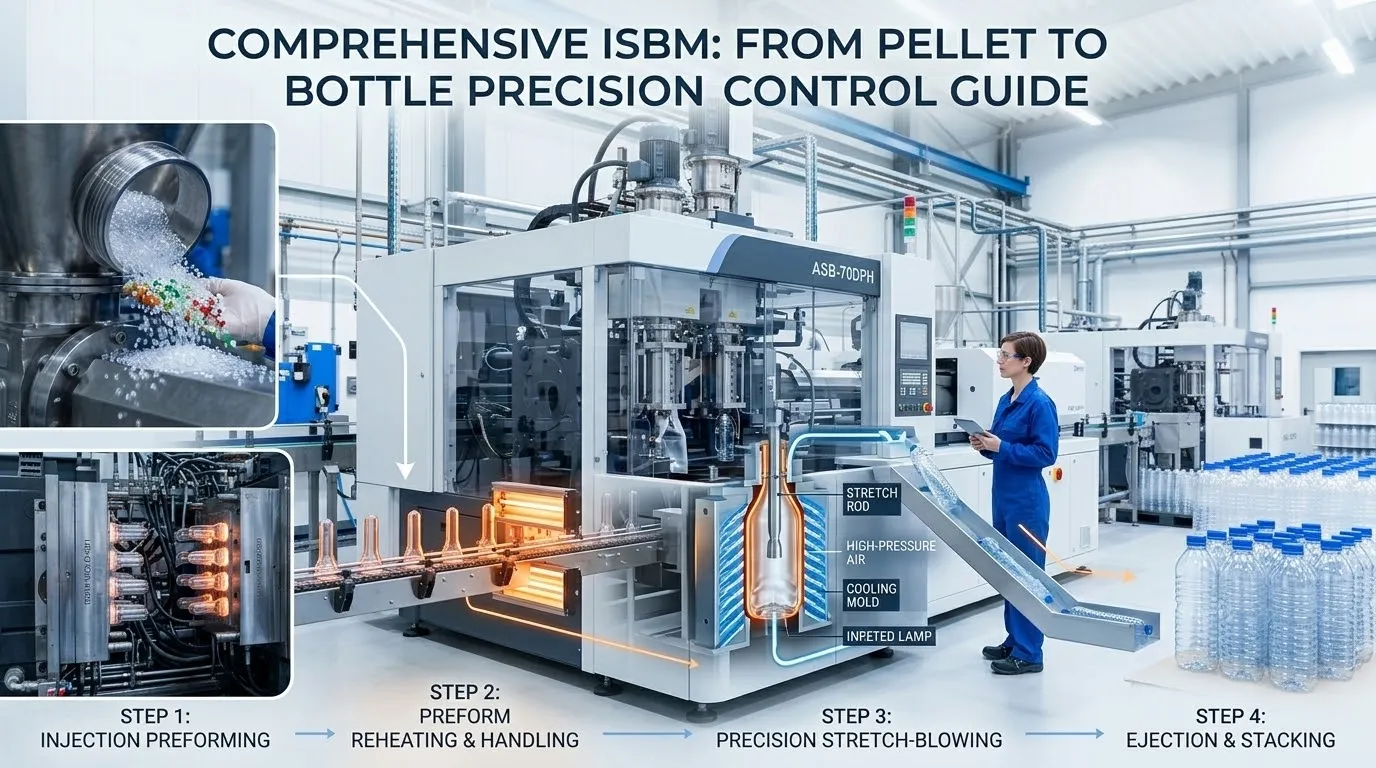
In the competitive landscape of modern PET packaging manufacturing, the simultaneous pursuit of energy efficiency and maximum production output is not a trade-off. It is an engineering synergy that defines the most advanced Injection Stretch Blow Molding machinery. For plant managers, sustainability officers, and manufacturing directors, understanding how an ISBM machine improves energy efficiency and production output is a critical competency that directly impacts operational expenditure, carbon footprint compliance, and market competitiveness. At Ever-Power, a globally recognized Brazilian manufacturer of ISBM equipment, our engineering philosophy is built upon the principle that thermal efficiency and throughput are two sides of the same thermodynamic coin.
The single-stage ISBM process inherently possesses compelling advantages in both energy conservation and production rate when compared to the fragmented two-stage reheat-blow methodology or the less sophisticated extrusion blow molding process. These advantages stem from three interconnected engineering principles: thermal continuity and the utilization of latent heat, the elimination of energy-wasting process fragmentation, and the application of high-precision servo-electric actuation that minimizes waste power consumption while enabling faster, more repeatable cycle times. This comprehensive technical dissertation will deconstruct each of these principles, quantifying their impact on kilowatt-hour consumption per thousand bottles and bottles-per-hour output. We will examine specific Ever-Power machine platforms, including the thermally efficient Máquina de 4 estações EP-HGY150-V4 and the fully electric Máquina servo completa EP-HGY150-V4-EV, to illustrate how these efficiency and throughput gains are achieved in real production environments.
The ability of an ISBM machine to simultaneously reduce energy consumption and increase production output is not merely a matter of incremental improvement over legacy technologies. It represents a step-change in manufacturing economics that can fundamentally alter the viability and profitability of a packaging operation. This guide will equip decision-makers with the engineering knowledge to evaluate and realize these benefits in their own facilities.
Thermal Continuity: The Foundational Energy Efficiency Principle
The single most significant factor in the superior energy efficiency of a single-stage ISBM machine is its exploitation of thermal continuity, avoiding the massive energy penalty of reheating cold preforms.
Latent Heat Utilization Versus the Two-Stage Energy Penalty
In a two-stage ISBM process, the injection-molded preform is completely cooled to ambient temperature, stored, and then must be reheated through its glass transition temperature back to approximately 105 degrees Celsius for stretching. This reheating step requires a massive input of thermal energy, typically delivered by banks of intense infrared heating elements that consume tens of kilowatts of electrical power continuously. In a single-stage ISBM machine, the preform is never fully cooled. It retains significant latent core heat from the injection process as it transfers to the conditioning station, which only needs to fine-tune the temperature, adding a fraction of the energy that full reheating would require. This thermal continuity translates directly into a 30 to 50 percent reduction in specific energy consumption per bottle. Machines like the EP-BPET-125V4 embody this principle, delivering exceptional energy efficiency for standard container production.
Gentle Conditioning Versus Aggressive Reheating
The energy efficiency advantage of thermal continuity is compounded by the gentleness of the conditioning process. In a two-stage reheating oven, the cold preform surface must be aggressively heated to bring the core to stretching temperature, inevitably overheating the surface and wasting energy to the environment. The conditioning station of a single-stage machine uses circulating thermal fluid at a precisely controlled temperature, gently soaking the preform. This is a more thermodynamically efficient heat transfer process, as the temperature difference between the heat source and the preform is smaller, minimizing exergy destruction. The conditioning station also precisely targets only the body of the preform, leaving the neck finish cool. This zonal thermal management is inherently more efficient than the broad infrared flood of a two-stage oven. For complex geometries requiring even more precise thermal preparation, the EP-HGYS280-V6 with its dual conditioning stations provides an extended, energy-efficient thermal profile.
Servo-Electric Actuation: Eliminating Hydraulic Power Waste
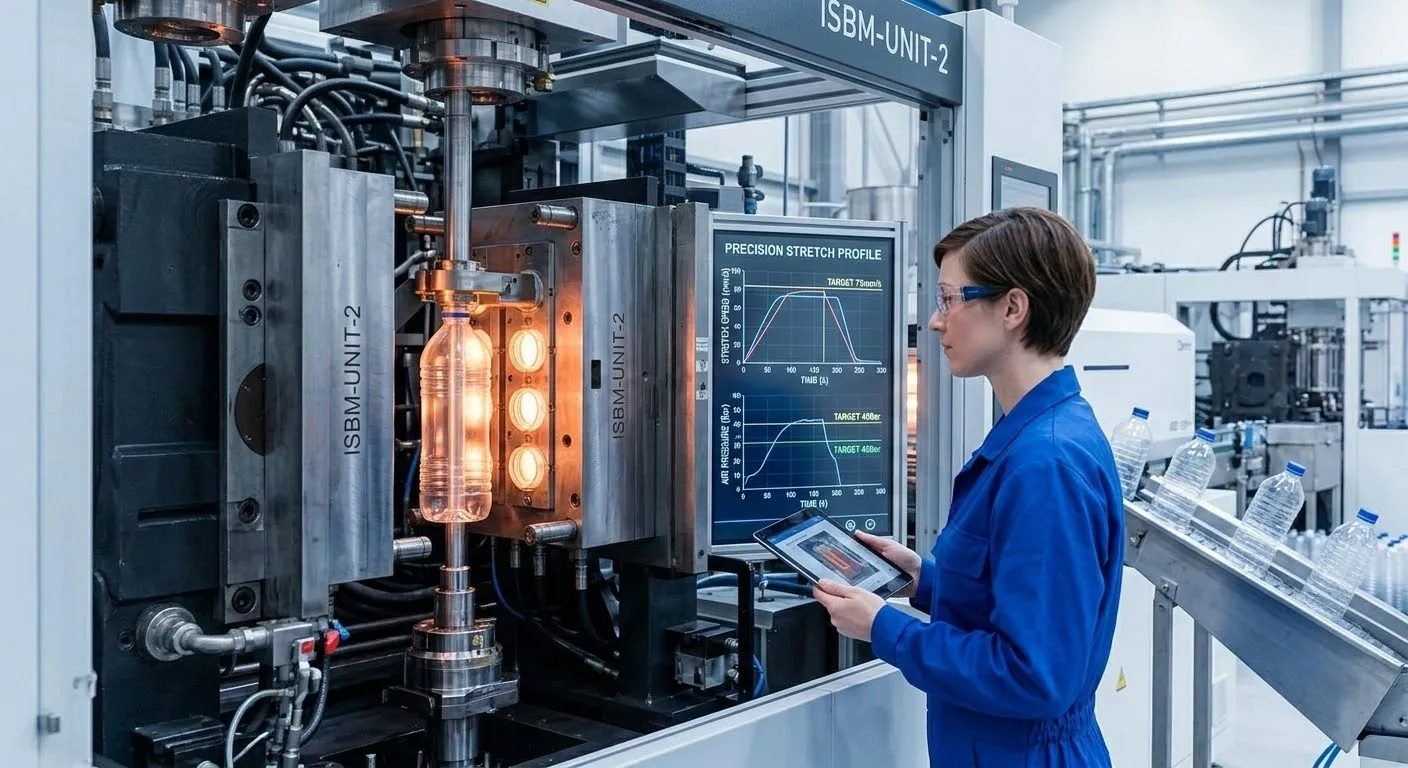
The transition from traditional hydraulic actuation to fully electric servo-driven systems represents the second major pillar of ISBM energy efficiency and throughput improvement.
⚡On-Demand Power Consumption Versus Constant Pump Draw
A traditional hydraulic ISBM machine operates a pump that runs continuously, consuming a baseline level of electrical power even during idle portions of the cycle. Hydraulic oil is circulated constantly, and energy is lost as heat through throttling valves and fluid friction. An all-electric ISBM machine, such as the EP-HGY150-V4-EV, consumes power only when a servo motor is actively moving. During the cooling phase of the injection cycle, or when the preform is being thermally conditioned, the servo motors are stationary and draw negligible power. This on-demand power consumption eliminates the constant energy overhead of a hydraulic system. Field data consistently demonstrates that all-electric ISBM machines reduce energy consumption by 40 to 60 percent compared to equivalent hydraulic models producing the same container at the same cycle time. Over a ten-year operational life, these savings can cumulatively exceed the initial capital investment of the machine, making the all-electric architecture the economically superior choice when total cost of ownership is considered.
⏱️Faster Cycle Times Through High-Speed Servo Response
Servo-electric actuation improves production output not only through energy efficiency but also through raw speed. A servo motor can accelerate, achieve its target velocity, and decelerate to a stop far more rapidly than a hydraulic cylinder, which is limited by the compressibility of oil and the response time of directional valves. This faster motion translates directly into reduced cycle times. The injection screw can recover faster, the clamp can open and close more quickly, and the stretch rod can execute its motion profile in less time. Even a reduction of half a second per cycle, when multiplied across millions of cycles per year, represents a significant increase in annual production output. Furthermore, the programmable motion profiles of servo drives allow overlapping of motions that would be mechanically impossible with a hydraulic system. For example, the clamp can begin to open while the stretch rod is still retracting, safely overlapping motions to shave critical milliseconds off each cycle. Compact servo-driven platforms like the EP-HGY50-V3-EV leverage this speed advantage to deliver impressive throughput from a compact footprint.
Integrated Process Architecture: Eliminating Logistical Energy Waste
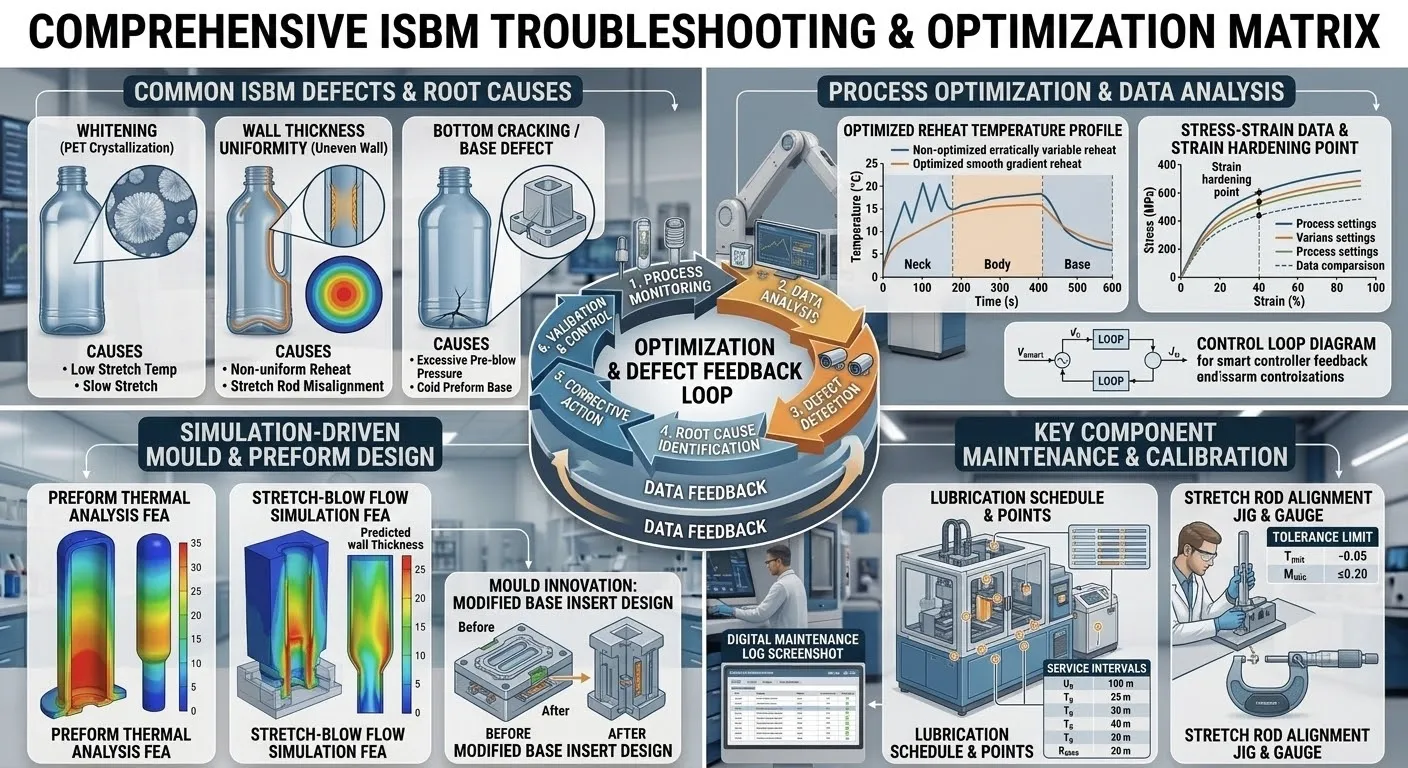
Beyond the direct thermal and electromechanical efficiencies, the single-stage ISBM architecture eliminates entire categories of energy waste associated with fragmented two-stage production.
🏭Eliminating Preform Storage, Transport, and Re-Feeding
A two-stage operation is not just two machines. It is an entire logistical ecosystem: a preform injection molder, a conveyor system, preform storage silos or gaylord boxes, possibly climate-controlled warehouse space to prevent moisture absorption, and a complex preform feeding and orientation system at the inlet of the reheat-blow molder. Every element of this logistical chain consumes energy. Conveyors draw power. Climate-controlled warehouses consume electricity for air conditioning and dehumidification. The preform feeding system uses compressed air and vibratory bowls. The single-stage ISBM machine eliminates all of this energy overhead. The preform is injection molded and conveyed directly to the blow station within the same cell, a distance measured in millimeters rather than meters or kilometers. This integration also eliminates the risk of preform contamination during storage and handling, reducing scrap rates and the embodied energy lost in rejected product. The compact, all-in-one nature of machines like the EP-BPET-70V4 embodies this logistical efficiency, delivering bottles from pellets in one seamless process.
📊High-Cavitation Architectures for Maximum Throughput
The production output of a single-stage ISBM machine is maximized through high-cavitation architectures that multiply the number of containers produced per cycle while maintaining the thermal precision that defines the process. Double-row machines like the Máquina de 4 estações de fileira dupla EP-HGY250-V4-B e o EP-HGY200-V4-B effectively double the cavitation of a single-row system, producing up to twice the bottles per cycle. For the absolute highest throughput of larger containers, the industrial-scale EP-HGY650-V4 provides the injection capacity and clamp force to handle immense preform payloads at high speed. The key to maintaining both energy efficiency and high throughput at these scales is the precision of the hot runner manifold, which ensures every cavity receives identical melt at identical temperature, and the robustness of the cooling system, which rapidly extracts heat from dozens of preforms simultaneously. This parallel processing capability allows a single integrated cell to achieve outputs that rival or exceed fragmented two-stage lines, while consuming significantly less energy per bottle.
Quantifying the Efficiency and Throughput Advantage
The combined effect of thermal continuity, servo-electric actuation, and integrated architecture delivers measurable, transformative improvements in both energy consumption and production output.
Energy Consumption Per Thousand Bottles
A modern servo-driven single-stage ISBM machine like the EP-HGY150-V4-EV can achieve specific energy consumption figures as low as 0.25 to 0.35 kilowatt-hours per thousand bottles for standard 500ml containers. In comparison, a two-stage production line producing the same bottle might consume 0.50 to 0.70 kilowatt-hours per thousand bottles, a penalty of up to 100 percent. A traditional hydraulic single-stage machine like the EP-HGY150-V4 still benefits from thermal continuity and achieves figures around 0.35 to 0.45 kilowatt-hours per thousand bottles, significantly better than two-stage. The servo-electric advantage is additive to the thermal continuity advantage, and together they deliver energy costs that are a fraction of legacy approaches. Over a production run of 100 million bottles per year, the annual energy cost savings can reach six figures, directly impacting the bottom line.
Annual Throughput and Floor Space Efficiency
A 32-cavity double-row single-stage machine operating at a 12-second cycle time with 85 percent uptime produces approximately 80 million bottles per year from a single compact cell. To achieve the same output with a two-stage system, a customer would need an injection molder, a cooling conveyor, storage silos, a preform feeding system, and a reheat-blow molder. The two-stage line occupies roughly three to four times the factory floor space and consumes significantly more energy per bottle. The single-stage machine’s superior output per square foot of factory floor is an often-overlooked efficiency metric. Floor space is a fixed cost, and maximizing the revenue generated per square meter is a key operational metric. Single-stage ISBM, by consolidating the entire production process into one compact cell, maximizes this metric while minimizing the energy and logistical complexity associated with a sprawling two-stage line.
EP-HGY250-V4 and the EP-HGY200-V4 provide proven, reliable hydraulic performance for standard production volumes.

Energy Efficiency and Throughput in rPET Processing
The global sustainability imperative demands that energy efficiency and production output improvements be evaluated in the context of processing post-consumer recycled PET, which presents unique challenges that the right ISBM machine can overcome.
Adaptive Injection for Consistent rPET Preforms
rPET’s variable intrinsic viscosity can cause shot weight inconsistencies and increased scrap rates if the injection unit cannot adapt in real-time. Servo-driven injection on machines like the EP-HGY150-V4-EV performs millisecond closed-loop pressure and velocity adjustments to compensate for fluctuating melt viscosity, maintaining perfect preform consistency. This adaptive capability preserves both energy efficiency and throughput by minimizing scrap. Every rejected bottle represents wasted energy, wasted material, and lost production time. By reducing the scrap rate from an industry average of 2 to 3 percent for rPET to well below 1 percent, the servo-driven machine directly improves both the effective energy efficiency per good bottle and the net production output. This is a virtuous cycle where precision control delivers both sustainability and productivity benefits simultaneously.
Lower Carbon Footprint Through Integrated Efficiency
The combined effect of thermal continuity, servo-electric efficiency, and integrated architecture on carbon footprint is substantial. A single-stage ISBM machine producing 100 million bottles per year with 50 percent rPET content generates a significantly smaller cradle-to-gate carbon footprint than a two-stage line producing the same output. This is driven by the lower energy consumption per bottle, the elimination of preform transport and its associated fuel consumption, and the reduced scrap rate. For brands pursuing ambitious science-based carbon reduction targets, the choice of an energy-efficient single-stage ISBM platform is a direct contributor to Scope 2 emissions reduction. The Moldes personalizados de injeção e sopro em uma única etapa from Ever-Power further enhance this efficiency through optimized cooling and minimal material waste, closing the loop on sustainable, high-output production.
Achieve Transformative Energy Efficiency and Maximum Throughput with Integrated ISBM Technology
The question of how an ISBM machine improves energy efficiency and production output is answered by the convergence of three powerful engineering principles: thermal continuity that leverages latent heat, servo-electric actuation that eliminates hydraulic power waste, and integrated architecture that abolishes logistical energy overhead. Together, these principles enable a modern single-stage ISBM machine to consume 40 to 60 percent less energy per bottle than a two-stage line while achieving throughputs of 80 million bottles per year or more from a single compact cell. At Ever-Power, nossas plataformas de máquinas avançadas, desde as versáteis EP-BPET-70V4 à escala industrial EP-HGY650-V4, embody these efficiency and throughput principles, delivering containers of uncompromising quality with the lowest possible energy footprint and the highest possible output per square foot of factory floor.