Polymer Science and Process Engineering
What Role Does Stretching Play in the ISBM Process, and What Is the Principle Behind It?
A comprehensive exploration of biaxial orientation, strain-induced crystallization, and the thermodynamic principles that transform an amorphous preform into a high-performance container.
The Stretching Phase: The Defining Thermodynamic Event in ISBM
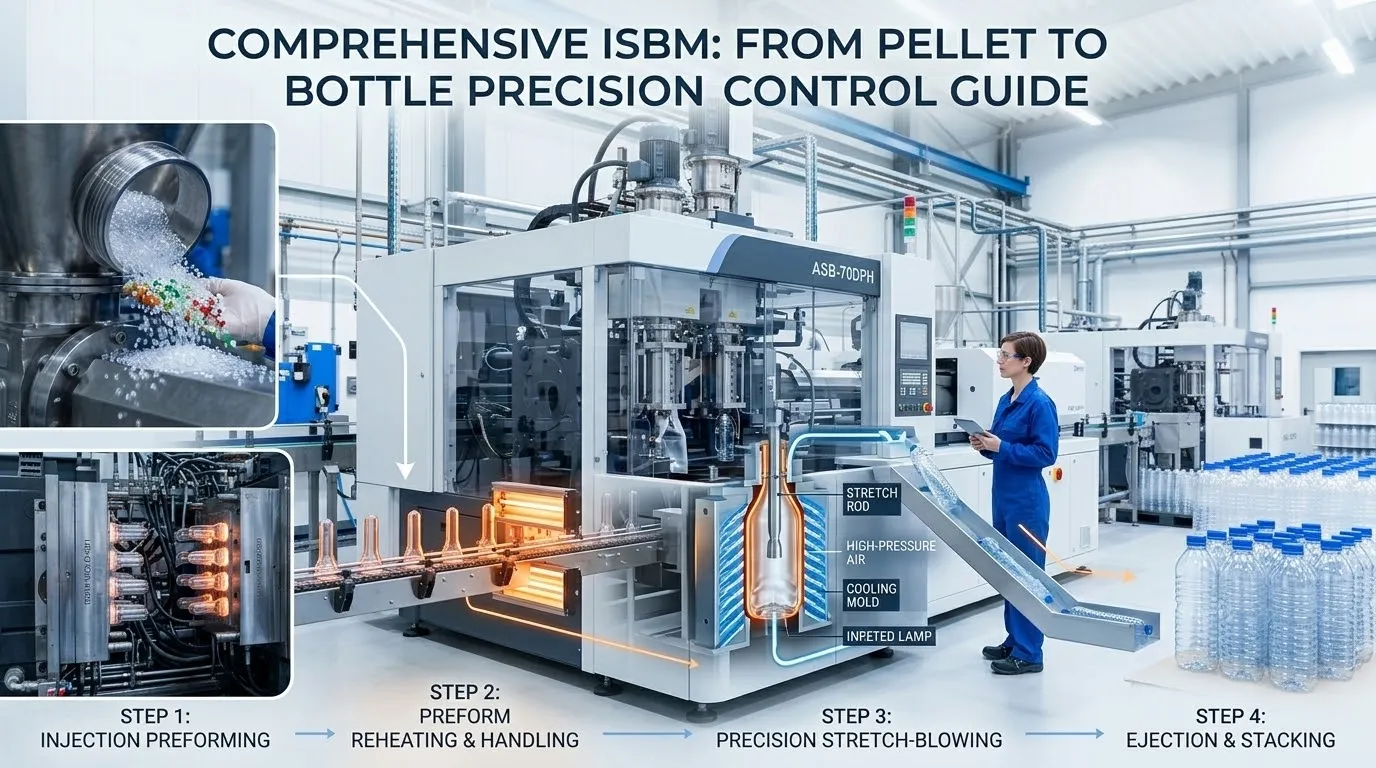
In the sophisticated domain of Injection Stretch Blow Molding, the stretching phase is far more than a simple inflation step. It is the critical, defining thermodynamic event that transforms a fragile, amorphous polyethylene terephthalate preform into a container possessing exceptional mechanical strength, gas barrier performance, and optical brilliance. For manufacturers seeking to understand the fundamental principles that differentiate ISBM from conventional extrusion blow molding or two-stage reheat processes, a rigorous examination of the stretching mechanism is essential. At Ever-Power, a leading Brazilian authority in ISBM equipment manufacturing, we recognize that the stretch blow process principle is the intellectual core of our entire engineering philosophy.
The role stretching plays in ISBM is multifaceted: it governs the final container geometry, dictates the degree of molecular alignment, and determines whether the finished product will exhibit the coveted glass-like clarity or suffer from catastrophic defects like pearlescence and thermal haze. This comprehensive technical dissertation will deconstruct the scientific principles underpinning biaxial stretching, explore the phenomenon of strain-induced crystallization, and demonstrate how mastery over stretch rod kinematics and pneumatic timing on advanced machinery can elevate a manufacturing line from mediocre output to world-class production. We will journey from the molecular architecture of PET to the real-time adjustments made on the Human Machine Interface of a high-performance ISBM cell like the EP-HGY150-V4 4-Station Machine.
Understanding the ISBM stretching principle is not an academic exercise; it is a practical necessity for process engineers, quality assurance managers, and plant directors who are tasked with delivering zero-defect packaging to the most demanding brands in the cosmetics, pharmaceutical, and premium beverage industries. This knowledge directly impacts scrap rates, energy consumption, and the structural integrity of every single container that leaves the production floor.
The Polymer Physics Foundation: From Amorphous Chaos to Ordered Strength
To appreciate the role of stretching in ISBM, one must first understand the molecular state of the preform before the stretch rod engages.
The Amorphous Preform State
When molten PET is injected into the chilled steel cavity of the preform mold and rapidly quenched, the polymer chains are frozen in a random, tangled, disorganized state. This is the amorphous phase. An amorphous preform is optically transparent because there are no large crystalline structures to scatter light, but its mechanical properties are poor. It is brittle at room temperature and would shatter under minimal impact force. The stretching process is the engineered solution to this structural inadequacy. By heating the amorphous preform to a precise temperature window just above its glass transition temperature and then mechanically forcing it to elongate both axially and radially, the tangled molecular chains are coerced into uncoiling, sliding past one another, and aligning tightly parallel to the direction of the applied force.
Molecular Alignment via Biaxial Orientation
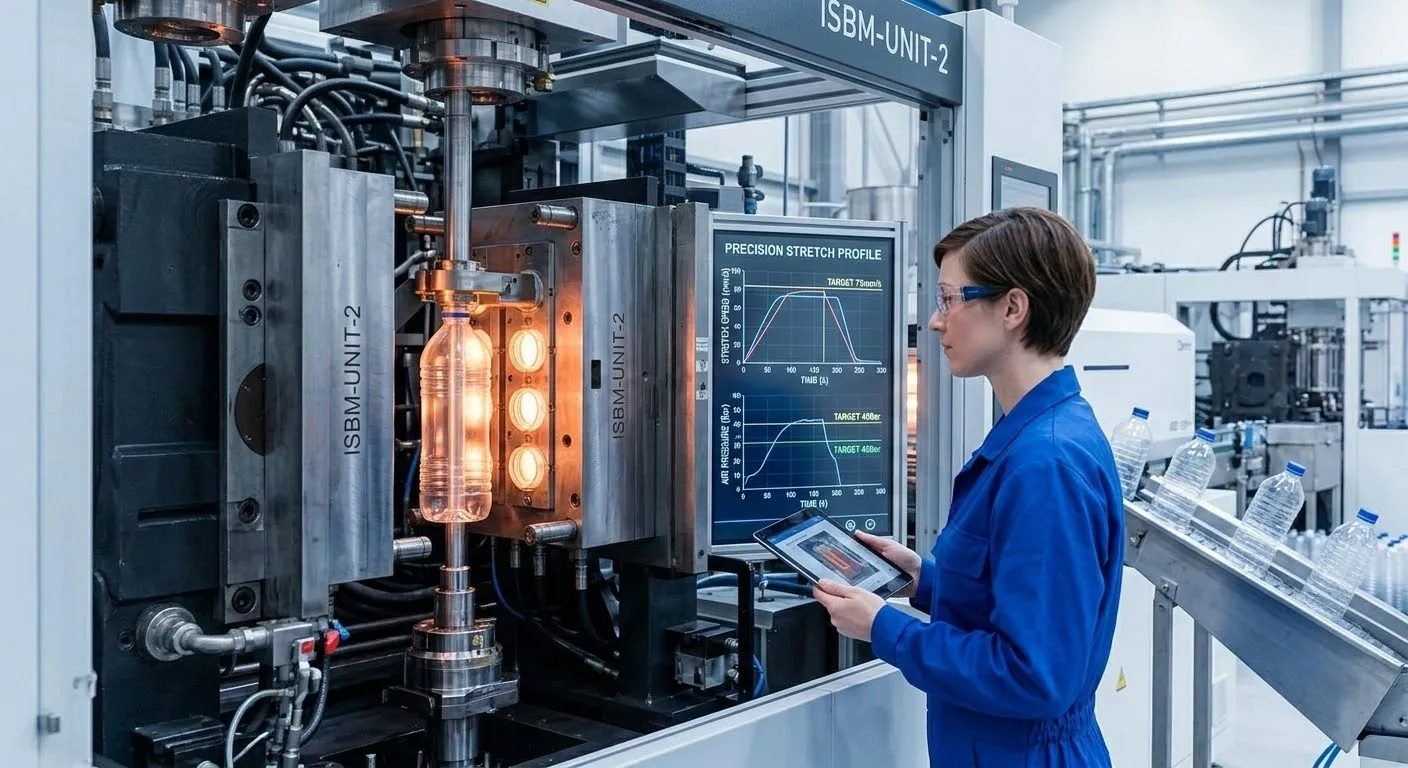
This alignment is not superficial; it restructures the entire polymer matrix at a molecular level. The principle behind this transformation is known as biaxial orientation, and it is the foundation of the ISBM process principle. The stretching sequence initiates when the thermally conditioned preform is transferred to the blow station. A highly polished, precision-ground steel stretch rod descends from the top of the blow cavity, making contact with the interior base of the preform. The role of stretching here is to physically push the material downward, elongating the preform along its vertical axis. Simultaneously, high-pressure blow air forces the plastic radially outward against the polished walls of the blow mold, completing the orientation in the hoop direction.
Deconstructing Biaxial Orientation: Axial and Radial Mechanics
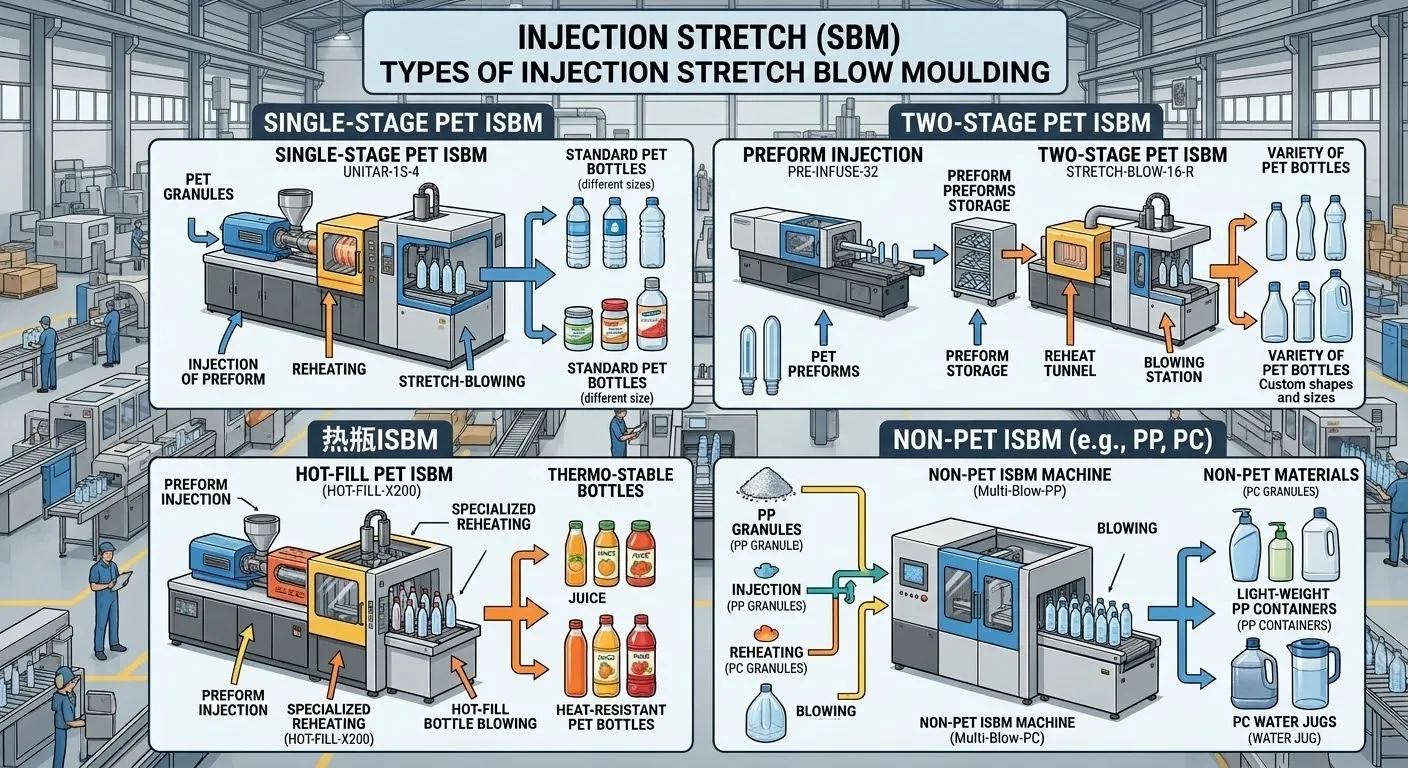
The stretching role in ISBM operates through two coordinated mechanical actions that together create the biaxial orientation necessary for high-performance containers.
⬇️Axial Stretching via the Mechanical Rod
The stretch rod’s descent is not arbitrary; it must be executed at a precisely controlled velocity and stroke distance. If the rod moves too fast, it can tear the still-cool polymer matrix, inducing stress whitening. If it moves too slowly, the material may begin to cool and resist further deformation, leading to uneven wall thickness. On elite servo-driven platforms like the EP-HGY150-V4-EV Full Servo Machine, the stretch rod position, speed, and acceleration are controlled through closed-loop feedback. Engineers can program a complex motion profile where the rod decelerates as it reaches the end of its stroke to gently pin the material against the base of the mold without any hammering effect. This level of kinematic control is essential for producing containers with extremely thin bases or intricate petaloid geometries used in carbonated beverage packaging.
🔵Radial Stretching via High-Pressure Air
Simultaneously, or in a precisely timed sequence, high-pressure blow air enters the cavity through the stretch rod or surrounding ports. This pneumatic force pushes the plastic radially outward against the polished walls of the blow mold. The radial stretching completes the biaxial orientation, forcing the molecular chains to align in the hoop direction. The synergistic combination of axial push and radial expansion creates a two-dimensional network of aligned polymer chains, dramatically enhancing the container’s hoop strength, top load capability, and drop impact resistance. The stretch blow process principle relies on the delicate balance between these two forces; an imbalance can lead to a container that is strong in one direction but catastrophically weak in the perpendicular axis. For complex container geometries, machines like the EP-HGYS280-V6 6-Station Machine provide dual conditioning workstations to ensure perfect thermal preparation before this critical phase.
The Principle of Strain-Induced Crystallization Explained
The most profound answer to the question of what principle governs the stretching in ISBM is strain-induced crystallization. Unlike thermal crystallization, which occurs when a polymer is simply heated and slowly cooled, strain-induced crystallization is a rapid, mechanically driven phase change. As the stretch rod and blow air apply biaxial stress to the polymer, the elongated chains become highly oriented. In this oriented state, the chains are sterically positioned with ideal regularity, allowing them to spontaneously nucleate and form tiny, tightly packed crystalline lamellae.
✨The Nanocrystal Paradox: Strength and Clarity Combined
Critically, the crystals formed through this mechanical process are infinitesimally small, on the order of nanometers, which is much smaller than the wavelength of visible light. This is the engineering secret behind the breathtaking clarity of a well-processed ISBM bottle. The material is structurally crystalline and immensely strong, yet optically, it behaves as if it were glass. If the same level of crystallinity were achieved through thermal means, the spherulites would grow to micron-scale dimensions, scattering light and producing an undesirable, foggy haze. The ISBM stretch principle thus delivers a unique, paradoxical combination of high crystallinity and high transparency, a feat unattainable by any other commercial polymer processing method.
The degree of strain-induced crystallinity directly correlates with the stretch ratio, which is defined as the product of the axial stretch ratio and the radial stretch ratio. For standard PET water bottles, a typical planar stretch ratio might range from 8 to 12. Exceeding the natural stretch ratio limit of the specific resin grade, however, can lead to micro-voiding and the onset of pearlescence, particularly if the preform temperature was below the optimal processing window. Understanding and respecting this limit is central to troubleshooting and process optimization on machines like the EP-BPET-125V4. The principle behind this transformation is what elevates ISBM far beyond simple extrusion blow molding, where no controlled stretching occurs and the polymer chains remain largely unoriented.
The Pivotal Role of Thermal Conditioning and Pneumatic Timing
Stretching cannot occur at any arbitrary temperature, and the timing of pneumatic events is equally critical to the success of the orientation process.
Precise Thermal Window Preparation
The preform must be brought into a narrow thermal window where the polymer is rubbery and pliable but not molten. This temperature region sits just above the glass transition temperature of PET. If the preform is too cold, the polymer chains lack sufficient mobility to uncoil; the applied force will simply tear the matrix, resulting in stress whitening. If the preform is too hot, thermal crystallization will have already nucleated, and the subsequent stretching will encounter hard crystalline regions that resist orientation. On sophisticated platforms like the EP-HGYS280-V6, two independent conditioning workstations allow engineers to execute a phased thermal profile for optimal stretching preparation.
The Pre-Blow and Final Blow Sequence
The pre-blow is a low-pressure burst of air introduced just before or during the stretch rod’s descent. Its purpose is to gently begin radial expansion, creating a bubble that the rod can guide downward without touching the cold blow mold walls prematurely. If the pre-blow pressure is too high or actuates too early, the plastic balloons outward aggressively, exceeding the natural stretch ratio limits and producing catastrophic pearlescence. If the pre-blow is too delayed, the stretch rod may force the plastic into contact with the mold wall before radial expansion begins, causing the material to stick and seize. The final high-pressure blast then forces the partially oriented polymer firmly into every intricate detail of the mold cavity, completing the strain-induced crystallization process.
Servo-Driven Kinematic Control
Fully electric servo drives, as featured on the EP-HGY50-V3-EV, provide programmable motion profiles that allow the rod to decelerate as it approaches the mold base, eliminating impact damage. This is particularly critical when processing post-consumer recycled PET, which exhibits a more brittle elongation behavior than virgin resin. The intelligent stretching capability enables brands to incorporate up to 100 percent rPET into premium packaging without sacrificing clarity and structural integrity.
Stretch-Related Defect Diagnostics and the rPET Challenge
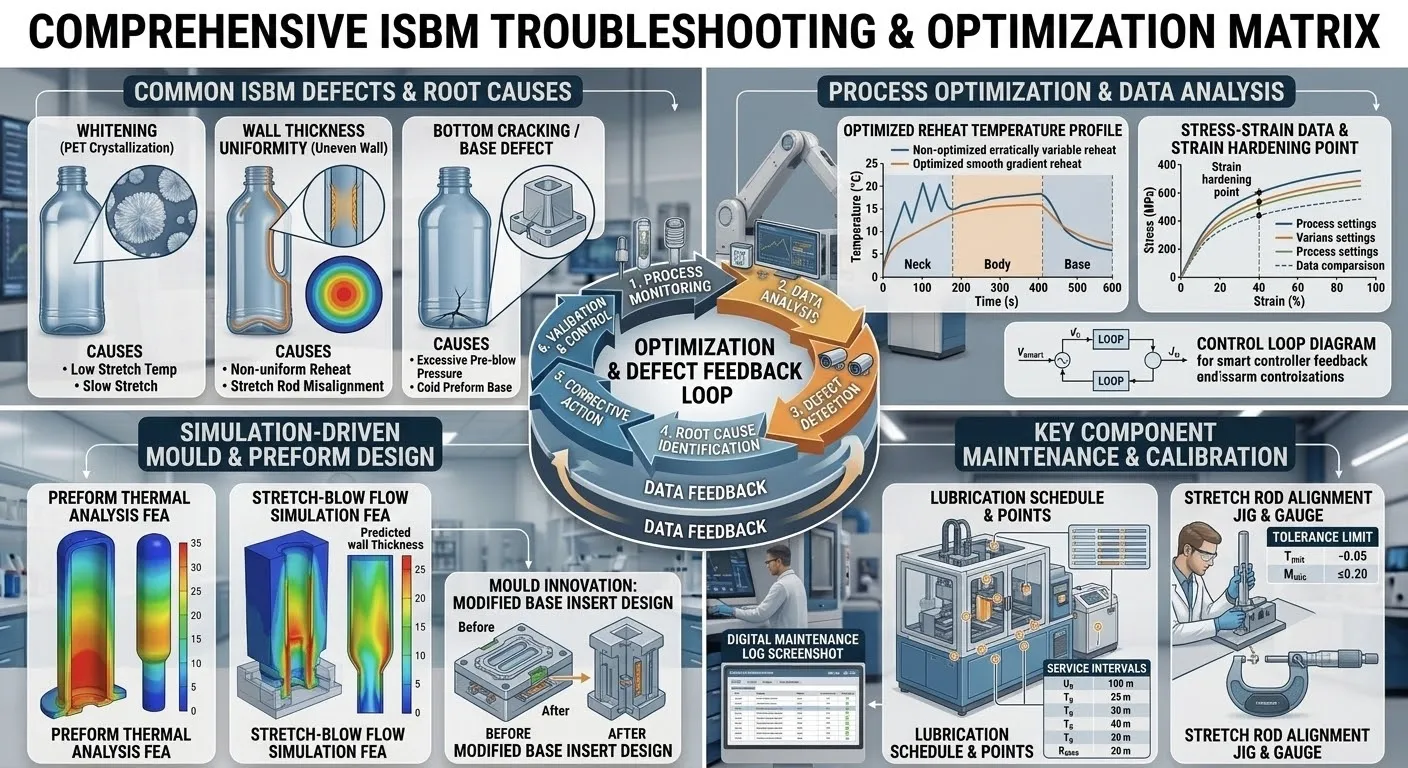
A thorough understanding of the stretching role is incomplete without the ability to diagnose its failures. Stress whitening, appearing as a pearlescent, silvery sheen, indicates that the material was stretched while too cold or at an excessive rate. The corrective action involves incrementally raising the conditioning pot temperature and slightly reducing the stretch rod velocity. Conversely, thermal haze presents as a smooth, foggy appearance and suggests the preform was too hot before stretching, allowing spherulites to form. The fix is to lower barrel temperatures and increase injection mold cooling time on machines like the EP-BPET-70V4.
- 🔍
Uneven Wall Thickness: Often manifesting as a heavy base and thin shoulder, this points to an imbalance in the biaxial stretch ratio. The stretch rod may be extending too far or too fast, pushing excessive material to the base before the radial blow can distribute it evenly. Adjusting the stretch rod end position or the pre-blow delay can rebalance the material distribution.
- ♻️
The rPET Stretching Adaptation: Post-consumer recycled PET exhibits a lower average intrinsic viscosity and a broader distribution of molecular chain lengths. During stretching, this heterogeneity can cause localized overstretching or premature crystallization. Stretch speeds must be reduced, and pre-blow pressures adjusted to provide a gentler orientation ramp. Large-format machines like the EP-HGY650-V4 incorporate adaptive servo algorithms that monitor stretch rod resistance in real-time, instantaneously adjusting velocity to prevent blowouts in lower-viscosity rPET pockets.

The Stretch Rod and Mold Cavity: An Integrated Engineering System
The stretching principle cannot be executed without flawless integration between the stretch rod, the blow mold cavity, and the preform geometry. The Custom One-Step Injection Stretch Blow Moulds engineered by Ever-Power are designed with the stretch kinematics in mind. The rod diameter, tip geometry, and stroke length are calculated relative to the preform’s internal bore and the desired axial stretch ratio. A rod that is too thin will puncture the base; too thick, and it will trap the preform against the mold wall prematurely. The blow mold cavity must also incorporate venting channels to allow trapped air to escape, otherwise, the rapidly stretching plastic cannot conform perfectly to the mirror-polished steel surface.
This integrated design philosophy distinguishes ISBM from traditional blow molding, where the air nozzle is a simple, standardized component. In ISBM, the stretch rod assembly is a custom-engineered tool, often fabricated from hardened, low-friction steel and internally cooled to prevent heat buildup from the repeated friction of traversing the hot preform. The role of stretching in ISBM is thus a fully engineered system, not a generic process step. For high-volume production of complex containers, double-row architectures like the EP-HGY250-V4-B Double-Row 4-Station Machine replicate this precise stretching across dozens of cavities simultaneously, ensuring container consistency from cavity to cavity.
Master the Stretching Principle to Dominate Your Packaging Segment
The role stretching plays in the ISBM process is nothing less than the complete transformation of a fragile, amorphous preform into an oriented, crystalline, high-performance container. By mastering the stretch blow process principle and its associated variables—axial rod kinematics, radial pneumatic timing, and precise thermal preparation—manufacturers can unlock the full potential of polyethylene terephthalate. At Ever-Power, our advanced machinery platforms, from the compact EP-BPET-70V4 to the industrial-scale EP-HGY650-V4, are engineered to deliver this transformative efficiency with micron-level precision. Understanding and controlling the stretching phase is the definitive competitive advantage for any packaging manufacturer seeking to produce containers of uncompromising quality, strength, and optical brilliance.