Polymer Science and Material Selection for ISBM
What Plastic Materials Are Most Suitable for ISBM Including PET PP and PC?
A definitive polymer science guide analyzing the rheological behavior, crystallization kinetics, and processing characteristics that determine the suitability of polyethylene terephthalate, polypropylene, polycarbonate, and other resins for the injection stretch blow molding process.
The Critical Role of Polymer Selection in ISBM Success
The Injection Stretch Blow Molding process does not treat all plastic materials equally. The very physics that make ISBM capable of producing containers with exceptional strength and optical clarity also impose stringent requirements on the polymer being processed. For packaging engineers, product designers, and manufacturing executives, understanding which plastic materials are most suitable for ISBM is a foundational competency that determines whether a container can be successfully manufactured, what its performance characteristics will be, and what the production economics will look like. At Ever-Power, a globally recognized Brazilian manufacturer of ISBM equipment, our polymer scientists and application engineers have accumulated decades of experience processing a wide spectrum of resins through our advanced machinery platforms.
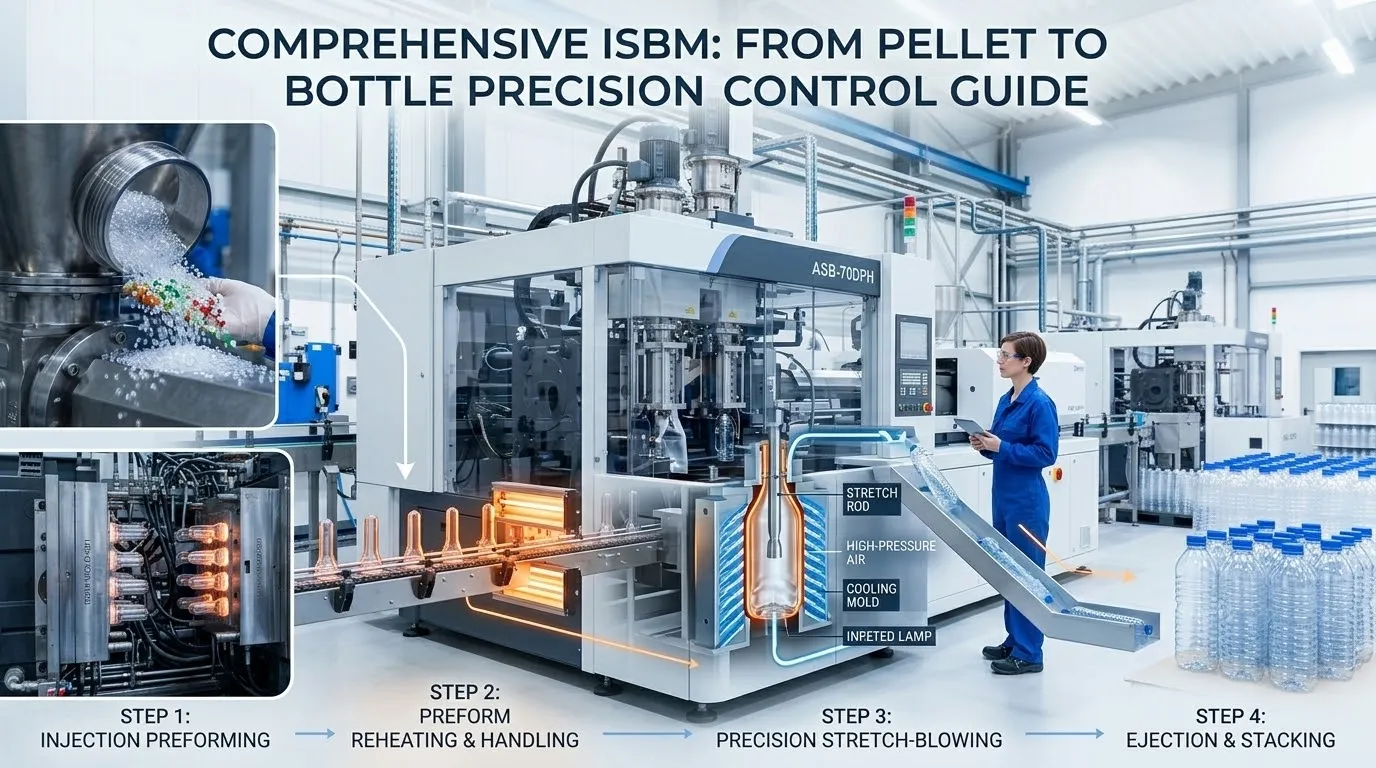
The suitability of a plastic material for ISBM is governed by its molecular architecture and its response to the defining steps of the process: rapid quenching to an amorphous state, precise thermal conditioning to a rubbery plateau, and biaxial stretching that induces strain-induced crystallization. The polymer must possess a glass transition temperature that allows for a practical conditioning window, a natural stretch ratio that accommodates the container geometry without tearing, and the ability to form strain-induced crystals that are smaller than the wavelength of visible light to preserve transparency. This comprehensive technical guide will analyze the most suitable plastic materials for ISBM, including polyethylene terephthalate, polypropylene, polycarbonate, and several specialty resins. We will explore the rheological and crystallization behavior of each, their processing requirements on machines like the EP-HGY150-V4 4-Station Machine, and the specific application domains where each excels.
The selection of the optimal material for an ISBM application is not merely a matter of reviewing a datasheet. It requires a nuanced understanding of how the polymer’s intrinsic viscosity, crystallization half-time, and thermal stability interact with the machine’s injection, conditioning, and stretch-blow capabilities. This guide provides that nuanced understanding, equipping you to make informed material decisions that optimize container quality, production efficiency, and total manufactured cost.
Polyethylene Terephthalate: The Quintessential ISBM Material
Polyethylene terephthalate is, by an overwhelming margin, the most suitable and most widely processed material for the ISBM process, and its dominance is rooted in its unique molecular behavior.
Crystallization Kinetics and the Amorphous Quench
The defining characteristic that makes PET so ideally suited for ISBM is its relatively slow crystallization kinetics. When molten PET is injected into a chilled preform mold, it can be rapidly quenched to a fully amorphous, transparent solid before spherulite crystals have time to nucleate and grow. This is the essential starting point for the entire ISBM process. Other semi-crystalline polymers, such as polyethylene or certain nylons, crystallize so rapidly that they cannot be quenched to a truly amorphous state in typical injection mold cooling times. PET provides a forgiving processing window. Its glass transition temperature, approximately 75 degrees Celsius, establishes a clear conditioning target. Its natural stretch ratio, typically between 8 and 12 for standard grades, aligns perfectly with common container geometries. When stretched biaxially at the correct temperature, PET undergoes strain-induced crystallization, forming nanoscale crystallites that impart strength without scattering light. On a machine like the EP-BPET-125V4, PET processes with a predictability and consistency that has made it the gold standard for premium packaging.
Virgin PET Grades and rPET Integration
PET suitable for ISBM is available in a range of intrinsic viscosity grades, typically from 0.72 to 0.84 dL/g for standard container applications. Higher-IV grades provide greater melt strength and are preferred for large-format containers or those requiring extreme stretch ratios. The modern sustainability imperative has driven the widespread adoption of post-consumer recycled PET in ISBM. rPET presents a processing challenge due to its reduced and variable IV, often lower by 0.05 to 0.10 dL/g compared to virgin resin. This requires adaptive processing parameters. Servo-driven injection units on machines like the EP-HGY150-V4-EV Full Servo Machine compensate for rPET viscosity fluctuations in real-time, ensuring consistent preform quality. The stretch blow parameters, including stretch rod velocity and pre-blow pressure, are adjusted to accommodate the more brittle elongation behavior of rPET. Despite these challenges, PET remains the most suitable material for ISBM, and the industry continues to push the boundaries of rPT content toward 100 percent.
Polypropylene: The Versatile Challenger for Hot-Fill and Barrier Applications
Polypropylene is the second most important material processed by ISBM, and its unique thermal and barrier properties make it the material of choice for specific high-performance container applications.
🌡️Higher Heat Deflection for Hot-Fill and Retort
The primary advantage of PP over PET in ISBM applications is its superior thermal resistance. Polypropylene has a melting point of approximately 160 to 170 degrees Celsius, significantly higher than PET. This allows PP containers produced by ISBM to withstand hot-fill temperatures of 85 to 95 degrees Celsius and even retort sterilization at 121 degrees Celsius without distortion. This thermal capability makes PP the material of choice for shelf-stable food products, nutritional beverages, and pharmaceutical containers that must be terminally sterilized. Processing PP on an ISBM machine requires several critical adjustments. The injection melt temperature is higher than PET, typically 220 to 240 degrees Celsius. The conditioning temperature window is narrower and must be controlled with greater precision. PP crystallizes faster than PET, so the injection mold cooling must be more aggressive to ensure an amorphous preform. The stretch ratio for PP is typically lower than PET, generally in the range of 6 to 8, reflecting its different elongation behavior. Machines with precise zonal conditioning, such as the EP-HGYS280-V6, are particularly well-suited to PP processing.
🔬Clarity and Haze Tradeoffs with Clarified PP Grades
Historically, the Achilles heel of ISBM-processed PP has been optical clarity. Standard polypropylene, when stretched, develops a characteristic hazy appearance due to its more rapid crystallization and the larger spherulite size. However, modern clarified polypropylene grades, incorporating nucleating agents and specialty clarifiers, have dramatically improved the optical performance of ISBM PP containers. These clarified grades can achieve haze levels approaching 10 to 15 percent, compared to 2 to 5 percent for PET. While still not matching the glass-like brilliance of PET, clarified PP offers acceptable transparency for many applications where its thermal and chemical resistance are the primary requirements. The stretch blow parameters for PP must be carefully optimized to maximize the effectiveness of the clarifying agents. The stretch temperature, stretch speed, and stretch ratio all influence the final crystal morphology and hence the optical properties. Processing PP on a machine with programmable stretch rod motion profiles, such as the compact EP-HGY50-V3-EV, provides the control necessary to achieve the best possible clarity from PP formulations.
Polycarbonate and Specialty Resins for Niche ISBM Applications
Beyond the mainstream PET and PP materials, a select group of specialty polymers can be successfully processed by ISBM for high-value niche applications where their specific properties justify the additional processing complexity and cost.
🛡️Polycarbonate: Extreme Impact Resistance and Clarity
Polycarbonate is a high-performance engineering thermoplastic that can be processed by ISBM for applications demanding extreme impact resistance, optical clarity, and the ability to withstand repeated sterilization cycles. PC is inherently amorphous, so the quenching and stretching of the ISBM process serve to orient the polymer chains for strength without inducing crystallization. Containers produced from PC by ISBM are virtually unbreakable under normal handling conditions, making them suitable for reusable water bottles, baby bottles, and medical device housings. Processing PC on an ISBM machine requires elevated melt temperatures of 280 to 310 degrees Celsius and a conditioning temperature around 140 to 150 degrees Celsius, near its glass transition temperature. The material is highly hygroscopic and demands aggressive drying to a moisture content below 0.02 percent before processing to prevent hydrolysis and bubble formation. The high processing temperatures place additional demands on the machine’s heater bands, hot runner manifold, and temperature control systems. Industrial-scale machines like the EP-HGY650-V4 are engineered to handle these elevated thermal requirements reliably.
🧪PEN, PETG, Tritan, and Other Specialty Copolyesters
Several specialty copolyesters and related polymers can be processed by ISBM for applications where standard PET or PP do not meet the performance specification. Polyethylene naphthalate offers superior gas barrier properties and UV resistance compared to PET, making it suitable for beer and other oxygen-sensitive beverage containers that require extended shelf life. PETG, a glycol-modified PET, is easier to process than PET because it is inherently amorphous and does not crystallize, eliminating the risk of thermal haze. However, its lack of strain-induced crystallization means it does not achieve the same strength as oriented PET. Tritan, an Eastman copolyester, combines the clarity and toughness of polycarbonate with BPA-free chemistry, making it suitable for reusable sports bottles and food containers. Each of these specialty resins has a specific processing window that must be accommodated by the ISBM machine. The Custom One-Step Injection Stretch Blow Moulds from Ever-Power can be engineered with the specific thermal and mechanical characteristics required for these niche materials, ensuring successful processing from the first trial.
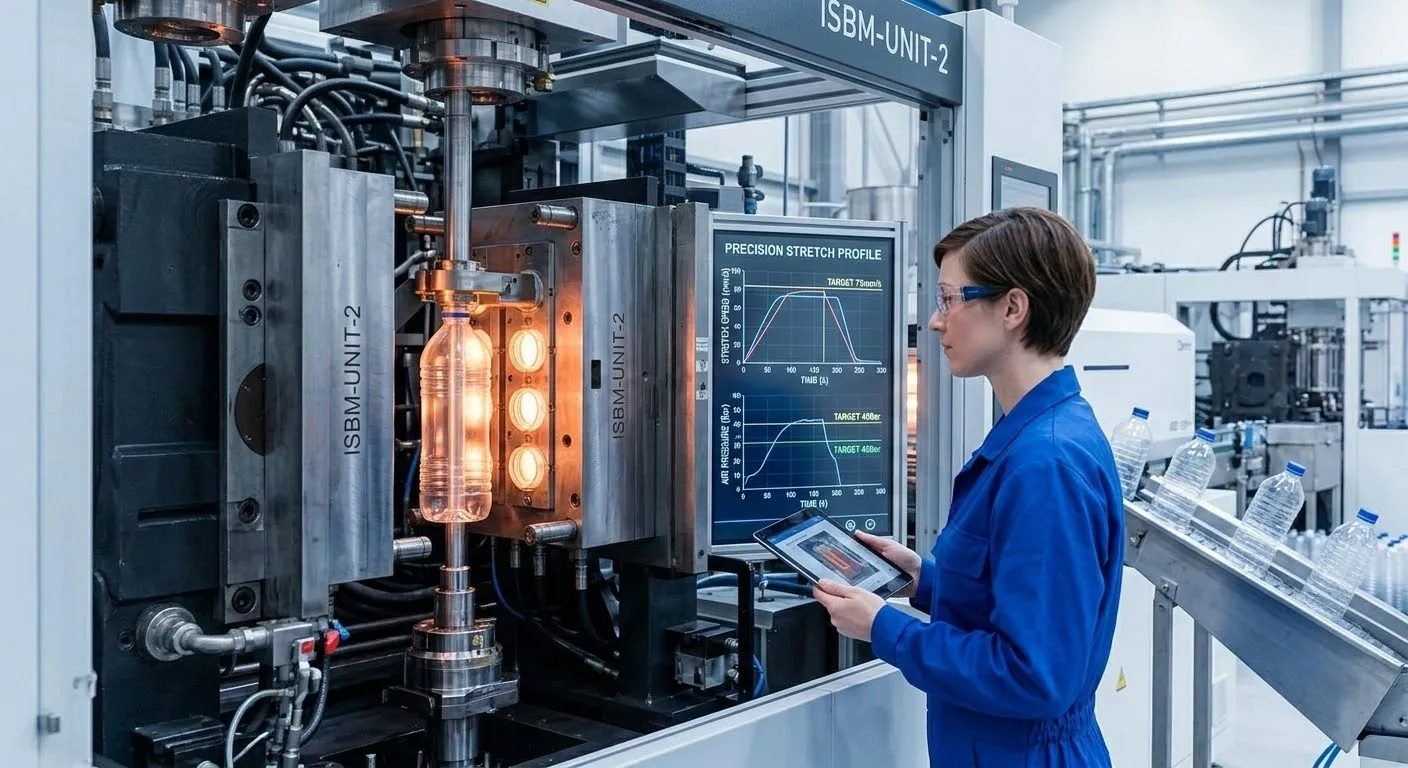
A Decision Framework for Selecting the Optimal ISBM Material
Choosing the most suitable plastic material for an ISBM application requires a systematic evaluation across multiple performance, processing, and economic dimensions.
Performance Requirements Matrix
Begin by defining the container’s must-have performance characteristics. Is optical clarity the paramount requirement? If so, PET is the clear winner, delivering glass-like transparency at an economical cost. Is thermal resistance the primary driver, such as for hot-fill or retort applications? Then PP becomes the leading candidate, with its ability to withstand temperatures that would deform PET. Is extreme impact resistance and reusability the goal? Polycarbonate or Tritan copolyester are the materials of choice. Is gas barrier performance for oxygen-sensitive products the critical specification? PEN or multilayer structures incorporating barrier resins may be required. Each material maps to a specific performance profile, and the selection must be driven by the container’s intended use case. For high-volume PET production, the EP-HGY250-V4 delivers the throughput and precision required.
Processability and Machine Compatibility
Not all ISBM machines are equally capable of processing all materials. PET and PP are within the capability of virtually all ISBM platforms, from compact cells like the EP-BPET-70V4 to high-output industrial systems. Polycarbonate and specialty copolyesters demand higher processing temperatures, more aggressive drying, and potentially corrosion-resistant screw and barrel materials. They may require machines with enhanced temperature control capabilities and higher clamp forces. Recycled PET demands servo-driven injection units with closed-loop viscosity compensation, as found on the EP-HGY150-V4-EV. The material selection must be made in concert with the machine selection. Procuring a material that your machine cannot process reliably is a recipe for production failure. Engaging with the engineering team at Ever-Power early in the material selection process ensures that the chosen polymer and the ISBM platform are perfectly matched.