What is the main difference between extrusion blow molding and injection blow molding?
The main difference between extrusion blow moulding (EBM) and injection blow moulding (IBM) is how the plastic intermediate is formed before blowing. In EBM, it is extruded as a continuous tube (parison). In IBM, it is injection-moulded as a precise preform on a core rod. This difference determines the container types, dimensional accuracy, resins, and applications each process serves.
EBM: Extruded Parison
In EBM, a continuous extruder pushes molten plastic through a die to form a hollow tube called a parison. The parison hangs between open mould halves; when it reaches the correct length, the mould closes, pinching the bottom, and blow air inflates it against the mould walls. The parison’s wall thickness is set by the die gap and drawdown — less precise than an injection-moulded preform. Neck finish is formed by the pinching mould, producing a seam at the base and lower neck precision than IBM. EBM handles large containers, integral handles, and resins like HDPE and PP that extrude well.
IBM: Injection-Moulded Preform on Core Rod
In IBM, plastic is injection-moulded around a core rod, forming a precise preform with the finished neck thread already moulded. The core rod transfers the preform to the blow station where air pressure inflates it. IBM produces containers with: accurate and consistent neck thread dimensions (critical for pharmaceutical closure compatibility); no base pinch seam (the bottom of IBM containers is seamless); precise weight control per cavity; and no waste trim. IBM is the preferred process for small pharmaceutical vials, dropper bottles, and HDPE personal care containers.
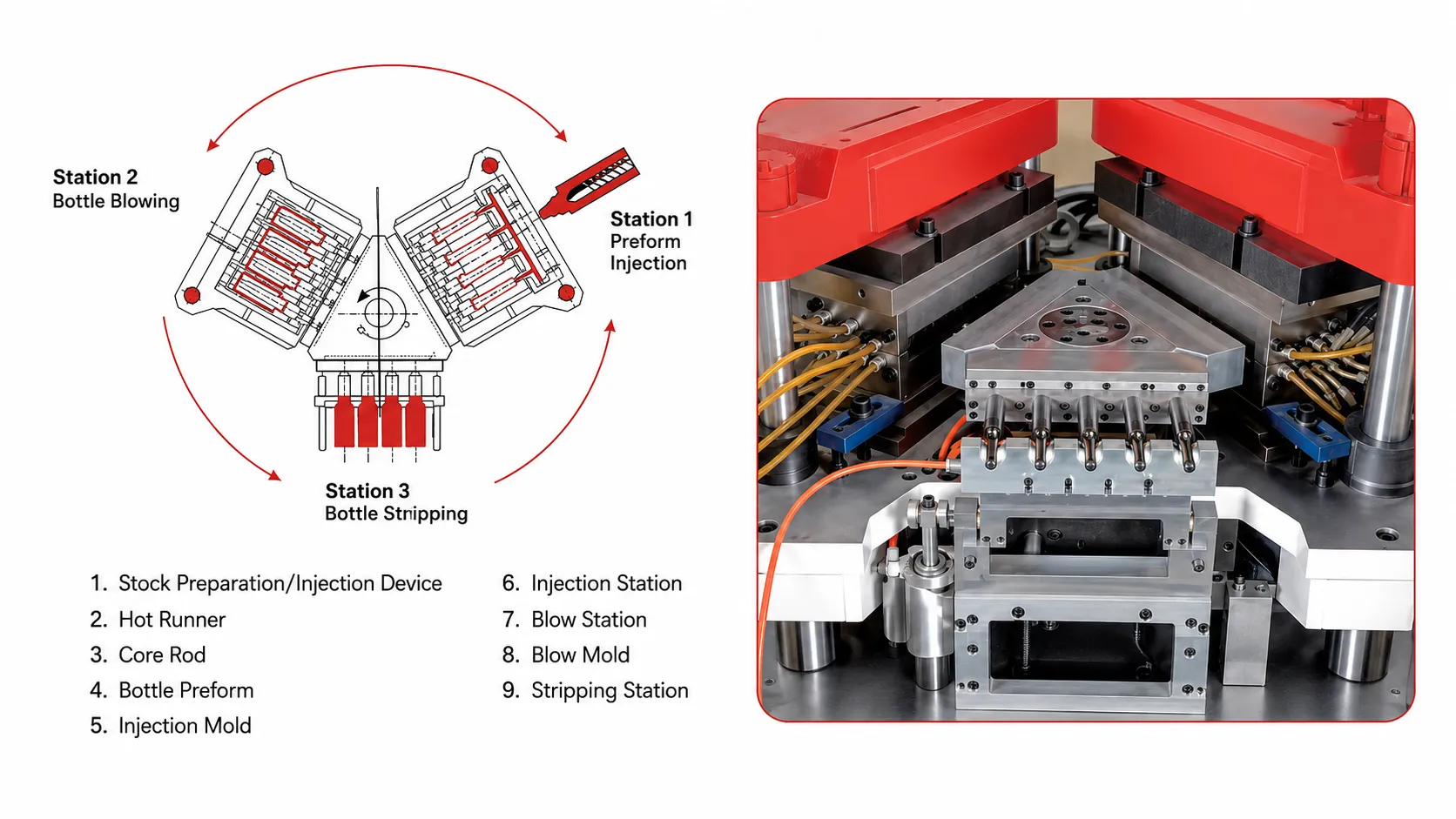
IBM: the injected preform on a core rod provides more precise neck geometry and seamless base than EBM’s pinched parison.
Direct Comparison
| Attribute | EBM | IBM |
|---|---|---|
| Intermediate | Extruded parison (tube) | Injection-moulded preform on core rod |
| Neck precision | Lower — formed by pinch | High — formed in injection mould |
| Base seam | Pinch seam present | Seamless base |
| Typical resins | HDPE, PP, LDPE | HDPE, PP, PC |
| Container size | Small to very large (>100 L) | 5–500 ml typically |
| Handles | Easily incorporated | Difficult |
| Molecular orientation | None | None (ISBM adds this) |
Where ISBM Fits: Adding Orientation to IBM
Neither EBM nor IBM produces biaxial molecular orientation. For containers requiring the strength, clarity, and light weight that orientation provides — PET water bottles, CSD bottles, pharmaceutical PET oral dose containers, cosmetic PETG flacons — injection stretch blow moulding (ISBM) is the process of choice. ISBM uses an injection-moulded preform like IBM, but adds a mechanical stretch rod that produces axial orientation before the radial blow.
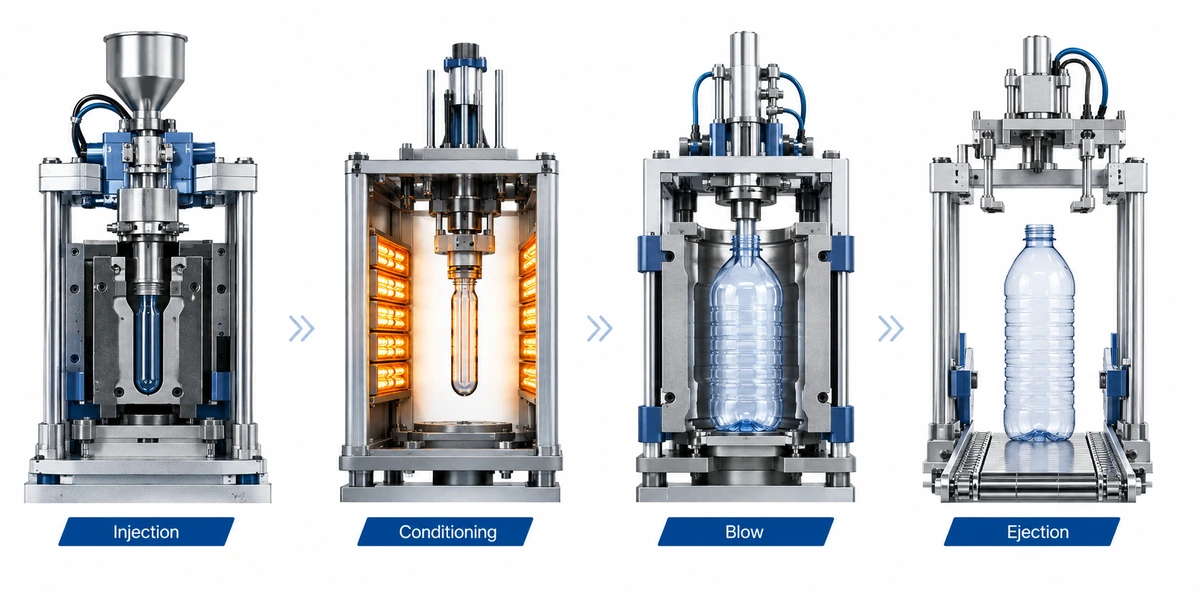
ISBM adds a stretch rod step absent from both EBM and IBM, producing biaxial orientation for superior container strength and clarity.
Need help choosing between EBM, IBM, and ISBM?
Ever-Power’s team can confirm the right process for your container size, resin, and performance requirements within 24 hours.
Explore the full one-step ISBM machine range, or review application examples for water, beverage, and chemical containers.
Frequently Asked Questions
Which is more expensive — EBM or IBM tooling?
IBM moulds are generally more expensive than EBM moulds at equivalent cavity count because the injection preform mould requires more precision machining, tighter cooling channel design, and accurate hot runner systems. EBM moulds are simpler because they only define the external container geometry. ISBM mould sets (preform mould plus blow mould plus stretch rod) represent the largest tooling investment of the three.
Can EBM process PET resin?
EBM is not used for PET in standard industrial production. PET’s narrow processing window and sensitivity to moisture and thermal degradation make parison extrusion difficult to control at commercial rates. PET is processed by ISBM (one-step or two-step) for virtually all container applications. EBM is used with HDPE, PP, LDPE, and some engineering resins.
Why does IBM not need a stretch rod?
IBM is designed for resins like HDPE and PP where biaxial orientation is not required or not practically achievable. The containers IBM produces — pharmaceutical vials, dropper bottles, personal care containers — do not need the light-weighting and clarity that orientation provides. Adding a stretch rod to IBM to produce orientation would change the process into ISBM and require significant machine redesign.