Advanced ISBM Container Engineering
What Challenges Do ISBM Manufacturers Face When Designing Bottles with Complex Shapes?
A comprehensive engineering analysis of the thermodynamic, kinematic, and mold design obstacles encountered when producing asymmetric, flat-oval, and highly contoured PET containers, and the advanced solutions that overcome them.
The Engineering Frontier of Complex Shape ISBM Production
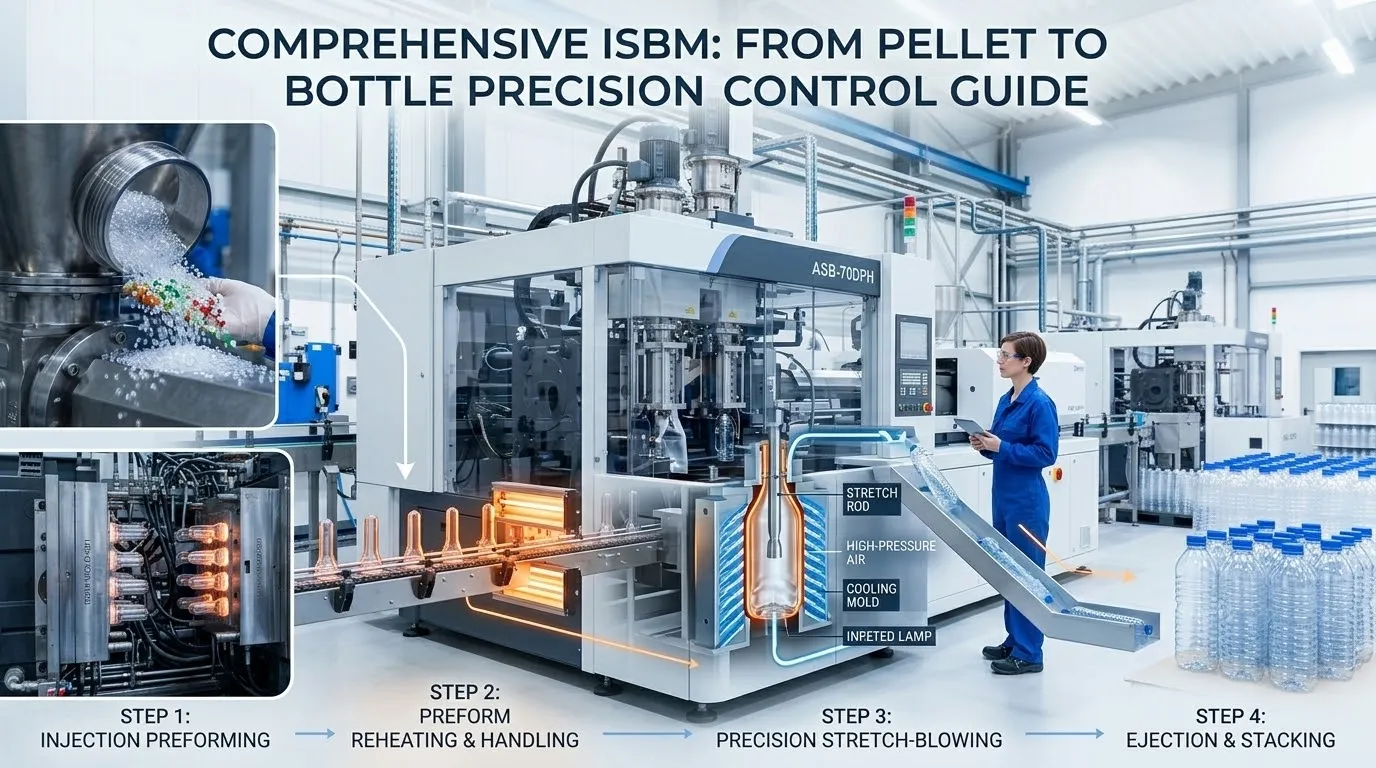
The injection stretch blow molding process is at its most forgiving when producing simple, axisymmetric cylindrical bottles. The physics of stretching a uniformly conditioned tubular preform into a round blow mold cavity is inherently balanced. The material stretches symmetrically, the wall thickness distribution is predictable, and the process window is generous. However, the modern packaging market is dominated not by simple cylinders but by complex shapes. Brand owners demand containers with gripping waists, pronounced shoulders, flat-oval cross-sections, sharp radii, deep contoured panels, and complex base geometries. These complex shapes are powerful marketing tools that differentiate products on crowded retail shelves, but they present formidable engineering challenges to the ISBM manufacturer. At Ever-Power, a globally recognized Brazilian authority in ISBM equipment, our engineering team has conquered these challenges through advanced machine architectures, sophisticated thermal conditioning, and precision tooling integration.
The challenges of designing bottles with complex shapes for ISBM span the entire manufacturing chain. The preform must be designed with an axial thickness profile that delivers material exactly where it is needed in the non-uniform container geometry. The thermal conditioning must often create deliberate temperature gradients around the circumference and along the length of the preform to encourage material to flow preferentially into the furthest reaches of the complex mold cavity. The stretch rod kinematics and pneumatic timing must be precisely coordinated to guide the material into every contour without inducing stress whitening or uneven wall thickness. The blow mold itself must be engineered with venting channels that allow trapped air to escape from deep recesses, and its cooling system must extract heat uniformly from regions with vastly different surface-to-volume ratios. This exhaustive technical analysis will dissect each of these complex shape challenges, exploring their root causes and detailing the engineering solutions that enable the production of visually stunning, structurally sound complex containers on advanced platforms like the EP-HGYS280-V6 6-Station Machine.
Understanding these challenges is the first step toward overcoming them. This guide will equip product designers, mold engineers, and process developers with the knowledge to navigate the complexities of shaping PET, PP, and rPET into containers that defy the simple symmetry of the preform from which they are born.
Challenge One: Managing Asymmetric Biaxial Stretching
The most fundamental challenge of complex shape ISBM production is that the material must stretch by different amounts in different directions to conform to an asymmetric mold cavity.
Differential Stretch Ratios in Flat-Oval and Rectangular Containers
Consider a flat-oval container, a shape that is extremely common in personal care and household product packaging. The preform is a circular tube. To form the flat faces of the oval, the preform must stretch significantly in the minor axis direction, pushing material far from the centerline, while relatively little radial stretch is required in the major axis direction. This creates a massive disparity in the local planar stretch ratio around the circumference. The regions that stretch to the flat faces may approach the natural stretch limit of the PET, risking stress whitening, while the regions that form the curved edges may be under-stretched, potentially leaving them with insufficient biaxial orientation and poor mechanical properties. The wall thickness distribution is inherently difficult to control because the material thins out more in the highly stretched regions. Achieving uniform wall thickness in a flat-oval container is one of the most challenging tasks in ISBM engineering. It requires a preform design with a carefully calculated axial thickness profile that provides extra material to the regions that will undergo high stretch. It also demands advanced thermal conditioning that can create a circumferential temperature profile on the preform, making the regions that must stretch further slightly warmer and more pliable. Machines like the EP-HGY150-V4 can achieve this through precise zonal control of the conditioning pots, but the optimization process is iterative and demands a deep understanding of the material’s behavior.
Stress Whitening and Orientation Imbalance
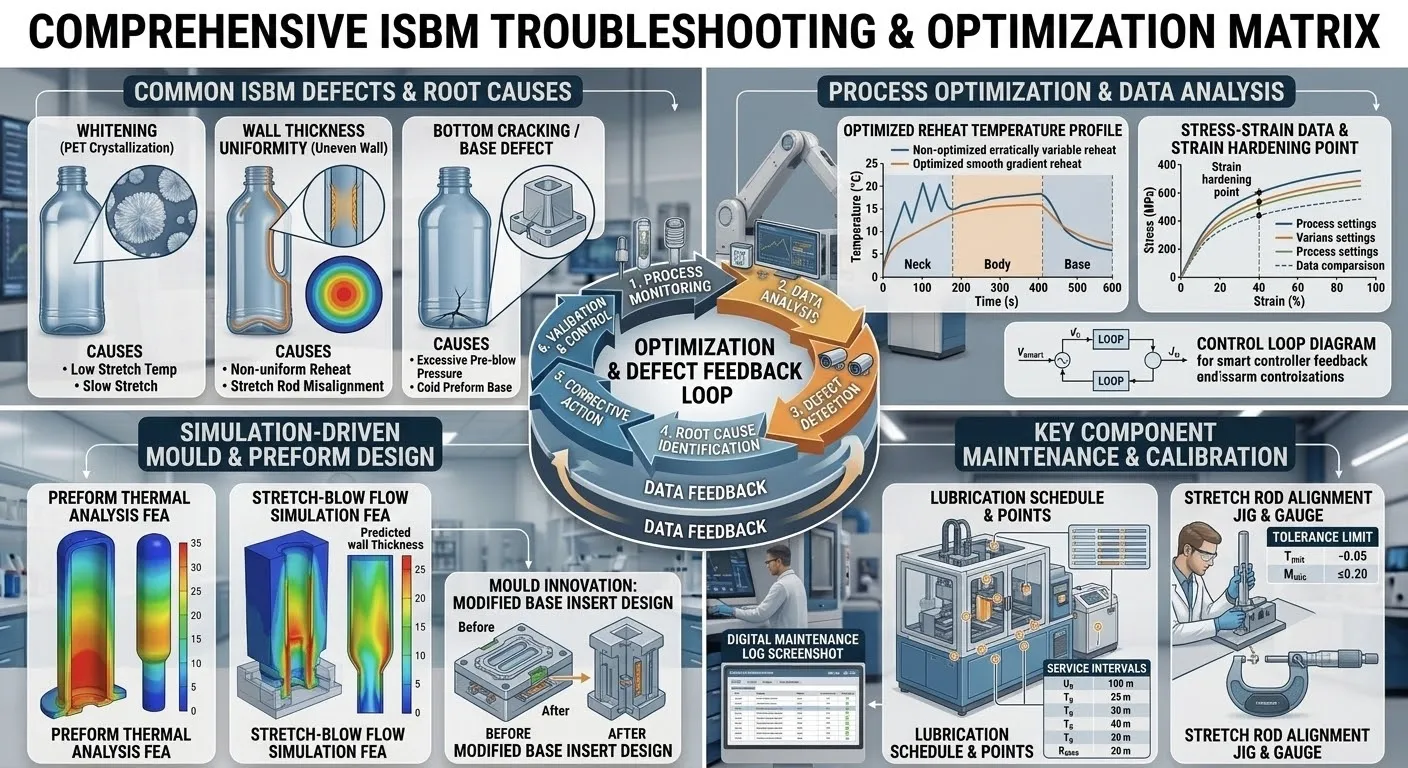
When a region of the preform is stretched beyond its natural stretch limit while it is too cold, the polymer matrix tears on a microscopic level. This manifests as stress whitening, also called pearlescence, a milky, iridescent sheen that is a catastrophic aesthetic defect in premium packaging. Complex shapes with deep contours or sharp corners are particularly prone to this defect because the material is forced to stretch around tight radii, creating localized regions of extreme strain. The challenge for the manufacturer is to design the preform and the process such that the maximum local stretch ratio everywhere on the container remains safely below the material’s limit. This requires finite element simulation to identify the stress concentration points, and then either modifying the preform geometry to provide more material to those regions, adjusting the conditioning to make those regions warmer and more pliable, or modifying the stretch rod motion to deliver material more gently. The servo-driven stretch rod on the EP-HGY150-V4-EV Full Servo Machine is particularly valuable here, as its programmable motion profile can decelerate as the material enters the tightest contours, reducing the peak strain rate and preventing tearing.
Challenge Two: Creating Deliberate Thermal Gradients for Directed Material Flow
For complex shapes, a uniform preform temperature is the enemy of uniform wall thickness. The thermal conditioning must create precise, often circumferential, temperature variations to control where material flows.
🌡️Circumferential Temperature Profiling for Flat-Oval Shapes
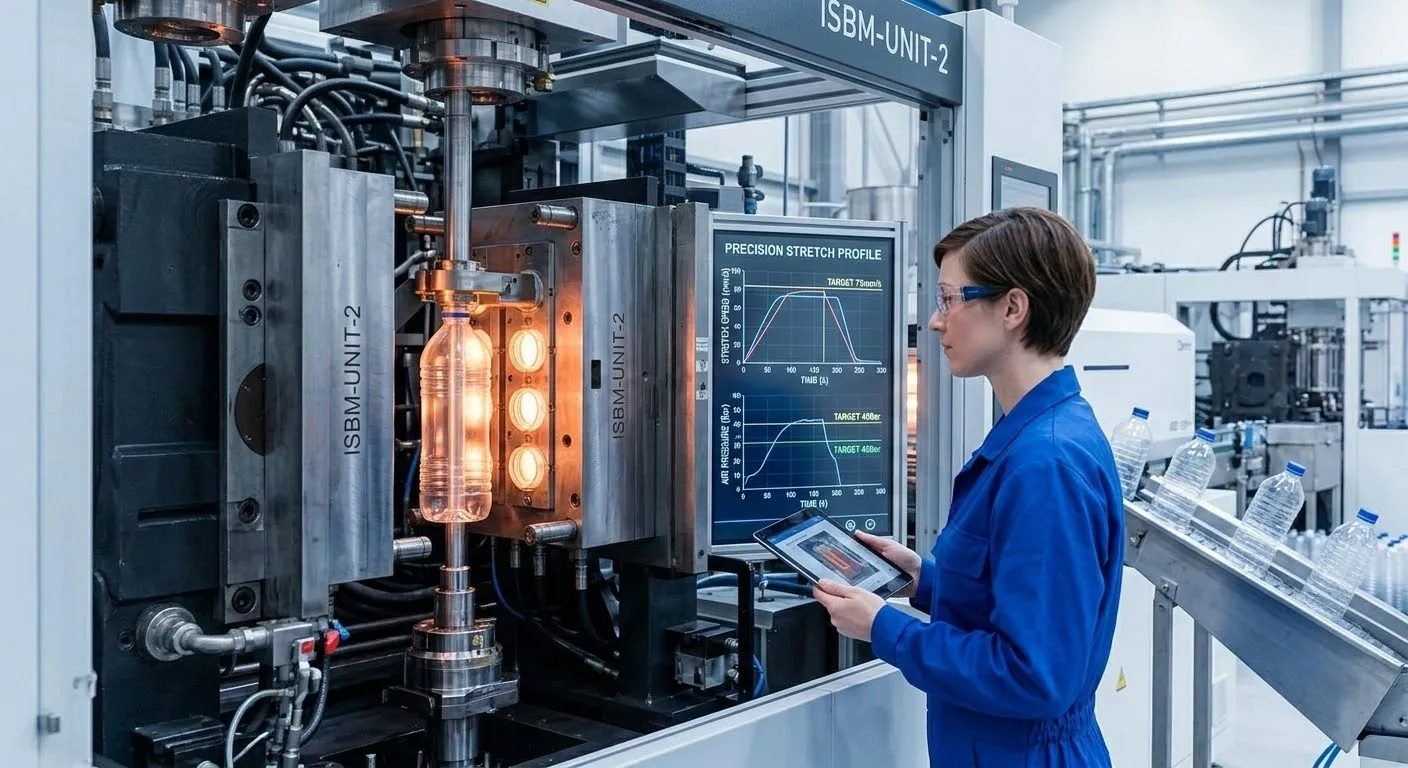
In a cylindrical container, the preform experiences essentially the same radial stretch in every direction. The conditioning target is a uniform temperature around the entire circumference. A flat-oval container completely overturns this paradigm. The preform must stretch much further toward the flat faces than toward the curved edges. If the preform is uniformly conditioned, the flat-face regions will become dangerously thin while the edge regions remain thick and under-oriented. The solution is to condition the preform with a deliberate circumferential temperature profile. The regions of the preform that will stretch toward the flat faces are conditioned to a slightly higher temperature, making them softer and encouraging them to flow more readily and thin out less per unit of stretch. The regions that will stretch toward the curved edges are conditioned to a slightly lower temperature, making them stiffer and encouraging them to retain their thickness. Creating this circumferential temperature profile is a significant engineering challenge. On simpler machines, it can be approximated by shielding portions of the preform from the conditioning heat, or by rotating the preform through a non-axisymmetric thermal field. On advanced six-station machines like the EP-HGYS280-V6, the dual conditioning stations can be programmed with different temperatures and exposure times to create a precisely controlled, stepped thermal profile that guides the material exactly where it is needed.
🎯Axial Zonal Profiling for Pronounced Shoulders and Bases
Complex shapes also demand sophisticated axial thermal profiling. Containers with pronounced, wide shoulders require the shoulder region of the preform to stretch radially much more than the body. Containers with deep punts or complex footed bases require the base region to be warm enough to fill the intricate mold features without becoming so hot that it crystallizes hazily. The conditioning station must provide independently controllable heating zones along the length of the preform. The body zone may be set to one temperature, the shoulder zone to a higher temperature, and the base zone to a carefully managed intermediate temperature. The neck finish must remain completely cool and rigid. Achieving this zonal thermal profile while maintaining a high cycle rate is a challenge that demands precise control over the conditioning fluid temperature and flow rate, as well as the physical design of the conditioning pots to ensure good thermal contact with the preform. For extremely complex containers, the extended conditioning time available on the EP-HGYS280-V6 is essential to allow the thermal profile to equilibrate through the wall thickness of the preform, ensuring that the material behaves consistently during stretching.
Challenge Three: Blow Mold Engineering for Complex Geometries
The blow mold itself presents formidable engineering challenges when the container geometry is complex. Trapped air, uneven cooling, and the difficulty of polishing deep recesses all threaten container quality.
💨Trapped Air and Venting in Deep Recesses
As the preform inflates against the blow mold wall, the air that was in the cavity must be evacuated. In a simple cylinder, the air can easily escape along the parting line. In a complex shape with deep contoured panels, undercuts, or intricate logo engraving, air can become trapped in these recesses. The rapidly expanding plastic cannot push the air out of the way, and the result is a defect: a rounded, unfilled corner, a burn mark from the heat of compressed air, or a surface blemish. The mold must incorporate an extensive network of precision venting channels that allow air to escape from every deep feature. These vents are typically microscopic slots or porous sintered metal inserts that allow air to pass but not the viscous PET. Designing the venting system for a complex mold requires computational fluid dynamics simulation to predict where air will be trapped. The Custom One-Step Injection Stretch Blow Moulds from Ever-Power incorporate sophisticated venting systems that are engineered concurrently with the cavity geometry, ensuring that every feature fills completely with every cycle.
🔧Differential Cooling and Surface Finish Challenges
The blow mold must cool the container to stabilize its dimensions before ejection. However, the heat transfer from the plastic to the mold wall is not uniform in a complex shape. Thick regions of the container, such as the base or thick shoulders, reject more heat and take longer to cool than thin regions. If the cooling is not balanced, the container will emerge with a non-uniform temperature distribution, leading to warpage or post-molding shrinkage that distorts the carefully engineered shape. The mold cooling channels must be designed to extract heat more aggressively from thick regions. Additionally, the interior surface of the blow mold must be polished to a mirror finish to impart the glass-like aesthetic expected of premium ISBM containers. Polishing a complex cavity with deep recesses, sharp corners, and intricate text is a highly skilled, time-consuming operation. Any imperfection in the polish will be replicated on every container, creating a cosmetic defect. For high-volume production of complex containers using double-row architectures like the EP-HGY250-V4-B, the quality of the mold polish across all cavities must be perfectly consistent to ensure that every bottle meets the brand’s aesthetic standard.
Challenge Four: Material Limitations Amplified by Geometric Complexity
The inherent processing challenges of recycled PET and other alternative materials are magnified when the container geometry is complex, demanding a higher level of process control and machine capability.
rPET Brittleness and Reduced Stretch Capability
Post-consumer recycled PET has a lower intrinsic viscosity and a broader distribution of molecular chain lengths than virgin resin. This makes it inherently more brittle and less tolerant of the high, localized stretch ratios encountered in complex container geometries. A corner or contour that a virgin PET preform can fill without issue may cause tearing and stress whitening when rPET is used. The natural stretch limit is effectively reduced, forcing the preform designer to use a more conservative geometry with thicker walls, which adds weight and cost. The servo-driven injection and stretch capabilities of machines like the EP-HGY150-V4-EV are essential for rPET complex shapes. The stretch rod can be programmed with a gentle, decelerating motion profile that reduces the peak strain rate in the tightest contours, giving the material more time to flow without tearing. The conditioning temperatures may need to be elevated slightly to increase the material’s pliability, but only within the narrow window before thermal crystallization begins. Processing complex shapes with rPET is a delicate balancing act that demands the highest level of machine precision and process expertise.
Polypropylene Processing for Complex Hot-Fill Shapes
Polypropylene is increasingly used in ISBM for hot-fill and retort containers. Complex PP shapes present a unique set of challenges. PP crystallizes more rapidly than PET, making it harder to maintain an amorphous preform. The processing window is narrower. PP also has a lower natural stretch ratio, typically 6 to 8 planar, limiting how aggressively the preform can be stretched into a complex mold cavity. This often means that PP preforms for complex shapes must be designed with a larger starting diameter, reducing the required radial stretch but increasing the preform weight. The optical clarity of PP, even clarified grades, is more sensitive to processing conditions. If the preform is stretched at the wrong temperature or speed, the crystal morphology will scatter light, producing an undesirable haze. The precise, programmable stretch rod and pneumatic control of the EP-HGY50-V3-EV are invaluable for navigating these tight processing constraints.
The Critical Role of Simulation in Complex Shape Design
Given the multitude of interacting challenges, designing a complex ISBM container without the aid of finite element simulation is effectively impossible in modern manufacturing. The simulation software models the entire process: the preform heating, the stretch rod descent, the pre-blow and final blow inflation, and the contact with the mold wall. It predicts the local stretch ratios, the wall thickness distribution, and even the residual stress patterns. This allows the engineer to identify problem areas before any steel is cut. The preform thickness profile, the conditioning temperatures, and the stretch rod motion can all be optimized in the virtual environment. This simulation-driven design process, a core service of the engineering team at Ever-Power, reduces the number of physical mold iterations and compresses the development timeline for complex containers. It is the intellectual foundation upon which successful complex shape ISBM production is built.

Integrated Solutions: How Advanced ISBM Platforms Overcome Complex Shape Challenges
The challenges of complex shape ISBM production are not overcome by any single technology. They require an integrated solution where the machine, the mold, and the process parameters are engineered as a unified system.
Dual Conditioning and Servo-Driven Precision
The six-station architecture of the EP-HGYS280-V6 provides the thermal preparation time and precision necessary for complex shapes. The dual conditioning stations allow the preform to be heated in stages, establishing the circumferential and axial temperature profiles that direct material flow. Servo-driven stretch rods on machines like the EP-HGY150-V4-EV provide the programmable motion control to guide the material into tight contours without overstressing it. These technologies, combined with precisely engineered Custom One-Step Injection Stretch Blow Moulds that incorporate optimized venting and conformal cooling, form an integrated solution that transforms complex shape production from a problematic source of scrap into a reliable, repeatable manufacturing process.
Simulation-Driven Preform Design and Process Development
The foundation of successful complex shape production is laid before the mold is manufactured. Finite element simulation allows the preform geometry to be optimized, the conditioning profile to be defined, and the stretch rod motion to be programmed in a virtual environment. This simulation-driven approach compresses development time and reduces the costly trial-and-error iterations on the production floor. At Ever-Power, our engineering team provides this simulation expertise as an integrated service alongside our machine and mold offerings, ensuring that our customers’ complex container designs transition from concept to production with minimal delay and maximum confidence. For high-volume production of complex shapes, the industrial-scale EP-HGY650-V4 provides the throughput to meet market demand without compromising on the precision required for complex geometries.
Conquer Complex Shape Challenges with Integrated ISBM Engineering
The challenges ISBM manufacturers face when designing bottles with complex shapes are formidable but surmountable. Asymmetric biaxial stretching, deliberate thermal gradient creation, intricate blow mold engineering, and the amplified difficulties of processing rPET and PP all demand a sophisticated, integrated approach. At Ever-Power, our advanced machine platforms, from the six-station EP-HGYS280-V6 to the servo-driven EP-HGY150-V4-EV, combined with our in-house Custom One-Step Injection Stretch Blow Moulds and simulation-driven engineering services, provide the complete solution for producing visually stunning, structurally flawless complex containers at production scale.