Are extrusion and injection molding the same?
Extrusion and injection moulding are not the same process. Both melt plastic and force it through a die or into a cavity under pressure, but the forming mechanism, the type of output, and the applications they serve are fundamentally different. Understanding the distinction — and where injection stretch blow moulding (ISBM) uses elements of both — is important for anyone specifying plastics manufacturing equipment.
Extrusion: Continuous Profiles
Extrusion is a continuous process in which plastic resin is melted and pushed through a die opening of a fixed cross-sectional shape. The output is a continuous profile — a tube, sheet, rod, film, or pipe — that is then cut or wound downstream. The extrudate takes the shape of the die opening and is not confined by a mould; its dimensions are set by the die geometry and drawdown speed. Extrusion is used to produce plastic pipe, film and sheet, window profiles, wire coatings, and the parison in extrusion blow moulding (EBM).
Injection Moulding: Discrete Solid Parts
Injection moulding is a cyclic process in which a precise shot of molten plastic is injected under high pressure into a closed mould cavity. The cavity defines the part’s geometry completely; the plastic fills the mould and solidifies against the walls. The mould opens, the part is ejected, and the cycle repeats. Injection moulding produces discrete solid parts with complex three-dimensional geometry — caps and closures, automotive components, medical devices, and preforms for the injection step in ISBM.
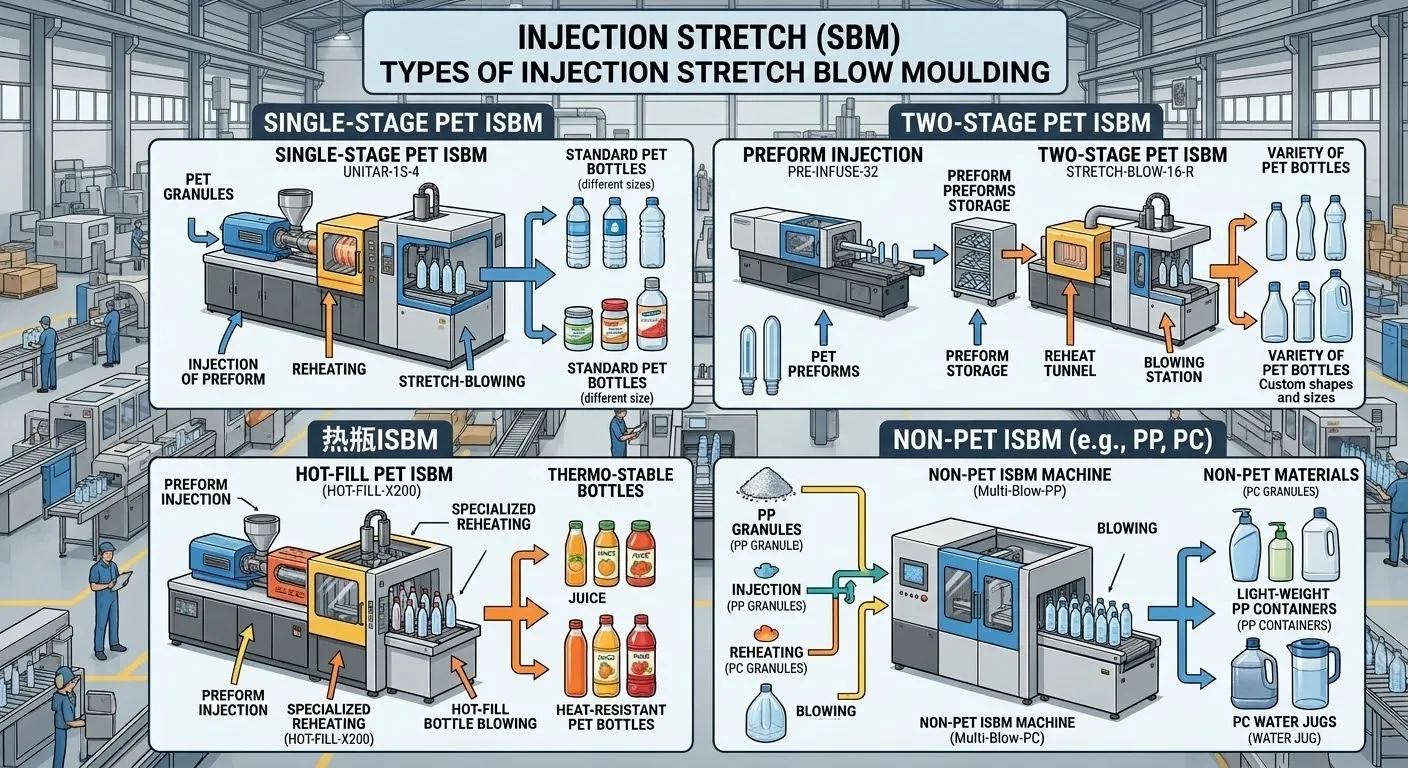
One-step ISBM uses injection moulding (not extrusion) to form the preform, then a blow step to form the finished container.
Key Differences
| Attribute | Extrusion | Injection Moulding |
|---|---|---|
| Process type | Continuous | Cyclic (batch) |
| Output | Continuous profile (tube, sheet, rod) | Discrete solid parts |
| Geometry control | Cross-section only (set by die) | Full 3D geometry (set by mould) |
| Tooling | Open die | Closed mould (cavity and core) |
| Pressure | Low to moderate | Very high (800–2,000 bar typical) |
| Applications | Pipe, film, sheet, profiles, parison | Caps, housings, preforms, components |
Where They Overlap: Extrusion Blow Moulding
In extrusion blow moulding (EBM), extrusion and blow moulding are combined in sequence. The extruder produces a continuous parison (hollow tube), which is captured by a closing mould and inflated with blow air. This is why EBM machines have a continuously-running extruder combined with a cyclic blow moulding station.
Where ISBM Uses Injection Moulding, Not Extrusion
One-step ISBM machines use injection moulding — not extrusion — to form the preform that is then stretch-blown into the finished container. This is a critical distinction from EBM. The ISBM injection step produces a precise, injection-moulded preform with a finished neck thread and controlled wall thickness; the EBM extrusion step produces a parison with less dimensional precision. This is why ISBM containers achieve the neck finish accuracy and weight tolerances required for pharmaceutical packaging, while EBM cannot.
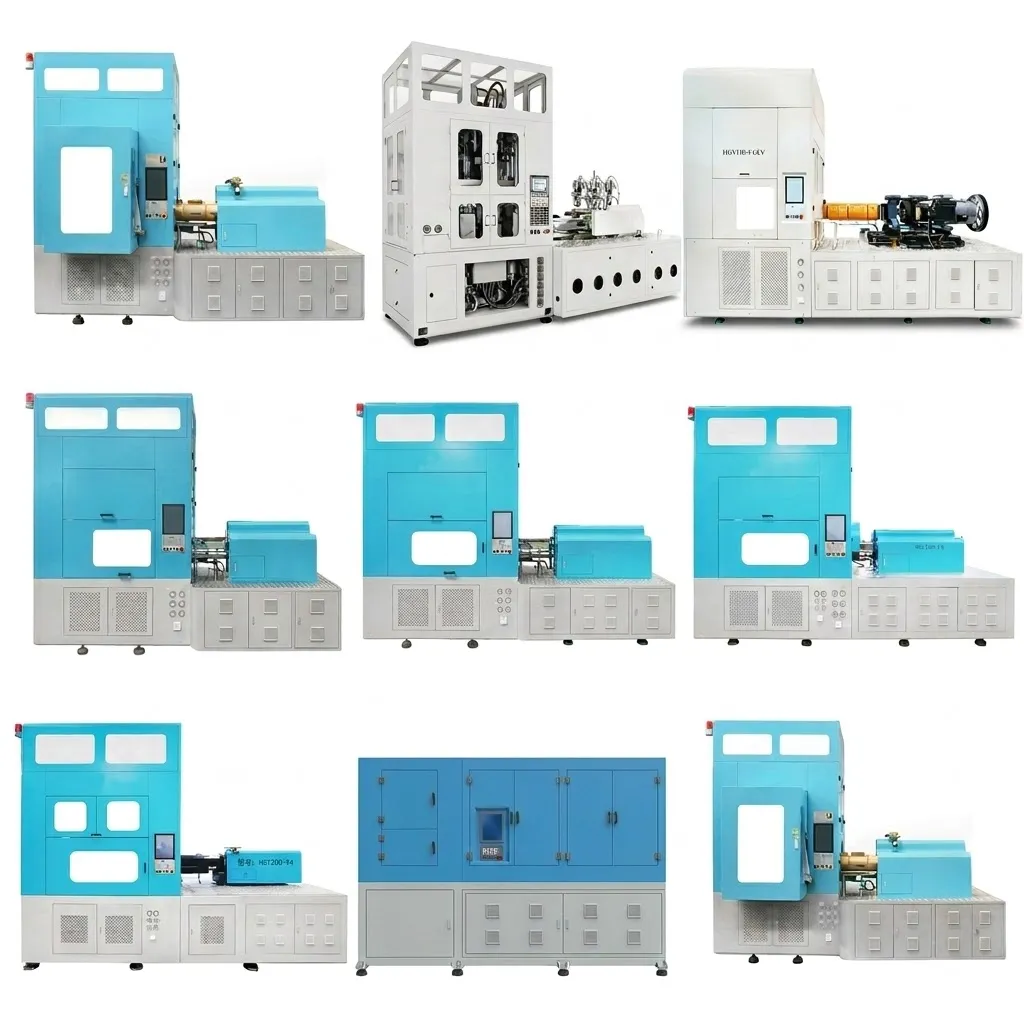
Containers from one-step ISBM — the injection moulding preform step enables tighter weight tolerances and better neck precision than EBM’s extruded parison.
Need to choose the right process for your container?
Ever-Power’s team can confirm whether one-step ISBM, IBM, or EBM is right for your container size, resin, and performance requirements within 24 hours.
Explore the one-step ISBM machine range, or visit the water, beverage and chemical container page for application-specific examples.
Frequently Asked Questions
Do injection moulding machines use an extruder internally?
Injection moulding machines use a reciprocating screw that functions as both an extruder (rotating to melt and convey resin) and an injection plunger (advancing axially to inject the melt shot). The screw mechanism is based on extruder design but operates cyclically rather than continuously. The process output — discrete shot-moulded parts — is fundamentally different from extrusion’s continuous profile output.
Which process produces PET bottles?
Neither extrusion alone nor injection moulding alone produces finished PET bottles. PET bottles are produced by injection stretch blow moulding (ISBM), which uses injection moulding to form the preform and a stretch-blow step to form the finished bottle. The injection moulding component of ISBM distinguishes it from EBM, where an extruded parison is used instead of an injection-moulded preform.
Is EBM better or worse than injection moulding for containers?
Neither is universally better — they serve different applications. EBM is better for large HDPE containers, containers with handles, and very high-volume commodity production where dimensional precision is less critical. Injection moulding (as part of ISBM) is better for precise pharmaceutical containers and for PET containers requiring biaxial orientation, high clarity, and light weight. The right process depends on container size, resin, performance requirements, and production volume.
The Screw: Where Extrusion and Injection Moulding Share Technology
Although extrusion and injection moulding are distinct processes, they share one critical piece of technology: the reciprocating screw. Both use a helical screw rotating inside a heated barrel to melt and convey plastic resin. In a continuous extruder, the screw rotates at constant speed and the melt flows continuously through the die. In an injection moulding machine, the screw rotates to plasticise resin (exactly as in an extruder) and then advances axially like a plunger to inject the accumulated melt shot. This axial injection stroke is what separates the injection moulding machine from a pure extruder and enables discrete, precisely metered shots of material to be delivered to the mould. In one-step ISBM machines, the reciprocating screw plasticises resin while the previous cycle’s preform is being blown and cooled, then advances to inject the new melt shot when the preform mould closes — combining both functions within each production cycle.
Process Selection: The Right Technology for Your Product
The plastics industry offers four primary forming technologies for containers and profiles: extrusion (for continuous profiles, pipe, and film); injection moulding (for solid discrete parts); extrusion blow moulding (for large HDPE containers); and injection blow or stretch blow moulding (for precise hollow containers in PET, PP, and PETG). Each has a distinct cost, quality, and application profile. The correct technology for any given product is determined by: the product’s geometry (solid or hollow; large or small; round or complex); the material required; the performance requirements (clarity, barrier, strength, weight); and the production volume. For finished PET bottles in pharmaceutical, cosmetic, food, or beverage applications at volumes from 100,000 to 10 million units per year, one-step ISBM is almost always the optimal forming technology. This is evidenced by the fact that the vast majority of PET bottles produced globally are made by some variant of injection stretch blow moulding.
Key Takeaway for Equipment Buyers
Extrusion and injection moulding are not the same process, and neither alone produces finished PET bottles. PET bottle production requires injection stretch blow moulding (ISBM) — a process that uses injection moulding to form the preform and blow moulding to form the bottle, integrated in one machine. When you see an ISBM machine described as an “injection moulding machine for bottles,” the description is partly accurate — but what matters is the output: finished hollow containers, not solid parts. If your goal is bottles, the machine you need is an ISBM machine, and Ever-Power’s EP-HGY and EP-BPET series covers the full range of one-step ISBM applications from 30 ml pharmaceutical vials to 10-litre industrial containers. Contact our team with your bottle specification and we will recommend the right machine within 24 hours.
Practical Implications for Plant Layout and Utility Planning
Understanding the difference between extrusion, injection moulding, and ISBM has direct implications for plant layout and utility planning. Extrusion lines are long and narrow — the extruder feeds into a die, then a cooling trough or air knife, then a haul-off and cutter or winder, all in line. Injection moulding presses are compact and self-contained, requiring only electrical power, cooling water, and compressed air at low pressure. ISBM machines are compact but require a broader utility package: high-pressure blow air at 25–40 bar (requiring a dedicated high-pressure compressor), mould cooling water at 8–12 °C (requiring a dedicated chiller), and a PET resin dryer (requiring a desiccant dryer at 160–170 °C with sufficient capacity for the machine’s throughput).
When planning a facility that will include ISBM production for the first time, the utility infrastructure must be designed to serve the ISBM machine’s specific requirements from day one. Attempting to adapt an existing injection moulding utility supply (low-pressure air, standard cooling tower water) to ISBM requirements is a common and costly mistake: the high-pressure compressor and precision chiller are not optional accessories but mandatory process requirements without which the ISBM machine cannot function.
Summary: Not the Same, but Related
Extrusion and injection moulding are not the same process, but they are related in two important ways. First, both use a screw-and-barrel mechanism to melt and convey plastic resin — the injection moulding machine’s reciprocating screw is derived from extruder technology. Second, both are combined with blow moulding in commercial hollow container manufacturing: extrusion is combined with blow moulding in EBM, and injection moulding is combined with blow moulding in IBM and ISBM. The combination of injection moulding and blow moulding in one-step ISBM is what produces the oriented PET containers that serve the global pharmaceutical, cosmetic, food, and beverage packaging markets. Understanding that ISBM is neither pure extrusion nor pure injection moulding but a hybrid of injection moulding and blow moulding is the key to understanding why it requires specialist machines, specialist moulds, specialist process knowledge, and specialist suppliers.
How to Start the Supplier Evaluation Process
For buyers new to ISBM equipment procurement, the process of selecting a machine and mould supplier can seem daunting. The practical starting point is not a supplier shortlist but a clear container specification: define the bottle volume, neck finish, resin, target weight, required output, and any application-specific requirements (pharmaceutical GMP, hot-fill, cleanroom compatibility) before approaching any supplier. With a complete container specification in hand, you can obtain meaningful and comparable quotations from multiple suppliers, because each quotation will be based on the same technical inputs.
Ever-Power’s pre-sales process begins with a technical review of the customer’s container specification. Our applications engineering team assesses the specification against our machine range, recommends the appropriate model (station count, clamping force, drive system), and provides a preliminary mould feasibility assessment — all at no charge and typically within 24–48 hours of receiving the specification. This preliminary assessment allows buyers to understand the likely machine and mould configuration, and the associated investment, before committing to a detailed quotation process.
Ever-Power’s Full ISBM Product Range
Ever-Power’s complete one-step ISBM machine range covers every major application in pharmaceutical, cosmetic, food, beverage, and industrial container production:
| Model | Stations | Clamp (kN) | Container Range | Drive |
|---|---|---|---|---|
| EP-HGY50-V3-EV | 3 | 50 | 30–500 ml | Full servo |
| EP-HGY150-V4 | 4 | 150 | 100 ml–2 L | Servo-hydraulic |
| EP-HGY150-V4-EV | 4 | 150 | 100 ml–2 L | Full servo |
| EP-HGY200-V4 | 4 | 200 | 200 ml–3 L | Servo-hydraulic |
| EP-HGY200-V4-B | 4 | 200 | 200 ml–3 L (handle) | Servo-hydraulic |
| EP-HGY250-V4 | 4 | 250 | 500 ml–5 L | Servo-hydraulic |
| EP-HGYS280-V6 | 6 | 280 | Complex shapes | Servo-hydraulic |
| EP-HGY650-V4 | 4 | 400 | 2–10 L | Servo-hydraulic |
| EP-BPET-70V4 | 4 | 200 | 500 ml–3 L (PET) | Servo-hydraulic |
| EP-BPET-94V3 | 3 | 250 | 1–5 L (PET) | Servo-hydraulic |
| EP-BPET-125V4 | 4 | 400 | 5–10 L (PET) | Servo-hydraulic |
For full technical specifications for each model, visit the EP-HGY and EP-BPET product pages. For application-specific guidance, contact our team at isbmmolding.com/contact-us or email [email protected]. We respond within 24 hours to all technical enquiries.
Practical Guidance for Buyers
If you are evaluating equipment to produce plastic bottles or containers, the key distinction to understand is that extrusion is not the right process — ISBM (which uses injection moulding as its preform step) is. If you are evaluating equipment for solid plastic parts, profiles, or sheet, injection moulding or extrusion are both relevant options depending on whether you need discrete parts (injection moulding) or continuous profiles (extrusion).
Confusion between extrusion and injection moulding most commonly arises when buyers encounter EBM machines for the first time, since EBM uses an extruder as its resin-melting system. But the output of an EBM machine is still a hollow blow-moulded container, not an extruded profile — the extruder in an EBM machine is a component of the blow moulding system, not a standalone extrusion line. The finished container’s quality, material, and performance are determined by the blow moulding step, not by the extruder. Specifying the right equipment category from the beginning prevents costly errors in machine selection, tooling investment, and production planning.