Blow Molding Technology Comparison
What Are the Differences Between ISBM and Extrusion Blow Molding?
A comprehensive head-to-head engineering analysis contrasting process architecture, molecular orientation, material compatibility, container performance, and economic suitability of the two dominant blow molding technologies.
Two Divergent Paths to Hollow Plastic Containers
In the vast landscape of plastic packaging manufacturing, two blow molding technologies dominate the production of hollow containers: Injection Stretch Blow Molding and Extrusion Blow Molding. While both processes ultimately deliver a hollow plastic bottle, the paths they take, the molecular architectures they create, the materials they can process, and the performance characteristics of their output are fundamentally and profoundly different. For packaging engineers, brand owners, and manufacturing executives, a clear understanding of the differences between ISBM and extrusion blow molding is not an academic exercise. It is a strategic imperative that directly determines which technology is appropriate for a given container application, which materials can be used, what performance specifications can be met, and what the manufacturing economics will look like. At Ever-Power, a globally recognized Brazilian manufacturer of ISBM equipment, our engineering teams work extensively with clients transitioning from or comparing against extrusion blow molding, providing deep technical insight into the capabilities and limitations of each process.
The differences between ISBM and extrusion blow molding span every aspect of the manufacturing process. ISBM is a discrete, indexed process that begins with an injection-molded preform, conditions it to a precise temperature, and then stretches it biaxially using a mechanical rod and high-pressure air. Extrusion blow molding is a continuous process that extrudes a molten tube, the parison, which is then inflated against a mold cavity. ISBM imparts biaxial molecular orientation and strain-induced crystallization, creating containers of exceptional strength, clarity, and barrier performance, but it is primarily limited to PET and a select few other semi-crystalline resins. Extrusion blow molding imparts minimal orientation, producing containers with lower strength and clarity but with the ability to process a wide range of materials, including HDPE, PP, PVC, and many engineering resins, and to produce containers with integrated handles and complex, asymmetrical shapes. This comprehensive engineering analysis will dissect these differences across every dimension that matters to a packaging operation, from process architecture and polymer physics to container performance characteristics and production economics. We will reference specific ISBM platforms like the EP-HGY150-V4 4-Station Machine to illustrate the technological capabilities that distinguish ISBM from its extrusion counterpart.
Choosing between ISBM and extrusion blow molding is one of the most consequential decisions in packaging manufacturing. This guide provides the comprehensive technical comparison necessary to make that decision with confidence and precision.
Fundamental Process Architecture: Discrete Precision Versus Continuous Flow
The most fundamental difference between ISBM and extrusion blow molding lies in their process architecture, which dictates every downstream capability and limitation.
ISBM: The Integrated, Indexed Four-Station Cell
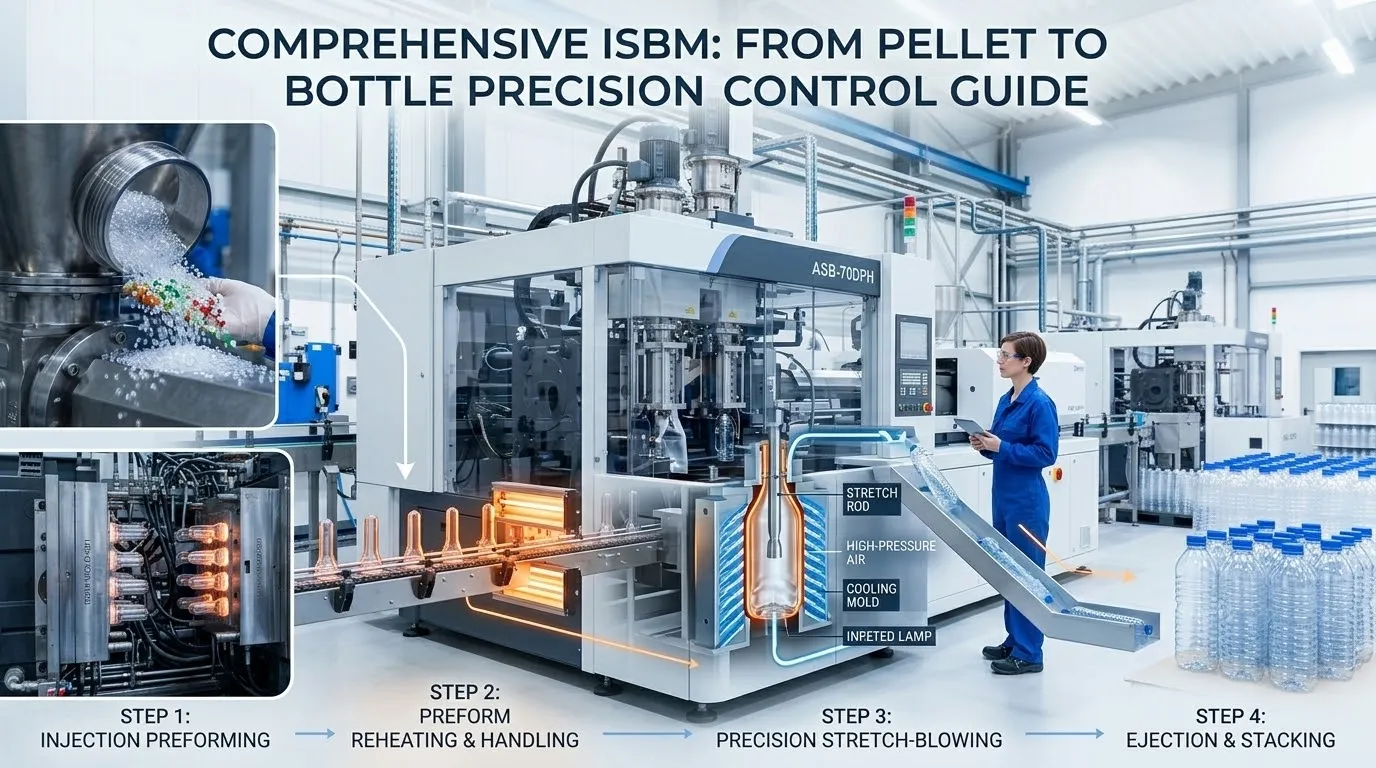
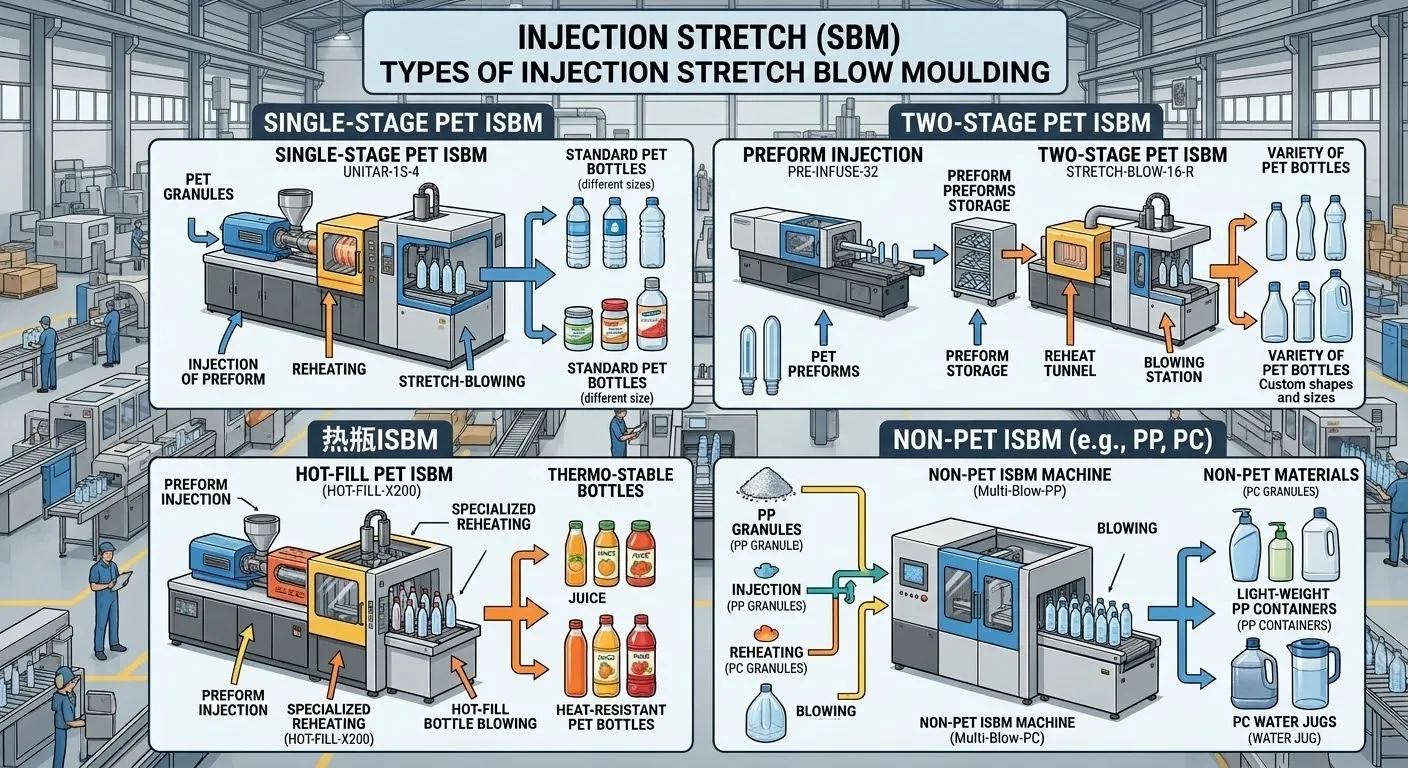
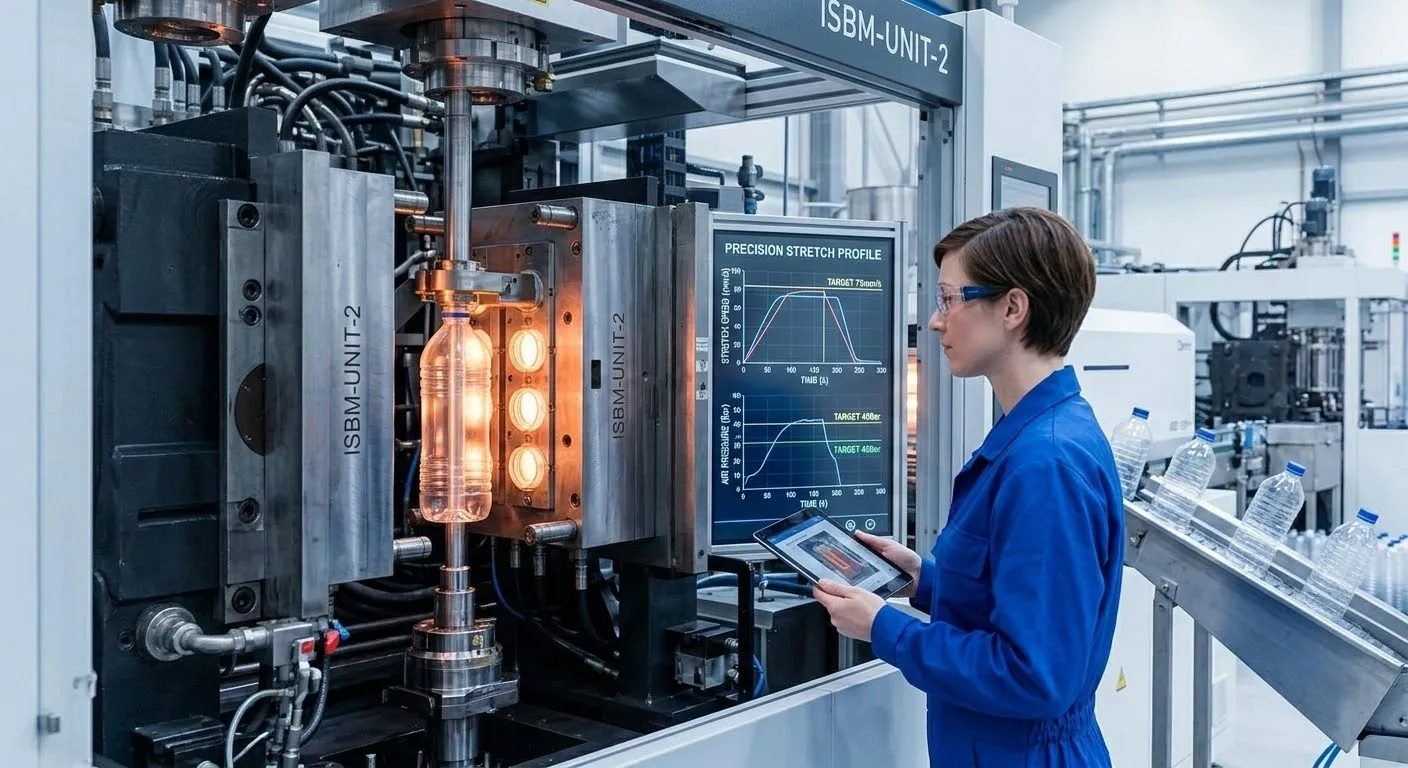
The ISBM process, particularly in its single-stage configuration, is a discrete, indexed operation. The entire transformation from pellet to finished container occurs within a single, compact machine cell. A rotary table indexes preforms sequentially through four stations: injection, where an amorphous preform is molded; conditioning, where it is brought to its precise stretching temperature; stretch-blow, where it undergoes biaxial orientation; and ejection. Each station performs its function simultaneously with the others, enabling parallel processing and high throughput from a compact footprint. The ISBM process begins with a solid preform of precisely defined geometry, wall thickness, and thermal history. This preform is the engineered blueprint for the final container. The stretch-blow step then mechanically and pneumatically forces this preform into the blow mold cavity with programmable speed and timing. This discrete, preform-based approach provides extraordinary control over material distribution and molecular orientation. Machines like the EP-HGY150-V4 embody this architecture, delivering micron-level precision in every movement. The single-stage nature also provides inherent energy efficiency through thermal continuity, as the preform retains latent heat from injection through to conditioning.
Extrusion Blow Molding: The Continuous Parison Process
Extrusion blow molding is a fundamentally continuous process. An extruder continuously plasticates and pumps molten polymer through a die head, forming a vertical tube of molten plastic called a parison. When the parison reaches a predetermined length, a two-part mold closes around it, pinching the top and bottom of the parison shut. A blow pin is inserted, and compressed air inflates the parison against the chilled mold walls. The container cools, the mold opens, and the finished container is ejected. The process then repeats for the next parison. There is no discrete preform stage, no mechanical stretching, and no intermediate thermal conditioning. The parison is a simple tube of molten, completely unoriented polymer. Its wall thickness is controlled by adjusting the gap of the extrusion die during the parison extrusion, a technique called parison programming. While this provides some ability to thicken the parison in regions that will undergo more stretching, the control is inherently less precise than the engineered preform of ISBM. The parison also sags under its own weight during extrusion, causing a natural thinning toward the top of the container. The continuous nature of extrusion blow molding allows for high throughput of simple containers and is well-suited to materials that are difficult to injection mold, but it cannot achieve the molecular orientation, optical clarity, or wall thickness precision of ISBM.
Molecular Architecture: The Chasm of Orientation
The most consequential technical difference between ISBM and extrusion blow molding lies at the molecular level. ISBM creates biaxial orientation and strain-induced crystallization. Extrusion blow molding does not.
🧬Biaxial Orientation in ISBM: The Source of Strength and Barrier
In the ISBM stretch-blow station, the conditioned preform is simultaneously stretched in two perpendicular directions. The stretch rod forces the material to elongate axially, while the blow air forces it to expand radially. This biaxial stretching aligns the polymer chains in both the axial and hoop directions, creating a two-dimensional network of oriented chains. The chains are stretched to the point where they spontaneously nucleate into nanoscale strain-induced crystallites. These crystallites act as physical crosslinks, dramatically increasing the material’s tensile strength, creep resistance, and impact toughness. They also serve as impermeable barriers to gas molecules, reducing the permeability of the container wall and extending product shelf life. This dual-axis orientation and crystallization is the defining feature of ISBM and the source of its superior container performance. The degree of orientation is controlled by the stretch ratios and the stretching temperature, parameters that are precisely adjustable on machines like the EP-HGY150-V4-EV with its servo-driven stretch rod and programmable pneumatic timing.
💧Limited Orientation in Extrusion Blow Molding: The Performance Gap
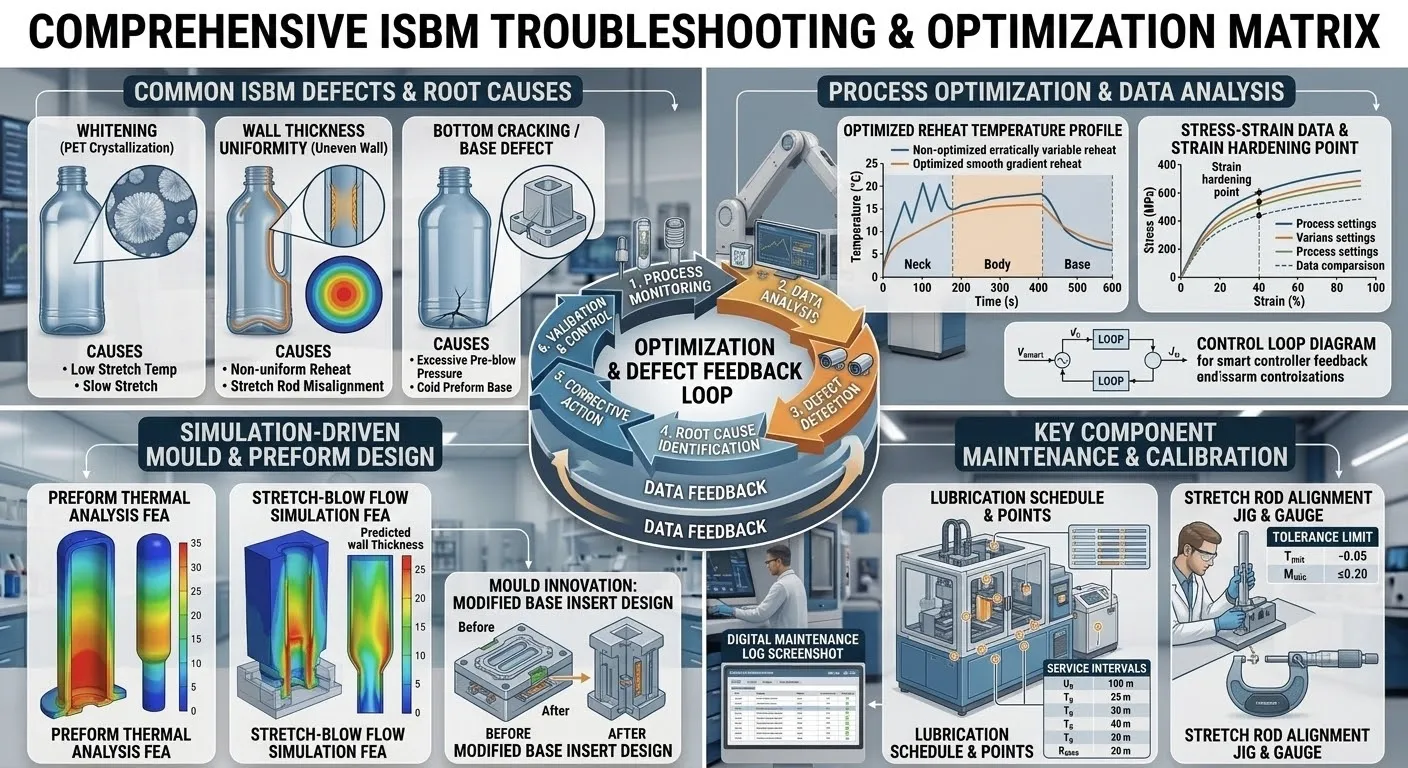
Extrusion blow molding inflates a completely molten, unoriented parison. The inflation provides some radial stretching, creating a degree of uniaxial orientation in the hoop direction, but there is no mechanism for axial stretching. The polymer chains remain predominantly randomly coiled in the axial direction. Furthermore, because the parison is molten, the polymer chains are highly mobile and can relax significantly during and after inflation, losing much of whatever orientation was imparted. The result is a container with polymer chains that are largely unoriented and amorphous, held together by relatively weak van der Waals forces rather than the strong covalent backbone alignment of oriented chains. This fundamental difference in molecular architecture explains why extrusion blow molded containers have significantly lower tensile strength, lower burst pressure resistance, higher creep rates, poorer gas barrier properties, and inferior optical clarity compared to ISBM containers of the same weight. The material is simply not being utilized to its full mechanical potential. This performance gap is the primary reason extrusion blow molding is commercially confined to non-carbonated products, opaque containers, and applications where the container’s mechanical performance requirements are relatively modest.
Material Compatibility and Container Performance Domains
The two processes serve largely different material and application domains, a divergence driven by the fundamental differences in their process physics.
🎯ISBM: The Domain of High-Clarity, High-Performance PET Packaging
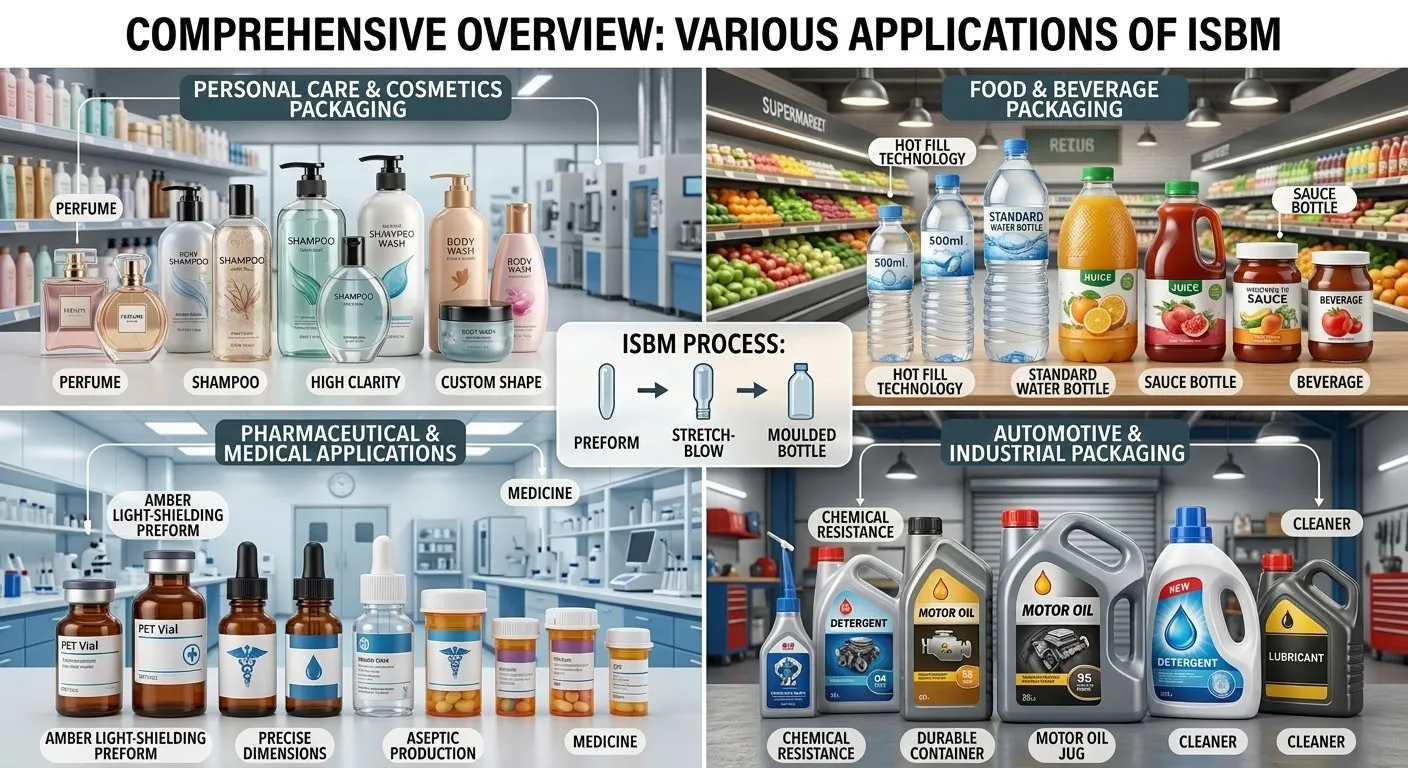
ISBM is overwhelmingly dominated by PET, which possesses the ideal combination of slow crystallization kinetics, a suitable glass transition temperature, and a natural stretch ratio that aligns with common container geometries. ISBM is the process of choice for carbonated soft drink bottles, premium water bottles, high-end cosmetic and personal care containers, pharmaceutical packaging, and any application where glass-like clarity, pressure resistance, and lightweight strength are required. ISBM can also process PP for hot-fill and retort applications, and specialty copolyesters like Tritan and PETG for reusable containers. However, ISBM is not a universal process. It cannot process HDPE, the workhorse material of extrusion blow molding for milk jugs and household chemical bottles, because HDPE is not amorphous at room temperature and does not undergo strain-induced crystallization in the same way. The material palette of ISBM, while growing, is narrower than that of extrusion blow molding. For its core materials, however, ISBM delivers container performance that extrusion blow molding cannot approach. Machines like the EP-HGY250-V4-B are purpose-built for high-volume production within this premium material domain.
Extrusion Blow Molding: The Versatile Generalist for Polyolefins and Engineered Shapes
Extrusion blow molding is the versatile generalist of hollow container manufacturing. Its continuous, parison-based process is inherently compatible with a wide range of thermoplastic materials, including HDPE, LDPE, PP, PVC, and many engineering resins. It is the dominant process for milk jugs, juice bottles, shampoo and detergent bottles, automotive fluid containers, industrial drums, and large storage tanks. It can produce containers with integrated handles, a feature that ISBM cannot easily replicate. It can process materials with high melt viscosity that would be difficult to injection mold. It can produce very large containers, up to several hundred liters in volume, far exceeding the practical size limits of ISBM. The trade-off for this versatility is lower container performance. Extrusion blow molded containers have lower strength-to-weight ratios, poorer barrier properties, and inferior optical clarity compared to ISBM containers. They are typically opaque or translucent, not transparent. They are heavier for a given strength requirement. They are unsuitable for carbonated beverages. The material versatility of extrusion blow molding is its defining strength, and for applications where this versatility is paramount and high clarity or pressure resistance are not required, it remains the appropriate technology choice.
Direct Comparative Matrix: ISBM Versus Extrusion Blow Molding
The following comparative analysis crystallizes the key differentiating factors between the two processes across the dimensions that matter most to packaging manufacturers.
Optical Clarity and Surface Finish
ISBM: The rapid quenching to an amorphous preform followed by strain-induced crystallization with nanoscale crystallites produces containers of exceptional, glass-like transparency. The mirror-polished blow mold imparts a flawless surface finish. This clarity is non-negotiable for premium cosmetics, spirits, and water brands. Extrusion Blow Molding: The inflated parison cools from a molten state, allowing spherulite crystals to grow to light-scattering dimensions. The parison surface can exhibit die lines and a slight waviness. The result is a container that is translucent or opaque, not optically clear. While colorants and surface textures can mask this, extrusion blow molding cannot achieve the glass-like transparency that defines premium ISBM packaging. For applications requiring optical clarity, ISBM is the only commercially viable blow molding process. Machines like the EP-HGY150-V4 are engineered to deliver this superior optical quality consistently.
Mechanical Strength and Pressure Resistance
ISBM: Biaxial orientation and strain-induced crystallization produce containers with exceptional tensile strength, burst pressure resistance, and top load capability. A 500ml ISBM carbonated soft drink bottle weighing 24 grams can reliably contain over 100 psi of internal pressure throughout its shelf life. Extrusion Blow Molding: The limited, uniaxial orientation of extrusion blow molding produces containers with significantly lower strength-to-weight ratios. An extrusion blow molded container of equivalent weight cannot withstand the internal pressure of a carbonated beverage. This is why extrusion blow molding is largely confined to non-pressurized applications such as milk, juice, and household chemicals. For any container that must function as a pressure vessel, ISBM is the only technically viable blow molding option.
EP-HGY650-V4 represent state-of-the-art ISBM technology that defines process capability boundaries, while extrusion blow molding continues to serve effectively in its traditional strongholds. The choice between them must be grounded in a clear understanding of the container performance requirements, the material to be processed, and the market positioning of the brand. For premium, high-clarity, high-strength PET packaging, ISBM is the definitive manufacturing technology.
Choose the Right Blow Molding Technology for Your Containers Competitive Success
The differences between ISBM and extrusion blow molding are profound and consequential. ISBM, with its discrete preform-based architecture, biaxial orientation, and strain-induced crystallization, delivers containers of unmatched optical clarity, mechanical strength, and gas barrier performance, but it is primarily limited to PET and a select group of semi-crystalline resins. Extrusion blow molding, with its continuous parison-based process, offers unparalleled material versatility, the ability to produce integrated handles and complex shapes, and suitability for very large containers, but at the cost of lower container performance and inferior optical quality. Understanding these differences is essential for selecting the right technology for your application. At Ever-Power, our advanced ISBM platforms, including the precision-engineered EP-HGY150-V4, the high-output EP-HGY250-V4-B, and custom-engineered Custom One-Step Injection Stretch Blow Moulds, represent the pinnacle of ISBM technology for brands demanding the highest levels of container quality and performance.