ISBM Process Engineering Blueprint
What Are the Specific Production Steps in the ISBM Process?
A station-by-station walkthrough of the single-stage injection stretch blow molding workflow, from raw polymer pellet to finished, biaxially oriented container.
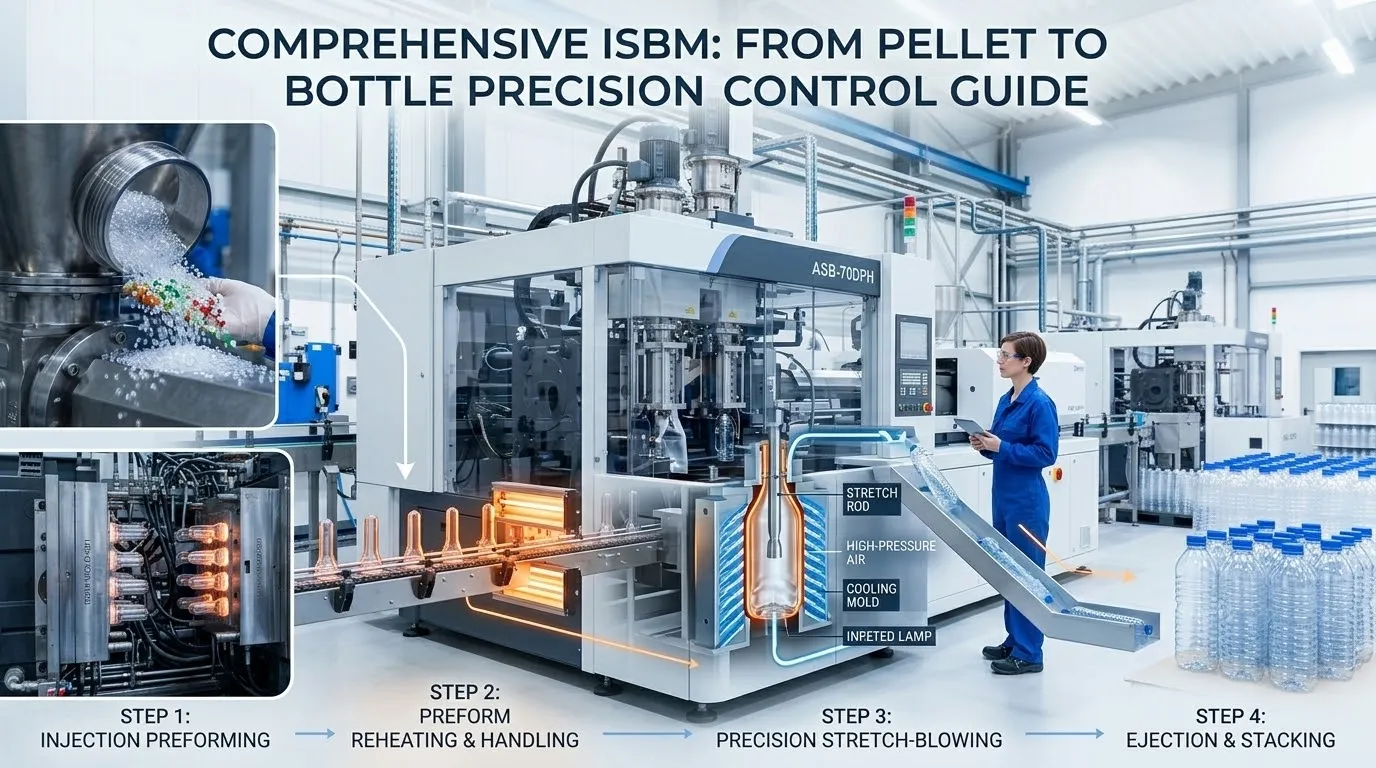
The Sequential Architecture of Single-Stage ISBM Production
For packaging engineers, plant managers, and procurement specialists, a granular understanding of the specific ISBM production steps is the foundation upon which efficient manufacturing is built. The Injection Stretch Blow Molding process is a discrete, indexed sequence of precisely choreographed thermodynamic events that transform a handful of polyethylene terephthalate pellets into a crystal-clear, structurally superior container. Unlike the continuous flow of extrusion blow molding or the fragmented logistics of a two-stage reheat system, the single-stage ISBM process steps unfold within a single, self-contained cell. At Ever-Power, a premier Brazilian ISBM manufacturer and global authority on polymer processing, our engineering team has refined this sequential workflow into a symphony of thermal conditioning, mechanical stretching, and pneumatic forming.
This exhaustive technical guide will walk you through every specific ISBM manufacturing step, from the initial plasticization of resin in the injection barrel to the final ejection of a fully formed, biaxially oriented bottle. We will dissect the function of each station, explain the critical process parameters that govern quality at each stage, and demonstrate how advanced machinery platforms execute these steps with micron-level precision. Whether you are evaluating a compact cell like the EP-BPET-70V4 or a high-output industrial system like the EP-HGY650-V4, the fundamental sequence of the ISBM production cycle remains the cornerstone of operational excellence.
The single-stage ISBM production steps are classically organized around a rotating table or indexing mechanism that transports the preform through four distinct stations: injection, conditioning, stretch-blow, and ejection. Each station performs a unique, non-overlapping function, and the entire cycle operates in parallel. While one set of preforms is being injected, another is being conditioned, a third is being stretched and blown, and a fourth is being ejected. This parallel processing architecture is what gives single-stage ISBM its remarkable productivity and energy efficiency. Understanding each ISBM production step in detail is essential for process optimization, defect troubleshooting, and achieving the zero-defect manufacturing standards demanded by premium packaging markets.
Step One: Resin Plasticization and Preform Injection Molding
The first ISBM production step begins with the transformation of solid PET pellets into a precisely shaped, amorphous preform within the injection station.
Pellet Drying and Melt Preparation
Before any melting occurs, PET resin must be aggressively dehydrated. Polyethylene terephthalate is profoundly hygroscopic, absorbing moisture from ambient air. If undried pellets enter the injection barrel, the combination of extreme heat and trapped water initiates hydrolysis, a devastating chemical reaction that severs polymer chains and permanently degrades the material’s intrinsic viscosity. Advanced desiccant dehumidifying dryers bake the resin at high temperatures in an environment with a negative forty degree dew point for several hours. Once dried to a moisture content below 50 parts per million, the pellets gravity-feed into the injection barrel. Inside, a reciprocating screw rotates, generating both conductive heat from external heater bands and frictional shear heat. The PET transitions from solid granules to a homogeneous, viscous melt suitable for high-pressure injection into the preform mold cavities.
Rapid Quenching to the Amorphous State
The molten PET is injected under immense pressure through a hot runner manifold into the water-cooled steel cavities of the preform mold. This is where the most critical physical phase change in the entire process occurs. The injection mold is chilled by industrial water circulating at temperatures typically between six and ten degrees Celsius through conformal cooling channels. As the melt contacts the cold steel, it is violently quenched, freezing the polymer chains in their tangled, disorganized amorphous state before they have any opportunity to organize into crystalline structures. This quenching must be both rapid and uniform. Any hesitation or inefficiency in the cooling system will allow the plastic to cool slowly in localized regions, permitting spherulite crystals to nucleate and grow. These crystals would cause hazy preforms that cannot be salvaged by the later stretching steps. On machines like the EP-HGY150-V4, precise control over injection speed, hold pressure, and cooling time is essential to produce preforms with consistent amorphous structure and dimensional accuracy.
Step Two: Thermal Conditioning of the Preform
The second ISBM production step is thermal conditioning, where the amorphous preform is brought into a precise temperature window essential for successful stretching and orientation.
🌡️The Glass Transition Target Window
Upon ejection from the injection mold, the preform retains significant latent core heat from the injection process. In a single-stage ISBM system, this thermal energy is not wasted. The preform is transferred via robotic clamps or a rotary table to the conditioning station, which consists of heated steel pots precisely contoured to cradle the preform’s exterior. The goal of this conditioning step is to bring the entire preform body into a uniform temperature range just above the glass transition temperature of PET, approximately 85 to 110 degrees Celsius. At this temperature, the polymer is in a rubbery, pliable state ideal for stretching. The molecular chains possess enough thermal energy to uncoil and slide past one another when mechanical force is applied, but the material has not become so fluid that it loses its shape or permits the uncontrolled growth of spherulite crystals. The conditioning pots circulate thermal fluid to effect this precise heating, and the temperature setpoints can be adjusted in single-degree increments on the machine HMI.
⚖️Zonal Temperature Profiling for Complex Geometries
For many container designs, a single uniform preform temperature is insufficient. The base of the preform, which corresponds to the injection gate, is inherently thicker and retains more heat. The neck finish must remain cool and rigid to prevent deformation during handling and to maintain precise thread dimensions. The conditioning station addresses these requirements through zonal heating. Individual heating zones along the length of the conditioning pot can be set to different temperatures. The body of the preform may be heated to the ideal stretching temperature, while the neck area is actively cooled, and the gate region is slightly tempered. For incredibly complex, asymmetrical container designs that require profound material manipulation, the revolutionary EP-HGYS280-V6 6-Station Machine provides two completely independent conditioning workstations. This architecture allows engineers to execute slow, multi-stage thermal soaking, gently elevating the temperature of specific preform zones to ensure they are perfectly pliable before they are subjected to the violence of the stretch blow phase.
Step Three: Stretch Blow Molding and Biaxial Orientation
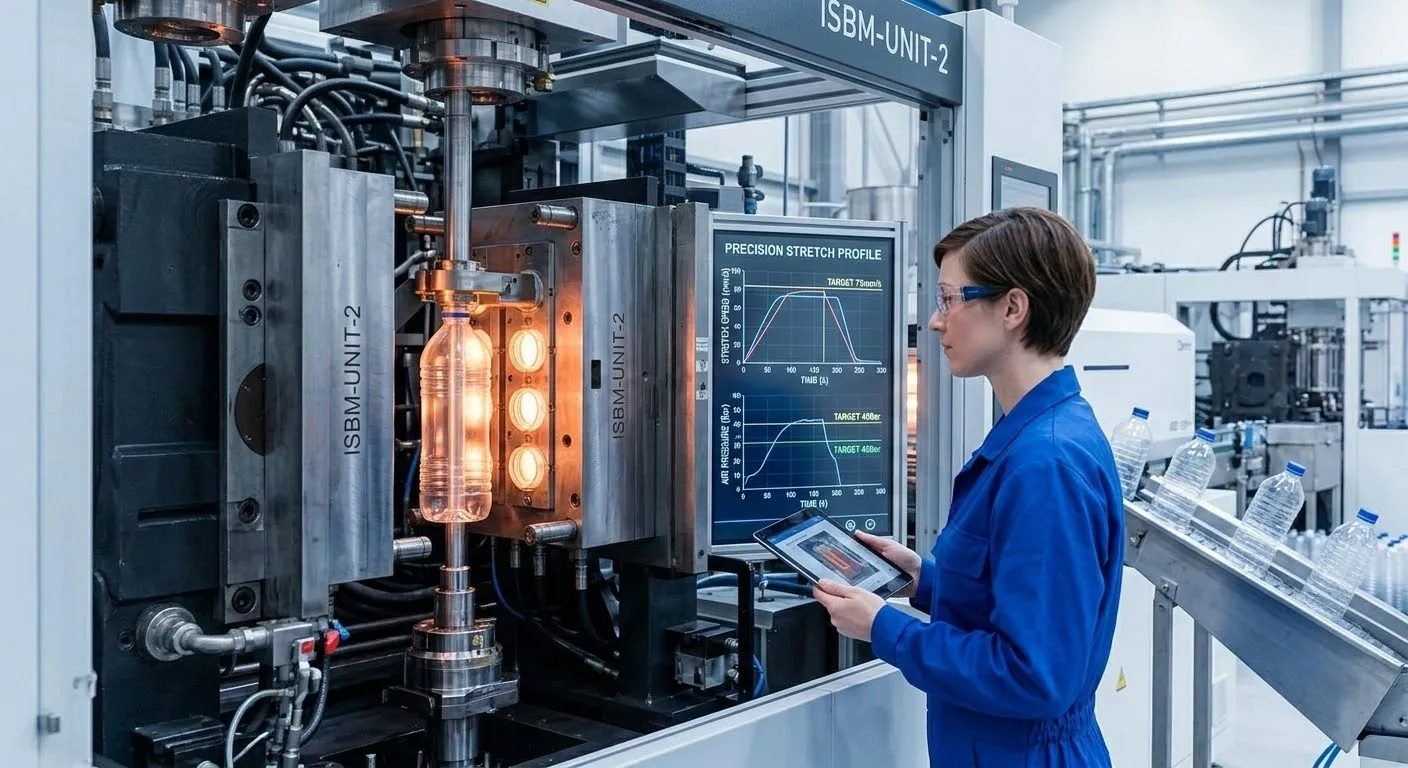
The third ISBM production step is the defining moment of the entire process. This is where the thermally conditioned preform undergoes biaxial orientation through the combined action of a mechanical stretch rod and high-pressure blow air.
⬇️Axial Elongation via the Stretch Rod
The conditioned preform is clamped by its neck finish into the blow mold cavity. A highly polished, precision-ground steel stretch rod descends from the top of the mold, entering the preform’s interior and making contact with its base. The rod then pushes downward, forcing the preform to elongate along its vertical axis. This axial stretching must be executed at a precisely controlled velocity and stroke distance. On advanced servo-driven platforms like the EP-HGY150-V4-EV Full Servo Machine, the stretch rod motion profile is fully programmable. Engineers can specify acceleration, constant velocity, and deceleration phases, allowing the rod to gently pin the material against the mold base without any hammering impact that could cause stress cracking or uneven wall distribution.
💨Pneumatic Radial Expansion and Strain-Induced Crystallization
Simultaneously with the rod’s descent, a precisely timed sequence of pneumatic events unfolds. First, a low-pressure pre-blow burst of air is introduced, gently inflating the preform into a bubble that the rod can guide downward without touching the cold mold walls. Then, once the rod has fully extended, a high-pressure final blow of air, typically between 20 and 40 bar, forces the plastic radially outward against the mirror-polished walls of the blow mold cavity. This combined axial and radial stretching induces a profound molecular transformation known as strain-induced crystallization. The polymer chains, forcibly aligned in both directions, spontaneously nucleate into infinitesimally small crystalline lamellae, far smaller than the wavelength of visible light. The result is a container that is simultaneously highly crystalline and immensely strong, yet remains brilliantly transparent like glass. The precise timing of the pre-blow and final blow valves, adjustable in milliseconds on the machine HMI, is critical to achieving a container free of defects like pearlescence or uneven wall thickness.
Step Four: Container Ejection, Cooling, and Quality Verification
The final ISBM production step involves ejecting the finished container, a brief ambient cooling phase, and the critical quality assurance checks that validate the entire process.
Automated Removal from the Blow Cavity
After the final blow air has been exhausted, the blow mold opens, revealing the finished container. Robotic take-out arms or mechanical grippers, synchronized with the machine’s indexing cycle, reach into the mold, grasp the bottle by its neck finish, and rapidly transfer it to a conveyor or collection bin. This ejection must be swift and gentle to avoid deforming the still-warm container. The mold cavity surfaces are often coated with a microscopically thin release agent or treated with a plasma coating to prevent the plastic from sticking after the intense pressure of the blow cycle. On high-cavitation systems like the EP-HGY250-V4-B Double-Row 4-Station Machine, multiple ejection robots work in concert to clear all cavities within the narrow window of the machine cycle.
Ambient Cooling and Dimensional Stabilization
As the bottle exits the mold, it undergoes a final, brief cooling phase in ambient air. The strain-induced crystalline structure, having been formed under the immense pressure and rapid stretching of the blow cycle, stabilizes as the container reaches room temperature. This is not a passive step to be ignored. If the bottle is subjected to mechanical stress, such as filling or capping, before it has fully stabilized, it can undergo post-molding shrinkage or warpage. For thick-walled containers or those destined for hot-fill applications, a dedicated cooling conveyor with forced air might be employed to accelerate this final thermal stabilization. The container’s final dimensions, including body diameter, height, and neck finish tolerances, are checked against the mold specifications during this phase.
Inline Quality Assurance and Defect Detection
The ejection step is closely integrated with quality control. Vision inspection systems, often positioned immediately after the take-out station, scan each bottle for defects such as haze, pearlescence, black specks, or geometric anomalies. Bottles that fail inspection are automatically diverted to a scrap bin for regrinding. Key quality metrics, including visual clarity, wall thickness distribution, top load strength, and drop impact resistance, are sampled at regular intervals from the production stream. Data from these inspections feeds back into the machine’s process control system, enabling real-time adjustments to the ISBM production steps. A manufacturer with a rigorous quality system, like Ever-Power, ensures that every machine is calibrated to deliver containers that meet the most demanding specifications from the very first cycle.
Process Integration and the rPET Production Adaptation
The specific ISBM production steps do not operate in isolation. They form an integrated, interdependent system where the quality of each step directly influences the success of the subsequent steps. A preform that is not properly quenched in the injection station will develop thermal haze that cannot be corrected by the conditioning or stretch blow steps. A preform that is unevenly conditioned will stretch inconsistently, leading to wall thickness variations and structural weak points. This interdependency is what makes single-stage ISBM both challenging to master and exceptionally powerful once optimized.
- ♻️
Adapting the Production Steps for rPET: The global shift toward circular economy mandates has forced the ISBM industry to adapt its production steps to post-consumer recycled PET. rPET exhibits a lower average intrinsic viscosity and a broader distribution of molecular chain lengths. During the injection step, the barrel temperature profile must be slightly lowered to prevent thermal degradation of the shorter chains. During conditioning, the preform temperature may need to be slightly elevated to ensure the lower-IV material is sufficiently pliable for stretching. During the stretch blow step, stretch speeds are typically reduced, and pre-blow pressures are adjusted to provide a gentler orientation ramp. Large-format machines like the EP-HGY650-V4 incorporate adaptive servo algorithms that monitor stretch rod resistance in real-time, instantaneously adjusting velocity to prevent blowouts in lower-viscosity rPET pockets during the stretch blow step.
- ⚙️
The Role of Proprietary Mold Integration: The specific ISBM production steps cannot be successfully executed without flawless integration between the machine and the mold tooling. The Custom One-Step Injection Stretch Blow Moulds engineered by Ever-Power are designed with each production step in mind. The injection mold cavities incorporate hyper-aggressive conformal cooling channels to ensure perfect amorphous quenching. The conditioning pots are machined to match the preform contour with micron-level precision. The blow mold cavities are polished to an extreme mirror finish and incorporate precise venting channels to allow the rapidly stretching plastic to conform perfectly to every detail. This integrated design philosophy ensures that each ISBM production step transitions seamlessly to the next, delivering containers of uncompromising quality.

Contrasting the ISBM Production Steps with Traditional Methods
To fully appreciate the elegance of the specific ISBM production steps, one must contrast them with the fragmented workflow of traditional two-stage processes. In a two-stage system, the injection step produces a completely cold, amorphous preform that is stored for days or weeks. The conditioning step is replaced by a harsh, energy-intensive infrared reheating oven that attempts to reheat the cold preform back to its stretching temperature. This reheating is inherently uneven; the surface of the preform can overheat and degrade while the core remains too cold. The stretch blow step then operates on a preform with a compromised thermal profile, leading to containers with higher levels of internal stress and haze. The ejection step is similarly fragmented, with preforms being ejected, packed, transported, and then re-fed into the blow molder.
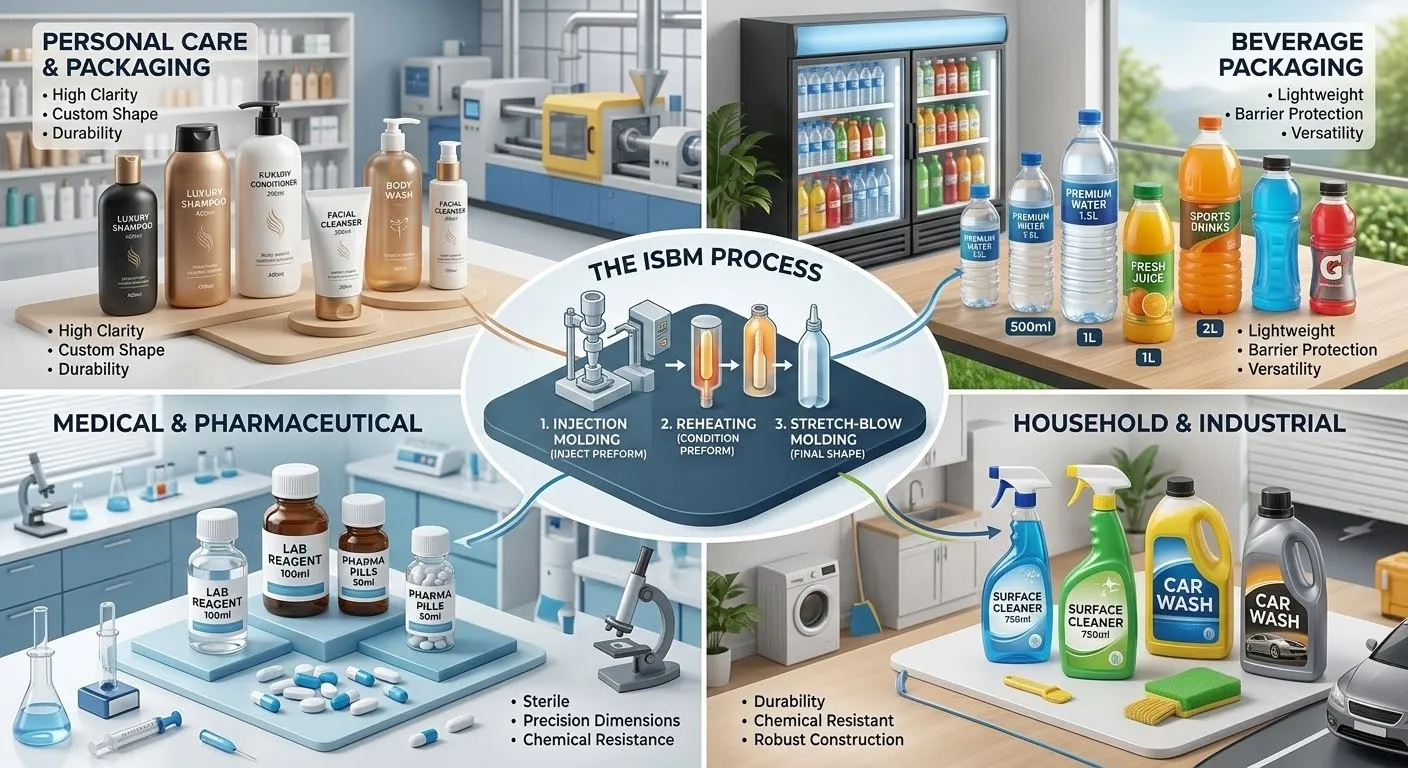
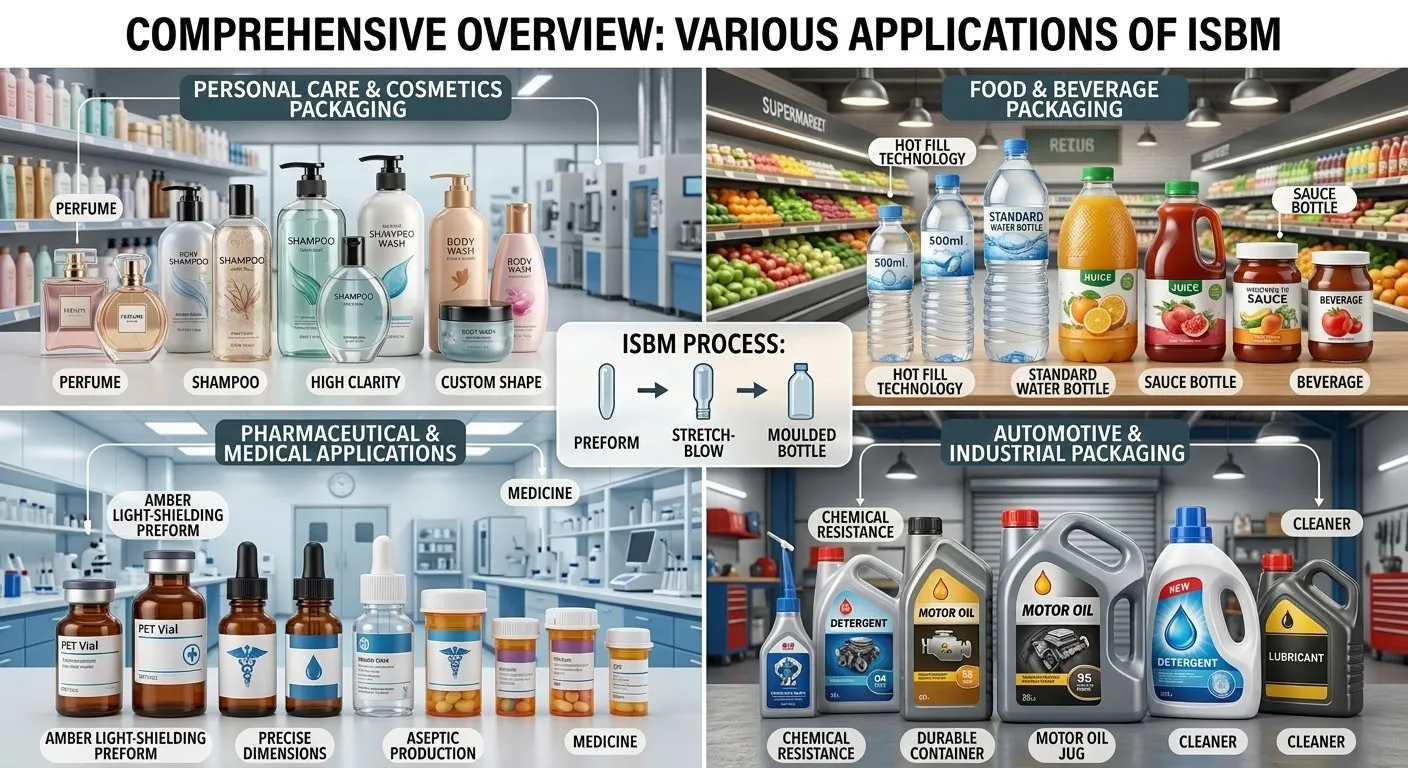
The single-stage ISBM process, by consolidating all production steps into one continuous, thermally integrated cell, avoids these compromises. The preform retains its latent heat, the conditioning step is a gentle, precise thermal soak rather than a violent reheat, and the stretch blow step operates on a preform with a perfectly uniform temperature distribution. The result is a container with superior optical clarity, structural strength, and dimensional consistency. For manufacturers seeking to produce premium packaging for cosmetics, pharmaceuticals, and premium beverages, the integrated nature of the single-stage ISBM production steps is not just an operational convenience; it is a competitive necessity. Machines like the compact EP-BPET-125V4 and the high-output EP-HGY200-V4 are engineered to execute these integrated steps with micron-level precision and repeatable cycle times.
Master the ISBM Production Steps for Manufacturing Excellence
The specific production steps in the ISBM process—injection, conditioning, stretch blow, and ejection—form a synchronized, four-station workflow that transforms raw PET pellets into high-performance, biaxially oriented containers within a single, thermally integrated cell. Each step is a precisely controlled thermodynamic event, and mastery over the parameters at each station is the key to unlocking zero-defect production, minimal scrap rates, and the exceptional optical clarity that defines premium packaging. At Ever-Power, our advanced machinery platforms, from the versatile EP-BPET-70V4 to the industrial-scale EP-HGY250-V4, are engineered to execute each ISBM production step with micron-level precision, delivering containers of uncompromising quality, strength, and visual brilliance to the world’s most demanding brands.