What resin is used in ISBM machines?
ISBM machines can process several thermoplastic resins, but PET — polyethylene terephthalate — is by far the most widely used resin in one-step injection stretch blow moulding. PP and PETG are the other significant resins in the ISBM segment, each serving specific application needs that PET cannot fully address. Understanding what each resin offers — and what it demands from the machine — is essential both for buyers specifying a new ISBM machine and for operators optimising an existing one.
PET: The Dominant ISBM Resin
PET (polyethylene terephthalate) is the resin of choice for the vast majority of one-step ISBM applications. Its combination of stretchability within a defined temperature window, excellent optical clarity when biaxially oriented, high intrinsic strength at low wall thickness, and proven food-contact and pharmaceutical suitability make it uniquely suited to ISBM bottle production. PET is used for water bottles, CSD bottles, edible oil containers, pharmaceutical oral dose bottles, cosmetic flacons, and agrochemical containers.
The key physical property of PET that enables ISBM is its glass transition temperature (Tg) at approximately 75 °C. Above Tg, PET becomes rubbery and stretchable; below it, it is glassy and rigid. The ISBM conditioning step brings the preform body to 90–115 °C — above Tg but below the crystallisation onset at approximately 130–140 °C. Within this window, the stretch rod and blow air can extend and inflate the PET preform with the combination of axial stretch (2.5–3.5×) and hoop stretch (up to 5.5×) that produces biaxial molecular orientation.
PET Intrinsic Viscosity (IV): Why It Matters
Not all PET resins are the same. The most important specification for ISBM-grade PET is intrinsic viscosity (IV), which measures the molecular chain length and correlates with the resin’s melt strength and processability. PET for ISBM is typically specified in the following IV ranges:
| Sollicitatie | Typical IV Range (dl/g) | Waarom |
|---|---|---|
| Water bottles | 0.72–0.76 | Standard IV for ambient-fill water |
| CSD bottles | 0.78–0.84 | Higher IV for CO₂ barrier and pressure resistance |
| Hot-fill containers | 0.80–0.86 | Higher IV for heat-set process stability |
| Farmaceutisch | 0.72–0.78 | Standard IV; emphasis on AA content <1 ppm |
| Edible oil / large format | 0.76–0.82 | Medium-high IV for heavier preforms |
Processing PET at too high a melt temperature or with inadequate drying degrades IV, reducing bottle strength and generating acetaldehyde (AA) — a compound detectable as off-flavour at below 10 ppb in water and at even lower levels in some beverages. IV degradation is irreversible; once the resin is processed at conditions that reduce IV, the molecular weight loss is permanent. The desiccant dryer and melt temperature control are the two process elements that protect IV during ISBM production.
PET Drying: Non-Negotiable
PET is hygroscopic — it absorbs moisture from the air. Moisture in the resin causes hydrolytic degradation during melt processing, breaking polymer chains, reducing IV, and producing AA. The standard drying protocol for ISBM-grade PET is: desiccant dryer at 160–170 °C; minimum 4–6 hours residence time; dryer dew point verified at −40 °C or below before processing begins; target moisture level below 50 parts per million (ppm).
A desiccant dryer rated for the machine’s hourly resin consumption is a mandatory ancillary for any PET-processing ISBM installation. Standard factory compressed air dryers are not suitable — they cannot achieve the −40 °C dew point required. Processing PET without adequate drying is the single most common cause of quality problems in new ISBM installations, producing brittle bottles, hazy surfaces, high AA content, and reduced wall thickness consistency.
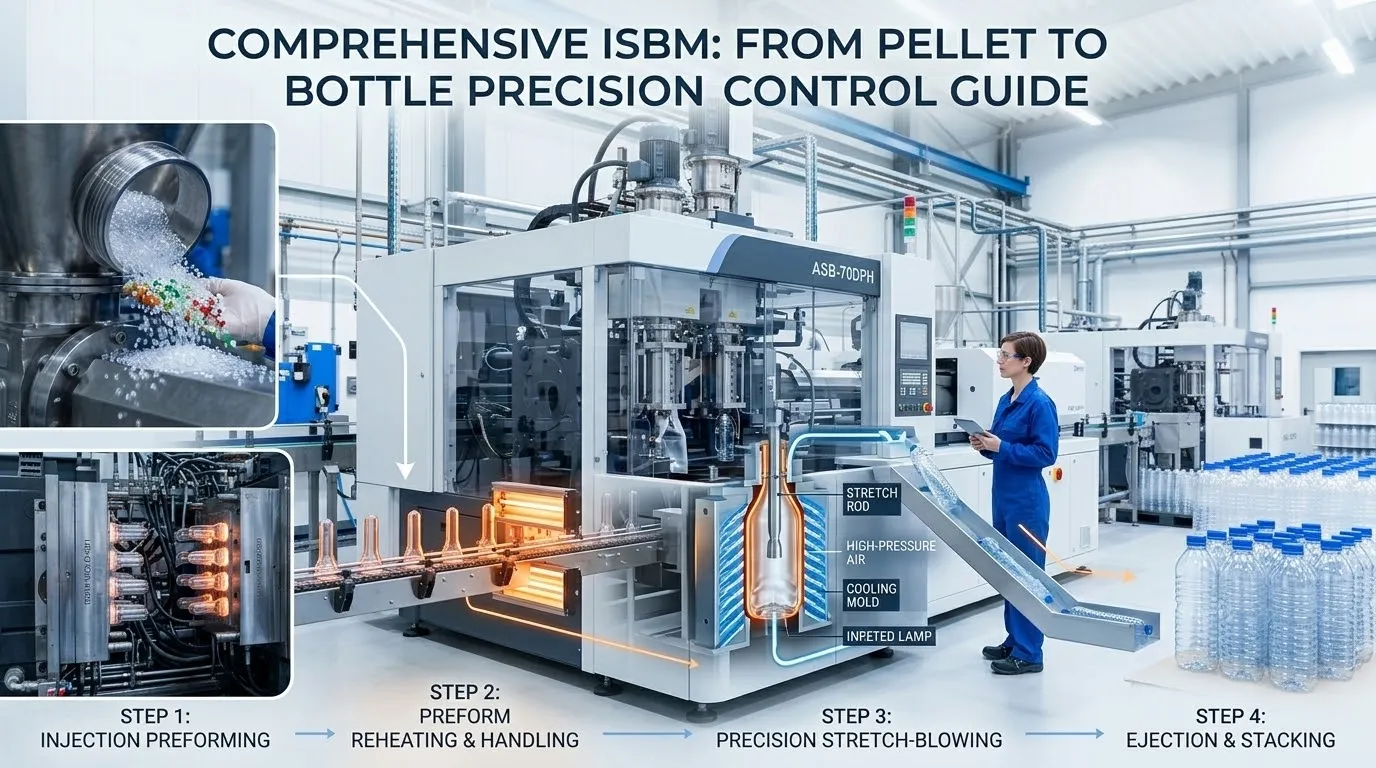
PET resin processing in ISBM — from correctly dried pellets through injection, conditioning, and stretch-blow to finished bottle, with critical parameters at each stage.
PP in ISBM: The Second Most Common Resin
Polypropylene (PP) is the second most common resin processed in one-step ISBM machines. PP offers excellent chemical resistance, good clarity (though not as glass-like as biaxially oriented PET), and suitability for hot-fill applications at temperatures up to 100 °C without the heat-set process modifications required for PET hot-fill. PP is used for pharmaceutical syrups and suspensions, agrochemical bottles, food containers, and personal care products where PET’s CO₂ barrier is not required.
PP processing in ISBM requires different machine settings from PET. The melt temperature is typically 200–230 °C (lower than PET’s 270–295 °C). The conditioning temperature window is narrower and the orientation behaviour less predictable than PET, making PP ISBM more process-sensitive. PP is not hygroscopic, so desiccant drying is not required — a standard hopper dryer at 80–100 °C to remove surface moisture is sufficient. EP-HGY machines can be configured for PP processing at order time; confirm your resin specification when ordering to ensure the barrel screw geometry and conditioning heater profiles are appropriate for PP.
PETG: For Demanding Cosmetic Applications
PETG (polyethylene terephthalate glycol) is a modified PET copolymer with lower crystallisation tendency, which produces containers with exceptional optical clarity (higher than standard PET), impact resistance, and surface gloss. PETG is used for premium cosmetic flacons, luxury personal care bottles, and high-clarity food containers where the visual appearance of the container is a primary packaging design attribute.
PETG has a lower Tg than standard PET (approximately 65–70 °C), which means the conditioning step must be set at lower temperatures. PETG does not crystallise during ISBM processing even at elevated temperatures, which gives it different orientation behaviour from PET — PETG containers have excellent clarity and gloss but lower CO₂ barrier performance than oriented PET. PETG is compatible with EP-HGY machines; specify your PETG grade when ordering to ensure the conditioning heater range is appropriate.
Container range from ISBM machines using PET, PP, and PETG resins — each resin serves specific application requirements that the others cannot fully replicate.
Resin Specification When Ordering an ISBM Machine
When ordering an ISBM machine, always provide the specific resin grade you plan to process, not just the generic resin type. The machine’s barrel screw geometry, heating band capacity, and conditioning heater profiles are configured for specific resin characteristics. A machine configured for PET will process PET most efficiently; processing PP in a PET-optimised barrel may produce acceptable bottles but will not achieve the PP’s full performance potential. If you plan to process multiple resins on the same machine — for example, PET for water bottles and PP for agrochemical containers — inform the supplier at order stage so the machine can be configured with appropriate screw geometry and heater range to accommodate both.
Need guidance on resin selection for your ISBM application?
Ever-Power’s applications team can advise on resin grade selection, drying requirements, and machine configuration for PET, PP, PETG, and rPET applications. Send your container specification for a 24-hour response.
Zie de full EP-HGY machine range with resin compatibility details, or review opties voor aangepaste mallen designed for specific resin and container combinations.
Veelgestelde vragen
Can ISBM machines process recycled PET (rPET)?
Yes. EP-HGY machines can process rPET in blends with virgin PET, typically up to 50% rPET for food-contact applications and higher percentages for non-food applications. rPET typically has lower and more variable IV than virgin PET, which requires tighter drying control (target moisture below 30 ppm for high rPET blends), reduced melt temperature to minimise further IV degradation, and may require adjusted blow parameters due to different orientation behaviour. The specific rPET grade and percentage should be confirmed with Ever-Power before machine and mould design is finalised.
What is acetaldehyde (AA) and why does it matter in PET ISBM?
Acetaldehyde is a degradation byproduct generated when PET is processed at too high a melt temperature, with insufficient drying, or at too long a residence time in the barrel. It migrates into the container contents and is detectable as a sweet, fruity off-flavour in water at concentrations above 5–10 ppb. For pharmaceutical applications, AA content in the container is a critical quality attribute. AA is controlled through correct PET drying (below 50 ppm moisture), melt temperature at or below 295 °C, minimal barrel residence time, and use of PET grades with certified low AA content. All these parameters are set and documented during the commissioning process for EP-HGY pharmaceutical installations.
Is PET or PP better for edible oil containers?
Both PET and PP are used for edible oil containers in ISBM production. PET produces containers with better clarity and lower oxygen transmission rate (OTR), which extends edible oil shelf life by reducing oxidation. PP produces containers with better chemical resistance and slightly better performance at elevated temperatures, and does not require the strict drying control of PET. For premium edible oil products where shelf life and appearance matter, PET is typically preferred. For commodity edible oil and cooking oil where cost is the primary driver, PP is a viable and often more economical alternative.
Barrier Properties by Resin: What They Mean for Your Application
Barrier performance — the resistance of the container wall to gas transmission — varies significantly between PET, PP, and PETG, and this difference is often the deciding factor in resin selection for specific applications.
Biaxially oriented PET provides excellent oxygen barrier performance (OTR approximately 0.05–0.10 cc/m²/day for a standard 500 ml bottle at 2–3% stretch ratio) and measurable CO₂ barrier for carbonated applications. This makes PET the preferred resin for carbonated beverages, oxygen-sensitive edible oils, and pharmaceutical products requiring low oxygen ingress. PP has substantially higher oxygen transmission than oriented PET (OTR approximately 0.5–2 cc/m²/day for equivalent wall thickness), making it unsuitable for oxygen-sensitive products but adequate for agrochemical containers, pharmaceutical syrups, and personal care products where oxygen barrier is not a primary requirement. PETG’s barrier performance is similar to PET but slightly lower due to its amorphous structure even after ISBM processing.
For applications requiring barrier performance beyond what PET can provide — oxygen-sensitive nutraceuticals, extended-shelf-life beverages, or barrier-critical pharmaceutical formulations — multi-layer ISBM technology (coinjection of PET with an EVOH or nylon barrier layer) is available on specialised machines. Contact Ever-Power’s technical team to discuss barrier-enhanced ISBM options for your specific application.