What plastic is used to make water bottles?
The vast majority of commercial water bottles — from small 330 ml single-serve bottles to 5-litre family containers — are made from PET: polyethylene terephthalate. PET’s combination of glass-like optical clarity, structural strength at very low wall thickness, food-contact safety, CO₂ barrier performance for carbonated water, and full recyclability make it the dominant material for commercial water bottle production worldwide. Understanding why PET is used, how PET water bottles are made, and what alternative materials exist helps both consumers and B2B buyers make informed decisions about packaging selection.
Why PET Is the Standard for Water Bottles
PET became the dominant material for water bottles in the 1990s, replacing glass and PVC in most markets, and has since come to represent over 90% of global commercial water bottle production. The reasons are both technical and economic:
- Optical clarity: biaxially oriented PET achieves light transmittance above 90% — comparable to glass and significantly better than any other plastic used for bottles. Consumers associate clear bottles with product purity, making PET’s clarity a commercial requirement in many water markets.
- Light weight: a 500 ml PET water bottle weighs 8–12 grams — approximately 15–20 times lighter than an equivalent glass bottle. This reduces transport cost and carbon footprint per unit of water delivered.
- Structural strength: biaxial molecular orientation from the ISBM process gives PET bottles tensile strength 2–3 times higher than unoriented plastic at the same wall thickness, enabling the thin walls (0.2–0.4 mm) that reduce material usage.
- Food-contact safety: PET is approved for food and beverage contact by regulatory agencies globally (FDA, EFSA, ANVISA, and others). It does not leach harmful compounds into water under normal use and storage conditions.
- Recyclability: PET is one of the most widely recycled plastics globally. Post-consumer PET bottles are collected, cleaned, and recycled into food-grade rPET for new bottles, fibre, and packaging applications.
How PET Water Bottles Are Made
PET water bottles are produced by injection stretch blow moulding (ISBM). In a one-step ISBM machine, the process begins with dried PET resin pellets and ends with a finished bottle in the same machine: resin is injection-moulded into a thick-walled preform at 270–295 °C; the preform transfers to a conditioning station where infrared heaters bring its body to 90–115 °C; a mechanical stretch rod then extends the preform axially to 2.5–3.5 times its injection length while high-pressure air simultaneously inflates it radially against the blow mould walls; and the finished bottle is ejected to a conveyor.
The simultaneous axial and radial expansion — biaxial stretch blow moulding — produces biaxial molecular orientation: polymer chains aligned in both directions simultaneously. This orientation is what gives PET water bottles their glass-like clarity, high strength at low wall thickness, and CO₂ barrier performance. Without the stretch step, PET remains amorphous and hazy — injection-moulded PET without stretching is not suitable for clear water bottle production.
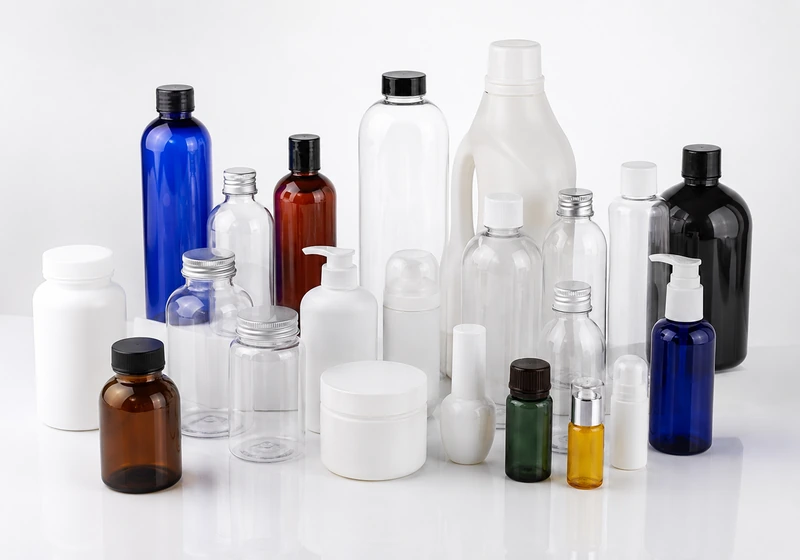
PET water bottles produced by one-step ISBM — biaxial molecular orientation gives them glass-like clarity, structural strength at 0.2–0.4 mm wall thickness, and light weight of 8–12 grams for a standard 500 ml format.
Alternative Plastics for Water Bottles
| Bahan | Proses | Advantages | Limitations |
|---|---|---|---|
| PETI | ISBM | Glass clarity, light, recyclable, CO₂ barrier | Not suitable for above 60 °C fill without heat-set |
| PP | ISBM or EBM | Good chemical resistance, hot-fill capable to 100 °C | Lower clarity than PET, lower CO₂ barrier |
| HDPE | EBM | Excellent chemical resistance, low cost for large formats | Opaque or translucent only; not used for clear water bottles |
| PC | IBM or ISBM | Very high impact strength, reusable | Higher cost, BPA concerns in some grades; declining use |
| PETG | ISBM | Higher clarity than PET, excellent impact resistance | Lower barrier than PET; used for premium cosmetic and food |
PET Identification: The Resin Code
PET water bottles are marked with the resin identification code “1” (inside the chasing-arrow recycling symbol) on the bottle base. This code identifies the resin type for recycling sorting purposes. PP bottles are coded “5”; HDPE bottles are coded “2”. These codes are mandated in many markets and help consumers and recyclers correctly sort packaging materials. The “1” code on a water bottle confirms it is PET and eligible for the PET recycling stream in most markets.
rPET: Recycled PET in Water Bottles
Increasing proportions of commercial water bottles now incorporate recycled PET (rPET) alongside virgin PET, driven by brand sustainability commitments and regulatory requirements in key markets. rPET is produced from collected and reprocessed post-consumer PET bottles, and when processed to food-grade standards, it is approved for use in direct food and beverage contact packaging in most markets. ISBM machines including the EP-HGY series can process PET/rPET blends of up to 50% rPET for food-contact applications, enabling manufacturers to meet sustainability targets without changing their bottle design or production process.
The technical challenge of rPET in ISBM is its variability: rPET typically has lower and less consistent intrinsic viscosity than virgin PET, which requires tighter drying control and may require adjustment of injection temperature and blow parameters compared to 100% virgin PET processing. Ever-Power can advise on machine configuration and process protocols for rPET-inclusive production.
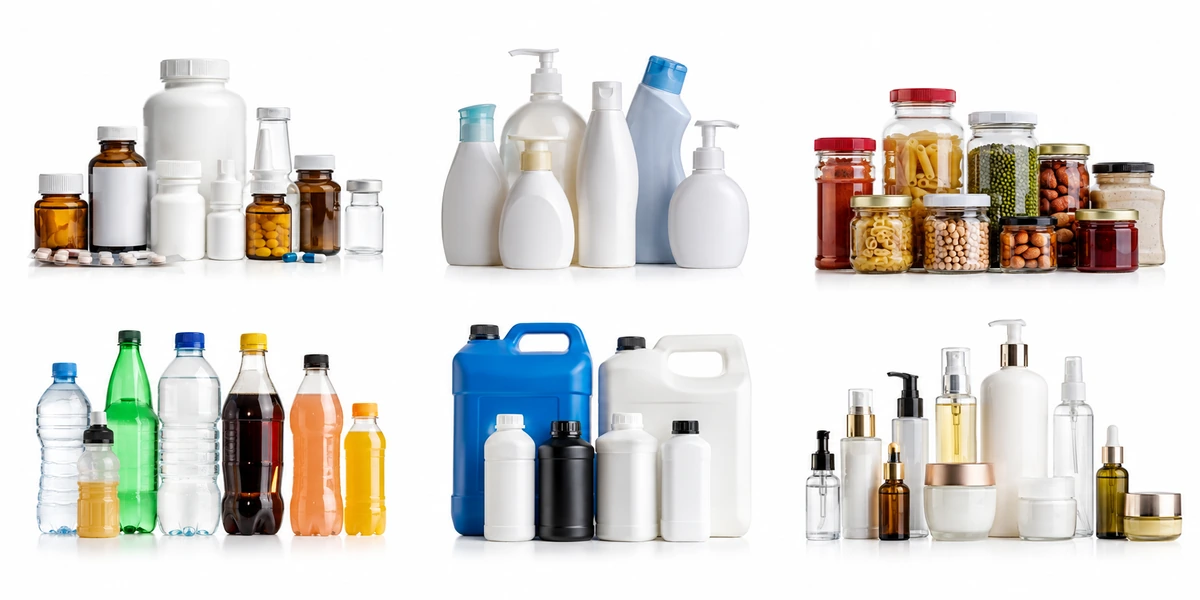
Water and beverage bottle applications served by ISBM machines — from still water to carbonated beverages, all requiring the biaxial orientation that only ISBM delivers.
Producing water bottles or beverage containers in-house?
Ever-Power’s EP-HGY ISBM machines produce PET water bottles from 250 ml to 5 litres. Send your bottle specification and annual volume for a machine recommendation and indicative pricing within 24 hours.
See the water and beverage container applications page for examples, or browse the full EP-HGY machine range for specifications.
Soalan Lazim
Is it safe to reuse a PET water bottle?
PET water bottles are designed for single-use or limited reuse under normal consumer conditions. The main practical concern with reuse is not chemical leaching from the PET (which is minimal under normal conditions) but microbial contamination from repeated handling and inadequate cleaning of the bottle interior, particularly around the neck. If reusing a PET water bottle, washing with warm soapy water and rinsing thoroughly between uses reduces this risk. For extended reuse applications, bottles made from HDPE or Tritan (a BPA-free copolyester) are better suited than PET.
How much does a PET water bottle weigh?
Standard single-use 500 ml PET water bottles weigh 8–12 grams, with light-weighted designs for high-volume water brands achieving 8–9 grams. A 1-litre PET water bottle typically weighs 18–25 grams; a 1.5-litre bottle 22–30 grams. These weights are set entirely by the preform design — the preform weight equals the finished bottle weight, and no material is added or removed during the ISBM process.
What is the minimum production volume for in-house PET water bottle production?
For most water bottling operations, in-house ISBM production becomes economically viable at annual volumes above 1–3 million bottles per format, depending on the purchased container price and mould investment required. At lower volumes, purchasing bottles from a contract blow moulder is typically more economical. Ever-Power can prepare a cost comparison for your specific bottle volume and annual production to confirm whether in-house production is justified at your scale.
The Environmental Case for PET Water Bottles
PET water bottles are frequently criticised for their environmental impact, but the environmental picture is more nuanced than consumer perceptions suggest. PET is one of the most widely recycled plastics globally, with well-established collection and reprocessing infrastructure in most developed markets. In countries with effective deposit-refund systems (such as Germany, Norway, and several US states), PET bottle collection rates exceed 90%. The collected PET is reprocessed into food-grade recycled PET (rPET) that can be used in new bottles at up to 100% content in some markets, reducing the demand for virgin PET produced from fossil fuel feedstocks.
The light weight of ISBM-produced PET water bottles — 8–12 grams for a 500 ml bottle — also means that the resin embedded in a single bottle is small in absolute terms: even if the bottle is not recycled and ends up in landfill, the weight of non-renewable material is minimal compared to glass or metal alternatives. The lifecycle environmental comparison between PET water bottles and alternative materials consistently shows PET to have lower carbon footprint per unit of water delivered when transport distances are significant — the weight saving during transport outweighs the production energy difference in most scenarios.
B2B Considerations for Water Bottle Producers
For B2B buyers — filling companies, beverage producers, and water bottling operations — the choice of bottle plastic is not a consumer preference decision but a technical and regulatory one. PET is the correct material for still and carbonated water bottles in all commercially relevant volume ranges. The decision that matters for B2B buyers is not which plastic to use (PET is standard) but whether to produce PET bottles in-house using a one-step ISBM machine or to purchase them from a contract blow moulder. In-house production gives control over bottle specification, quality, and supply continuity, and becomes economically superior to purchasing at annual volumes above 1–3 million bottles per format. Ever-Power’s EP-HGY series covers the full range of water bottle formats from 250 ml to 5 litres.