플라스틱 사출 금형의 평균 수명은 얼마입니까?
The lifespan of a plastic injection mould — measured in production cycles — depends primarily on mould material, the resin being processed, process conditions, and the quality of preventive maintenance applied throughout the mould’s operating life. For ISBM mould sets (preform mould and blow mould), the two components often have different lifespans because they operate under different conditions and experience different wear mechanisms.
Mould Lifespan by Material
| Mould Material | Typical Lifespan | Best Application |
|---|---|---|
| Aluminium alloy | 500,000–1,000,000 cycles | Standard PET bottles, frequent format change |
| Beryllium copper (BeCu) | 1,000,000–3,000,000 cycles | High-output continuous production |
| Pre-hardened steel (P20) | 1,000,000–3,000,000 cycles | Textured surfaces, abrasive resins |
| Hardened tool steel (H13) | 3,000,000–10,000,000+ cycles | Very high-volume, glass-filled resins |
Preform Mould vs Blow Mould: Different Wear Mechanisms
Preform mould wear is driven by the high-pressure, high-temperature injection cycle. The components that wear fastest are the gate tip (erosion from high-velocity melt), the neck splits (mechanical wear from frequent opening and closing), and hot runner nozzle tips. The preform mould cavity surface can be polished and recoated multiple times to extend life.
Blow mould wear is driven by repeated contact of the blown bottle against the mould surface and thermal cycling of the cooling circuit. On aluminium blow moulds, surface erosion and corrosion in cooling channels are the primary mechanisms. On BeCu moulds, the base insert — which receives repeated impact from the stretch rod and inflating preform base — is typically the first component to require replacement.
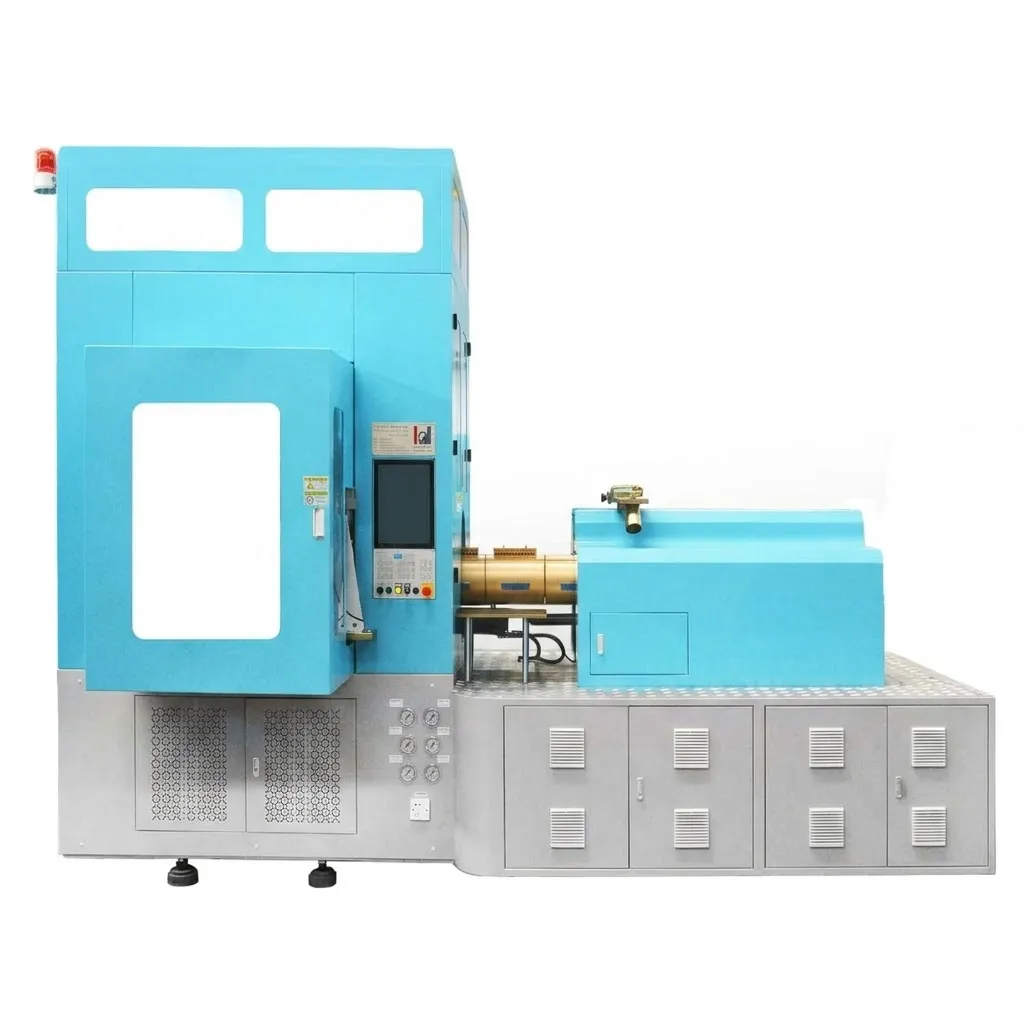
ISBM preform mould and blow mould operate under different conditions and require separate maintenance schedules to achieve rated mould life.
How Maintenance Extends Mould Life
The difference between a mould that reaches its rated cycle count and one that fails early is almost always maintenance quality. A preventive maintenance programme should include:
- Cooling channel cleaning at fixed cycle intervals — scale build-up reduces heat removal efficiency and causes uneven bottle cooling
- O-ring replacement on cooling connections and neck split slides before leaks develop
- Gate tip inspection and replacement on the preform mould — a worn gate tip produces oversized gate vestiges and increased AA content
- Parting surface inspection — wear on the parting surface eventually causes flash that cannot be corrected by process adjustment alone
Replace vs Refurbish
Not every worn ISBM mould needs full replacement. Many can be refurbished at 20–40% of new mould cost by replacing worn components (gate tips, neck splits, blow mould base inserts) while retaining the core mould body. The decision to refurbish vs replace depends on the extent of wear and whether the bottle format will continue in production.
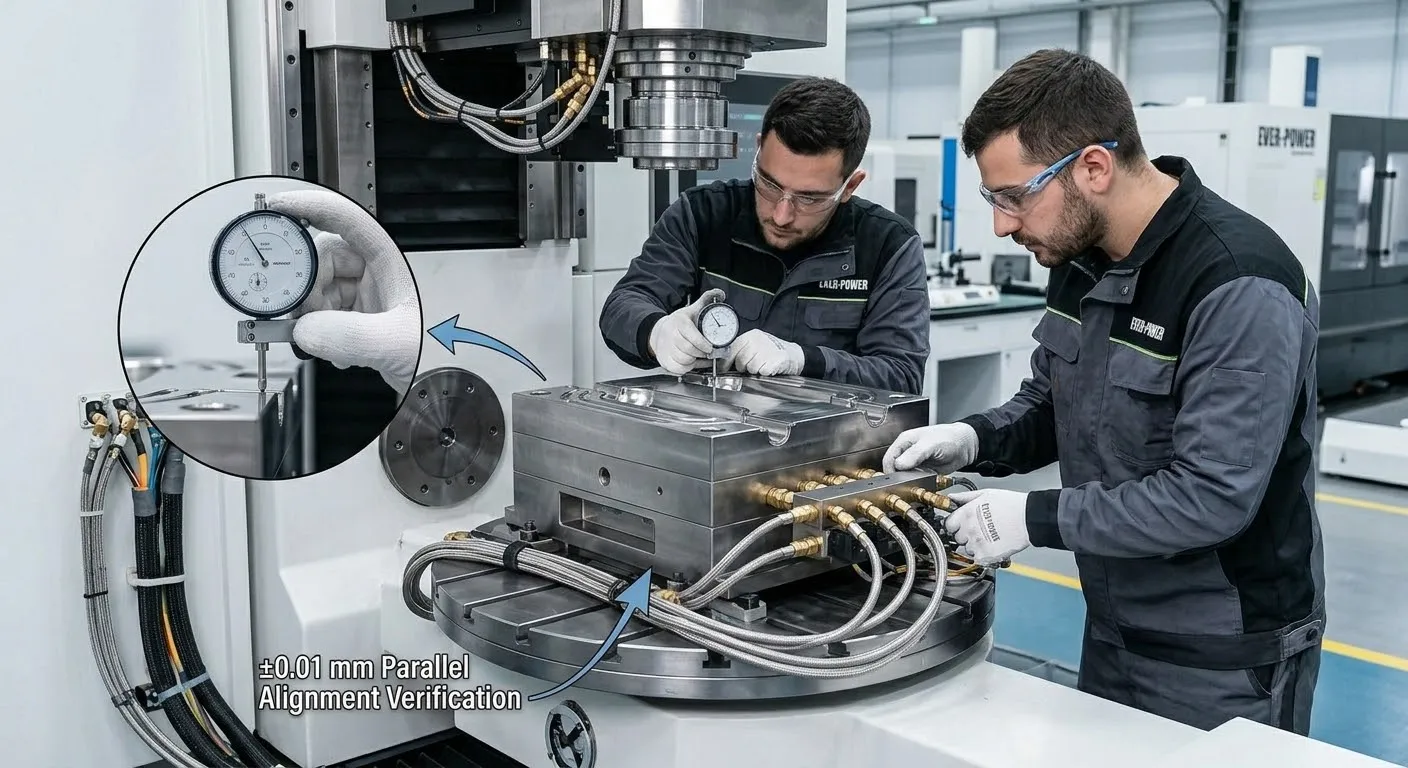
Correct mould installation and platen alignment are prerequisites for achieving rated mould life — misaligned platens accelerate parting surface wear.
Need a new ISBM mould or a refurbishment assessment?
Ever-Power designs and manufactures custom ISBM mould sets and can assess worn moulds for refurbishment viability. Send your bottle drawing or mould details for a 48-hour response.
탐색해 보세요 custom ISBM mould range, or review the machine specifications to confirm which mould configuration fits your production line.
자주 묻는 질문
Does resin type affect mould lifespan?
Yes. Standard PET and PP are relatively non-abrasive; moulds processing these reach their rated cycle count without unusual cavity surface wear. Glass-filled or mineral-filled resins are significantly more abrasive and require hardened steel moulds rather than aluminium to achieve acceptable life. Always provide your specific resin grade to the mould manufacturer when ordering.
How do I know when my ISBM mould needs replacement?
Primary indicators: flash at the preform parting line not correctable by increased clamping force; persistent gate vestige defects despite gate tip replacement; bottle weight variation increasing beyond specification despite stable process parameters; and surface finish deterioration that cannot be corrected by mould polishing. When multiple indicators appear simultaneously, full replacement is usually more economical than attempting to repair each component.
Is it worth choosing steel over aluminium for an ISBM blow mould?
Steel blow moulds cost more upfront but last 3–10 times longer than aluminium equivalents and offer better surface texture durability. For high-volume continuous production (above 2–3 million bottles per year on the same format), steel or BeCu moulds are typically the more economical choice when total cost of ownership — mould cost divided by cycle count — is calculated over the planned production volume.
Spare Parts Planning for Long-Term Mould Life
For ISBM operations running at high volume, maintaining a stock of the most frequently replaced mould wear parts is essential to avoiding unplanned downtime. The parts to stock on-site are: gate tips (2–4 spares per preform mould cavity count); neck split inserts (1 complete set per mould); stretch rod assemblies (1 spare per mould); O-rings for cooling connections and neck split slides (a 12-month supply); and blow mould base inserts for moulds running above 500,000 cycles per year. Ever-Power maintains spare parts for all EP-HGY and EP-BPET machines and their associated moulds with a standard 24-hour dispatch for critical wear parts.
Comparing Mould Lifespan Across Blow Moulding Types
For context, mould lifespans in EBM and IBM differ from ISBM because operating conditions differ. EBM blow moulds see lower temperatures (no injection step in the mould) and lower pressures, but the parison-pinching action creates high stress at the pinch-off base insert, which is a common early-wear item replaced at 200,000–500,000 cycles depending on material. IBM moulds experience similar injection station conditions to ISBM preform moulds but do not have the high-cycle thermal fatigue of ISBM blow mould cooling circuits. Across all three types, consistent preventive maintenance is the most reliable predictor of whether a mould reaches its rated cycle count.
Mould Life Documentation and Tracking
Tracking mould cycle count accurately is the foundation of effective mould life management. Modern ISBM machines with HMI data logging record the total cycle count for each mould in the recipe management system, providing an accurate running total without relying on operator manual records. For older machines without automatic cycle counting, a simple production log recording the mould identifier and cycle count at the start and end of each production shift provides the minimum documentation needed to manage mould life proactively. Without accurate cycle count tracking, preventive maintenance schedules based on cycle intervals cannot be implemented reliably, and mould failures tend to be reactive rather than prevented.
Mould Life vs Mould Performance: An Important Distinction
Mould “life” is sometimes used to mean cycles to failure, but a more practical definition for production planning is cycles to the point where the mould no longer consistently produces containers within specification. A mould can still be mechanically intact but producing containers with marginal dimensional conformance, surface finish degradation, or increasing inter-cavity weight variation. The point at which mould performance falls below the specification threshold — not the point of mechanical failure — is the effective end of mould life for quality-controlled production. This distinction is particularly important for pharmaceutical and food-grade applications, where process-related quality attributes (container weight, neck finish dimensions, surface quality) are subject to defined acceptance criteria that must be met on every production run.
Establishing a mould performance monitoring programme — tracking bottle weight per cavity, neck finish dimensions, and surface quality over the mould’s operating life — allows the production team to predict when a mould is approaching its effective end of life and plan its replacement or refurbishment proactively, rather than discovering the performance issue during a production run that may have already produced non-conforming containers.
Mould Storage Best Practices
ISBM moulds that are not in regular production must be properly stored to prevent corrosion damage during idle periods. Best practices for mould storage: clean the mould thoroughly before storage to remove all traces of resin, release agent, and cooling water deposits; dry all cooling channels completely (compressed air purge followed by warm air drying); apply a corrosion-inhibiting oil or coating to all unpainted metal surfaces, particularly cavity surfaces and parting lines; seal cooling channel connections with plugs to prevent moisture ingress; wrap the mould in VCI (vapour corrosion inhibitor) film or store in a controlled-humidity environment; and inspect and re-apply corrosion protection every 3–6 months for moulds in long-term storage. Proper storage can prevent the corrosion damage that is one of the most common causes of premature mould failure in humid climates.
공급업체 평가 프로세스를 시작하는 방법
ISBM 장비 구매 경험이 부족한 구매자에게는 기계 및 금형 공급업체 선정 과정이 다소 부담스러울 수 있습니다. 실질적인 출발점은 공급업체 후보 목록을 작성하는 것이 아니라 명확한 용기 사양을 수립하는 것입니다. 공급업체에 문의하기 전에 병 용량, 넥 마감, 수지, 목표 중량, 필요한 생산량, 그리고 특정 용도에 필요한 사항(제약 GMP, 고온 충전, 클린룸 적합성 등)을 명확히 정의해야 합니다. 완벽한 용기 사양을 갖추면 여러 공급업체로부터 의미 있고 비교 가능한 견적을 받을 수 있습니다. 각 견적은 동일한 기술 정보를 바탕으로 작성되기 때문입니다.
에버파워의 사전 판매 프로세스는 고객의 컨테이너 사양에 대한 기술 검토로 시작됩니다. 당사의 애플리케이션 엔지니어링 팀은 사양을 당사의 장비 제품군과 비교하여 적절한 모델(스테이션 수, 클램핑력, 구동 시스템)을 추천하고, 예비 금형 타당성 평가를 제공합니다. 이 모든 서비스는 무료로 제공되며, 일반적으로 사양 접수 후 24~48시간 이내에 완료됩니다. 이 예비 평가를 통해 구매자는 상세 견적 절차에 착수하기 전에 예상되는 장비 및 금형 구성과 관련 투자 비용을 파악할 수 있습니다.
Ever-Power의 ISBM 전체 제품군
Ever-Power의 완벽한 원스텝 ISBM 기계 제품군은 제약, 화장품, 식품, 음료 및 산업용 용기 생산의 모든 주요 응용 분야를 포괄합니다.
| 모델 | 역 | 클램프(kN) | 컨테이너 범위 | 운전하다 |
|---|---|---|---|---|
| EP-HGY50-V3-EV | 3 | 50 | 30~500ml | 풀 서보 |
| EP-HGY150-V4 | 4 | 150 | 100ml~2L | 서보 유압식 |
| EP-HGY150-V4-EV | 4 | 150 | 100ml~2L | 풀 서보 |
| EP-HGY200-V4 | 4 | 200 | 200ml~3L | 서보 유압식 |
| EP-HGY200-V4-B | 4 | 200 | 200ml~3L (손잡이 포함) | 서보 유압식 |
| EP-HGY250-V4 | 4 | 250 | 500ml~5L | 서보 유압식 |
| EP-HGYS280-V6 | 6 | 280 | 복잡한 형태 | 서보 유압식 |
| EP-HGY650-V4 | 4 | 400 | 2~10리터 | 서보 유압식 |
| EP-BPET-70V4 | 4 | 200 | 500ml~3L (PET) | 서보 유압식 |
| EP-BPET-94V3 | 3 | 250 | 1~5리터(PET) | 서보 유압식 |
| EP-BPET-125V4 | 4 | 400 | 5~10리터(PET) | 서보 유압식 |
각 모델의 전체 기술 사양은 다음 웹사이트를 참조하십시오. EP-HGY 및 EP-BPET 제품 페이지특정 응용 분야에 대한 안내가 필요하시면 저희 팀에 문의해 주세요. isbmmolding.com/contact-us 또는 [email protected]으로 이메일을 보내주세요. 모든 기술 문의에 대해 24시간 이내에 답변드리겠습니다.
How to Plan Mould Replacement Into Your Production Budget
The most common financial planning mistake in ISBM operations is failing to account for mould replacement as a recurring capital cost. Moulds are not permanent assets — they have a finite cycle life that must be planned for. The correct approach is to calculate the expected production life of each mould set, determine the replacement cost, and allocate a per-bottle mould depreciation charge into the container cost model.
For example: an aluminium ISBM mould set rated for 800,000 cycles at a cost of USD 28,000 gives a mould depreciation cost of USD 0.035 per bottle. Over the mould’s 800,000-cycle life, the total mould replacement cost is fully recovered within the container production cost. If the mould is replaced with a BeCu equivalent at USD 45,000 and 2,000,000 cycle life, the mould depreciation drops to USD 0.0225 per bottle — a meaningful saving at high production volumes that partially offsets the higher initial mould investment.
This per-bottle mould depreciation calculation should be performed for every new container format introduced on an ISBM machine. It transforms the mould cost from a one-time capital shock into a predictable operating cost that can be managed within the container’s cost structure. Ever-Power includes mould life expectancy and recommended replacement schedule data in the documentation supplied with every custom mould set, enabling operators to plan mould replacement budgets accurately from the start of production.
Mould Storage and Long-Term Preservation
ISBM moulds that are taken out of production for format change or seasonal products require proper storage to preserve their condition and prevent corrosion. Aluminium moulds are particularly susceptible to oxidation and pitting if stored in humid environments without protective treatment. The correct storage procedure for an ISBM mould set is: flush all cooling circuits with clean water, dry with compressed air, apply a rust-inhibiting oil or corrosion-inhibiting spray to all cooling channels and unpainted steel surfaces, close all cavities with plugs to prevent ingress of contamination, and store in a dry, temperature-stable environment away from direct contact with the floor. Preform mould hot runner systems should be purged with a compatible purging compound before shutdown if PET is the last resin run, to prevent residual PET degrading inside the hot runner during storage. A correctly stored mould set resumes production with minimal qualification time and without cavity damage that would reduce its remaining cycle life.