In the plastics and packaging industry, ISBM stands for 사출 연신 블로우 성형. Each word describes a specific physical event in the manufacturing sequence. Understanding what each term means in practice is the quickest route to understanding why this process produces the containers it does — and how it differs from every other hollow-container manufacturing method.
Breaking Down the Acronym: I – S – B – M
I — Injection. The process begins with injection moulding. Plastic resin — most commonly PET, though PP, PETG, and PC are also processed — is fed from a hopper into a heated barrel where it melts. A reciprocating screw pushes the melt at high pressure into a closed preform mould. The result is a thick-walled tube, closed at one end and open at the neck, called a preform. Wall thickness, neck diameter, and body length are determined entirely by the preform mould geometry.
S — Stretch. While still warm from injection, the preform is transferred to the blow station. A mechanical stretch rod descends into the preform and pushes against its base, extending it axially — typically to 2.5–3.5 times its injection length. This longitudinal stretching begins the molecular orientation process. At orientation temperature (roughly 90–110 °C for PET), the polymer chains align along the direction of force, contributing directly to top-load strength.
B — Blow. Simultaneously with the stretch rod’s descent, high-pressure air (25–40 bar) expands the preform radially against the walls of the closed blow mould. The hoop orientation produced by radial expansion complements the axial orientation from the stretch rod, producing what engineers call biaxial molecular orientation — the defining characteristic of ISBM containers.
M — Moulding. The blow mould is temperature-controlled — typically at 8–15 °C for standard clear PET — which freezes the molecular orientation in place and prevents post-blow shrinkage. For hot-fill applications, the mould runs at 100–120 °C to allow heat-setting. The cooled bottle is ejected and the rotary table advances the next preform.
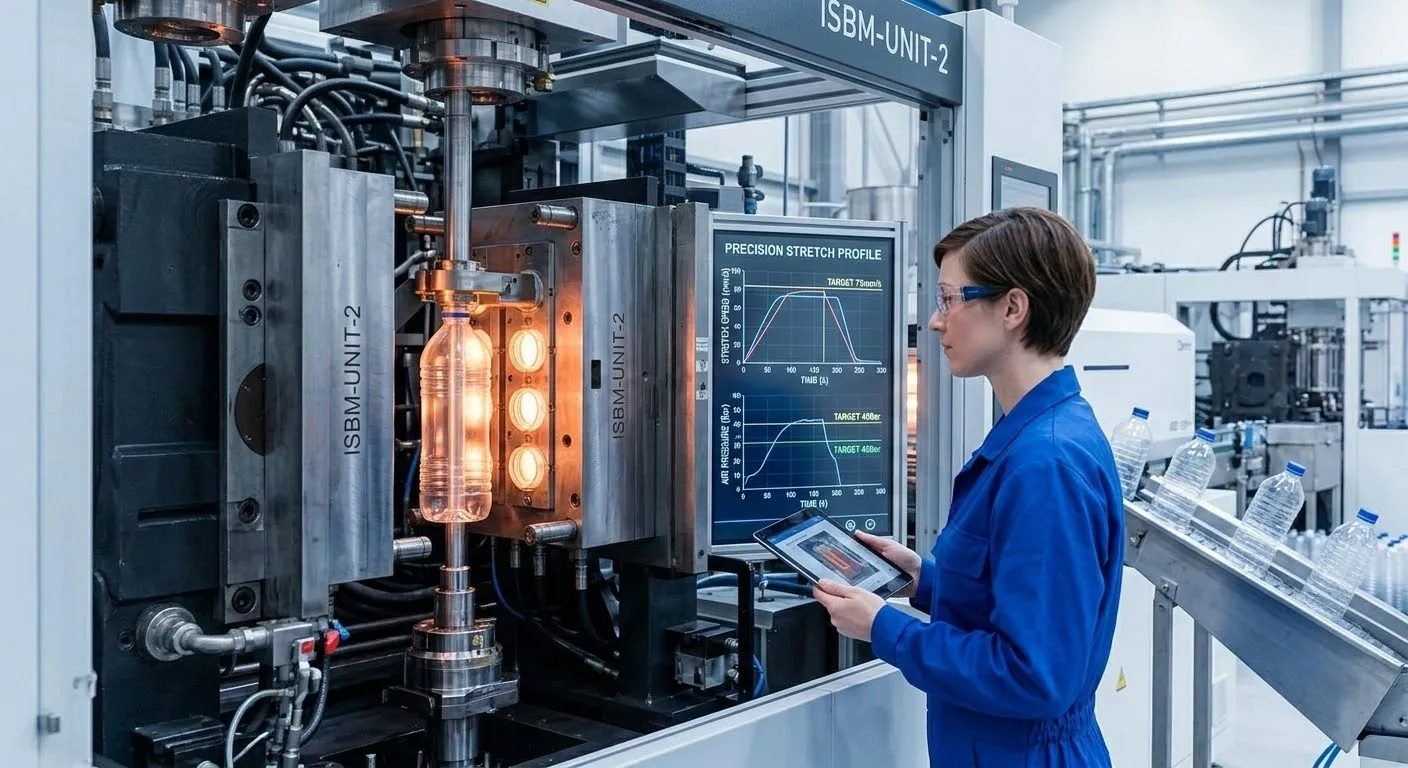
Ever-Power ISBM production facility — machines operating in a controlled environment with continuous cycle monitoring and parameter logging.
Why Biaxial Orientation Changes Material Properties
The most important technical consequence of the ISBM process is biaxial molecular orientation. In an unoriented PET bottle, the polymer chains are randomly tangled and the material is relatively brittle, hazy, and permeable. When aligned in two dimensions, the material’s properties change fundamentally:
| Property | Unoriented PET | Biaxially Oriented PET (ISBM) |
|---|---|---|
| 인장 강도 | ~55 MPa | ~165 MPa (up to 3× increase) |
| 광학적 선명도 | Hazy to translucent | Glass-clear, >90% light transmittance |
| CO₂ barrier | Poor | Suitable for CSD shelf life up to 6 months |
| Impact resistance | Low drop resistance | Survives 1.5 m drop test when filled |
Related Acronyms and How They Differ
- IBM (Injection Blow Moulding) — injection-and-blow without the stretch step. Produces non-oriented bottles, typically HDPE or PP for pharmaceutical vials. Lower strength and less clarity than ISBM.
- ISBM one-step — pellets in, finished bottle out. No separate preform production step. All Ever-Power EP-HGY and EP-BPET machines are one-step ISBM.
- RSBM (Reheat Stretch Blow Moulding) — two-step format using pre-manufactured preforms cooled, stored, and later reheated. Very high throughput at scale; the preform is heated twice.
- EBM (Extrusion Blow Moulding) — a fundamentally different process using an extruded parison instead of an injected preform. No molecular orientation. Used for HDPE containers, automotive tanks, and jerry cans.
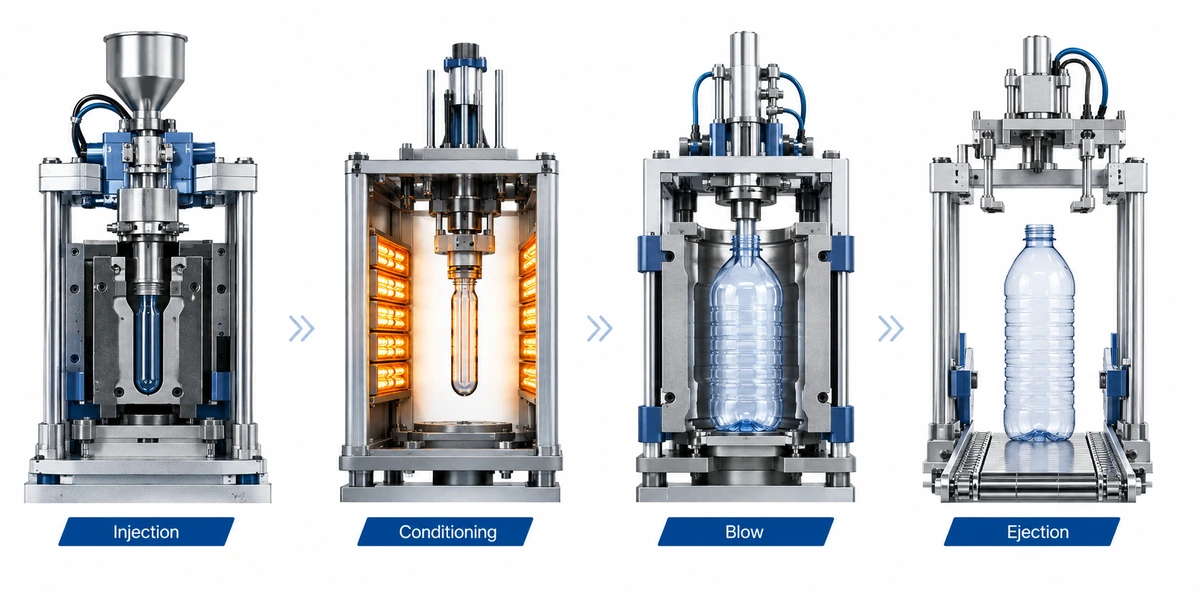
Schematic of the 4-station rotary ISBM process — injection, conditioning, stretch-blow, and ejection running simultaneously on a rotating table.
How the Term Is Used Across Different Markets
In some markets — particularly South America and parts of Europe — “ISBM machine” is used loosely for any one-step PET blow moulding machine. In precise technical usage, particularly in pharmaceutical and high-barrier packaging, the term is reserved for machines with a confirmed biaxial stretch-blow mechanism, as distinct from IBM machines that blow without stretching.
When sourcing equipment, always ask the supplier to confirm: does the machine use a mechanical stretch rod, and does it achieve biaxial orientation in the blow step? These two questions definitively distinguish ISBM from IBM — and they have significant implications for bottle performance in pressure-sensitive or barrier-critical applications.
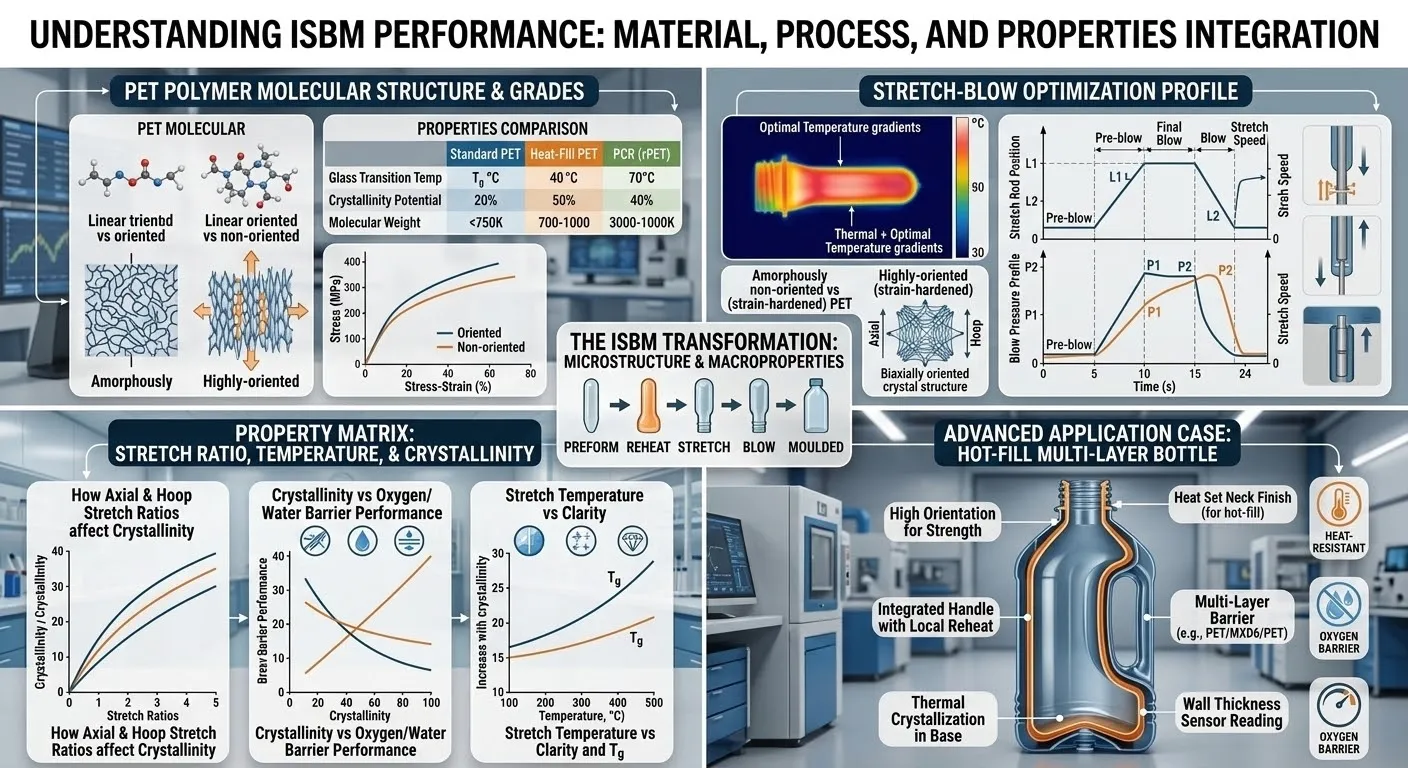
How resin selection, temperature profile, and stretch ratios integrate to determine final bottle performance — a systems view of the ISBM process.
Have a container specification and need the right machine?
Send Ever-Power your bottle drawing, resin type, and target volume — we confirm which EP-HGY or EP-BPET model fits your application within 24 hours.
To explore Ever-Power’s full range of 3, 4 and 6-station ISBM machines, or to learn how mould design shapes each bottle, visit our custom ISBM mould page.
ISBM in Manufacturing Classification
Within the broader plastics industry classification system, ISBM sits at the intersection of primary forming (the injection step) and secondary forming (the blow and stretch step). This dual nature is why one-step ISBM machines are mechanically more complex than either injection moulding machines or standalone blow moulding machines: they must perform both operations within a single cycle, synchronised on a rotary table, with temperature and timing controlled across all stations simultaneously.
This complexity is also why specialist manufacturers — rather than general plastics machinery companies — dominate the ISBM market. Building a machine that injects, conditions, stretches, blows, cools, and ejects in under 8 seconds per cycle, repeatably across millions of cycles, requires engineering expertise specific to this process and the material science that underlies it.
Why Terminology Precision Matters in Practice
For procurement professionals and plant engineers, the difference between ISBM, IBM, and RSBM is not academic. Specifying an IBM machine when the application calls for ISBM — because the supplier described their machine as “blow moulding” without specifying the presence of a stretch rod — results in bottles that fail CO₂ retention, drop impact, or weight reduction targets. Conversely, specifying a one-step ISBM machine when two-step reheat blow moulding would be more appropriate for very high volumes and simple bottle geometries means paying a premium for process flexibility that will never be used.
The simplest check: ask any prospective supplier whether their machine has a mechanical stretch rod at the blow station. If the answer is yes, the machine is ISBM. If the answer is no, the machine is IBM. If the answer is uncertain, find a different supplier.
Resin Compatibility and the ISBM Acronym
One nuance worth noting: while the ISBM acronym does not specify a resin, the process was developed primarily for PET, and most published process data, machine specifications, and industry benchmarks relate to PET. When a machine supplier or a technical reference says “ISBM” without specifying a resin, PET is almost always implied. PP, PETG, and PC are processed on ISBM machines but with significantly different barrel temperatures, conditioning profiles, and stretch ratio targets than PET. If you are planning to process a non-PET resin on an ISBM machine, always confirm explicitly with the machine manufacturer that the machine is configured for that resin — screw geometry, barrel heating capacity, and conditioning station infrared wavelength all need to be matched to the specific resin being processed.
Summary: What ISBM Means in Practice
ISBM — Injection Stretch Blow Moulding — is the process by which a plastic resin pellet is transformed into a biaxially oriented, finished hollow container in a single machine through a sequence of injection, mechanical stretching, and high-pressure blow moulding. Each word in the acronym describes a physical event with measurable consequences for bottle performance. Understanding those events — and how they interact — is the foundation for specifying the right machine, the right mould, and the right process parameters for any container application.
자주 묻는 질문
Is ISBM University related to injection stretch blow moulding?
No. ISBM University in India is unrelated to the plastics industry acronym. In plastics manufacturing, ISBM always refers to Injection Stretch Blow Moulding — the process used to produce PET and PP bottles. The two uses of the abbreviation are entirely separate.
Does ISBM always use PET resin?
No, though PET is the most common resin. ISBM machines also process PP (polypropylene), PETG, and PC. Each resin has different orientation temperature requirements and stretch ratio limits. The machine must be configured — screw geometry, barrel heating capacity, conditioning station infrared wavelength — to match the specific resin being processed.
What is biaxial orientation and why does it matter?
Biaxial orientation is the alignment of polymer chains in two perpendicular directions (axial and hoop) produced by simultaneous stretch-rod extension and high-pressure blow. Oriented PET is up to 3 times stronger in tensile strength than unoriented PET, has glass-like clarity, and provides adequate CO₂ barrier for carbonated beverage applications. Without biaxial orientation, PET bottles would be hazy, heavy, and fragile.
How can I verify whether a machine is truly ISBM and not just IBM?
Ask the supplier to confirm that the machine uses a mechanical stretch rod at the blow station that physically extends the preform axially before or simultaneously with the application of blow air. If a stretch rod is present and produces measurable biaxial orientation in the finished bottle (verifiable by polarised light microscopy or birefringence testing), the machine is ISBM. If there is no stretch rod, the machine is IBM regardless of how it is marketed.