ISBM Asset Management and Reliability Engineering
ISBM生産における機械摩耗を防止するための最善策は何ですか?
A comprehensive reliability engineering guide covering lubrication protocols, contamination control, thermal management, mechanical alignment, and predictive maintenance strategies that extend the service life of injection stretch blow molding machinery.

Machine Longevity as a Strategic Manufacturing Asset
An injection stretch blow molding machine is a substantial capital investment that is expected to operate reliably for a decade or more, producing hundreds of millions of containers over its service life. However, this longevity is not guaranteed by the quality of the initial manufacture alone. The harsh operating environment of an ISBM machine, characterized by high temperatures, high pressures, rapid mechanical motions, continuous cycle rates, and the ever-present threat of abrasive contamination from degraded polymer or external particulates, relentlessly attacks every bearing surface, every seal, every screw thread, and every mold cavity. Without a disciplined, proactive approach to wear prevention, even the most robustly engineered machine will suffer a gradual degradation in precision, an increase in unplanned downtime, and a premature decline in container quality. At エバーパワー, a globally recognized Brazilian ISBM manufacturer, our machines are built with premium materials, hardened wear surfaces, and precision bearings precisely because we understand the operational demands they will face. However, even the best-built machine requires a comprehensive wear prevention program to achieve its full design life.
The best practices for preventing machine wear in ISBM production span a wide range of interconnected disciplines. They include meticulous lubrication management for every grease point and oil reservoir. They include rigorous contamination control, both of the hydraulic oil and of the resin entering the injection barrel. They include thermal management practices that prevent overheating of critical components. They include regular mechanical alignment checks that prevent uneven loading and accelerated wear of bearings and guide rails. They include mold maintenance protocols that preserve the precision of the cavity surfaces and the cooling channels. They include the implementation of predictive maintenance technologies, such as vibration analysis and oil analysis, that detect incipient wear before it progresses to component failure. And they include the cultivation of an operator culture that treats the machine as a precision instrument to be cared for, not merely a production tool to be run. This comprehensive guide will detail each of these wear prevention practices, providing actionable protocols for maintenance technicians and production managers operating machines like the EP-HGY150-V4 4ステーションマシン そして高出力 EP-HGY250-V4-B 2列4ステーションマシン.
Preventing machine wear is not an expense. It is an investment that pays for itself many times over in avoided downtime, sustained container quality, and extended machine life. This guide provides the complete reliability engineering framework to realize that return on investment.
Lubrication Management and Contamination Control: The Foundation of Wear Prevention
Proper lubrication is the single most effective and most fundamental practice for preventing machine wear. Contamination, conversely, is the single most common cause of accelerated wear.
Systematic Lubrication Schedules and Proper Grease Selection
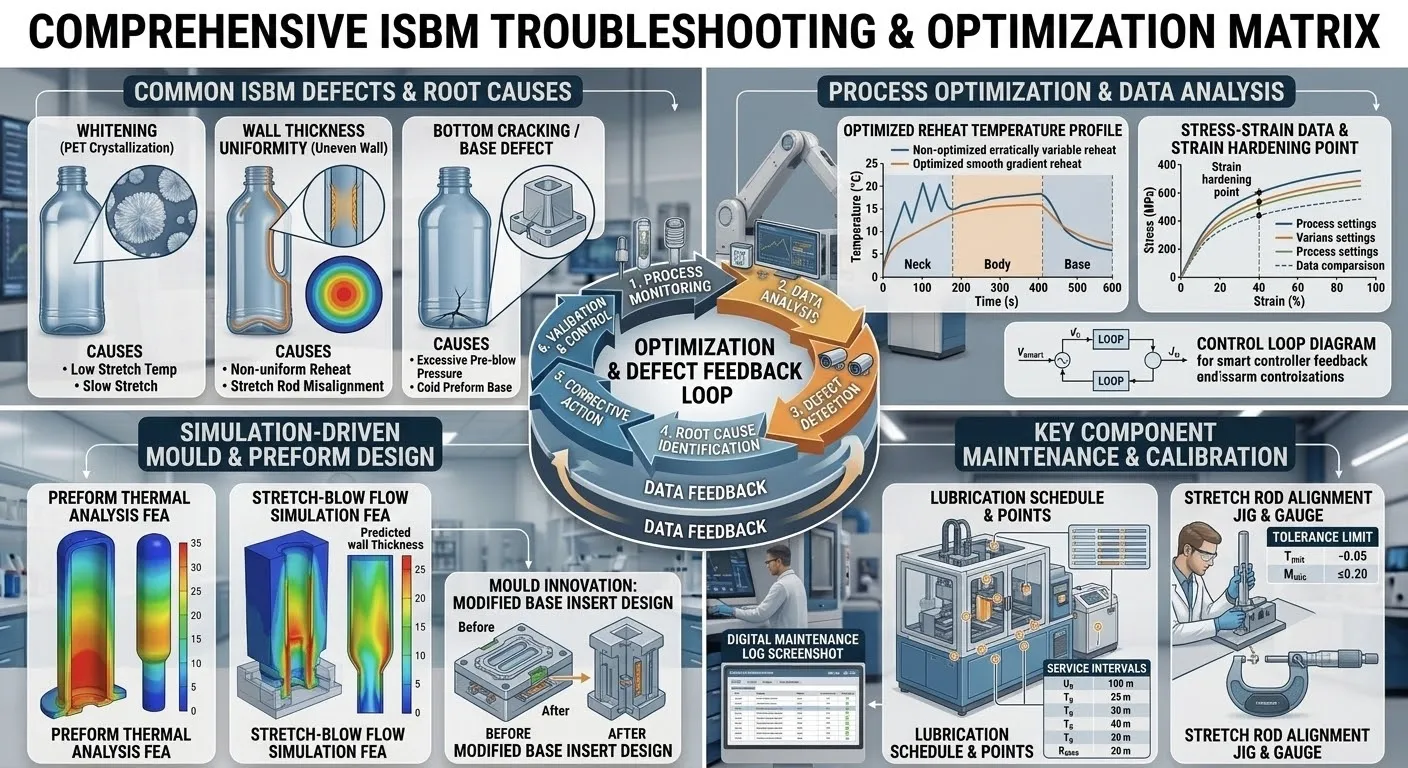
Every moving component in an ISBM machine, from the main rotary table bearing to the linear guide rails of the stretch rod actuator, from the toggle links of the injection clamp to the gripper fingers of the ejection robot, requires lubrication at specified intervals with the correct lubricant. The first best practice is to establish and rigorously follow a documented lubrication schedule. This schedule should be based on the machine manufacturer’s recommendations and should specify which components require lubrication, at what frequency, with which specific lubricant type and grade. The schedule should be posted at the machine and integrated into the computerized maintenance management system. The second best practice is to use only the specified lubricants. Substituting a different grease because it is available or less expensive is a false economy that leads to premature bearing failure. The grease used for high-temperature applications near the barrel and hot runner must be a high-temperature synthetic grease that will not carbonize and lose its lubricating properties. The grease used for the rotary table bearing must have the correct viscosity and extreme pressure additives. Over-greasing is also a problem. Excessive grease can overheat bearings, blow out seals, and contaminate the product. Grease guns should be calibrated, and operators trained on the correct quantity to apply. On servo-driven machines like the EP-HGY150-V4-EV, the ball screws and linear guides that actuate the injection, clamp, and stretch rod motions require clean, correctly specified grease at regular intervals to maintain their micron-level positioning accuracy.
Hydraulic Oil Cleanliness and Resin Contamination Prevention
For hydraulic ISBM machines, maintaining hydraulic oil cleanliness is paramount for preventing wear of pumps, valves, and cylinders. The hydraulic oil should be filtered to the cleanliness level specified by the component manufacturers, typically ISO 4406 code 16/14/11 or better. The oil filter elements must be changed at the specified intervals, and the oil should be sampled and analyzed annually for particle count, water content, and additive depletion. Contaminated oil carries abrasive particles that lap away at精密 surfaces inside valves and pumps, causing internal leakage, sluggish response, and eventual failure. Equally important is preventing contamination of the resin entering the injection barrel. Abrasive contaminants in the PET pellets or rPET flake, such as metal particles from grinders, dirt, or sand, will score the injection screw, the barrel, the check ring, and the hot runner channels. The resin handling system should include magnetic grates to capture ferrous metal particles and screens to capture non-ferrous contaminants. The area around the machine hopper must be kept clean, and hopper lids must be kept closed to prevent airborne dust from entering. For rPET processing, the incoming flake should be sourced from a supplier with rigorous washing and contaminant removal processes. The servo-driven injection on the EP-HGY150-V4-EV eliminates the hydraulic oil entirely, removing one major contamination source, but the resin contamination risk remains and must be managed through the material handling system.

Thermal Management and Mechanical Alignment Practices
Excessive heat and mechanical misalignment are two silent accelerators of machine wear that can be effectively controlled through disciplined operational practices.
🌡️Preventing Overheating of Critical Components
Heat is a primary enemy of machine longevity. Excessive temperatures degrade lubricants, anneal hardened steel surfaces, cause thermal expansion that alters critical clearances, and accelerate the degradation of elastomeric seals. The barrel and hot runner heaters must be controlled precisely to prevent overheating of the melt and the surrounding machine components. The cooling water circuits for the injection mold, the blow mold, the hydraulic oil cooler, and the feed throat must be maintained at their correct temperatures and flow rates. Blocked or restricted cooling channels cause localized overheating that can warp mold plates and damage seals. The cooling water quality must be managed to prevent mineral scale buildup in the cooling channels, which insulates the mold from the cooling water and causes the mold to run hot. Regular ultrasonic descaling of the mold cooling channels, as described in our mold maintenance guide, is a critical wear prevention practice. The electrical cabinets must be adequately ventilated. Overheating of servo drives and control electronics will shorten their life significantly. Cabinet cooling fans and filters must be cleaned or replaced on a regular schedule. The ambient temperature of the production area should be controlled. Excessive ambient heat adds thermal load to all the machine’s cooling systems. For hydraulic machines, monitoring the hydraulic oil temperature and ensuring the oil cooler is functioning correctly prevents the oil from thinning excessively, which would reduce its lubricating film strength and increase wear on pumps and valves.
📐Regular Mechanical Alignment and Fastener Torque Verification
Mechanical misalignment places uneven loads on bearings, guide rails, and structural components, dramatically accelerating wear. The alignment of the injection unit to the mold platen, the alignment of the mold halves to each other, the alignment of the rotary table to each station, and the alignment of the stretch rod to the blow mold centerline must all be verified on a regular schedule. A dial indicator should be used to check these alignments. The tolerances are specified in the machine maintenance manual. Fastener torque is equally critical. The bolts securing the mold halves to the platens, the bolts securing the tie bars, and the bolts securing the rotary table segments are all subjected to cyclic loading and vibration. They can loosen over time. Loose fasteners allow movement between components, causing fretting wear and eventual fatigue failure. A systematic torque verification program, using a calibrated torque wrench, should be part of the preventive maintenance schedule. Critical fasteners should be marked with a torque stripe after they are properly tightened. A visual inspection of the torque stripes during routine maintenance rounds immediately reveals any fastener that has loosened. On high-speed, high-cavitation machines like the EP-HGY250-V4-B, the sheer number of fasteners makes a systematic torque management program essential. Neglecting fastener torque is a common root cause of otherwise inexplicable machine damage.

Predictive Maintenance Technologies and Mold Preservation Strategies
Moving beyond calendar-based preventive maintenance, predictive technologies and rigorous mold care practices detect wear in its earliest stages, before it causes unscheduled downtime.
Vibration Analysis, Oil Analysis, and Thermography
Predictive maintenance technologies allow the condition of internal machine components to be assessed without disassembly. Vibration analysis, performed by attaching accelerometers to bearing housings on the rotary table drive, the injection screw drive, and the hydraulic pump motor, detects the characteristic vibration signatures of bearing wear, imbalance, or misalignment. Trending vibration data over time reveals the progression of wear and allows maintenance to be scheduled before a failure occurs. Oil analysis for hydraulic machines involves periodically sampling the hydraulic oil and sending it to a laboratory for spectrometric analysis. The analysis detects the presence and concentration of wear metals, such as iron, copper, and aluminum. A sudden increase in a specific wear metal indicates accelerated wear of a specific component. The oil is also analyzed for viscosity, water content, and additive depletion. Thermography, using an infrared camera, can detect hot spots on electrical connections, bearing housings, and mold surfaces that indicate abnormal resistance, friction, or cooling deficiencies. On machines like the EP-HGY200-V4, these predictive technologies can be integrated into the machine’s condition monitoring system, providing continuous, automated surveillance of critical components.
Mold Cavity Preservation and Periodic Refurbishment
The injection and blow molds are the most valuable and wear-sensitive tooling on the ISBM machine. Preserving the precision of the mold cavities is essential for maintaining container quality and preventing the gradual drift of dimensions that leads to increased scrap. The molds should be inspected on a regular schedule for surface damage, corrosion, and wear of the parting line. After removal from the machine, molds should be cleaned, coated with a rust-preventive oil, and stored in a climate-controlled environment. The blow mold cavities, which are polished to a mirror finish, are particularly susceptible to damage from improper handling. They should never be touched with metal tools or abrasive materials. The cooling channels should be periodically descaled to maintain heat transfer efficiency. The hot runner nozzles and tips should be inspected for wear and replaced at intervals determined by the operating history. Worn nozzle tips cause leakage and inconsistent melt delivery. The injection mold cores and cavities should be dimensionally inspected on a coordinate measuring machine at regular intervals to verify that they are within tolerance. A mold that has worn beyond its dimensional tolerance will produce preforms that are out of specification, and no amount of process adjustment can compensate for a worn mold. The カスタムワンステップ射出延伸ブロー金型 from Ever-Power are manufactured from hardened, corrosion-resistant tool steels and are designed for long service life, but even the best molds require periodic inspection and refurbishment to maintain their precision.
EP-HGY250-V4とコンパクトな EP-BPET-70V4 are designed with accessible service points, documented maintenance procedures, and comprehensive spare parts kits that facilitate the execution of these wear prevention practices. The investment in a rigorous maintenance culture is returned many times over in machine reliability and sustained container quality.

Protect Your ISBM Investment Through Disciplined Wear Prevention
Preventing machine wear in ISBM production is a comprehensive reliability engineering discipline that encompasses lubrication management, contamination control, thermal management, mechanical alignment, predictive maintenance technologies, mold preservation, and the cultivation of a skilled, engaged workforce. Each of these practices addresses a specific wear mechanism, and together they form a comprehensive defense against the degradation of machine precision and reliability. At エバーパワー, our advanced machinery platforms, including the servo-driven EP-HGY150-V4-EV, the high-output EP-HGY250-V4-B, and our precision-engineered カスタムワンステップ射出延伸ブロー金型, are built to the highest standards of durability, and they are supported by comprehensive maintenance documentation, spare parts availability, and technical support to enable our customers to implement these wear prevention best practices effectively.