What is the difference between PET and PP bottles?
PET and PP are the two most widely used resins in one-step ISBM bottle production. They produce bottles with different performance profiles, and choosing between them is one of the earliest and most consequential decisions in any new container development project. This guide compares PET and PP across the performance attributes that matter for pharmaceutical, food, cosmetic, and industrial packaging applications, and explains how to make the right selection for your specific requirement.
PET: The Clarity and Barrier Leader
PET (polyethylene terephthalate) is the dominant ISBM resin globally. When biaxially oriented by the ISBM stretch-blow process, PET produces containers with optical clarity above 90% light transmittance — equivalent to glass — that no other thermoplastic resin can match at comparable wall thickness. This clarity is not an inherent property of PET as a material; unoriented, injection-moulded PET is hazy. The glass-like appearance of PET water bottles, pharmaceutical flacons, and cosmetic containers is a result of the biaxial molecular orientation produced by the ISBM stretch rod and blow air.
PET also offers the best CO₂ barrier performance of any ISBM-processable resin, making it the only practical choice for carbonated beverage bottles. Its oxygen transmission rate (OTR) — approximately 0.05–0.15 cc/m²/day for a standard 500 ml bottle — is significantly better than PP, extending the shelf life of oxygen-sensitive contents such as edible oils, juices, and nutritional beverages.
PP: The Chemical Resistance and Hot-Fill Leader
Polypropylene (PP) offers different advantages from PET that make it the preferred choice for specific applications. PP’s most important advantages over PET in ISBM bottle production are:
- Chemical resistance: PP resists a broader range of solvents, acids, and bases than PET, making it the preferred material for agrochemical bottles, industrial chemical containers, and pharmaceutical formulations that would attack or permeate PET.
- Hot-fill capability: PP can be filled at temperatures up to 100 °C without thermal distortion, and without the heat-set process modification required for hot-fill PET. This makes PP the preferred resin for aseptically filled pharmaceutical syrups, hot-filled fruit juices and teas, and food products filled above 80 °C.
- Moisture barrier: PP has better water vapour transmission rate than PET, making it slightly preferred for moisture-sensitive pharmaceutical powder formulations or hygroscopic active ingredients where water vapour ingress through the container wall is a concern.
- No drying required: PP is not hygroscopic, so it does not require the desiccant drying that PET demands. This simplifies the production process and eliminates one of the key operating cost and quality risk factors of PET processing.
Side-by-Side Property Comparison
| Property | ペット | PP |
|---|---|---|
| 光学的な透明度 | Excellent (>90% transmittance) | Good (lower than PET) |
| CO₂ barrier | Excellent (CSD applications) | Poor (not suitable for carbonated) |
| O₂ barrier | 良い | 適度 |
| Max fill temperature | 60 °C (standard); 90–95 °C (heat-set) | 100 °C (standard ISBM) |
| Chemical resistance | Good; limited for strong solvents | Excellent; broad chemical compatibility |
| Moisture barrier | 適度 | 良い |
| Drying required | Yes (desiccant dryer, 160–170 °C) | No (hopper dryer sufficient) |
| Recyclability | Excellent (resin code 1) | Good (resin code 5) |
| 代表的な用途 | Water, CSD, pharma, cosmetics, edible oil | Agrochem, pharma syrups, hot-fill food |
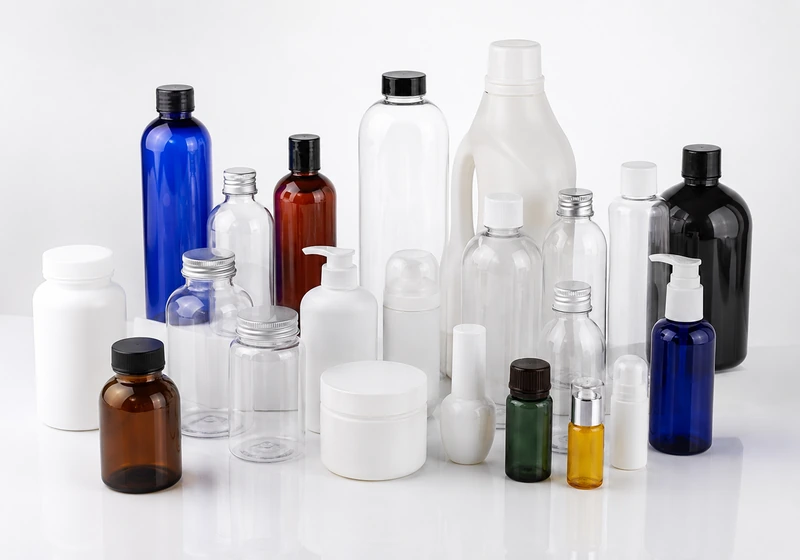
PET and PP bottles from one-step ISBM machines — both achieve biaxial orientation and high container performance, but for different application profiles.
Processing Differences: PET vs PP in ISBM
PET and PP have different processing windows in ISBM machines, which is why it is important to specify your intended resin when ordering a machine and mould set. PET is processed at 270–295 °C melt temperature and requires a desiccant dryer at 160–170 °C to reduce moisture below 50 ppm. The conditioning step targets 90–115 °C for PET, and the biaxial orientation window is well-defined and reliably repeatable. PP is processed at 200–230 °C (significantly lower than PET) and does not require desiccant drying — a standard hopper dryer at 80–100 °C is sufficient to remove surface moisture. PP’s orientation window is narrower and less forgiving than PET’s, making PP ISBM more process-sensitive and requiring more careful conditioning temperature control for consistent results.
If you plan to process both PET and PP on the same machine at different times for different formats, inform Ever-Power at the time of ordering. The barrel screw geometry can be configured to handle both resins acceptably, though a screw optimised for one resin will not be equally optimal for the other. The conditioning heater range must also accommodate both conditioning temperatures.
Regulatory Considerations: PET vs PP for Food and Pharmaceutical Packaging
Both PET and PP are approved for food contact and pharmaceutical primary packaging in most major markets, but the specific grades used must carry the appropriate food-contact or pharmaceutical-contact certification. For pharmaceutical applications, the resin specification in the regulatory submission for the drug product typically names the specific grade, IV range (for PET), and melt flow rate (for PP) — any change to the resin grade after regulatory approval requires a variation or supplement filing. Confirm with your regulatory affairs team which resin grade is acceptable for your specific formulation and regulatory territory before finalising the container design.
Need help choosing between PET and PP for your container?
Ever-Power’s applications team can advise on resin selection for your specific container, fill conditions, and market requirements, and recommend the right EP-HGY machine configuration for the resin you choose.
Review water, beverage and chemical container applications (predominantly PET), or cosmetic and personal care applications (both PET and PP), for application-specific examples.
よくある質問
Can I change from PET to PP on the same ISBM machine?
Yes, subject to confirming that the machine’s barrel screw geometry and conditioning heater range are compatible with both resins (confirm with Ever-Power at order stage). Changing from PET to PP requires a full barrel purge with a compatible purging compound to remove residual PET before PP processing begins. Different mould sets are required for each resin type if the preform dimensions differ (PP preforms for the same bottle volume typically have different wall thickness and body geometry than PET preforms due to PP’s different stretch behaviour).
Which is more expensive: PET or PP resin?
PET and PP resin prices fluctuate with crude oil prices and regional supply conditions. Historically, PP has been priced slightly below PET in most markets, but the price difference is typically small (5–15%). The more significant cost difference is in bottle weight: for the same container volume, PP bottles are typically 10–20% heavier than PET equivalents because PP’s lower biaxial orientation efficiency requires thicker walls to achieve equivalent structural performance. This weight difference partially or fully offsets any raw material cost advantage of PP over PET on a per-bottle basis.
Is PP or PET better for cosmetic packaging?
For premium cosmetic flacons requiring glass-like clarity, PET or PETG is the preferred choice. PETG offers even higher clarity and surface gloss than standard PET and is increasingly used for high-end cosmetic packaging. PP is used for cosmetic containers where chemical resistance to the formulation is a requirement (some cosmetic active ingredients or solvents are incompatible with PET) or where hot-fill conditions during filling require a resin with higher thermal stability than standard PET can provide. For most cosmetic flacons, pump bottles, and lotion containers, PETG or PET is the industry standard; PP is the exception rather than the rule in premium cosmetic packaging.
Making the Final Resin Decision: A Practical Framework
For buyers who are unsure whether to specify PET or PP for a new container, a practical decision framework based on the most critical application requirements resolves most cases unambiguously. Start with the question: does the container need to be clear? If yes, and if the clarity requirement is for glass-like optical transparency, PET or PETG is the answer — PP cannot match PET’s clarity when biaxially oriented. If clarity is secondary (agrochemical, industrial, or opaque-label covered containers), PP becomes a viable option.
Second: what is the fill temperature? If the container will be filled above 65 °C, standard PET requires heat-set modification (the blow mould runs at 100–120 °C instead of the standard 8–12 °C to induce partial crystallisation in the bottle wall). If the fill temperature exceeds 90–95 °C (sterilisation or high-temperature filling), PP is the simpler and more reliable choice. Third: what chemical compatibility is required? If the contents include solvents, strong acids, or bases that are incompatible with PET, PP is likely the correct answer. For most pharmaceutical liquids, cosmetic formulations, food products, and beverages that are not chemically aggressive, PET is compatible and is the preferred choice for clarity and barrier reasons. Using this three-question framework, the correct resin is clear for most applications without requiring extensive materials testing at the outset.
Supply Chain Implications of Resin Choice
Beyond the technical performance comparison, the choice between PET and PP has supply chain implications that can affect production reliability and cost. PET for ISBM is a globally traded commodity with established supply chains in most major markets — the same resin grades used in the EP-HGY machines are available from multiple suppliers in Brazil, South Korea, Australia, the Netherlands, and other markets where Ever-Power operates. This supply chain depth means that PET ISBM producers rarely face resin supply disruption, and competitive pricing between multiple resin suppliers keeps PET prices relatively stable and transparent.
PP for ISBM is less commoditised than PET — the specific grades suitable for ISBM processing (high MFR, random copolymer grades with controlled crystallisation behaviour) are a smaller portion of the total PP market than ISBM-grade PET, and may have fewer supplier options in some markets. For producers in markets where PP supply for ISBM is limited, this can be a practical consideration that favours PET even for applications where PP would be technically acceptable. Before committing to PP for a new container, confirm the availability of appropriate PP grades from at least two qualified suppliers in your market, and maintain a safety stock of 4–6 weeks’ production resin to buffer against supply disruptions.